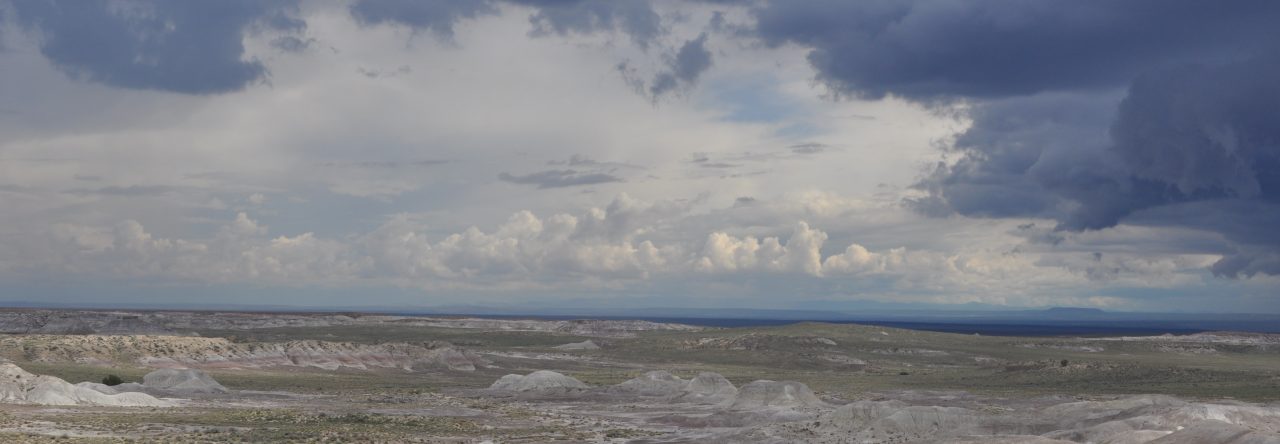
This week I am lecturing on the Pueblo Revolt of 1680. Here, in this short clip, I talk about how the Hopi participated in the so-called Indian uprising by forcing Catholic priests off the mesa edge. Part of a class I am teaching, this is our last week learning about the Spaniards and ways Natives resisted to survive as a people (total run time 4 min and 37 sec).
Category: Department of History at University of Arizona
Hopi and Spanish First Encounter (lecture clip)
This afternoon I lectured on initial encounters between Natives and Europeans. In one section of my lecture I focused on the Hopi who first encountered the Spanish when Pedro de Tovar and a small group of men arrived uninvited on Hopi lands in 1540. In this lecture clip, I speak about this event and Hopi attempts to understand it from Hopi cultural perspectives (total run time 4 min and 40 sec.).
Hopi emergence and migration (lecture clip)
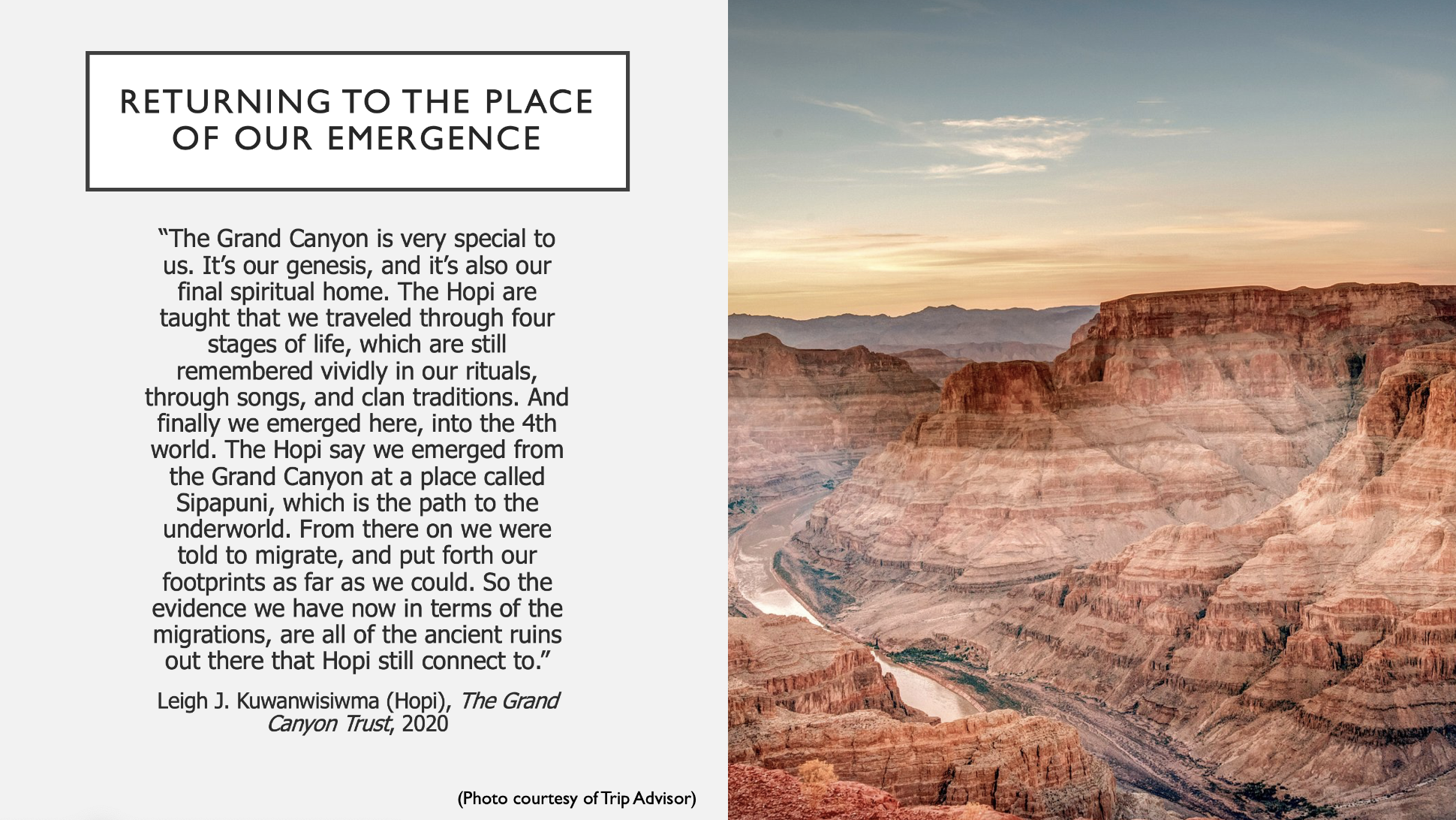
This semester I am teaching an undergraduate course titled HIST 236 Indians in U.S. History. Throughout the semester I will upload short lecture clips that may be of interest to readers of this blog. The first clip takes place at the end of class where I close my lecture (on Native American oral history and tradition) talking briefly on Hopi emergence and migration. I have inlcuded the PowerPoint slide that I am discssing above, and the video below (video and sound quality are not the best…I will make necessary improvements for next time).
Diversity and inclusivity in the classroom
Ten years ago, while serving as the Dean’s Diversity Fellow in the College of Liberal Arts and Sciences (LAS) at the University of Illinois at Urbana-Champaign, I was asked to write a brief statement on diversity and inclusivity in the classroom. My views on diversity and inclusivity are primarily based on my Christian beliefs, values I received from my parents, and belonging in the Hopi community. My opinions here are not comprehensive; others have written many books about the topic. They are, however, principles that guide each class that I teach. I have included the statement below and adapted it to reflect my teaching at the University of Arizona.
********
Every Person Matters
Every person has an important role in furthering diversity and inclusivity at the University of Arizona. For some, “diversity” speaks only to one’s gender, racial or ethnic background. While representing these areas is crucial for any environment to be diverse, a fuller understanding of diversity includes much more.
Over the semester, you will sit next to students from different regions of the United States and other parts of the world. And you will learn alongside individuals from different social, cultural, or religious backgrounds. Some of your peers will hold views that are vastly different or perhaps even very similar to yours.
But as long as people from the same cultures or other commonalities keep only to themselves or only value the opinions of those who are like-minded, then a truly inclusive community will never be achieved. Having a diverse group of people in any one place is not enough. A diverse environment is not always an inclusive one.
Inclusivity begins when diverse people, which includes all people, acknowledge each other’s presence. It happens when individuals converse with one another and when they care enough to appreciate their differences.
A classroom committed to inclusivity functions with the understanding that every person matters. It does not require people to agree with one another or to see the world in the same or similar manner. But it is a space where everyone’s perspectives and opinions are valued and where people’s presence and participation are encouraged.
From the moment you walk into the classroom, you will already enter a very diverse space. In this regard, obtaining a diverse environment in class is the easy part. The challenge and excitement come when each person works together to transform that space into an inclusive one.
 BEYOND THE MESAS, LLC