PRESS RELEASE – Former Hopi Leaders Want Disclosure

PRESS RELEASE

Former leaders of the Hopi Tribe Object to Senator Jon Kyl’s Bill and Introduce Tribal Legislation to Reject Senate Bill 2109, the “Navajo and Hopi Little Colorado River Water Rights Settlement Act of 2012”.

Contact: Benjamin Nuvamsa, (928) 380-6677

Vernon Masayesva, (928) 255-2356

Ivan Sidney, (928) 205-5504

____________________________________________________________________

Vernon Masayesva, Ivan Sidney and Benjamin Nuvamsa, former Hopi tribal chairmen; and Clifford Qötsaquahu, and Caleb Johnson, former Hopi vice chairmen, have endorsed a Hopi Tribal Council Action Item that would require Hopi Chairman Shingoitewa to call a Special Tribal Council Meeting to listen to the testimony of the Hopi and Tewa People on the federal legislation introduced by Arizona Senator Jon Kyl (R) concerning tribal water rights. The former tribal elected leaders are echoing the concerns of tribal members over the provisions of the water settlement bill introduced by Arizona Senator Jon Kyl.

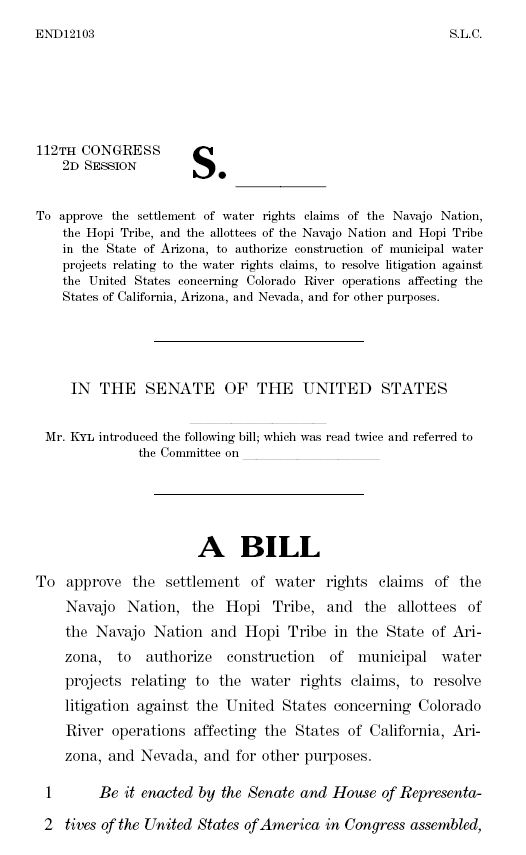
On February 14, 2012, Senator Jon Kyl (R), introduced Senate Bill, 2109, the “Navajo and Hopi Little Colorado River Rights Settlement Act of 2012”, that contains several dangerous provisions for the Hopi Tribe and which requires a permanent waiver of the Hopi Tribe’s rights to the Little Colorado River and possibly the Lower Colorado River, in exchange for municipal groundwater delivery projects for the Hopi villages.

Former Chairman Nuvamsa said: “We are in the fight of our life. Our tribal government is in the process of negotiating away what remains of our sovereignty, our precious water rights. The Hopi Tribal Council does not have the legal authority to permanently waive and extinguish our aboriginal and ancestral rights to our water. Those rights belong to our traditional villages. The aboriginal rights and powers of our traditional villages have never been, nor will they ever be delegated to the Hopi Tribal Council.”

Former Chairman Masayesva said “Hopi Chairman Shingoitewa and the Water & Energy Team are in the process of permanently waiving our traditional water rights without first consulting with, and gaining approval of our traditional villages and the Hopi – Tewa people.”

Former Chairman Sidney said “Arizona Senators Jon Kyl and John McCain are pressuring our tribal government to permanently sign away our water rights, in exchange for giving outside corporations and interests, exclusive life-of-mine leases to our remaining coal fields and all the free water they need to process the coal to make electricity and ensure the Central Arizona Project canal continues to provide water to non-Indian lands.”

Senate Bill 2109, when it becomes federal law, may permanently waive and extinguish Hopi’s rights to the waters in the Little Colorado River system and possibly the Lower Colorado River system; and will prevent Hopi from filing future claims for damages to water quality and quantity.

This means Hopi cannot file claims for damages to the Navajo Aquifer, for contamination of domestic water supplies, and for the drying of sacred Hopi springs.

“The bill contains empty promises for funding of groundwater delivery projects but exempts the federal government from liability if Congress does not provide funding for the projects. It heavily favors non-Indian interests and will give federal water rights to the Navajo Generating Station. It will ensure that Peabody Western Coal Company continue mining coal and pumping the Navajo Aquifer. If this bill becomes federal law, Hopi may permanently lose all sovereign rights or authority over its coal leases”, said former Vice Chairman Qötsaquahu.

The former Hopi tribal elected leaders said, “Water is sacred and is central to our Hopi and Tewa Way of Life; and we have a sacred covenant to protect our traditions, our ceremonies and our resources. Our ancestors occupied the Colorado Plateau, the Colorado River, and Little Colorado River basins since time immemorial so we have superior aboriginal, ancestral, federal reserved rights to the surface and subsurface waters in the river systems. We have aboriginal water rights under the 1848 Treaty of Guadalupe Hidalgo. The Kyl bill could extinguish these rights. Water rights belong to our traditional villages. These rights have never been delegated to the Hopi Tribal Council so neither Chairman Shingoitewa, the Water & Energy Team, nor the Hopi Tribal Council have the legal authority to waive these rights.”

“We want Hopi Chairman Shingoitewa to honor this request and hold a Special Hopi Tribal Council meeting immediately so that our members can have a say in this important matter. If he does not honor this request, then he will be in direct violation of the Hopi Tribe’s constitution; and we will have no option but to pursue our remedies through our courts.

“We believe it should be our traditional villages and our people, the rightful owners of water rights, who should decide on this matter and not the Hopi Chairman, the Water and Energy Team, and Hopi Tribal Council.”

###

Click here for the official press release.
Hopi and Tewa Villages Own Winters Rights

[The following letter was written by Benjamin H. Nuvamsa (Shungopavi), former Chairman of the Hopi Tribe, and Gary LaRance (Upper Moenkopi), former Chief Judge of the Hopi Tribal Court ]

                                                                                   February 24, 2012

Hopi and Tewa Villages Own Winters Rights

Our ancestors, the Hisat Senom, occupied the Colorado Plateau long before the coming of any other ethnic group. Anthropologists referred to us as the Anasazi, Moqui and Sinaqua. Occupation of our ancestral lands is evidenced by our ancient ruins and through documented research by anthropologists. These sites are proof of that our clans historically occupied this region before the settlement of any other people. We, Hopi Senom, practiced our traditional forms of government, ceremonies, and land and water use practices that sustained us back then and still sustain us today.

In the 1848 Treaty of Guadalupe Hidalgo, entered into between the United States and Mexico, indigenous people were recognized as having sovereign rights, including water rights. This included the Pueblos of what is now the State of New Mexico and the Hopi (Moqui). The indigenous people were deemed to be citizens of Mexico; and the United States committed, under Title VIII of the Treaty, to honor and protect the property rights of those citizens that chose to remain in the ceded territories. Some of the Pueblos of New Mexico, after proving their Mexican land grants, were successful in claiming their Guadalupe Hidalgo rights in their water rights settlements. Hopi villages also have a legitimate argument to claim their water rights under the Treaty.

Our villages existed long before the federal government established our homelands in 1882, as a federal Indian reservation, and certainly long before the formation of our modern day central tribal government. In fact, when Oliver LaFarge was sent to our reservation in 1935 by the federal government to craft a new tribal constitution, he consulted with our village Kikmom’nqwit (traditional village chiefs) on how the new tribal constitution should be developed. Our Kikmom’ngwit gave specific instructions to LaFarge to protect the sovereign powers of the villages, and only to provide limited powers to the central tribal government.

Today, our tribal constitution, adopted in 1936, recognizes the inherent, self-governing powers of our traditional villages. It outlines certain limited authorities granted to the new central tribal government by our villages. Other powers not delegated to the central government are inherent to, and remain as reserved powers of the villages. The reserved village rights include aboriginal, ancestral water rights. Recently, the Hopi Appellate Court issued its Final Answer to Bacavi Village’s Certified Question, and said that our villages always had powers called “inherent aboriginal sovereignty”.

But Hopi Chairman LeRoy Shingoitewa tried to change our village traditional and inherent powers when he and his attorney, Robert Lyttle, introduced Draft 24A as a revision to our tribal constitution. Draft 24A would have diminished, and perhaps destroyed the traditional powers of our villages by making the villages a fourth branch of the central tribal government. Some of us saw the dangers of Draft 24A and quickly went to the villages to educate tribal members of these dangers. Shingoitewa’s crazy idea was soundly defeated by tribal members in a referendum vote. Now, we find we must fight again to protect our sacred village water rights that Shingoitewa and the Water and Energy Team may have given away in the pending water rights negotiations.

The United States Supreme Court ruled in the 1908 Winters v. United States case, that when the federal government establishes an Indian reservation, it reserves sufficient quantities of water to sustain the reservation. When this case was decided, there was no central Hopi tribal government. Only the traditional villages existed, as was the case when the 1848 Treaty of Guadalupe Hidalgo was signed. Sothere is sufficient legal argument that our traditional villages own the Winters Rights and Guadalupe Hidalgo rights, not the central Hopi tribal government.

We recently learned that Shingoitewa and the Water & Energy Team agreed to allow Arizona Senator Jon Kyl to introduce Senate Bill 2109, which, if it becomes federal law, would permanently waive our water rights to the Little Colorado River. This Shingoitewa did without first consulting with the villages and the Hopi and Tewa people, much less with the Hopi Tribal Council. More importantly, he did so without having the proper legal authority and without the approval of the villages. Our tribal constitution prevents the sale, disposition, lease or encumbrance of tribal lands, or other tribal property. A water right is treated as a right to property. This means Shingoitewa and the Water & Energy Team violated our tribal constitution and violated the property (water) rights of our villages.

This action by Shingoitewa and the Water and Energy Team may also be an unconstitutional and wrongful taking of property without just compensation under federal and Hopi tribal law. The Indian Civil Rights Act of 1968 prohibits any Indian tribe from taking private property for a public use without just compensation. This means the villages would arguably have a legitimate claim for compensation against the Hopi central government and Shingoitewa for the unlawful taking of their water rights (property) if the Hopi Tribe proceeds with the water rights settlement agreement and waives the aboriginal water rights of the villages.

Our villages may assert their water rights under the following legal theories: (1) “aboriginal, ancestral” water rights derived from time immemorial when our ancestors occupied the Colorado Plateau and settled in the villages; (2) water rights granted the villages from the Spain and Mexico when these countries governed the southwest as documented in the 1848 Treaty of Guadalupe Hidalgo; and (3) water rights established under federal law, specifically the “Winters Doctrine”.

Our constitution also mandates the tribal council to protect our traditions and ceremonies. Water is sacred and is central to our Hopi way of life. As Hopi Senom, we have a sacred covenant to protect our traditions, our ceremonies and our natural resources. Important matters such as land and water are properly addressed by our traditional leaders. Just as he and his attorney did with the proposed constitution, Draft 24A, Shingoitewa continues to ignore and show his disrespect for the traditional powers of our villages and traditional leaders. He fails to recognize and understand why our ceremonies are crucial to the preservation of our culture. Neither Shingoitewa, the Hopi Water & Energy Team, nor the Hopi Tribal Council have the legal right and authority to waive our village aboriginal and Winters Rights. This is why we must stop Shingoitewa and the Water & Energy Team from further damaging and waiving the villages’ federal reserved and aboriginal water rights.

Benjamin H. Nuvamsa                               Gary LaRance
Former Hopi Tribal Chairman                    Former Chief Judge, Hopi Tribal Court
Shungopavi Village, Bear Clan                  Upper Moenkopi Village, Sun Clan

“This bill is not good for Hopi”: Benjamin Nuvamsa on “S.2109 – Navajo-Hopi Little Colorado River Water Rights Settlement Act of 2012”

February 20, 2012

To the Hopi Tribal Council

To the Hopi and Tewa Senom

On the 100th birthday of the State of Arizona, February 14, 2012, Senator Jon Kyl (R), former Salt River Project attorney, introduced Senate Bill 2109, the “Navajo-Hopi Little Colorado River Water Rights Settlement Act of 2012”, which would approve the settlement of water rights claims of the Hopi Tribe (and Navajo Nation) and allottees of both tribes. The bill would “resolve litigation against the United States concerning Colorado River operations affecting the States of California, Arizona, and Nevada and for other purposes”. This bill is not good for Hopi.

Senator Kyl, in introducing his bill, said: “Legally, the Navajo Nation and the Hopi Tribe may assert claims to larger quantities of water, but, as seen here, they do not have the means to make use of those water supplies in a safe and productive manner. Among water-law practitioners, the tribes may be said to have „paper water, as opposed to „wet water. Those claims are far reaching, extending beyond the mesas and plateaus of northern Arizona calling into question water uses in California and Nevada”. He continued: “In exchange for legal waivers, the Navajo Nation and the Hopi Tribe will receive critical water infrastructure”. This means the tribes will be required to waive their aboriginal water rights, or Winters Rights, (and rights of individual allottees) in order to receive groundwater delivery projects. But funding for these projects is not guaranteed. In fact, the bill relieves the federal government from funding the operation and maintenance of the projects.

Senator Kyl would not have introduced this bill without first obtaining concurrence of the Hopi Chairman and the Hopi Water and Energy Team. In fact, Hopi Chairman Shingoitewa is quoted in recent news articles as saying “Were very happy that weve gotten to this point where we are able to get things done, and the benefit is for our people”. I disagree with Shingoitewa. This bill is a death sentence because it would forever waive and extinguish the Hopi Tribe’s aboriginal rights, Winters Rights, including the rights of allottees, in exchange for a promise for groundwater projects without guaranteed federal funding. The bill does not acknowledge Hopi’s rights under the 1848 Treaty of Guadalupe Hildago.

It is no surprise that S.B. 2109 favors non-Indian water users such as the Arizona Public Service, Central Arizona Project, Navajo Generating Station (NGS), and Peabody Western Coal Company. In his presentation, Kyl said: “Importantly…(the bill) provides immeasurable benefits to non-Indian communities throughout Arizona, California, and Nevada”. Kyl, former attorney for the Salt River Project, will retire soon from the Senate and the negotiating teams are in a hurry to complete these agreements before he retires. The non-Indian water users need his continued support.

The bill ensures continued operation of NGS and Peabody Coal Company. It would give NGS about 34,000 acre feet per year of federal water rights that it currently does not own. The existing coal leases, brokered by the late John Boyden, already give Peabody exclusive subsurface rights to our water (Navajo Aquifer), coal and other and minerals. If this bill becomes law, NGS and Peabody would now have federal water rights to continue pumping water from the precious N-aquifer. And, Hopi and Navajo could lose all sovereign rights and authority over the coal leases and NGS operations.

Peabody and NGS damaged our environment, the N-aquifer, and our natural resources through almost 50 years of coal mining on our lands. Peabody pumped over 3.3 million gallons of pristine N-aquifer water each day to slurry coal to the Mohave Generating Station (MGS) until it was stopped by the tribes and MGS shut its doors in 2005. There is evidence now that the N-aquifer has, in fact, been damaged. The study by Dr. Daniel Higgins provides empirical evidence of water level decline at Kayenta and spring discharge decline at Moenkopi from excessive pumping. Our sacred springs are drying up and our drinking water supply is contaminated. But S.B. 2109 requires the tribes to agree to a “waiver and release of claims for water rights, injury to water rights, and injury to water quality from time immemorial and thereafter, forever…”

Our ancestors, Hisat Senom, occupied the Colorado Plateau and the Little Colorado River basin since time immemorial. When the federal government established the Hopi Indian Reservation, it set aside sufficient quantities of water to sustain our people. So, by the 1908 federal court decision in Winters v. United States, we have aboriginal and superior water rights over other water users. Yes, we need critical water delivery infrastructure. Yes, we need to quantify our Winters Rights. But these are aboriginal rights that we must not waive and give up. Water is sacred. It is central to our traditional ceremonies and our way of life. We have a sacred covenant to protect our resources and our Hopi way of life. Our forefathers and elders fought very hard to protect and preserve our sovereign rights. They fought hard to preserve everything that is Hopi. We cannot be forced to violate our moral conscience and abandon our religious rights guaranteed us by the First Amendment to the United States Constitution.

The Hopi and Tewa People have not been consulted, nor have they been informed of the terms and conditions of S.B. 2109 by Shingoitewa and the Hopi Water & Energy Team, yet these officials apparently expressed agreement with the proposed bill to allow Senator Kyl to introduce this bill. We also do not believe the entire Hopi Tribal Council was consulted. And while many question the legal composition of the Hopi Tribal Council, Hopi and Tewa People must mandate the tribal council to immediately reject this disastrous bill. Finally, any agreement to settle Hopi’s water rights must be done only through the vote of the People. Hopi and Tewa People have already demonstrated their disagreement with this Administration’s legislative agenda when they defeated, by a referendum vote, the proposed revision to the tribal constitution.

Benjamin H. Nuvamsa

Former Hopi Tribal Chairman

Ivan Sidney voices concern over “S.2109 – Navajo-Hopi Little Colorado River Water Rights Settlement Act of 2012”

IVAN L. SIDNEY
P.O. BOX 174
KYKOTSMOVI, ARIZONA 86039

February 15, 2012

Hopi Tribal Council
P.O. Box 123
Kykotsmovi, Arizona 86039

Dear Honorable Hopi Tribal Council Representatives:

I have to date, for several years, elected to refrain from writing to the Tribal Council for my own reasons and mostly to avoid political retaliations for voicing my opinions. I have read many documents of these retaliatory happenings and chose to continue my livelihood only to reflect on favorable memories of my many years of dedicated services to the Hopi People. I still believe and support the purpose of our Hopi Constitution and By-Laws as was understood by our Past Leaders and Traditional Village Governments. At the foremost was the support for our constitution due to its mandate that our tribal government’s authority is the Hopi People.

Also, included was the provision to mandate our Tribal Council Representatives to fairly and impartially represent the people. It further required the Tribal Council Representatives to inform the people of all matters before the Tribal Council. Today, I was informed of a bill introduced in the Congress of the United States to settle the long time Little Colorado River Adjudication. This is a very complicated case that for years have been primarily written to satisfy ranchers, municipalities, energy companies, industry, etc. What is offered to the Hopi and Navajo Tribes appears promising to resolve our need for future water but remain without adequate and guaranteed funding.

I read your resolution to approve the extension of your Legal Counsel’s contract based on this pending case. Some of us expected reports to the villages to informed the Hopi People of the status and details of the case. During the Hopi-Navajo Land Dispute, Chairman Abbott Sekaquaptewa and I were mandated by the Tribal Council to report to all the villages on a monthly basis. Today, reporting by the Elected Officials to the villages today is virtually non-existence. In my opinion, it does not excuse the Tribal Council Representatives’ from reporting on these important and complex cases.

I read the 157 pages of the bill only to have more questions and concerned for the immediate so-called resolution to our water rights. The introduction of the bill by Senator Kyle includes the statement, “Legally, the Navajo Nation and Hopi Tribe may assert claims to larger quantities of water, but, as seen here, they do not have the means to make use of those water supplies in a safe and productive manner. Among water practitioners, the tribes’ may be said to have “paper” water, as opposed to “wet” water. Those claims are far reaching, extending beyond the mesa and plateaus of northern Arizona calling question water uses in California and Nevada”. What is meant by these statements and what is the understanding and position of the Hopi Tribe. What is of great concern is terminating forever, our aboriginal rights and title to our water on passage of this bill.

I write this letter to strongly and respectfully urge the Tribal Council to immediately schedule meetings in the villages to personally explain this bill. I would consider your understandings, explanations and recommendations as a Hopi member versus an Attorney who is supposedly only providing his opinion. I also recommend that you seriously consider a referendum to place this matter to the vote of the Hopi People. This would place the outcome of the vote in the hands of the people including its possible future ramifications. The outcome of the vote will be the will of the people and no longer will the blamed be solely on the Tribal Council. I trust that the Tribal Council remains the representation of the people and in that representation, you would seriously consider the contents of my letter. Some of us are members of villages that are not represented on the Tribal Council and must rely on your sworn duty to include reports to our villages. I will be available to answer any questions at anytime. I remain….

Sincerely,

Ivan L. Sidney Sr.
Former Chairman

Chairman Vernon Masayesva
Chairman Benjamin Nuvamsa
Chairman Wayne Taylor
Hopi Village Leaderships

————————————

Senator Jon Kyl (R-AZ) introduces the “Navajo-Hopi Little Colorado River Water Rights Settlement Act,” February 14, 2012

“S.2109 – Navajo-Hopi Little Colorado River Rights Settlement Act of 2012”

Click image to download (157 pages)

Water is Life Water is Sacred Conference, February 29 at Greyhills Academy Auditorium, Tuba City, Az

Click image to download

See below for Conference itinerary…

Click image to download

A Hopi discussion on coal mining, water rights, and the environment

[The following letter was written by former Hopi Tribe chairman Benjamin H. Nuvamsa from Shungopavi.  He presented the letter to the Hopi Tribal Council on Friday January 13, 2012]

January 13, 2012
Hopi Tribal Council
Hopi – Tewa Senom

It is time we have a serious discussion about coal mining on our reservation, our water rights and our environment.  For far too long, we have pushed these issues aside, not willing to talk about how these issues impact our lives.  We must talk about how the Peabody Western Coal Company and Navajo Generating Station are affecting our lives.  Since the mid 1960’s, Peabody Coal has been mining our coal, pumping our precious Navajo Aquifer water and paying us pennies on the dollar in return.  Navajo Generating Station is emitting dangerous and harmful particulates into the air we breathe.  Our coal resources are being depleted.  Our Navajo Aquifer has been damaged and is decreasing.  Our drinking water supply is contaminated; and our sacred springs are drying up.  And, our people are suffering health problems from the mining activity and production of electricity.  But who is really benefiting from this mining?

Most people know about how Attorney John Boyden, with the help of the Interior Department, managed to negotiate coal leases designed to benefit the coal mining industry and the utility companies.  They literally stole our coal and water right from under us; and we allowed it to happen.  We were sold a bill of goods by Boyden.  Sadly, we are still allowing this to continue as evidenced by the latest Hopi tribal council’s action to approve the Peabody Lease Reopener.

Our elected leaders are being told by Peabody Coal, Office of Surface Mining, and by the Salt River Project (and other owners of the Navajo Generating Station) that if they did not approve the lease reopeners, that our tribal economy would suffer.  I do not believe this story.  It was the Federal government, in the first place, that determined what our economy would be; who would mine our coal and use our water; and literally what price we would be paid.  The Federal government created a monopoly for Peabody Coal.  Although it is our water and our coal, we were not allowed to make these decisions.  We could not exercise our inherent sovereign right to determine our own economic future.  Those decisions were taken away from us when the Federal government pushed the coal leases with Sentry Royalty (Peabody’s predecessor).  We did not have control over our resources and our economy.  We still don’t.  The Federal government designed these leases so that we would become dependent on coal royalties.

So what happens with the money we get from Peabody Coal?  We get a mere $11.0 to $13.0 million each year from Peabody Coal in the form of coal royalties and some bonuses.  This money is put into an investment account at the Department of Interior’s Office of Trust Funds Management in Albuquerque, but most of it is given to the Hopi Water and Energy Team for their travel and other expenses.  Most of this money is used by attorneys and other specialists to produce biased reports that our resources are safe and have not been damaged.  Hopi and Tewa Senom have no say in how this money is used.  Very little, if any of this money is used to create jobs and help villages.

So, as owners of the resources, we have to ask hard questions, such as:  Do we really need coal mining on our reservation?  Is it worth the loss of our resources? Is it worth damaging our resources and environment?  Is it worth the health and welfare of our people?  Again, we must ask:  Who is really benefiting from coal mining on our reservation?  Peabody Coal is a global company.  The ten-year coal leases give Peabody Coal full subsurface rights to our coal, water and other minerals (except oil and gas).  The leases give Peabody Coal full rights to the millions/billions of tons of our coal for which they do not pay us anything until they mine the coal.  Because of how the leases are structured, we cannot market our coal to other companies to get better prices and have a say on how our coal is mined.

Peabody Coal reported that in October 2011, its net income rose to $274.1 million, or a rise of 22.3% from last year.  Its revenues rose 9.2% to $2.04 billion from last year.  The Navajo Generating Station buys the coal from Peabody Coal to produce electricity.  The power plant is owned by the Bureau of Reclamation (24.3%) Salt River Project (21.7%), Los Angeles Water & Power (21.2%), Arizona Public Service (14.0%), Nevada Power (11.3%), and Tucson Gas & Electric (7.5%).  Salt River Project recently reported a profit of over 26.0% in 2011.  Peabody Coal, in its 2005 report, said it paid the State of Arizona about $67.5 million during the period 1986 to 2004; and paid the Navajo Nation over $82.9 million in various forms of taxes during the same period.  Hopi did not and does not receive any tax revenues because of a reported covenant to not tax Peabody.  So, who is benefiting from coal mining?

So what should do?  Should we continue coal mining, or should we enter into alternative forms of energy production, or should we just stop coal mining?  In any event, we must exercise our sovereign right to decide for ourselves, and decide our own economic future; and no longer allow the Federal government, owners of the Navajo Generating Station, and Peabody Coal to dictate our economy to us.

The Hopi Tribe (and the Navajo Nation) holds the key to the economy of the entire Southwest.  It is our coal and water that makes it possible for Arizona, southern Nevada and southern California to have electric power.  And, while others profit handsomely from our diminishing resources, our tribal socioeconomic conditions remain dismal.  We get no direct benefit from coal mining revenues, we have limited or no jobs, our homes are in disrepair; and many of us do not have electricity and running water in our homes.  After almost 50 years, we have nothing to show how coal mining on our reservation has improved our lives.

Our economic future starts with a serious round of discussions; adoption of sound energy and water policies; and renegotiating the Peabody Coal leases to demand higher prices and accountably for the damage they have done to our resources.  It also starts with the tribe imposing taxes on Peabody Coal.  It starts with requiring the Navajo Generating Station to comply with strict Federal emissions control regulations.  And, it starts with holding our trustee, the Federal government, to carry out its trust obligations to us.

Benjamin H. Nuvamsa
Former Hopi Tribal Chairman