A Petition for God’s Mercy and Grace

A prayer I delivered on February 11, 2024, at The Ridge Christian Fellowship, Tucson, Arizona.

A Petition for God’s Mercy and Grace

by Matthew Sakiestewa Gilbert

Our Father in Heaven, You are Holy, set apart in every way. 

You are the God of Abraham, Isaac, and Jacob. The One who rescued the Israelites from Pharoah and caused the horse and rider to be thrown into the sea. The One who is faithful and “keeps His covenant for a thousand generations.” To You, and You alone, we pray. 

This morning, we are reminded of the words of the psalmist David: “I was glad when they said to me, let us go into the house of the LORD.”

Today, we enter your house with joy and thanksgiving, offering our thanks for Your goodness, Your provisions, and Your Word. 

LORD, forgive us of our sins. The “lust of the flesh, and the lust of the eyes and the boastful pride of life.” Hold not these trespasses against us, we pray. 

LORD, we ask that You give healing to the sick, encouragement to the downcast, strength to the weak, and humility to the proud. Comfort the widows and provide for the orphans.  

LORD, be with our elders and others who serve among us, including the staff. Grant our elders wisdom and conviction as they oversee and shepherd the flock. Bless those who lead us in song, minister to our youth, and who rise early and stay late to prepare this place for worship. To You, and for them, we give You thanks.  

LORD, we pray that You would protect the children, the most vulnerable in our church and society. Help us see clearly the war waging upon them, taking place within our schools, across the internet, and by our governments. Protect them from all evil. Have mercy on the little ones, especially those still in their mother’s womb. 

LORD, we pray for those who are unrepentant and remain guilty before You…our loved ones, neighbors, and those in authority, including our President. Soften their hearts to understand and receive the good news of salvation. Have mercy on them, and save them from Your wrath, we pray. 

LORD, prepare us now to hear and receive Your word. Let us not seek to have our “ears tickled” or egos lifted, but our minds renewed and hearts convicted.

LORD, be with our brother, Pastor Jeremiah. May he preach confidently and boldly, rightly dividing the Word of truth. Give him clarity of mind, reverence for You, love for the saints, and a heart for the lost. 

We lay these petitions before Your throne of grace, asking in the name of Christ Jesus, our mediator, the Author and Perfector of our Faith. In His name, we pray. 

Amen.
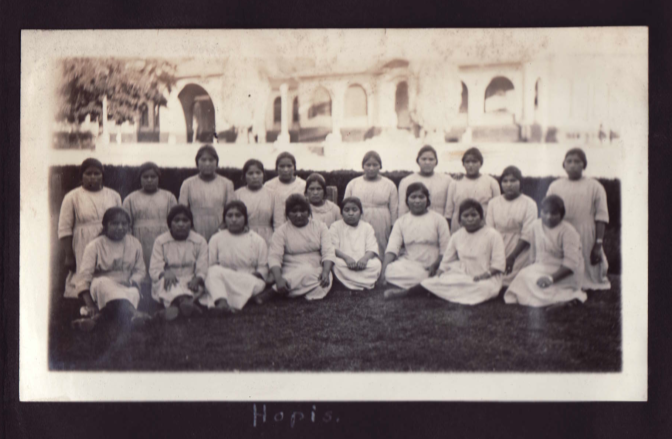
1920s photo of Hopi girls at Sherman Institute

I was once asked how many photos and other images we included in Beyond the Mesas. I do not know the exact number, but it had to have been over a hundred. Some of these photos came from people who we interviewed for the film, others we uncovered at various archives. One of these photos was of a group of Hopi girls at Sherman Institute during the 1920s. I came across this picture in the Veva Wight Collection at the Sherman Indian Museum in Riverside, California. Wight was a Protestant missionary who led Bible studies and other Christian activities at the school. She worked as a “Religious Worker” at Sherman for more than thirty years. Although government officials allowed Christianity at Sherman to encourage the assimilation of Indian students, some Hopi girls had a genuine committment or interest in the Christian faith.

Matthew Sakiestewa Gilbert

Hopis and Christmas at Indian schools

Over the years I have come across several documents and other sources, including children’s books and newspaper accounts, that involve Hopi students and Christmas at Sherman Institute and the Phoenix Indian School. Many Hopis at off-reservation Indian boarding schools looked forward to Christmas, but not every Hopi enthusiastically celebrated the holiday.

In the children’s book Climbing Sun (1980), Marjorie Thayer and Elizabeth Emanuel note that prior to Hubert Honanie’s first Christmas at Sherman in the late 1920s, the school’s superintendent, Frank M. Conser, mandated that students attend church the Sunday before Christmas day. While Hubert sat in the chapel service, he listened carefully to what the minister said about the birth of Jesus, but he did not see why this baby was so important. Hubert concluded that Christmas held little significance. Although he liked having the day off from school and he enjoyed eating the traditional Christmas food of turkey and cranberries, he would have “preferred stewed rabbit or mutton and corn” prepared according to Hopi custom.

By the 1930s the tradition of Christmas had become very popular among Hopi children on the reservation. In The Hopi Indians of Old Oraibi (1972), anthropologist Mischa Titiev observed that in December 1933, Hopi women walked to Kykotsmovi at the foot of Third Mesa to purchase Christmas presents for the Orayvi children. Titiev noted that several children had taken part in “Christmas programs” at places such as Sherman and the Phoenix Indian School, and several of their parents enjoyed giving them presents on Christmas. Afraid that the children would be disappointed if they did not receive gifts, the women purchased enough presents for each child in the village.

Although the Christmas tradition continues with many Hopis today, Hopis incorporate their culture into the holiday as well. Hopi artists demonstrate this through their art, and some Hopis, particularly those who belong to church congregations on the reservation, still sing Christmas carols in the Hopi language.

Matthew Sakiestewa Gilbert

——————————————————

[Portions of this post were adapted from a newspaper article that I wrote titled “Christmas experiences at Sherman Institute and Phoenix Indian School”, Hopi Tutuveni, December 21, 2005, Issue 26, p. 6]