Diversity and inclusivity in the classroom

Ten years ago, while serving as the Dean’s Diversity Fellow in the College of Liberal Arts and Sciences (LAS) at the University of Illinois at Urbana-Champaign, I was asked to write a brief statement on diversity and inclusivity in the classroom. My views on diversity and inclusivity are primarily based on my Christian beliefs, values I received from my parents, and belonging in the Hopi community. My opinions here are not comprehensive; others have written many books about the topic. They are, however, principles that guide each class that I teach. I have included the statement below and adapted it to reflect my teaching at the University of Arizona.

********

Every Person Matters

Every person has an important role in furthering diversity and inclusivity at the University of Arizona. For some, “diversity” speaks only to one’s gender, racial or ethnic background. While representing these areas is crucial for any environment to be diverse, a fuller understanding of diversity includes much more. 

Over the semester, you will sit next to students from different regions of the United States and other parts of the world. And you will learn alongside individuals from different social, cultural, or religious backgrounds. Some of your peers will hold views that are vastly different or perhaps even very similar to yours.
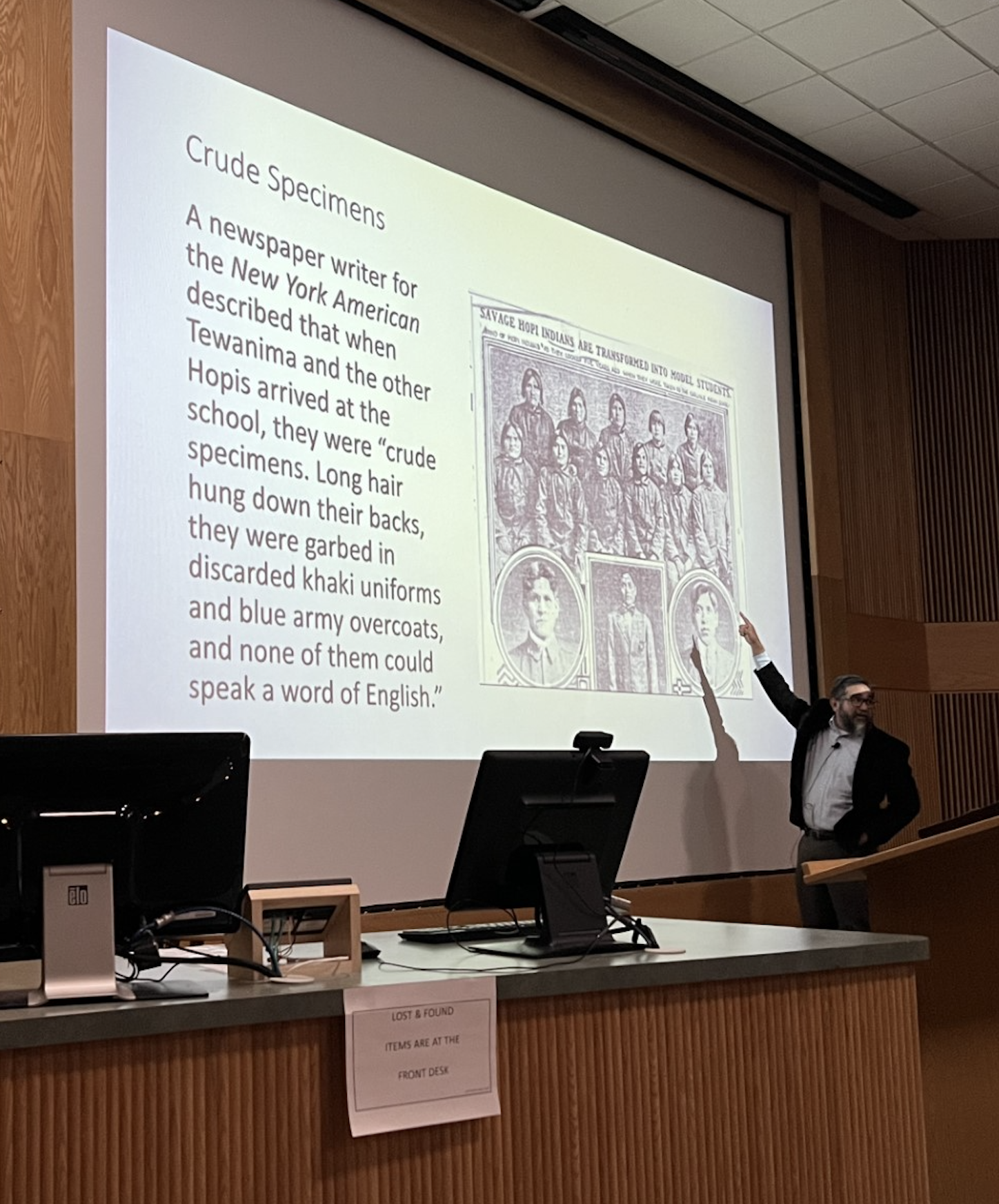
Author lecturing at the UofA. Photo by Faraz Saberi

But as long as people from the same cultures or other commonalities keep only to themselves or only value the opinions of those who are like-minded, then a truly inclusive community will never be achieved. Having a diverse group of people in any one place is not enough. A diverse environment is not always an inclusive one.

Inclusivity begins when diverse people, which includes all people, acknowledge each other’s presence. It happens when individuals converse with one another and when they care enough to appreciate their differences.

A classroom committed to inclusivity functions with the understanding that every person matters. It does not require people to agree with one another or to see the world in the same or similar manner. But it is a space where everyone’s perspectives and opinions are valued and where people’s presence and participation are encouraged.

From the moment you walk into the classroom, you will already enter a very diverse space. In this regard, obtaining a diverse environment in class is the easy part. The challenge and excitement come when each person works together to transform that space into an inclusive one.
Job shadowing my father, and my path to tenure

Earlier this summer the University of Illinois granted me promotion to associate professor with indefinite tenure in American Indian Studies & history. Since then, I’ve been thinking a lot about my path to tenure, and the road I took to get where I am now.

Thirty years ago I wanted to grow up to be an astronaut, a veterinarian, or a professional musician. I did not imagine that I would become a university professor or a “scholar.” But when I was a senior in high school, my perspective and desire changed.

At this time, I had a rare opportunity to “job shadow” my father* who was (and still is) a professor of education at Northern Arizona University (NAU).Picture 8

I clearly remember sitting in the back of the classroom as he taught his students from the front.

I had never seen my father in this type of setting, and I was amazed at his ability to communicate to his students, present his topic with much enthusiasm, and provide his students with a safe place to learn, disagree with each other, and to think analytically.

But there was more. My father also exemplified for me how powerful a skilled Native American instructor could be, both as someone who could offer unique insights into course material, and as someone who could be a model for others.

When he lectured on the integration of western science and Navajo and Hopi cultures, he did so with authority and confidence. His teaching was grounded in who he was as an indigenous person. His students understood this, and they benefited from the unique and personal perspective he brought to his lecture.

Although the class period lasted for only an hour, my experience observing my father had a major influence on my life.

In this brief moment, my father demonstrated to me the characteristics of a successful teacher. And he showed me how to excel as an American Indian faculty in a classroom of Native and non-Native students.

My observation job shadowing my father in the College of Education at NAU set in motion my eventual career as an academic.

It launched me on a path toward college and graduate school, and a tenure track faculty position at the University of Illinois.

As an assistant professor, I worked hard to fulfill my obligations  and responsibilities to the academy and my Hopi community. But I did not do it alone.

I had the support of my wife and children, my parents and other extended family members, colleagues and friends at Illinois and beyond, and many people back home.

Now on sabbatical, and on the other side of tenure, I find myself thinking a lot about the past seven years at Illinois.

But I also keep recalling the time when I job shadowed my father, and the significance this experience had, and continues to have, on my career and life.

——————————

*My father, Willard Sakiestewa Gilbert, is professor of Bilingual and Multicultural Education at Northern Arizona University (NAU). He grew up on the Hopi and Navajo Indian reservations in Arizona, and he received his Ed.D. (Doctor of Education) at the University of New Mexico. He has published a number of articles and book chapters, and once served as President of the National Indian Education Association (NIEA).