Spanish mission buildings and sandstone homes

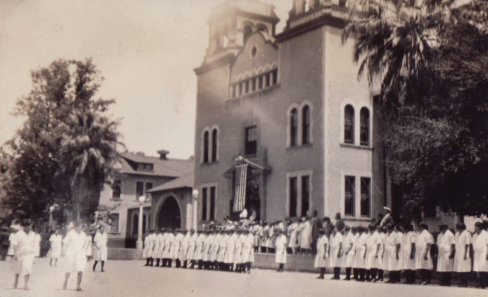
The producers of Beyond the Mesas were very fortunate that Marsah Balenquah from Bacavi on Third Mesa agreed to be interviewed for the film. In the documentary she explains that she attended Sherman for thirteen or fourteen years. At one point in the film she describes her impression of the school’s buildings. Built by Indian students in a Spanish Mission architectural style, the buildings did not resemble the sandstone homes she and other Hopis were familiar with on the reservation.

This photograph was taken when Marsah attended the Indian school in Riverside from 1920 to 1934. In the photo girls are standing in a line waiting for roll call and inspection. Everyday life at Sherman was very regimented. An American flag drapes from the portico of the school’s main building. Photo courtesy of the Sherman Indian Museum.

Matthew Sakiestewa Gilbert

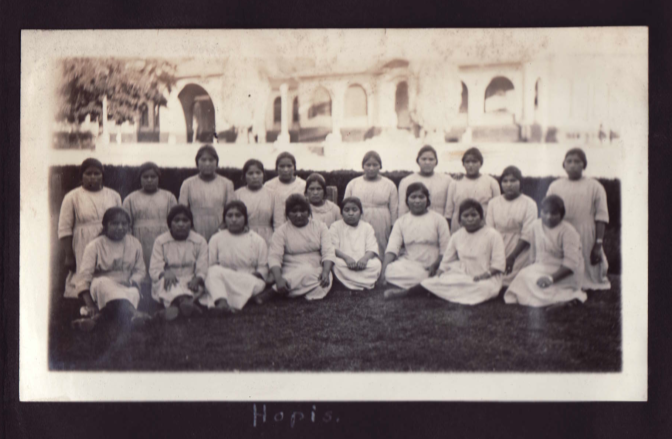
1920s photo of Hopi girls at Sherman Institute

I was once asked how many photos and other images we included in Beyond the Mesas. I do not know the exact number, but it had to have been over a hundred. Some of these photos came from people who we interviewed for the film, others we uncovered at various archives. One of these photos was of a group of Hopi girls at Sherman Institute during the 1920s. I came across this picture in the Veva Wight Collection at the Sherman Indian Museum in Riverside, California. Wight was a Protestant missionary who led Bible studies and other Christian activities at the school. She worked as a “Religious Worker” at Sherman for more than thirty years. Although government officials allowed Christianity at Sherman to encourage the assimilation of Indian students, some Hopi girls had a genuine committment or interest in the Christian faith.

Matthew Sakiestewa Gilbert

Beyond the Mesas to air locally and via internet

I am pleased to announce that UI-7, a local television station associated with the College of Media at the University of Illinois, will air Beyond the Mesas this week on the following days and times:

Tuesday, January 19 – 7:30pm and 9:00pm CST
Wednesday, January 20 – 1:00 pm CST
Friday, January 22 – 10:00 pm CST
Saturday, January 23 – 8:00 pm CST

UI-7 can be seen on Channel 7 for local Comcast subscribers.

On the same days/times, Beyond the Mesas will air simultaneously over the internet via a live stream at: http://www.media.illinois.edu/service/ui7live.html

If you are planning on watching the film on-line, remember to account for the different time zones. The above showings are listed in Central Standard Time (CST)

Beyond the Mesas Trailer

About the film:

Directed by Emmy Award winning director, Allan Holzman, and produced by Leigh J. Kuwanwisiwma, Stewart B. Koyiyumptewa, Matthew Sakiestewa Gilbert, and Gerald Eichner, Beyond the Mesas is a thirty-six minute documentary film on the removal of Hopis to on and off-reservation boarding schools and their experiences at schools such as Sherman Institute, Phoenix Indian School, Ganado Mission School, and Stewart Indian School. Topics covered in the film include Hopi understandings of education, early U.S. government attempts to assimilate Hopis, the Orayvi Split, Hopi language loss at American schools, and the future of the Hopi people. Produced with the cooperation and involvement of the Hopi Cultural Preservation Office in Kykotsmovi, Arizona, Beyond the Mesas is part I of a series of films on children and American Indian culture titled “Keeping the Culture Alive.”

The first public showing of the film was at the Hotevilla Bacavi Community School on the Hopi Reservation on November 8, 2006. Shortly afterwards, the Applied Indigenous Studies Department at Northern Arizona University and the Hopi Cultural Preservation Office hosted a screening at the Cline Library auditorium. Since November 2006, official screenings have taken place at other universities and schools, including the University of Illinois, University of California, Riverside, Cornell University, and Sherman Indian High School. The film has aired on several regional PBS stations throughout the United States.

Matthew Sakiestewa Gilbert

Hopis and Christmas at Indian schools

Over the years I have come across several documents and other sources, including children’s books and newspaper accounts, that involve Hopi students and Christmas at Sherman Institute and the Phoenix Indian School. Many Hopis at off-reservation Indian boarding schools looked forward to Christmas, but not every Hopi enthusiastically celebrated the holiday.

In the children’s book Climbing Sun (1980), Marjorie Thayer and Elizabeth Emanuel note that prior to Hubert Honanie’s first Christmas at Sherman in the late 1920s, the school’s superintendent, Frank M. Conser, mandated that students attend church the Sunday before Christmas day. While Hubert sat in the chapel service, he listened carefully to what the minister said about the birth of Jesus, but he did not see why this baby was so important. Hubert concluded that Christmas held little significance. Although he liked having the day off from school and he enjoyed eating the traditional Christmas food of turkey and cranberries, he would have “preferred stewed rabbit or mutton and corn” prepared according to Hopi custom.

By the 1930s the tradition of Christmas had become very popular among Hopi children on the reservation. In The Hopi Indians of Old Oraibi (1972), anthropologist Mischa Titiev observed that in December 1933, Hopi women walked to Kykotsmovi at the foot of Third Mesa to purchase Christmas presents for the Orayvi children. Titiev noted that several children had taken part in “Christmas programs” at places such as Sherman and the Phoenix Indian School, and several of their parents enjoyed giving them presents on Christmas. Afraid that the children would be disappointed if they did not receive gifts, the women purchased enough presents for each child in the village.

Although the Christmas tradition continues with many Hopis today, Hopis incorporate their culture into the holiday as well. Hopi artists demonstrate this through their art, and some Hopis, particularly those who belong to church congregations on the reservation, still sing Christmas carols in the Hopi language.

Matthew Sakiestewa Gilbert

——————————————————

[Portions of this post were adapted from a newspaper article that I wrote titled “Christmas experiences at Sherman Institute and Phoenix Indian School”, Hopi Tutuveni, December 21, 2005, Issue 26, p. 6]
Hopis and earthquakes

When I screen Beyond the Mesas I enjoy taking questions from the audience. Some people ask me to explain more about the Orayvi Split, Chief Tawaquaptewa, or the reasons why the film makers produced the film. At a screening in the School of Social Work at the University of Illinois, Adelaide Aime asked me if there was anything that was not in the film that I wish we had included. This is a great question. The film producers spent a week on the Hopi Reservation to conduct interviews. We had many hours of material to work with, but due to time and budget constraints, we only used 35 minutes of the interviews in the final cut. One of the stories that I wish we had included in the film spoke to a unique occurence that Hopis experienced at Sherman Institute. Of the five people we interviewed who went to Sherman, two of these individuals talked about what it was like for them to experience an earthquake. Although I have written about Hopis and earthquakes at Sherman in my forthcoming book, it would have been great if these stories were also part of the film.

Matthew Sakiestewa Gilbert

A living history

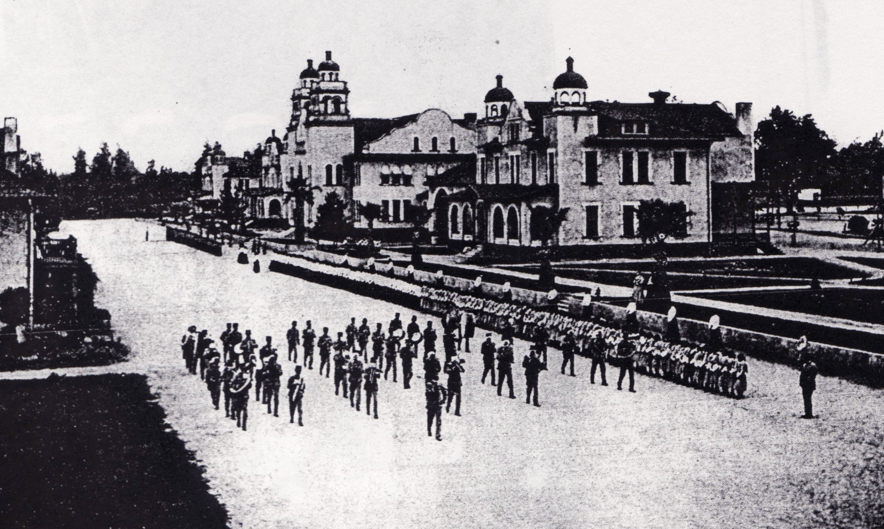
Sherman Institute marching band (1908), courtesy of the Sherman Indian Museum

Leigh J. Kuwanwisiwma of the Hopi Cultural Preservation Office once said to me that the Hopi boarding school experience is a “living history.” Some of the Hopis who attended boarding schools during the era of assimilation (1880s-1930s) are still with us today. Others are not, but their stories remain with their children and other family members. My grandfather, Victor Sakiestewa from Orayvi, attended Sherman from 1906 to 1909 and he played the clarinet in the school’s marching band. He was among the first Hopis to attend Sherman in the early twentieth century. Schools such as Sherman Institute, now called Sherman Indian High School, the Phoenix Indian School (“PI”), Stewart Indian School, Ganado Mission School, Santa Fe Indian School, and the Albuquerque Indian School, play an important role in Hopi history. The Hopi boarding school experience is indeed a “living history,” and by sharing and recording these stories we will help keep that history alive for Hopi and non-Hopi people. This conviction was a driving force behind the production of Beyond the Mesas.

Matthew Sakiestewa Gilbert