Museum of Northern Arizona director condemns Paris auction of Hopi and other Native ceremonial objects

The following post was taken from the Facebook page of the Museum of Northern Arizona. I thank Director Dr. Robert Breunig for granting me permission to repost his letters (English and French versions) on BeyondtheMesas.com. Please distribute widely.

______________________________________________

Museum of Northern Arizona Facebook page:

An auction house in Paris, France, Neret-Minet Tessier & Sarrou, plans to auction off 70 ceremonial katsina friends, improperly translated into English as “masks,” on April 12. Below is an open letter in both English and French to the auction house, in which Museum of Northern Arizona Director Dr. Robert Breunig voices his condemnation of this planned sale of significant religious objects, adding MNA to the public opposition to this sale by the Hopi and Zuni tribal members, the Heard Museum, and many individuals.

______________________________________________
March 29, 2013

Étude Neret-Minet Tessier & Sarrou
Commissaires-Priseurs
8, Rue Saint-Marc
75002 Paris FRANCE

To the Directors,

I am the director of the Museum of Northern Arizona in Flagstaff, Arizona. If the name of the museum is familiar to you, it is because this museum was founded by Harold S. Colton, my predecessor and the author of “Hopi Kachina Dolls,” the book you have cited as an authoritative source in the listing of 70 Hopi, Zuni, Acoma, and Jemez “masques katsinam,” properly called “katsina friends” and advertised for an auction by your firm on April 12, 2013.

I am writing to request that you cancel this auction, withdraw the katsina friends from sale, and that they be returned by the “owner” to the Hopi, Zuni, Acoma, and Jemez people. I have placed quotation marks around the word “owner,” because no one can “own” them but the Hopi, Zuni, Acoma, and Jemez people. Although katsina friends can be held and cared for by individuals, they belong to the communities from which they come or to specific ceremonial societies. Under tribal custom and law they cannot be sold or given away by an individual.

I can tell you from personal knowledge that the proposed sale of these katsina friends, and the international exposure of them, is causing outrage, sadness, and stress among members of the affected tribes. For them katsina friends are living beings; that is why they are called “friends” (kwatsi) in the Hopi language. The friends are loved, cared for, and ceremonially fed. They are a connection between the human world and the spirits of all living things and the ancestors. To be displayed disembodied in your catalogue and on the internet is sacrilegious and offensive. If one claims to value these katsina friends as “works of art,” one must also respect the people who made them and the native traditions that govern their use. And, as fellow human beings, it is my hope that you will offer understanding and empathy to the tribal people who are so deeply affected by this proposed sale. You cannot honor and value these katsina friends while dishonoring their makers. These are universal principles of cross-cultural human conduct.

On behalf of the Museum of Northern Arizona, I appeal to your sense of decency and humanity, and request that you terminate the auction and send these katsina friends to their proper homes among the native people in Arizona and New Mexico.

Sincerely,
Robert G. Breunig, Ph.D.
Director, Museum of Northern Arizona

_______________________________________________
Ce 29 mars 2013, Flagstaff

Étude Neret-Minet Tessier & Sarrou
Commissaires-Priseurs
8, Rue Saint-Marc
75002 Paris FRANCE

Messieurs les Directeurs:

C’est dans ma capacité de Directeur du Museum of Northern Arizona (Flagstaff, Arizona, États-Unis) que je me permets de vous contacter. Le nom de notre musée vous est connu : son fondateur, mon prédécesseur Harold S. Colton, fut l’auteur du livre Hopi Kachina Dolls que vous citez comme source d’autorité dans votre catalogue de 70 “masques katsinam” – plus correctement nommés des amis katsinam – présentés pour une vente aux enchères de votre établissement, prévue pour ce 12 avril 2013.

Je vous écris pour demander dès aujourd’hui l’annulation de cette vente ; le retrait desdits amis katsinam de toute vente présente ou future ; et surtout, que ceux-ci puissent être restitués aux peuples Hopi, Zuni, Acoma et Jemez par leur « propriétaire ». Si je mets entre guillemets ce dernier, c’est que nul ne peut être en « possession » des amis katsinam, à part les peuple Hopi, Zuni, Acoma, et Jemez dont ils proviennent. Je tiens par ailleurs à vous assurer par ma propre expérience récente et personnelle, que cette vente annoncée des amis katsinam, ainsi que leur exposition publique et internationale, est source d’outrage, tristesse et angoisse – profonds et réels – parmi les membres des tribus concernées. Pour eux, les amis katsinam sont des êtres vivants : raison pour laquelle la langue Hopi les dénomme « amis » (kwatsi). Les kwatsi sont aimés, chéris, nourris de façon rituelle. Ils incarnent le lien entre le monde humain, les esprits de tout ce qui vit, et les ancêtres. Se trouver ainsi exposés – désincarnés – dans votre catalogue et sur Internet, est une offense profonde, un sacrilège. Si les amis katsina peuvent être soignés et tenus entre mains humaines, ils appartiennent seules aux communautés dont ils sont issus, spécifiquement à leurs sociétés cérémonielles. Par coutume et par loi tribale, leur vente, donation ou dation par qui que ce soit, est proscrite.

Quiconque prétend estimer ces amis katsina comme « œuvres d’art » se doit en parallèle de respecter les peuples qui les ont crées, et les traditions amérindiennes qui gouvernent leur utilisation. Aussi, sur un plan purement humain, devriez-vous étendre votre compréhension, voire votre empathie, envers les peuples tribaux si profondément affectés par cette vente dont vous êtes l’organisateur. On ne peut apprécier et estimer ces amis katsina tout en déshonorant leurs créateurs. Il s’agit de principes universels, et d’une conduite humaine digne de ce nom…

Au nom du Museum of Northern Arizona, je fais appel à votre sens de décence et d’humanité en vous priant de supprimer cette vente, et de faire parvenir ces amis katsina à leur seul vrai lieu d’appartenance : chez les peuples amérindiens de l’Arizona et New Mexico, afin que ceux-ci puissent en disposer selon leur rite et coutume.

Je vous prie, Messieurs les Directeurs, de recevoir l’expression mon sentiment respectueux et profondément déconcerté.

Robert G. Breunig, Ph.D.
Director, Museum of Northern Arizona

Arizona Daily Sun: Auction Offends Hopi

Auction Offends Hopi

April 2, 2013 5:05am – CYNDY COLE – Sun Staff Reporter

More than 70 sacred artifacts from tribes in the Southwest, mostly from Hopi, are slated to head to auction in Paris next week over tribal objections.

The Hopi items are mostly worn on the head in religious ceremonies that continue today. They are widely held as living beings that connect people to ancestors and the spirits of other living things.

The artifacts at issue in this case date from the 1800s and 1900s and are typically handed down from one generation to the next.

“These are items that should be home with our people, and that’s where they rightfully belong,” said Hopi Chairman LeRoy Shingoitewa.

The Hopi tribal government is asking the Paris auction house, Neret-Minet, to return them.

It is slated to auction them April 12.

Items from the Jemez Tribe, of New Mexico, are also up for bidding.

Shingoitewa is also working with embassies, he said, and does not know how the artifacts wound up in Europe, other than to guess they long ago were acquired by an individual outside the tribe.

“All we’re doing is trying to find a way to stop that auction … we’re asking for them to honor Hopi by not doing any selling of any kind,” Shingoitewa said.

He has instructed members of his government not to comment on the issue.

The items are worn about the face or head, but use of the word “mask” is deeply offensive to some Hopis, Shingoitewa said.

The keepsakes are kept in kivas and most often worn by Hopi men, who sometimes fast for days before the ceremonies.

Museum of Northern Arizona Director Robert Breunig posted a letter online Friday calling on the auction house to return the items.

“… they belong to the communities from which they come or to specific ceremonial societies. Under tribal custom and law they cannot be sold or given away by an individual,” Breunig wrote.

His letter had received nearly 13,000 reads as of Monday.

“I guess to use a common term, it went viral,” he said.

Cyndy Cole can be reached at 913-8607 or at ccole@azdailysun.com.

Originally published at: http://azdailysun.com/news/local/auction-offends-hopi/article_36ae0624-5233-527e-be1a-f94c5720125a.html

——————–

See also:

“French plan to auction Hopi masks stirs furor” by Dennis Wagner, The Republic, April 2, 2013

“Hopis seek return of artifacts at auction” by Felicia Fonseca, The Associated Press, April 3, 2013

“Museums join Hopi Tribe to oppose Paris artifact sale” by Agence France-Presse, April 3, 2013

“71 Hopi and Zuni Masks to be Auctioned in Paris” by ICTMN Staff, March 7, 2013

Running on a track

Armory track
Armory track & field – University of Illinois at Urbana-Champaign

This winter I’ve been running on the Armory track at the University of Illinois.

The last time I used a track was in high school.  Back then I was quite a bit faster.

Now days I plug along at a 10 minute per mile pace.

I am obviously not out to impress anyone, especially members of the UofI’s men’s or women’s track team who run circles around me during their practice.

But it’s a pace that I’m able to maintain, at least for a while.

There are benefits to running on a track, and there are a lot of things about running on the streets of Champaign that I don’t miss: Traffic, car exhaust, stop lights, curbs, potholes, imbalanced dogs, angry geese, angry people, extreme temperatures, and those darn concrete slabs!

When the weather warms up, I will once again take my place among Champaign’s outdoor runners.

But I doubt this will last for long.

As soon as the temperatures reach into the 90s, and we start experiencing high humidity, it’s back to the track for me!

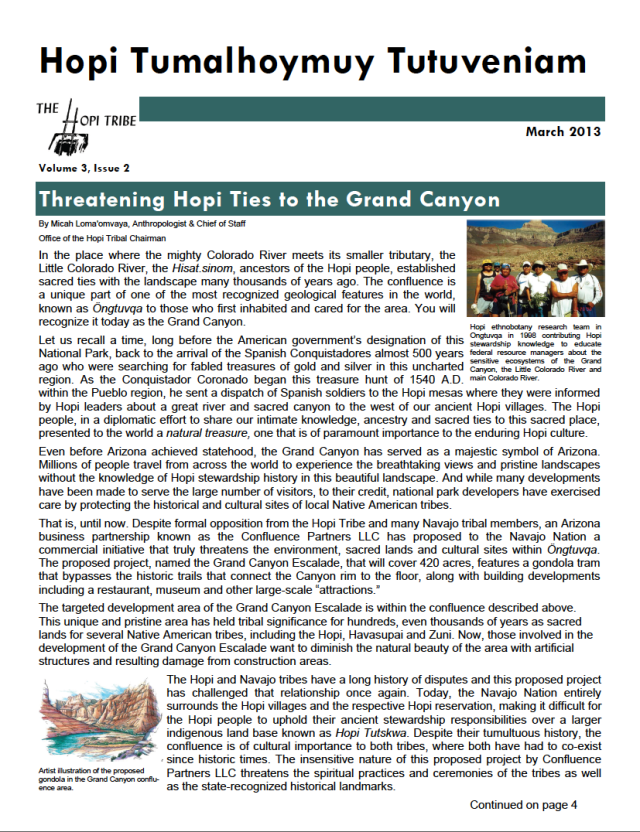
Hopi Tumalhoymuy Tutuveniam – March 2013

Screen shot 2013-03-13 at 3.09.40 PM
Click image to download (10 pages)

NAU Applied Indigenous Studies Lecturer Position

Position: Applied Indigenous Studies, Lecturer

Vacancy Number: 600182

Department: Applied Indigenous Studies

Status: Full-Time, Regular

Location: Flagstaff

Special Information

• Non-tenure track Lecturer position will be a year-to-year appointment with a possible three-year appointment in the future.

Application Procedure

• To apply, send a letter of interest, curriculum vitae, writing sample, evidence of teaching effectiveness (e.g. teaching evaluations and syllabi), and names/addresses/phone numbers of three professional references to: AIS Search Committee Department of Applied Indigenous Studies Northern Arizona University PO Box 15020 Flagstaff, AZ 86011- 5020

Job Description

• The Department of Applied Indigenous Studies (AIS) at Northern Arizona University invites applications for a full-time, non-tenure track lecturer. Primary duties will be to teach undergraduate courses in Applied Indigenous Studies; these courses address an applied focus for working with indigenous communities, skills in global and comparative studies, and introduction to the basic principles of U.S. American Indian law and comparison to other global Indigenous Peoples. The position begins August 2013.

Minimum Qualifications

• Minimum requirements include PhD, EdD, JD, or DrPH conferred by August 2013 with major training in fields related to global comparative indigenous studies. We recognize that Applied Indigenous Studies is a new, interdisciplinary and multi-disciplinary field and we welcome applications from areas that might include American Indian Studies, Native American Studies, or in related fields such as anthropology, sociology, education, literature, fine arts, health, economics, law, or political science. Experience working with indigenous communities, preferably in government or community organizations.

Preferred Qualifications

• Preference will be given to individuals with evidence of interdisciplinary teaching ability, the potential for publications and working effectively with students, colleagues, and community members from diverse cultures, especial Indigenous Peoples in the Southwest. In addition, we encourage applications from candidates who are willing to incorporate web-based delivery strategies in their teaching and mentor students as they undertake internships with tribal organizations and other organizations that employ people working with indigenous communities.

General Information

• Northern Arizona University has a student population of about 25,000 at its main campus in Flagstaff and at over 30 sites across the state. Committed to a diverse and civil working and learning environment, NAU has earned a solid reputation as a university with all the features of a large institution but with a personal touch, with a faculty and staff dedicated to each student’s success. All faculty members are expected to promote student learning and help students achieve academic outcomes. While our emphasis is undergraduate education, we offer a wide range of graduate programs and research. Our institution has carefully integrated on-campus education with distance learning, forming seamless avenues for students to earn degrees. Flagstaff has a population of about 65,000, rich in cultural diversity. Located at the base of the majestic San Francisco Peaks, Flagstaff is 140 miles north of Phoenix at intersection of Interstate 17 and Interstate 40. Northern Arizona University requires satisfactory results for the following: a criminal background investigation, an employment history verification and a degree verification (in some cases) prior to employment. You may also be required to complete a fingerprint background check. Additionally, NAU is required to participate in the federal E-Verify program that assists employers with verifying new employees’ right to work in the United States.

Salary

• $43,000 – $45,000

Application Deadline

• This position will be open until filled or closed. Review of applications will begin on March 15, 2013.

FLSA

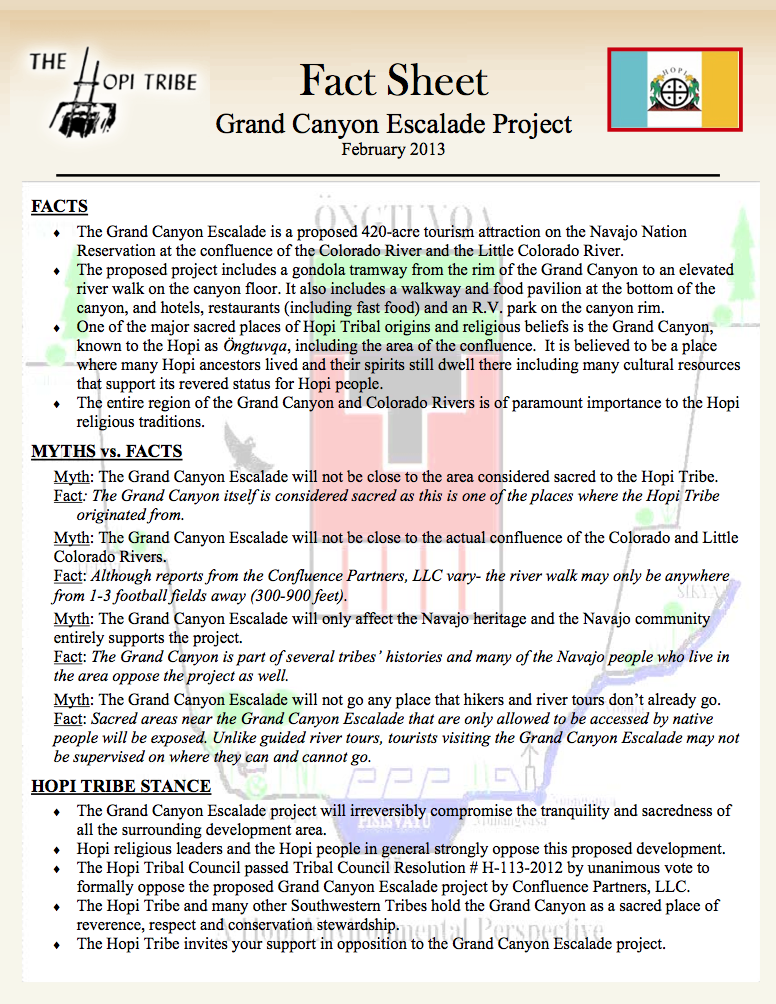
Hopi Fact Sheet: Grand Canyon Escalade Project

Screen shot 2013-02-22 at 12.34.15 PM

UPCOMING TALK: “Hopi Runner Harry Chaca and the 1929 Vallejo Pre-Olympic National Marathon”, UC Riverside, February 7

I am scheduled to give a talk entitled “Hopi Runner Harry Chaca and the 1929 Vallejo Pre-Olympic National Marathon” this Thursday February 7 at 1:30PM.

My presentation is part of the two-day symposium, “Sherman Institute: The American Indian Boarding School Experience”, which will be held at UC Riverside’s Costo Library.

For more information about the gathering, please visit UC Riverside, Sherman Indian High School Host Symposium

Below is the schedule for the event:

Sherman Institute: The American Indian Boarding School Experience

February 7, 2013: Costo Library (4th Floor Rivera Library)

9 AM: Wlecome by Clifford E. Trafzer and Lorene Sisquoc, Moderators

Invocation by Henry Vasquez

9:30-10: David Adams (Cleveland St. University), “What We Don’t Know about the
History of Indian Boarding Schools”

10-10:30: Robert McCoy (Washington St. University), “Building to Assimilate:
Mission Architecture of Sherman Institute”

10:30-11: Diana Bahr (UCLA), “Robert Kennedy and Sherman Institute, A Promise
Fulfilled.”

11-11:30: Leleua Loupe (CSU Fullerton), “A Network of Control: Exploiting
Indigenous Labor in the West”

11:30-12: Kevin Whalen (UCR), “Indian School and Company Town: Sherman
Student-Laborers at Fontana Farms Company, 1907-1930″

Lunch Break

1:30-2: Matthew Sakiestewa Gilbert (University of Illinois), “Hopi Runner Harry
Chaca and the 1929 Vallejo Pre-Olympic National Marathon”

2-2:30: William O. Medina (Riverside Community College), “Patriotic Indians at
Sherman Institute”

2:30-3: Jason Davis (CSU San Bernardino), “Paradigm Shift: Assimilation to
Preservation at Sherman Indian School”

3-3:30: Kathleen Bartosh (UCLA), “Domesticity and Defense: The Female Experience
at the Sherman Institute, 1930-1960.”

3:30-4: Jean Keller (Palomar College), “Before Sherman Institute: The Perris Indian
School.”

Rupert Costo Chair, California Center for Native Nations, Native American Student
Programs, Native American Educational Program of UC Riverside and the Sherman
Indian Museum offer this Symposium as Sponsors.

—————————————————————————————————

Sherman Institute: The American Indian Boarding School Experience

February 8, 2013, Sherman Indian High School Auditorium

9-10:  Panel 1,  Former Students, Staff, and Faculty

10-11:  Panel 2,  Current Students, Staff, and Faculty

11-12:  Panel 3,  Sherman Scholars and Historians

12-1:  Lunch Break

1-4:  Sherman School Museum is Open

2-3:  Visit to Sherman School Cemetery

Symposium is sponsored by the Sherman School Museum and Costo Chair, California Center for Native Nations, Native American Educational Program,

and Native American Student Programs of UC Riverside. 

FOR IMMEDIATE RELEASE: APS Foundation donates nearly $60,000 to Lowell’s Navajo-Hopi Program

FOR IMMEDIATE RELEASE / January 30, 2013

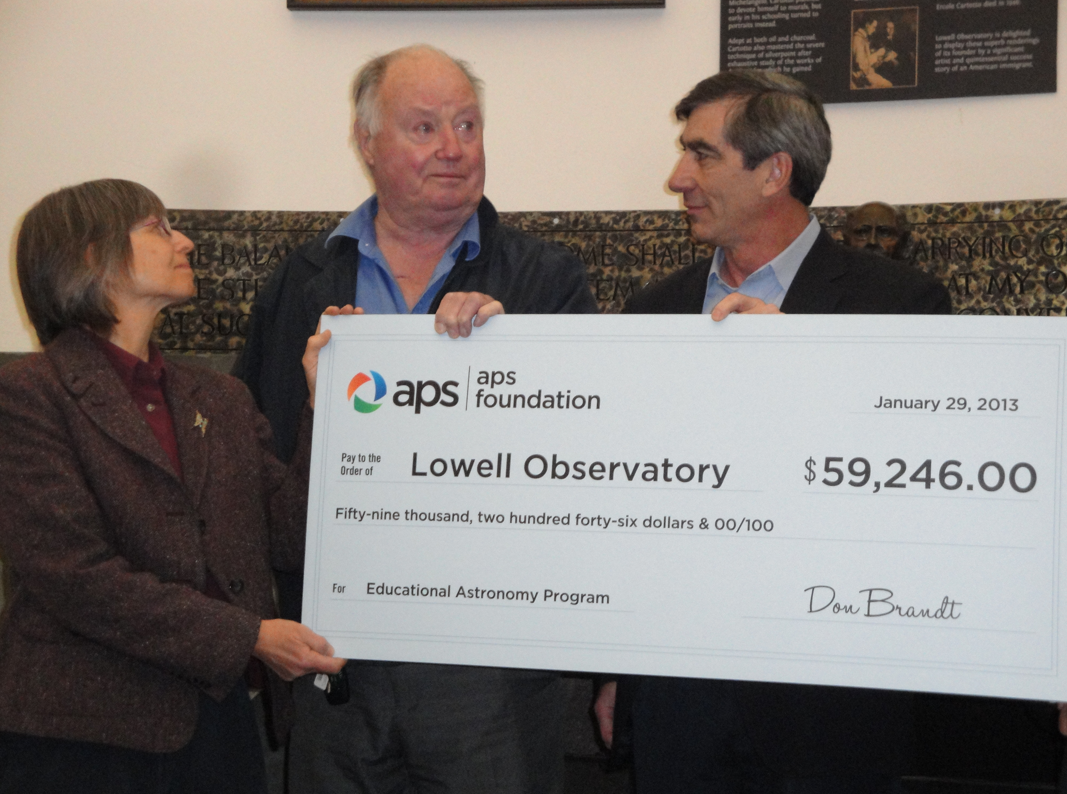
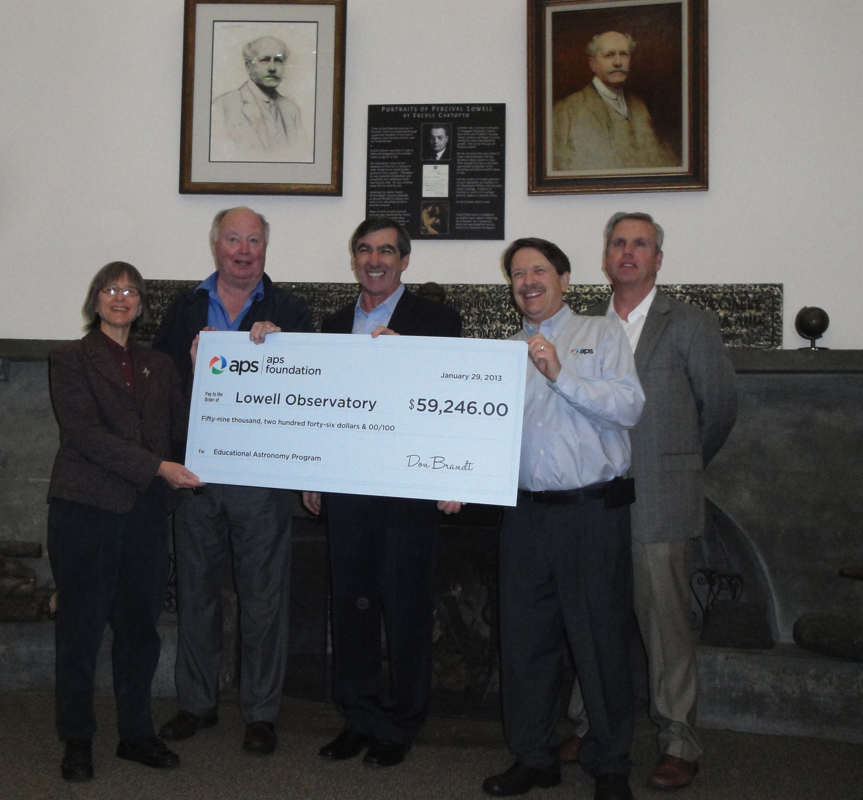
Lowell Observatory is proud to announce a generous gift of nearly $60,000 from the APS Foundation to support the Observatory’s Navajo-Hopi Astronomy Outreach Program. The $59,246 donation will go directly towards supporting this groundbreaking, 17-year-old STEM (science, technology, engineering, mathematics) program.

“APS has been a long-time supporter of Lowell’s education programs, and we are very grateful for this generous gift in support of our outreach to Navajo and Hopi middle schoolers,” said Lowell Director Dr. Jeffrey Hall.

“We very much appreciate not only the APS Foundation’s financial support but their enthusiasm for our program,” added Dr. Deidre Hunter, Deputy Director for Science, Program manager and Program co-founder.

Mr. Mark Schiavoni, Arizona Public Service Executive Vice-President of Operations and APS Foundation Board Member, echoed the sentiments. “We are proud to continue our longstanding partnership with Lowell Observatory, which plays a critical role in educating our youth about astronomy and science. This grant will enable the Navajo-Hopi Outreach Program to further support STEM education that invests in today’s youth, developing future leaders for Arizona,” he said.

The goals of the Navajo-Hopi Astronomy Outreach Program are twofold: 1) to use astronomy to help teachers get Navajo and Hopi children excited about astronomy and science in general, encouraging a life-long understanding of science for all and advanced study for some, and 2) to help teachers of Navajo and Hopi students learn about astronomy and astronomy activities so that they will be better able to incorporate astronomy in their classrooms.

The Program was initiated in 1996 by Dr. Hunter and Dr. Amanda Bosh (Lowell/MIT).

For more about the Program, visit lowell.edu/news

APS Bill tears up

APSFoundationNHdonation

Image descriptions:

-Lowell Trustee Bill Putnam (center) gets a bit emotional as he and Dr. Deidre Hunter, Deputy Director for Science and the Program’s co-founder, receive the ceremonial check from Mr. Mark Schiavoni (right), Arizona Public Service Executive Vice-President of Operations and APS Foundation Board Member.

-Lowell’s Dr. Deidre Hunter and Trustee Bill Putnam (left) receive the ceremonial check from Mr. Mark Schiavoni, Arizona Public Service Executive Vice-President of Operations and APS Foundation Board Member; Mr. Bruce Nordstrom , Pinnacle West Board of Directors; and Mr. Richard Nicosia, Arizona Public Service Energy Delivery Manager, Flagstaff.
Tom Vitron
Media and Communications Coordinator
Lowell Observatory
(928) 233-3260
(928) 853-5233 cell
www.lowell.edu
facebook.com/lowellobservatory
Twitter: @PercivalLowell

New website to be launched on Hopi runners

HopiRunners.com logo

I have been working hard to develop a new website on Hopi runners: http://www.HopiRunners.com. The website will highlight the long tradition of running among the Hopi people of northeastern Arizona.

Here the public will find material on individual runners, links to photographs and videos, and articles and other sources related to Hopi running.

Every week, several people stumble upon BEYOND THE MESAS in search of information on Hopi runners. It seemed clear to me that an entire website ought to be dedicated to this topic.

I also want to highlight that the logo (above) for HopiRunners.com was designed by Wendell Sakiestewa of WenSaksDesigns. Wendell is Hopi, and he’s also a relative of mine.

The logo represents the continuity of Hopi running by depicting the transition of a traditional Hopi clan runner (far left) to a Hopi runner in modern running attire (far right).

I hope to have the website up and “running” at some point in February.

Navajo-Hopi Observer: Hopi High runners to compete in national Wings of America meet

Screen shot 2013-01-15 at 3.38.52 PM
Click image to read full article