 In April of this year, Susan Bundock, C-SPAN’s American History TV Producer, interviewed me at the 2013 Organization of American Historians conference in San Francisco, CA. At the end of June, the interview aired on national television and streamed on-line. Bundock asked me a number of questions about Hopi and Native American history. She also asked about my family history, and the American Indian Studies Program, and Department of History, at the University of Illinois at Urbana-Champaign. The interview is just over 20 minutes long, and can be viewed at the following address: http://www.c-spanvideo.org/program/312267-6
1000 Words and a Cup of Coffee: A new Hopi-authored blog

Be sure to check out a relatively new Hopi-authored blog by VaNiesha Honani of Walpi entitled “1000 Words and a Cup of Coffee.” So far VaNiesha has written on a handful of topics, including the Hopi Code Talkers, and the recent auction of 71 Hopi ceremonial items in France.
Here’s an excerpt from a post that she wrote entitled “This Little House on Walpi”. I think you will find her writing style and perspective to be quite engaging.
This past summer, I was in a mood and set on sitting in that little house during our Home Dance, moping and eating stew. I sat still. Little girls ran in and out, screaming with laughter and the boys chased each other around with bows in the summer.
As the day passed, they got dirtier. I held my little niece and talked to her. “You see this craziness?” She smiled. All the girls were dressed in traditional dresses. Even in my grumpiness, as I held my niece and had random one-sided conversations with her, my breath was taken away. The memories multiplied to the present. I looked at all my sisters, my nieces and aunts, in the same traditional clothes as 1000 years ago. The corn stalks and kachina dolls. The random small toy arrow that would come flying through the door. How beautiful.
I smile because when I hear somebody in an L.A. gallery wonder, “I can’t imagine growing up there, I wonder if people still live there or did they leave because it’s hard living.” I muse. Yes, we do still live there. No matter where or how far. Technology and all. It’s home. I smile as I stand next to them pondering over my house, this little house on Walpi.
Want to read more? Head on over to her blog: www.1000wordsandacupofcoffee.com
Hopi Tumalhoymuy Tutuveniam – July 2013

Wings of America 15th Annual American Indian Running Coaches’ Clinic

In June I had a great opportunity to speak at the Wings of America organization’s annual American Indian Running Coaches’ Clinic in Albuquerque, New Mexico.
Wings of America exists to “enhance the quality of life for American Indian youth” by promoting running and pride in one’s “cultural identity.”
I spoke to a group of nearly 50 Native high school runners, and a number of coaches, including Hopi coach Rick Baker. I don’t often get a chance to speak to such a well-informed audience!
However, the highlight for me was listening to Hopi runner Wendi Lewis from Kykotsmovi, who gave a wonderful talk on running through the “trials and tribulations of life.”
Other presenters included Navajo scholar Lloyd Lee, Anthropologist Peter Nabakov, who once published a remarkable book entitled Indian Running, Jemez Pueblo runner Steve Gachupin, and many others.
Although I was not able to listen to Steve Gachupin’s talk, I have great respect for him as a runner.
Known for winning six consecutive Pikes Peak Marathons in the late 1960s and early 1970s, he is a strong advocate for running among Native youth.
I first learned about Gachupin and his running accomplishments from an excellent article by historian Brian S. Collier entitled “’To Bring Honor to My Village’: Steve Gachupin and the Community of Jemez Running and the Pikes Peak Marathon” (Journal of the West, Fall 2007).
If you are at all interested in running, be sure to read this article (it’s an article that I often cite in my work).
I should also note that the beautiful plate above was given to everyone who presented at the Clinic. It was made by Jemez Pueblo potter Bernice Gachupin, Steve Gachupin’s wife.
Finally, I want to give a special thanks to Wings of America Program Director Dustin Quinn Martin and other organizers for their hard work in making this terrific event possible.
Kwakwha’!
InciWeb: The Hopi Camp Crew Gives Back to Mimbres Valley Children’s Garden
Incident: Silver Fire Wildfire
june 30, 2013
The Hopi Camp Crew Gives Back to Mimbres Valley Children’s Garden
The Hopi Agency Camp Crew of Arizona was recently dispatched to the New Mexico Incident Management Team to work the Silver Fire.The fire broke out June 7, 2013 when lightning hit in the Gila National Forest. The Hopi Camp Crew of 11 cared for the incident command post in San Lorenzo and its 728 personnel who camped there while fighting the fire. The command post was established at the San Lorenzo Elementary School.
Crew Boss Arley Woodty said it was ‘the best assignment yet’, because during down time, the Hopi Crew also completed a service project for the youth and community.
The school is home to the Mimbres Valley Community Nature Garden. School Custodian Linda Jones has been watering the vegetables during summer break and needed help expanding plots for a new crop of sweet potatoes.
““Our students started a pollinator garden and grow their own food and learn the importance of agriculture to this valley that began 1,000 years ago with the Native Americans, continued with the homesteaders, and organic farms today,” Jones said.”
Thanks to the Hopi crew, the school has three new raised garden beds that are decorated in traditional Hopi symbols – Butterflies, Bears, Corn, Eagles, and Horses.
““We are artists back home; we all do arts and crafts, making baskets, dolls and jewelry, but we hardly ever get to do things for kids. We like it,”” Woodty said.
Each member of the crew, even the bus driver, took part in painting. They hope the youth appreciate the meaning of the art as it relates to agriculture, snow, water, and prayer.
Jones saw the work and started showing it off. “”I had no idea of the talent of this crew.””
She called the school’s volunteer archaeologist, Marilyn Markel. When Markel saw the garden work, she brought the school’’s historic mascot (of sorts), a wooden rabbit named Conejo Mimbreño. ““We teach the kids about the history of the valley through the rabbit visits,”” she explained.
The next lesson will focus on the locations where the firefighters were stationed and how their work, and the New Mexico Incident Management Team, helped protect Mimbres Valley resources.
During down time in fire camp, it is common for firefighters to assist the communities that host them in service projects. Facilities used by crews are always left looking better than when the emergency trucks rolled into town.
Indigenous Confluences – A New Book Series from the University of Washington Press
I am co-editing (with Charlotte Cote and Coll Thrush) a new book series entitled Indigenous Confluences with the University of Washington Press. The Press will announce the series at the year’s Native American and Indigenous Studies conference in Saskatoon, Canada.

Hopi engineer and artist to receive honorary doctorate
FOR IMMEDIATE RELEASE
Contact: Matt Lazier
805-756-7109; mlazier@calpoly.edu
Cal Poly to Confer Three Honorary Doctorate Degrees at Commencement June 15, 16
SAN LUIS OBISPO — Rodeo icon Cotton Rosser, agricultural industry leader James W. Boswell, and engineer-turned-artist Alfred Qöyawayma — all Cal Poly alumni — will receive honorary Doctor of Science degrees at the university’s spring commencement ceremonies Saturday and Sunday, June 15 and 16.
Qöyawayma will deliver the keynote address at Saturday’s event, and Boswell will give the keynote Sunday.
Qöyawayma, whose name is Hopi for “Grey Fox Walking at Dawn,” studied mechanical engineering at Cal Poly. He graduated in 1961 and began his career developing guidance systems for military and commercial applications, including the X-5, the F-15, the 747, and even Air Force One. He then worked for Arizona’s utility industry, leading a team of scientists and engineers in solving challenges to the state’s power and water systems.
He co-founded the American Indian Science and Engineering Society, serving as the first chairman of an organization that has helped more than 12,000 students graduate in the critical STEM (science, technology, engineering and mathematics) disciplines. In 1988 he received a White House appointment to become vice chairman of the Institute of American Indian Art, and he became a full-time artist and published researcher on native culture in the Western Hemisphere. He has been a Fullbright Scholar and a featured artist at the Smithsonian’s permanent Archives of American Art, and his “Corn Mother” sculpture is on permanent display at Cal Poly.
Boswell — a 1977 graduate with a bachelor’s in business administration — is chairman and CEO of J.G. Boswell Co., an agriculture and real estate development firm his family founded in 1925. The company owns and operates farms in California and Australia, producing, processing and marketing a variety of crops and developing innovative practices in plant biotechnology and livestock operations. The real estate arm of the company develops planned communities and business parks throughout the Western U.S.
As head of J.G. Boswell, he is also the president of the James G. Boswell Foundation, which supports agricultural education and has helped more than 1,200 graduates. He is a major supporter of Cal Poly’s College of Agriculture, Food and Environmental Sciences. Through the foundation, he has established an endowed chair in the Horticulture and Crop Sciences Department, invested in the Agribusiness Management Club, and contributed to the college’s Learn by Doing Fund for Agricultural Education. He has also served on the Cal Poly President’s Cabinet, sharing his real-world insight to help the university continue to educate resourceful leaders in California agriculture.
As a student at Cal Poly, Rosser led the university’s rodeo team to the forefront of intercollegiate rodeo competition, launching a winning tradition that would garner 41 national championships. After graduating in 1952, he purchased the Flying U Rodeo Co. and began producing rodeos and making his mark on the industry.
Rosser’s rodeo events are known for their colorful pageantry, innovative showmanship and energetic patriotism. He was instrumental in bringing high school rodeo to California and has been a longtime Cal Poly Rodeo booster and Cal Poly Alumni Association supporter. For his contributions to rodeo culture in the Western U.S., Rosser has been inducted into several rodeo halls of fame and Western museums.
About 4,000 students are eligible to graduate in Cal Poly’s spring commencement.
# # #
See also: http://www.calpolynews.calpoly.edu/news_releases/2013/May/doctorate.html
Hopi Tumalhoymuy Tutuveniam – May 2013

Yale University Press to publish second edition of Don C. Talayesva’s book Sun Chief: The Autobiography of a Hopi Indian
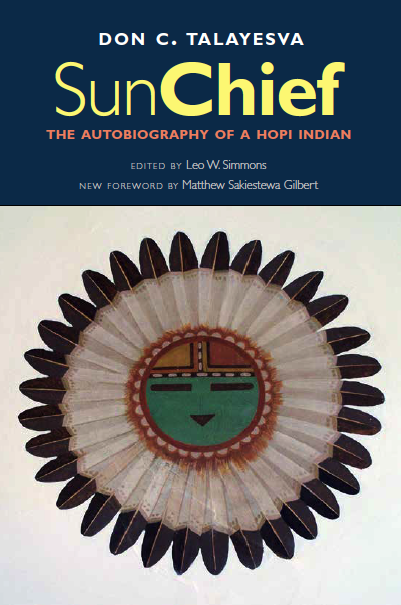
Several months ago Yale University Press asked me to write the new Foreword to the second edition of Don C. Talayesva’s book Sun Chief: The Autobiography of a Hopi Indian. The book was originally published in 1942. Yale will release the second edition in December of this year.
Talayesva was from the village of Old Oraibi (Orayvi) on Third Mesa. As a young man, he had been educated in western schools, including Sherman Institute, but eventually returned home to live according to Hopi ways and customs.
In the 1930s and early 1940s, he worked alongside a white anthropologist named Leo W. Simmons to write and publish his autobiography.
In the new Foreword, I situate Sun Chief within contemporary Hopi studies, and explore the ways scholars have used the book since its publication more than seventy years ago.
The Hopi Tawa image on the cover is of a mural by Hopi artist Fred Kabotie of Shungopavi. I collaborated with Kabotie’s grandson, Ed Kabotie, the Hopi Cultural Preservation Office, the National Parks Service, and the Press to help get this image on the cover.
If you are interested in obtaining a copy of the book, it is now available for pre-order through several distributors, including Amazon and Barnes & Noble.
Hopi Tumalhoymuy Tutuveniam – April 2013

 BEYOND THE MESAS, LLC