I have been running regularly for the past twelve months. This winter I found myself running in all kinds of wet and frigid conditions. Sometimes when I run, I imagine myself on the dirt trails out at Hopi, and not the city streets and paths of Champaign, Illinois. But Hopis have a long tradition of running beyond the mesas, and I like to think that this tradition still exists in the Midwest.
I am not the only one in my immediate family who runs. My wife is an avid runner, and our daughters refer to themselves as “Hopi runners.” They are also Irish on their mother’s side and I often remind them that the Irish are known for running long distances as well. I hope they will appreciate this more as they get older.
My daughter is already quite the runner. I am constantly amazed by her running form and how effortlessly she makes running appear. She and her sisters are sure to run cross-country in middle and high school.
Some people run to lose weight or to relieve stress. Others run to lower their cholesterol or blood pressure. Although these are great benefits of running, I tend to focus less on these reasons. A friend once asked me why I run. I simply replied, “I run because I’m Hopi, and that’s what Hopis do.”
I came across an interesting YouTube video on running by Hopi video producer Alexander D. Chapin. The video appeared on YouTube in November 2010. I do not know much about Chapin, except that he has produced a number of short videos on-line. A few years ago, Chapin discovered interview tapes of his grandfather James (Jimmy) S. Kewanwytewa and he used a section of the interview on running to make Running Spirit. Kewanwytewa was from Orayvi on Third Mesa. Some people consider him to be the most famous Hopi kachina carver of the twentieth century. In addition to carving, he spent several years working with zoologist Harold S. Colton, co-founder of the Museum of Northern Arizona, to identify a large collection of kachina dolls. Below is the YouTube commentary that goes with the video:
I recently (2009) obtained an audio recording of my Great Grandfather Jimmy Kewanwytewa. In this recording I chose one of the stories he told and composed music to it.
My Great Grandfather was Hopi Indian and was known for being a talented distance runner. So in this story he tells about a time when he was headed home from work and saw someone running ahead of him, so he thought he would go an catch up with that person on his way home.
But the entire way to the Oraibi village, as talented as a runner that my great grandfather was said to be, he could not catch up with that person. Afterwards he told his father what happened and his father laughed at him and told him the same thing happen to him one time, and that he was never going to catch that person because that person was a spirit.
I created this video for the song in a rush so I could share this song with everyone but hope to produce a better video in the future.
Watch & listen or just listen & enjoy my most accomplished musical composition to date.
Thank you.
Shot & Edited by Alexander D. Chapin
Alexander D. C. Productions
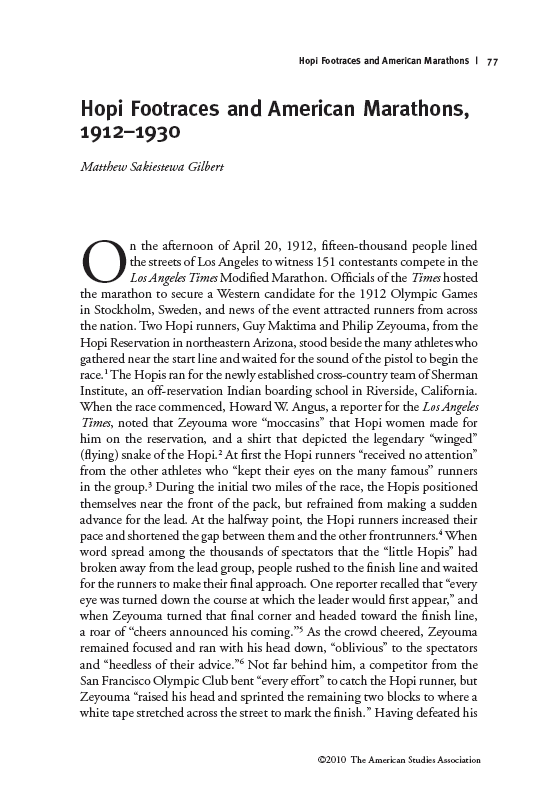
Over the past year, several people have stumbled across my blog looking for information on Hopi runners. For those who might be interested, I have made my article “Hopi Footraces and American Marathons, 1912-1930” (American Quarterly, March Issue 2010, Vol. 62, No. 1, pp. 77-101) available for download. Simply click on the above image to download the article as a PDF document.
I want to congratulate our Hopi High boys cross country team for winning their 21st straight Class 2A State Championship. This is a remarkable achievement. In an article in The Arizona Republic, reporter Jose M. Romero noted that Hopi runner Justin Secakuku won the Division IV meet for the team yesterday in Phoenix, Arizona. Congratulations to the Hopi High runners and their coaches for once again bringing honors to our people. Be sure to check out the following link for more information about this story: http://www.azcentral.com/sports/preps/articles/2010/11/06/20101106hopi-boys-cross-country-titles.html
On September 9, 2010, Victor Masayesva, Jr. from the village of Hotevilla screened a short film and gave a presentation at the University of Illinois at Urbana-Champaign. Masayesva’s visit was part of a university sponsored initiative titled “Sovereignty and Autonomy in the Western Hemisphere: National & Regional Struggles for Power, Identity and Space.” The American Indian Studies Program organized the event.
Masayesva is known throughout the world as an accomplished Hopi photographer and filmmaker. Some of his award winning films include Hopiit, Itam Hakim Hopiit, Ritual Clowns, Imagining Indians, and one of my favorites, Paatuwaqatsi: Water, Land & Life, a film on Hopi running, the sacredness of water, and Hopi relationship with the indigenous people of Mexico.
I arrived at the village of Shungopavi at 5:30 in the morning. A crowd of people gathered at the baseball field. An event volunteer welcomed everyone to the race and gave instructions to the runners.
“The 10K race will begin in 20 minutes” he announced.
A large camera and flash hung around my neck. “Hey, are you with the press?” one man asked. “No, ” I replied, “I am working on a project with the Hopi Cultural Preservation Office on runners. I’m here to photograph the event.”
“The 10K race will begin in 5 minutes” the person behind the megaphone announced.
The runners gathered around the start line. The race had officially begun. Ten seconds later, the runners were gone.
I made my way to the southeast side of the village. The sun had not yet risen over First Mesa. In the valley below, a running trail etched its way through the rocky landscape.
“Any sight of the runners” I asked. “Not yet” a man replied. Everyone waited.
After 25 minutes, the first runner appeared in the distance. It was Hopi runner Juwan Nuvayokva from Oraivi. He ran with ease and strength, showing few signs of fatigue.
On the opposite end of the village 5K runners were climbing their way up the mesa. I arrived to see my father make the final push to the top.
Back at the baseball field the 1 and 2 mile fun runs had started. Children of all ages ran toward the camera.
People clapped and cheered as the youngest runner approached the finish. It was a perfect way to end the race.
Matthew Sakiestewa Gilbert
———————————————
Throughout the week I will be adding more photographs to the slideshow, so be sure to check back.
If you or a family member are pictured in the above slideshow, and you would like a high resolution copy of the photograph, please email me at sakiestewa@gmail.com. I want to also extend a special thanks to Bonnie Talakte, Catherine Talakte, and other event organizers for granting me permission to photograph the 37th Annual Louis Tewanima Footrace on Second Mesa.
Louis Tewanima standing with his many trophies and medals. He is wearing his Carlisle track suit. Photo courtesy of the American Indian Athletic Hall of Fame
In less than a week, family members of Hopi runner Louis Tewanima will host the 37th Annual Louis Tewanima Footrace at the village of Shungopavi on Second Mesa. Tewanima is one of the most celebrated runners in Hopi history and he is best known for winning a silver medal at the 1912 Olympic Games in Stockholm, Sweden. As I think about the upcoming footrace, I am reminded of another Hopi footrace on Second Mesa that involved Tewanima.
In a previous post, I wrote about a Hopi runner named Philip Zeyouma who competed for Sherman Institute at the same time Tewanima ran for the Carlisle Indian Industrial School in Pennsylvania. In April 1912, Zeyouma won the Los Angeles Times Modified Marathon of 12 miles, which earned him an opportunity to compete for the U.S. team in Stockholm. On the other side of the country, Tewanima, who by this time had won several running events, was also scheduled to run in the Olympics.
When news that the two Hopi runners would race against each other in Sweden, excitement spread among the students at both schools. Students at Sherman Institute gloried in the thought that one of their Hopi runners would defeat the famous Louis Tewanima, and the pupils at Carlisle had great confidence that Tewanima would outrun the Hopi runner from Sherman. But the showdown between Zeyouma and Tewanima at the Olympic Games in Sweden never took place.
Shortly before Zeyouma was supposed to leave for Sweden, his father expressed disapproval of his son’s participation in the Olympics. Not wanting to disappoint his father, Zeyouma honored his request and went back to the Hopi Reservation for the summer. However, in my article “Hopi Footraces and American Marathons, 1912-1930,” I note that the
rivalry between the two Hopi runners did not cease when Tewanima migrated back to the Hopi mesas as an Olympian. In September 1912, shortly before they returned to their schools, Tewanima and Zeyouma challenged each other to a race on the Hopi Reservation. On the day of the race, Hopis from the surrounding villages gathered around the starting line and anxiously watched as the two runners made their mark for the twelve-mile course. Zeyouma proudly wore his “Sherman colors,” while Tewanima “appeared in his Carlisle track suit.”
By wearing their running uniforms, the Hopi athletes saw the event as a race between the two schools and identified themselves according to their school affiliation. However, such a display of school loyalty did not go unchallenged by the other Hopi runners in the crowd. Seconds before the race began, some of the older Hopi men remarked that the “boys did not look like [Hopi] runners” at all, and teased Zeyouma and Tewanima for wearing their running outfits. A New York Times reporter noted that when Tewanima heard the men’s insults, Tewanima replied, “If you don’t like our looks get in, and show what you can do.”
The men promptly accepted his challenge and entered the race with no shoes or track suits, and wore “merely discarded” clothes. Six miles into the race, the older men proved too much for the young runners and Zeyouma and Tewanima quit and left the “race to the barefooted runners in the lead.” Coach Joe Shoulder recalled that the winner was about fifty years old, and he looked like he was “dying of consumption” (tuberculosis).
The outcome of the race provides a telling commentary on running in Hopi culture, as well as the relationship between older and younger runners. While the younger runners migrated to off reservation Indian boarding schools, the vast majority of the Hopi people, including older men who were known for the ability to run long distances, remained at home. Consequently, some of the best long-distance runners in U.S. history received little or no attention by those outside of the Hopi community. Although newspaper reporters seemed surprised that men in their fifties had the ability to defeat the younger athletes, the people knew that other Hopis could easily outrun the Hopi Olympian and the track star from Sherman Institute. [“Hopi Footraces and American Marathons, 1912-1930,” American Quarterly, March 2010, vol. 62, no. 1, p. 87, 88]
On Sunday September 5, 2010, runners of various ages will come together to run a footrace on Second Mesa. They will once again make their mark on the start line and run a course similar to the one taken by Tewanima, Zeyouma, and the older runners of the village. In honor of Tewanima, who still inspires thousands of individuals to run, the annual Louis Tewanima Footrace gives testimony to Tewanima’s legacy as an Olympic runner and the continuation of footraces among the people.
Matthew Sakiestewa Gilbert
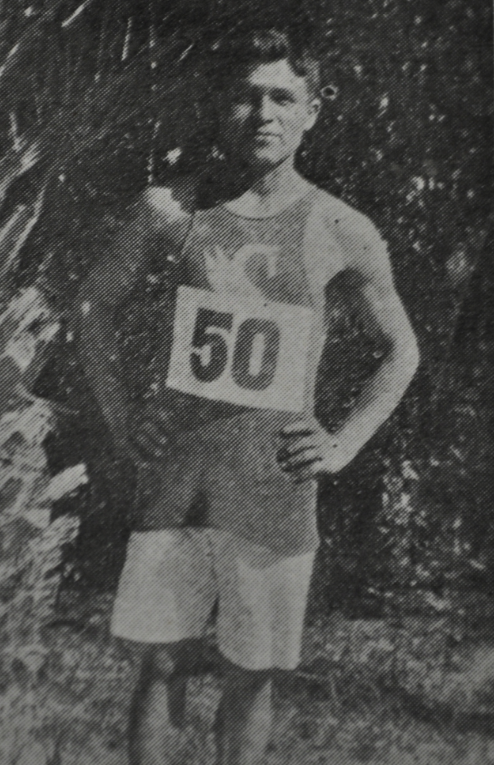
Philip Zeyouma after winning the 1912 Los Angeles Times Modified Marathon. Photo courtesy of the Sherman Indian Museum


 BEYOND THE MESAS, LLC