This summer David Skinner, editor of Humanities Magazine (published by the National Endowment for the Humanities) invited me to write an article reflecting on Larry C. Skogen’s excellent book To Educate American Indians: Select Writings from the National Educational Association’s Department of Indian Education, 1900-1904 (University of Nebraska Press, 2024). The article was part of a special edition of Humanities Magazine on Indigenous-related topics and edited by Shelly C. Lowe (Navajo), Chair of the NEH. I was honored to write this piece and have included the text and the link to the essay below.
*****
Indian Boarding Schools and the “Problem” They Were Meant to Solve by Matthew Sakiestewa Gilbert
“Originally published as “Education for the Indian Problem” in the Summer 2024 issue of Humanities magazine, a publication of the National Endowment for the Humanities.”
Over the past 20 years, I have taught Native American history at community colleges, Christian schools, and large universities. I have encouraged my students to think critically, ask hard questions, and consult primary resources. “Don’t just read about what people said,” I tell them, “Do the hard work, go to the original source, and read them for yourself.”
In his edited collection of essays from the National Educational Association’s Department of Indian Education (1900–1904), Larry C. Skogen, a scholar long affiliated with Humanities North Dakota, has made that hard work a little easier. Skogen’s book, To Educate American Indians, includes speeches by white educators employed by the U.S. government’s Indian Service to teach Native American children. Some of the speeches resonated with me not only as a scholar but as a Hopi person, causing me to reflect on my family history and experiences as a teacher who has written extensively on the Indian boarding school experience.
When I lecture on Indian education, I often first introduce my students to the so-called Indian Problem, providing a lens for students to understand how non-Native people viewed Indians—not as an asset or benefit, but as a “problem” that needed to be addressed and eliminated. Not eliminated by slaughter or outright genocide (the U.S. government had failed in those attempts) but eliminated in the sense of eradicating culture and identity.
By the turn of the twentieth century, the U.S. government had stopped warring with Indian nations on the Great Plains and elsewhere, but the battle for the minds and affections of Indian youth continued at Indian schools. School officials, such as H. B. Frissell, principal at the Hampton Normal and Agricultural School in Virginia, believed schools played a major role in solving the Indian problem by making Indian youth discontent. “It is sometimes said of the schools off the reservation,” observed Frissell, “that when their students return they are not willing to live as their parents did. . . . A wholesome discontent is a most helpful sign.”
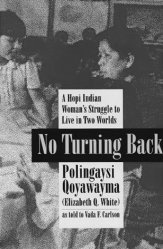
For the Hopi, the most widely known example of this comes from the life of Polingaysi Qoyawayma. Polingaysi spent four years, from 1906 to 1910, at Sherman Institute, an off-reservation Indian boarding school in Riverside, California. When she returned home, she judged her parents for living according to Hopi ways and customs (No Turning Back is her autobiography). Young people, especially teenagers, are already disposed to be critical of their parents. School officials such as Frissell used this to their advantage to turn Indian youth against their families.
Alienating Indian youth from their communities and cultures was accomplished by various means. At Indian schools, officials instructed students in math, science, history, and other disciplines. Teachers wanted their Indian pupils to see the supposed superiority of Western education while simultaneously becoming critical and doubtful of Indian teachings and worldviews. Male students learned trades and female students learned to be good housekeepers according to Western values. Some students also participated in sports and musical ensembles, while others used their skills in the English language to work in the print shop or as editors for the school newspaper.
In my office, a prized possession sits on a bookcase: a complete ten-volume set of The Red Man, the official student-written newspaper of the Carlisle Indian Industrial School in Pennsylvania. Hardbound and organized by year, the books recall happenings throughout the school year, motivational speeches, Native American stories, and alumni news.
“Every Indian school should have the newspaper,” William T. Harris, U.S. Commissioner of Education, remarked in his 1902 speech in Skogen’s collection. Telling his audience that Indian pupils should read “first that which interests him,” the commissioner further observed that the pupil will “go from that to the far-off events of the world, according as he grows in intellectual capacity.”
School officials did not encourage Indian youth to listen to their parents back home on Indian reservations. They did not encourage them to seek wisdom from their tribal elders or other knowledge-keepers about the world beyond their homelands. Instead, they wanted them to learn from newspapers and considered the printed word far superior to the oral tradition often spoken in one’s Native language.
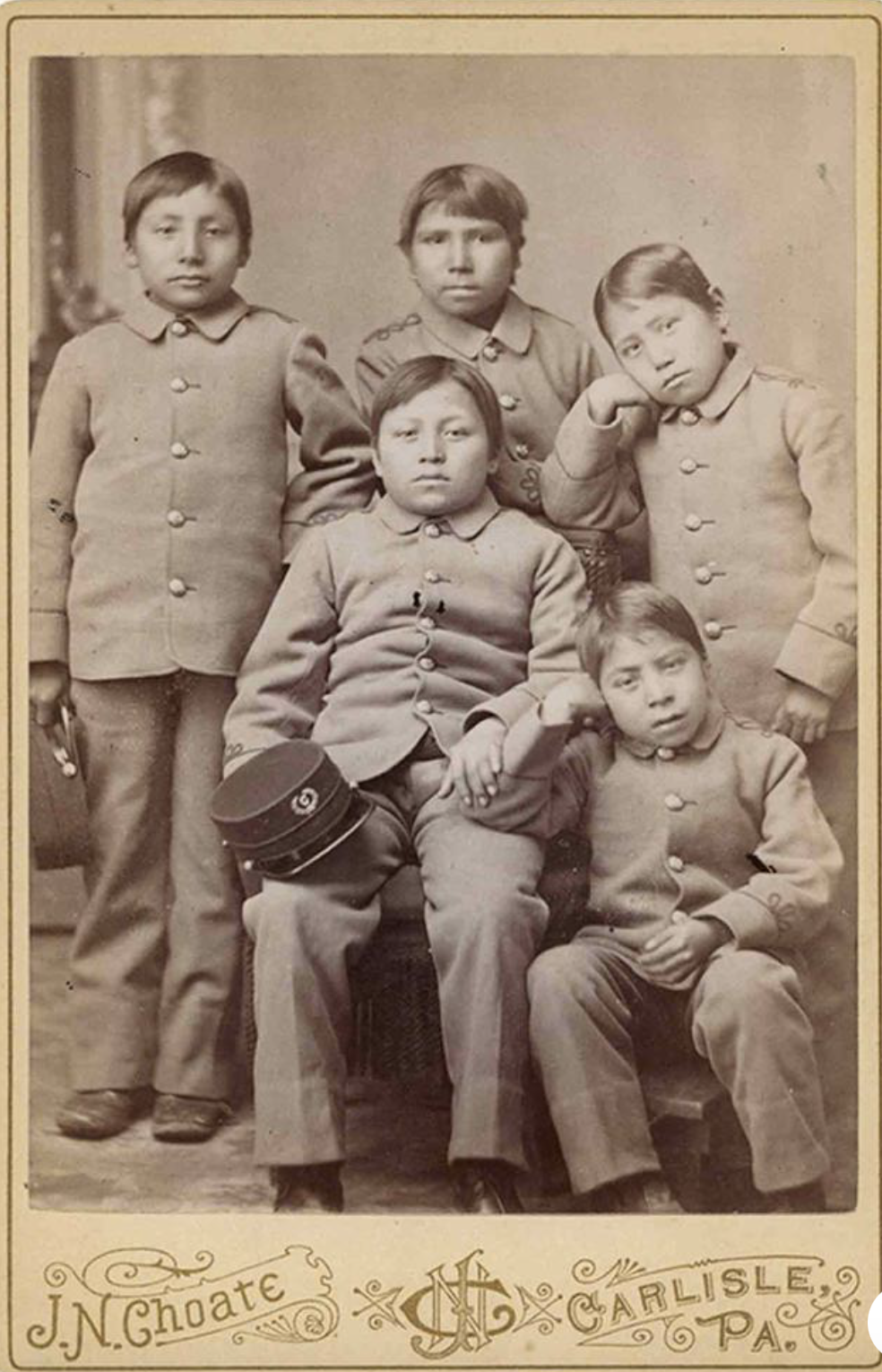
Photo caption
Studio portrait of Sioux students wearing their Carlisle boarding school uniforms in 1880, identified as, back row: David (Kills Without Wounding), Nathan (Ear), Pollock Spotted Tail; and front row: Marshall (Marshall Bad Milk) and Hugh (Running Horse).
—Photo by John N. Choate, Carlisle, Pennsylvania, Swedish National Museums of World Culture
The U.S. government’s attempt to suppress Native languages took various forms. One especially interesting piece in Skogen’s volume is Emily S. Cook’s 1904 address titled “What’s in a Name?” Skogen notes that oftentimes Indian people had no say in the matter and that government officials changed Indian names, which they struggled to pronounce, to make it easier to keep records related to Indian affairs.
The government’s name-changing policy sought to weaken Indian identities and eradicate the use of Indigenous languages. But not every individual in the Indian Service, especially those who lived and worked with Indian communities, saw the wisdom in eliminating Indian names.
Cook was one of these people. “Why should Imogen be preferred to the Kiowa name Imguna, or Jack to Zapko?” Cook asked, “Why not have a few less Marys and Johns in the world and enrich our nomenclature by picking out gems from aboriginal matrices?” Cook knew the value of Indian culture in American society, and she considered it cruel and “short of criminal” to assign names to Indian children and adults that did not reflect their tribal identity and caused great confusion within the family.
Reflecting on Cook’s advocacy for Indian names, I cannot help but think about my own family and how things could have been different for us had more school officials listened to Cook.
In the late 1940s, my grandfather, Lloyd Gilbert, attended the Phoenix Indian School in Arizona with his two siblings. The three arrived at the school with the surname Quache (pronounced Kwah-tsee), which means “friend” in the Hopi language. Officials at the Phoenix school, however, did not tolerate Indian names and told them they needed to consult with one another and replace theirs with an English name.
The mandate likely caused my grandfather and his siblings great stress and a sense of loss. It also required them to think deeply about appeasing the government while not disconnecting themselves from their family. They ultimately chose “Gilbert,” their father’s first name. A disheartening and difficult position to be in, they nonetheless demonstrated agency and worked together to address a problem imposed upon them.
While Indian students studied at government schools, prominent and influential employees in the Indian Service waxed eloquently on the state of Indian affairs, the challenges of training Indian youth, and their responsibility to “uplift” Indian pupils with Western education and values. Some did so with an air of arrogance or even ignorance. Others, such as Cook, did so with compassion and balanced foresight. Within this collection, Skogen exposes them all and provides an insightful resource to read their words within a larger historical and cultural context.
As the late David Wallace Adams wrote in the foreword, the “historical gap” between all that has been written and taught about the history of Indian education and the documentation on how “leading educators of the day viewed the proper ends and means of Indian schooling . . . is now closed.” However, the opportunity for students and others to interpret these essays and critically analyze their recommendations for solving the Indian Problem is now open.
https://www.neh.gov/article/indian-boarding-schools-and-problem-they-were-meant-solve


 BEYOND THE MESAS, LLC