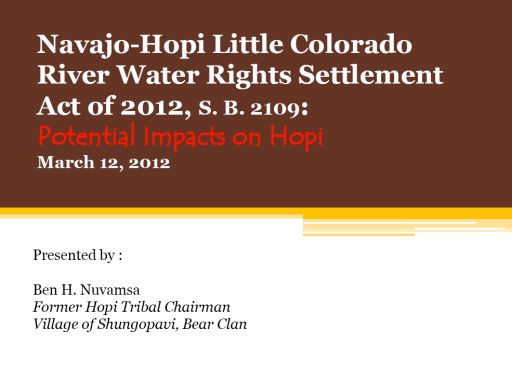
S.B 2109 and Potential Implications for Hopi

Please see below Benjamin H. Nuvamsa’s very informative PowerPoint presentation on the potential (negative) implications of S.B. 2109 for Hopi. Nuvamsa gave this presentation on March 12, 2012, out at First Mesa. Earlier today, two readers of my blog asked what they could do to help with Hopi attempts to prevent the passage of S.B. 2109. HELP SPREAD THE WORD. Let people know what’s going on. Also, many thanks to those readers who have already circulated my posts on S.B. 2109 via email, Facebook, Twitter, and other social networks. Every bit helps.

Click to download PDF (45 pages)

“This bill is not good for Hopi”: Benjamin Nuvamsa on “S.2109 – Navajo-Hopi Little Colorado River Water Rights Settlement Act of 2012”

February 20, 2012

To the Hopi Tribal Council

To the Hopi and Tewa Senom

On the 100th birthday of the State of Arizona, February 14, 2012, Senator Jon Kyl (R), former Salt River Project attorney, introduced Senate Bill 2109, the “Navajo-Hopi Little Colorado River Water Rights Settlement Act of 2012”, which would approve the settlement of water rights claims of the Hopi Tribe (and Navajo Nation) and allottees of both tribes. The bill would “resolve litigation against the United States concerning Colorado River operations affecting the States of California, Arizona, and Nevada and for other purposes”. This bill is not good for Hopi.

Senator Kyl, in introducing his bill, said: “Legally, the Navajo Nation and the Hopi Tribe may assert claims to larger quantities of water, but, as seen here, they do not have the means to make use of those water supplies in a safe and productive manner. Among water-law practitioners, the tribes may be said to have „paper water, as opposed to „wet water. Those claims are far reaching, extending beyond the mesas and plateaus of northern Arizona calling into question water uses in California and Nevada”. He continued: “In exchange for legal waivers, the Navajo Nation and the Hopi Tribe will receive critical water infrastructure”. This means the tribes will be required to waive their aboriginal water rights, or Winters Rights, (and rights of individual allottees) in order to receive groundwater delivery projects. But funding for these projects is not guaranteed. In fact, the bill relieves the federal government from funding the operation and maintenance of the projects.

Senator Kyl would not have introduced this bill without first obtaining concurrence of the Hopi Chairman and the Hopi Water and Energy Team. In fact, Hopi Chairman Shingoitewa is quoted in recent news articles as saying “Were very happy that weve gotten to this point where we are able to get things done, and the benefit is for our people”. I disagree with Shingoitewa. This bill is a death sentence because it would forever waive and extinguish the Hopi Tribe’s aboriginal rights, Winters Rights, including the rights of allottees, in exchange for a promise for groundwater projects without guaranteed federal funding. The bill does not acknowledge Hopi’s rights under the 1848 Treaty of Guadalupe Hildago.

It is no surprise that S.B. 2109 favors non-Indian water users such as the Arizona Public Service, Central Arizona Project, Navajo Generating Station (NGS), and Peabody Western Coal Company. In his presentation, Kyl said: “Importantly…(the bill) provides immeasurable benefits to non-Indian communities throughout Arizona, California, and Nevada”. Kyl, former attorney for the Salt River Project, will retire soon from the Senate and the negotiating teams are in a hurry to complete these agreements before he retires. The non-Indian water users need his continued support.

The bill ensures continued operation of NGS and Peabody Coal Company. It would give NGS about 34,000 acre feet per year of federal water rights that it currently does not own. The existing coal leases, brokered by the late John Boyden, already give Peabody exclusive subsurface rights to our water (Navajo Aquifer), coal and other and minerals. If this bill becomes law, NGS and Peabody would now have federal water rights to continue pumping water from the precious N-aquifer. And, Hopi and Navajo could lose all sovereign rights and authority over the coal leases and NGS operations.

Peabody and NGS damaged our environment, the N-aquifer, and our natural resources through almost 50 years of coal mining on our lands. Peabody pumped over 3.3 million gallons of pristine N-aquifer water each day to slurry coal to the Mohave Generating Station (MGS) until it was stopped by the tribes and MGS shut its doors in 2005. There is evidence now that the N-aquifer has, in fact, been damaged. The study by Dr. Daniel Higgins provides empirical evidence of water level decline at Kayenta and spring discharge decline at Moenkopi from excessive pumping. Our sacred springs are drying up and our drinking water supply is contaminated. But S.B. 2109 requires the tribes to agree to a “waiver and release of claims for water rights, injury to water rights, and injury to water quality from time immemorial and thereafter, forever…”

Our ancestors, Hisat Senom, occupied the Colorado Plateau and the Little Colorado River basin since time immemorial. When the federal government established the Hopi Indian Reservation, it set aside sufficient quantities of water to sustain our people. So, by the 1908 federal court decision in Winters v. United States, we have aboriginal and superior water rights over other water users. Yes, we need critical water delivery infrastructure. Yes, we need to quantify our Winters Rights. But these are aboriginal rights that we must not waive and give up. Water is sacred. It is central to our traditional ceremonies and our way of life. We have a sacred covenant to protect our resources and our Hopi way of life. Our forefathers and elders fought very hard to protect and preserve our sovereign rights. They fought hard to preserve everything that is Hopi. We cannot be forced to violate our moral conscience and abandon our religious rights guaranteed us by the First Amendment to the United States Constitution.

The Hopi and Tewa People have not been consulted, nor have they been informed of the terms and conditions of S.B. 2109 by Shingoitewa and the Hopi Water & Energy Team, yet these officials apparently expressed agreement with the proposed bill to allow Senator Kyl to introduce this bill. We also do not believe the entire Hopi Tribal Council was consulted. And while many question the legal composition of the Hopi Tribal Council, Hopi and Tewa People must mandate the tribal council to immediately reject this disastrous bill. Finally, any agreement to settle Hopi’s water rights must be done only through the vote of the People. Hopi and Tewa People have already demonstrated their disagreement with this Administration’s legislative agenda when they defeated, by a referendum vote, the proposed revision to the tribal constitution.

Benjamin H. Nuvamsa

Former Hopi Tribal Chairman

A Hopi discussion on coal mining, water rights, and the environment

[The following letter was written by former Hopi Tribe chairman Benjamin H. Nuvamsa from Shungopavi.  He presented the letter to the Hopi Tribal Council on Friday January 13, 2012]

January 13, 2012
Hopi Tribal Council
Hopi – Tewa Senom

It is time we have a serious discussion about coal mining on our reservation, our water rights and our environment.  For far too long, we have pushed these issues aside, not willing to talk about how these issues impact our lives.  We must talk about how the Peabody Western Coal Company and Navajo Generating Station are affecting our lives.  Since the mid 1960’s, Peabody Coal has been mining our coal, pumping our precious Navajo Aquifer water and paying us pennies on the dollar in return.  Navajo Generating Station is emitting dangerous and harmful particulates into the air we breathe.  Our coal resources are being depleted.  Our Navajo Aquifer has been damaged and is decreasing.  Our drinking water supply is contaminated; and our sacred springs are drying up.  And, our people are suffering health problems from the mining activity and production of electricity.  But who is really benefiting from this mining?

Most people know about how Attorney John Boyden, with the help of the Interior Department, managed to negotiate coal leases designed to benefit the coal mining industry and the utility companies.  They literally stole our coal and water right from under us; and we allowed it to happen.  We were sold a bill of goods by Boyden.  Sadly, we are still allowing this to continue as evidenced by the latest Hopi tribal council’s action to approve the Peabody Lease Reopener.

Our elected leaders are being told by Peabody Coal, Office of Surface Mining, and by the Salt River Project (and other owners of the Navajo Generating Station) that if they did not approve the lease reopeners, that our tribal economy would suffer.  I do not believe this story.  It was the Federal government, in the first place, that determined what our economy would be; who would mine our coal and use our water; and literally what price we would be paid.  The Federal government created a monopoly for Peabody Coal.  Although it is our water and our coal, we were not allowed to make these decisions.  We could not exercise our inherent sovereign right to determine our own economic future.  Those decisions were taken away from us when the Federal government pushed the coal leases with Sentry Royalty (Peabody’s predecessor).  We did not have control over our resources and our economy.  We still don’t.  The Federal government designed these leases so that we would become dependent on coal royalties.

So what happens with the money we get from Peabody Coal?  We get a mere $11.0 to $13.0 million each year from Peabody Coal in the form of coal royalties and some bonuses.  This money is put into an investment account at the Department of Interior’s Office of Trust Funds Management in Albuquerque, but most of it is given to the Hopi Water and Energy Team for their travel and other expenses.  Most of this money is used by attorneys and other specialists to produce biased reports that our resources are safe and have not been damaged.  Hopi and Tewa Senom have no say in how this money is used.  Very little, if any of this money is used to create jobs and help villages.

So, as owners of the resources, we have to ask hard questions, such as:  Do we really need coal mining on our reservation?  Is it worth the loss of our resources? Is it worth damaging our resources and environment?  Is it worth the health and welfare of our people?  Again, we must ask:  Who is really benefiting from coal mining on our reservation?  Peabody Coal is a global company.  The ten-year coal leases give Peabody Coal full subsurface rights to our coal, water and other minerals (except oil and gas).  The leases give Peabody Coal full rights to the millions/billions of tons of our coal for which they do not pay us anything until they mine the coal.  Because of how the leases are structured, we cannot market our coal to other companies to get better prices and have a say on how our coal is mined.

Peabody Coal reported that in October 2011, its net income rose to $274.1 million, or a rise of 22.3% from last year.  Its revenues rose 9.2% to $2.04 billion from last year.  The Navajo Generating Station buys the coal from Peabody Coal to produce electricity.  The power plant is owned by the Bureau of Reclamation (24.3%) Salt River Project (21.7%), Los Angeles Water & Power (21.2%), Arizona Public Service (14.0%), Nevada Power (11.3%), and Tucson Gas & Electric (7.5%).  Salt River Project recently reported a profit of over 26.0% in 2011.  Peabody Coal, in its 2005 report, said it paid the State of Arizona about $67.5 million during the period 1986 to 2004; and paid the Navajo Nation over $82.9 million in various forms of taxes during the same period.  Hopi did not and does not receive any tax revenues because of a reported covenant to not tax Peabody.  So, who is benefiting from coal mining?

So what should do?  Should we continue coal mining, or should we enter into alternative forms of energy production, or should we just stop coal mining?  In any event, we must exercise our sovereign right to decide for ourselves, and decide our own economic future; and no longer allow the Federal government, owners of the Navajo Generating Station, and Peabody Coal to dictate our economy to us.

The Hopi Tribe (and the Navajo Nation) holds the key to the economy of the entire Southwest.  It is our coal and water that makes it possible for Arizona, southern Nevada and southern California to have electric power.  And, while others profit handsomely from our diminishing resources, our tribal socioeconomic conditions remain dismal.  We get no direct benefit from coal mining revenues, we have limited or no jobs, our homes are in disrepair; and many of us do not have electricity and running water in our homes.  After almost 50 years, we have nothing to show how coal mining on our reservation has improved our lives.

Our economic future starts with a serious round of discussions; adoption of sound energy and water policies; and renegotiating the Peabody Coal leases to demand higher prices and accountably for the damage they have done to our resources.  It also starts with the tribe imposing taxes on Peabody Coal.  It starts with requiring the Navajo Generating Station to comply with strict Federal emissions control regulations.  And, it starts with holding our trustee, the Federal government, to carry out its trust obligations to us.

Benjamin H. Nuvamsa
Former Hopi Tribal Chairman

Nuvamsa letter to Hopi Tribal Council and PowerPoint to “Water is Life” forum

Peabody Coal Leases PowerPoint / Nov 12, 2011 / Click to download (24 pages)

                                                                                               November 14, 2011

Honorable Hopi Tribal Council Members:

Enclosed is a copy of a presentation on Peabody Coal Leases that was presented at our recent “Water is Life” forum on November 12, 2011, held at the Hopi Veterans’ Memorial Center.

As you may know, the Hopi Tribe and Navajo Nation entered into three separate leases with Sentry Royalty Company (predecessor to Peabody Western Coal) beginning in the mid-1960’s. The Navajo Nation has a “Navajo Exclusive” lease (No. 8580) and shares another lease with the Hopi Tribe (No. 9910). Peabody pays 12.5% of monthly gross realization (royalty) on Lease 8580 to Navajo; and pays 6.25% monthly gross realization to both Hopi and Navajo under Lease 9910. The leases now provide for renegotiation every ten years, referred to as “Lease Reopener”. Lease 9910 has not been formally approved by Hopi although it was due for renewal in 2007. Navajo approved its portions in April 2011.

Coal from the Black Mesa Mine was dedicated to the Mohave Generating Station (MGS), but MGS shut its operations in 2005. Today, very little if any mining is occurring in the Black Mesa Mine area. Coal mined on the Kayenta Mine area is delivered to NGS and royalties are shared by the two tribes under Lease 9910 Lease; and Navajo receives all royalties under is lease, No. 8580.

Since the inception of the leases, Peabody Coal has not paid Hopi and Navajo at current fair market prices for the coal it mined and the water it pumped for mining operations. During its heyday, Peabody pumped over 3.3 million gallons each day from our precious Navajo Aquifer to slurry coal, over 275 miles from Black Mesa to MGS in Laughlin, Nevada. Since it began mining, Peabody mined over 400 million tons of coal from the Black Mesa and Kayenta mines.

If you review the leases, you will find the leases provided only for leasing of surface acres. No consideration was made on the value of the massive coal and water deposits that were the subject of the leases. No appraisals or valuation of the coal and water deposits were made to determine the fair market value of these resources. As a result, the tribes lost millions, if not billions, of revenues since the inception of the leases. Yet, by virtue of the leases, Peabody obtained exclusive subsurface rights to our vast deposits of coal and water without paying a dime for them. We (the tribes and the federal government) allowed Peabody to build a considerable company portfolio at our expense. This coal and water became an asset to Peabody that it would leverage for other business ventures. Tribal coal and water were “locked in” for the duration of the leases and tribes could not re-negotiate the terms of the leases, or could they leverage the resources. The leases effectively kept the tribes from diversifying their respective economies because the tribes lost control over the resources.

In a typical business scenario, a company would buy raw materials that it would use in manufacturing its products. Not so under the Peabody coal leases. The tribes received no upfront payments for the coal and water Peabody secured under the leases. Instead, tribes are compensated minimally (12.5% and 6.25% gross monthly realization) when Peabody sells the coal to NGS. Incidentally, the royalty rates were the subject of the Racketeering Influenced and Corrupt Organizations Act (RICO) which is a matter for later discussion.

Peabody and owners of NGS receive considerable benefits from the production and sale of electricity using our coal and water. Yet the tribes do not participate in the sharing of profits. See the Value Chain chart in the presentation. The chart depicts that owners of NGS (Arizona Public Service, Tucson Gas & Electric, Bureau of Reclamation, Salt River Project, Los Angeles Water & Power, and Nevada Power) are also “customers” of NGS.

Concerning tax revenues, while the Navajo Nation and the State of Arizona receive some tax revenues, the Hopi Tribe receives no tax revenues because it does not impose taxes on Peabody because of a reported covenant to not tax Peabody. In its 2005 report, Peabody reported that the Navajo Nation received over $82.9 million in various forms of taxes during the period 1986 to 2004, while the State of Arizona received over $67.5 million during the same period.

Payments made by Peabody are not commensurate with the profits they earn from our resources. Hopi only receives about $11.0 million to $13.0 million in royalties and other benefits each year from Peabody, very little, if any, of which goes to our people. But Peabody reported that its revenues rose 21% to a record $2.0 billion; and its operating profits rose 41% to $458 million for the Quarter ending June 2011. Peabody’s Chairman and Chief Executive Officer alone received a salary of $11.9 million in 2009; and its Executive Vice President and Chief Financial Officer earned $4.1 million. And the Salt River Project recently reported a profit of over 26% in 2011.

After almost 50 years of mining, we have nothing to show how the mining of our coal and the pumping of our precious Navajo Aquifer has benefited us. Simply look around. We have dilapidated infrastructure, dismal housing conditions, limited water supply, contaminated drinking water, limited scholarships, limited or no jobs, etc. Our socioeconomic conditions remain dismal while Peabody, NGS and their holding companies make significant profits from our resources. It is time to make a change in the structure of the coal leases so that our tribe, our villages, and our people can all benefit from sale of our resources:

  • Demand upfront payments for coal and water that will be the subject of the leases on an annual basis at fair market prices.
  • Increase the monthly royalties to reflect current fair market rates (instead of a minimum 12.5% and 6.25%).
  • Demand that Peabody complies with the leases and find alternative sources of water, other than using the Navajo Aquifer; and reclaim and repair the area including damages to the aquifers.
  • Limit the leases to coal and water, and exclude other “kindred” products.
  • Enact a tax ordinance and begin imposing possessory interest taxes, business activity taxes, sales taxes, fuel excise taxes, severance taxes, etc. on Peabody.
  • Hold Peabody accountable for damage done to our resources, including damages to our archaeological resources.
  • If Peabody refuses to amend its lease and agree to these conditions, seek competition to find a more responsible and accountable lessee.
  • Develop alternative uses of our resources and transition to use of alternative energy.
  • And impose on the Secretary of Interior Salazar to declare that Material Damage has occurred on Black Mesa and the Navajo Aquifer. There is clear evidence of damages done to our resources.

Benjamin H. Nuvamsa

Shungopavi Village

Former Hopi Chairman

Nuvamsa responds to defeated Hopi Tribe Constitution Draft 24A

Let this be a lesson that we must choose our leaders wisely. We are Hopi. Our elected leaders must understand and respect our Hopi ways.

Our 1936 constitution reflects who we are as Hopi and Tewa Sinom; and respects our village inherent powers. It is a living document that is meant to protect and preserve our sovereignty.

Maasau gave us specific instruction that we must honor our covenant; that we have to hold on to and protect our Hopi way; and that we must not forget who we are.

I am glad that our people spoke against this potential atrocity. This was a dangerous non-Hopi proposal and would have caused irreparable harm to our people.

Our Hopi and Tewa Sinom stood unified in opposition to this bad idea.  Our elected leaders need to listen to us and make sure they truly “preserve the good things of Hopi life”.

Now let us work together in the spirit of cooperation and make sensible improvements to our 1936 constitution.

Benjamin H. Nuvamsa

Village of Shungopavi & Former Hopi Tribal Chairman

Hopi Tribe Constitution Draft 24A Defeated

I just received word from Benjamin Nuvamsa that the proposed Hopi Tribe Constitution Draft 24A has been defeated.

Vote: 656 NO; 410 YES

I hope to get official word on the matter in the morning, and I will be sure to update this post with any new information.

See also BEYOND THE MESAS post: Nuvamsa responds to defeated Hopi Tribe Constitution Draft 24A, and the following news stories: Hopis reject proposed changes to tribal constitution (Felicia Fonseca, Associated Press/Arizona Central), Hopi voters reject proposed Hopi constitution amendment (Navajo-Hopi Observer),  Hopi Secretarial Election Results (Hopi We the People website) and Hopis Reject Constitutional Changes (Carol Berry, Indian Country Today).

Letter to Hopi and Tewa people regarding Hopi Constitution Draft 24A by Benjamin H. Nuvamsa

January 21, 2011

To The Hopi and Tewa People:

On January 27, 2011, Hopi and Tewa people will be going to the polls to vote on a new tribal constitution that will replace our 1936 constitution, if the injunctions filed in tribal and federal courts by tribal members do not stop the election.  It is sad that many of the voters simply do not know what is contained in the proposed new constitution, Draft 24A, because the proponents failed to explain to them, in detail, the provisions of the proposed constitution.

The Hopi Tribal Council, on August 4, 2010, voted to allow the Secretarial Election to proceed, without knowing the full implications on our way of life.  The Hopi tribal leadership and council members that voted in favor of the action item failed to listen to tribal members who expressed grave concern over this draft.  Tribal members wanted to have input but were denied.  So once again, our tribal government has divided us.

A few of us who are concerned about the impacts the Draft 24A, took it upon ourselves to educate our people.  In our sessions, we found most, if not all are opposed to the proposed constitution.  We found that people are very angry at the tribal leadership for allowing this to happen without full consultation and their input.  Tribal members are adamant that we do what we can to preserve our traditional ways of life.

I cannot help but think of all the hard work and thought processes that the framers of our original 1936 constitution must have gone through to craft a document that has sustained us for over 75 years.  They were visionary people.  They were not divided and cared for the future of our people.  My grandfather, Peter Nuvamsa, Sr., our first tribal chairman, was one of the spokesmen along with Irving Pabanale, Albert Yava, and George Cochise.  Our village chiefs, Kikmomgnwit, throughout the villages were consulted, including Kutka and Tunewa (Sichomovi and Walpi), Sateli (Tewa), Talahevtewa (Shungopavi), Masaquaptewa (Sipaulovi), Komalevtewa (Mishongnovi), Lomavitu (Kykotsmovi), Tawakwaptewa (Oraibi), Kochongva (Hotevilla), Kiwanimptewa (Bacavi) and Siemptewa (Moenkopi).

The leaders and framers gave specific instructions to Oliver LaFarge to craft language that protected village sovereignty and our traditional ways.  They made sure the following provision was included: “Each village shall decide for itself how it shall be organized.  Until such a village shall decide to organize in another manner, it shall be considered as being under a traditional Hopi organization, and the Kikmongwi of such village shall be recognized as its leader”. (Emphasis added).  The leaders made sure the sovereign right of our villages was not delegated to the Hopi tribal council.  They made sure we did not simply adopt an Indian Reorganization Act template constitution.  But now, we are faced with a proposed constitution that is modeled after the Cheyenne-Arapaho Tribes’ constitution where Robert Lyttle participated in drafting their constitution.

Draft 24A destroys our traditional village governments because it contains the following replacement language: “Each village shall decide for itself how it shall be organized, including selection of its council representatives subject to section 3(b)(vi) below. Each form of village organization shall be consistent with the constitution”. (Emphasis added).  The new language eliminates a village’s decision-making right and eliminates them as “traditional organizations” and will require the villages to adopt new village constitutions that must be consistent with the new tribal constitution (Draft 24A).

There are many other things wrong with Draft 24A, including the complete elimination of Article XI – Taxation, from our current tribal constitution.   If 24A passes, the Hopi Tribe and villages can no longer impose taxes, fees, duties and assessments to produce revenues.  The tribe’s budget is heavily dependent on these revenues and will be impacted significantly.  Villages depend heavily, if not solely, on annual allocations from the tribe’s general fund.  Bringing our sovereign villages in as a fourth branch of tribal government is a foreign concept, even to how the United States and state governments are organized.  Draft 24A gives the tribal council and the president very broad powers and we lose the “balance-of-powers” controls.

The election process is also highly questionable.  While the Secretarial Election, by law and regulation, is the sole responsibility of the Bureau of Indian Affairs, we all know the tribal chairman and his staff is actually running the federal Secretarial Election while the local BIA offices stand by and allow it to happen.  Once the BIA assumed control and responsibility when it authorized the Secretarial Election on November 4, 2010, our voter registration and personal information came under the control of the federal government and protection under the federal Privacy Act, but the tribal staff gained direct and unauthorized access to our records.  As a result, some voters received a letter from the tribal chairman’s office in an attempt to sway their votes using the addresses of the registered voters.  Because of the breach of our privacy, I am no longer confident that we will, in fact, have a clean, legitimate election.

It is unfortunate the tribal council (the 8 members that voted in favor) did not consider the full impacts of Draft 24A and did not allow for full dialogue on this draft before they voted to approve the action item on that infamous day of August 4, 2010.

Federal rules require that only 30 per cent of the 1,488 registered voters are required to cast their votes to make this a legitimate election.  This means a minimum of 446 votes must be cast and a majority of those votes, or a minimum of about 227 votes, are required to approve Draft 24A.  We only hope and pray that Hopi and Tewa people will make an informed decision before casting their votes.

Benjamin H. Nuvamsa

Village of Shungopavi & Former Hopi Tribal Chairman


Websites relating to Hopi Tribe Constitution Draft 24A

****LAST UPDATED JANUARY 28, 2011 *****

GENERAL INFORMATION

Proposed Hopi Constitution (Hopi We the People)

Inform Hopi website (Silent Majority)

Comparison between Old and “New” (Proposed) Hopi Constitution (Beyond the Mesas)

Hopi Secretarial Election voter list posted (Louella Nahsonhoya, Navajo-Hopi Observer)

NEWS STORIES

Hopi voters reject proposed Hopi constitution amendment (Navajo-Hopi Observer)

Hopis rejected proposed changes to tribal constitution (Felicia Fonseca, Associated Press/Arizona Central)

Hopi Election Process Challenged (Carol Berry, Indian Country Today)

Hopis split over new constitution (Felicia Fonseca, Associated Press/Arizona Daily Sun)

Hopis to vote on revising tribal constitution (KSWT 13 News)

Three lawsuits filed against Draft 24A (Rosanda Suetopka Thayer, Navajo-Hopi Observer)

Hopi Tribal Constitution Election drawing near (Tyler Tawahongva, Navajo-Hopi Observer)

Hopi Constitution Draft 24A raises community questions (Rosanda Seutopka Thayer, Navajo Hopi-Observer)

Hopi Secretarial Election set for Jan. 27, 2011 (Louella Nahsonhoya, Navajo-Hopi Observer)

Hopi constitution draft proposal alarms Hopi political factions (Rosanda Suetopka Thayer, Navajo-Hopi Observer)

Constitutional issues in flux (Carol Berry, Indian Country Today)

Silent Majority shares concerns about Draft 24A (Rosanda Suetopka Thayer, Navajo-Hopi Observer)

Hopi Chairman’s Proposal Removes Religious Protections in Hopi Constitution (Brenda Norrell, Censored News)

Hopi At Crossroads of Their Traditional Way of Life (Kathy Helms, Gallup Independent, reprinted in Native Unity Digest)

LETTERS & VIEWPOINTS

A step in the right direction (Howard Dennis, Jr., Navajo-Hopi Observer)

Vote no on draft 24A (Monica J. Kahe, Navajo-Hopi Observer)

We have the opportunity to make changes (Elgean Joshevama, Navajo-Hopi Observer)

Attend forums to cast an educated vote Jan. 27 (Larry Hamana, Navajo-Hopi Observer)

Registered voters encouraged to vote on Draft 24A (Vernon Masayesva, Navajo-Hopi Observer)

Hopis have a great opportunity to help their tribe (Anthony Honanie, Navajo-Hopi Observer)

Hopi Constitution Draft 24A should pass (Doris Sekayumptewa, Navajo-Hopi Observer)

Hopi Constitution Draft 24A will not succeed (Caleb Johnson, Navajo-Hopi Observer)

Hopi Chairman has support from Navajo tribal member (Tacheeni Scott, Navajo-Hopi Observer)

Hopi Chairman’s response to Nov. 24 Guest Viewpoint (LeRoy N. Shingoitewa, Navajo-Hopi Observer)

Exercise your right to vote on Hopi Constitution Draft 24A (Benjamin H. Nuvamsa, Navajo-Hopi Observer)

Power grab by Hopi Tribal Council (Ronald Wadsworth, Navajo-Hopi Observer)

Letters from http://informhopiwebsite.com