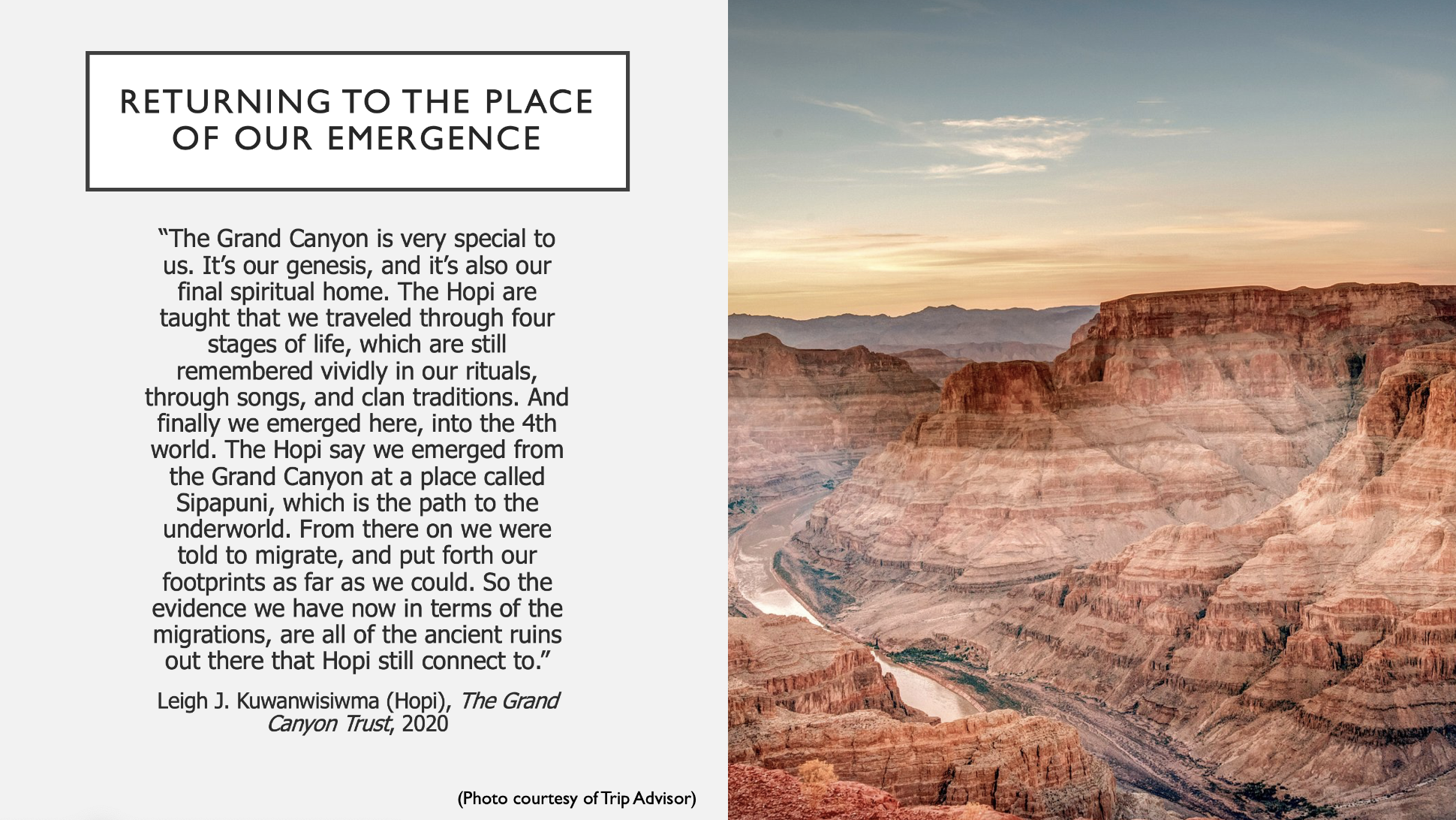
This semester I am teaching an undergraduate course titled HIST 236 Indians in U.S. History. Throughout the semester I will upload short lecture clips that may be of interest to readers of this blog. The first clip takes place at the end of class where I close my lecture (on Native American oral history and tradition) talking briefly on Hopi emergence and migration. I have inlcuded the PowerPoint slide that I am discssing above, and the video below (video and sound quality are not the best…I will make necessary improvements for next time).
Matthew Sakiestewa Gilbert lectures on Hopi emergence and migration. The lecture takes place at the University of Arizona, January 22, 2025, in the course: HIST 236 Indians in U.S. History (video run time 2min 35 sec).
When I started BeyondtheMesas.com in 2009, only a small number of blogs on the Hopi existed that were also written and managed by Hopis themselves. But this number is increasing every year. One of the latest blogs to emerge is called Paaqavi Inc. by Gwendolyn Dyer (Hopi), Marilyn Fredericks (Hopi), and Suzanne Jamison. Be sure to check it out. Here’s their “Mission” statement:
“We believe that Self Determination for Hopi communities is achieved through grassroots momentum that creates strong foundations, resulting in an improvement in the quality of life for Hopi People. We support initiatives that directly benefit Hopi communities through partnerships which leverage financial donations with contributions by the recipient communities through labor, knowledge and prayers”.
Paaqavi Incorporated is a recognized 501 (C) (3) non-profit organization and was formed in 1994 by members of the Village of Bacavi, located on Third Mesa of the Hopi Reservation. Its purpose, as stated in our mission goals, is to:
Promote use of traditional Hopi knowledge, language and culture.
Preserve Hopi agriculture practices, arts and architecture.
Promote positive and healthy community environments of the Hopi villages.
Create social, economic and cultural opportunities for individuals, groups and villages as a collective.
Since the creation of Paaqavi Incorporated, the organization has helped to organize, fund and complete several projects that have directly benefited Hopi People and their communities.
We invite you to read about our accomplishments and encourage you to support our endeavors!
Many thanks to Polly Nordstrand (Hopi), a Ph.D. student in History of Art & Visual Studies at Cornell University, for letting me know about the following exhibit.
This exhibit opens June 29 at the Autry in Los Angeles. And is the culmination of a long project by Susan Secakuku
Katsina in Hopi Life, featuring remarkable Katsina dolls from the Autry’s Southwest Museum of the American Indian Collection, provides a glimpse into Hopi life and culture. Katsinam (the plural form of Katsina) are spiritual beings who represent all aspects of life and travel to be with the Hopi people six months of the year. Told from the Hopi perspective, this exhibition shares the unique relationship the Hopi people have with the Katsinam, focusing on the values, lessons, and encouraging messages learned from them.
This semester I am teaching a course on Native religious traditions. Last week I assigned Emory Sekaquaptewa’s article “One More Smile for a Hopi Clown.”
After reading this article, one of my students sought additional information on Hopi clowning and discovered the above video on Youtube.
She wrote a really interesting post about it on her class blog.
The video is a fascinating look into Hopi clowning and the life of Hopi artist Michael Kabotie. Ed Kabotie, Michael Kabotie’s son, is the one giving the presentation.
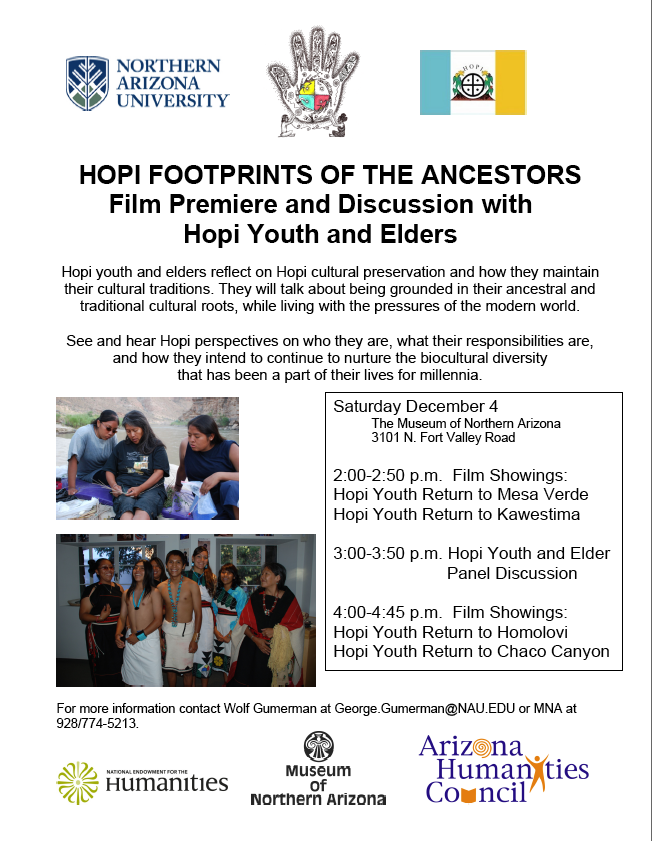
A few weeks ago I passed along an announcement on my blog about 4 Hopi film screenings at the Museum of Northern Arizona. One of these films was Hopi Youth Return to Mesa Verde. This film examines a group of Hopis who traveled to a Hopi migration settlement called Mesa Verde in Colorado. As you watch the film, take note of the similarities that the youth bring up between Hopi ancestral ways and the practices of today’s Hopi people. Their remarks on the continuity of Hopi culture is an important theme in the film.
This past summer I took my family to Walnut Canyon National Monument in northern Arizona. When we entered the visitor center gift shop, my girls immediately ran to the shelves with children’s books and “oohed” and “aahed” over the glossy pages with colorful illustrations. At least half of the books in the gift shop were for young readers, and some of them were on the Hopi.
At Walnut Canyon, park officials mostly had books about the Hopi that non-Hopi people wrote. One of these books was Heather Irbinskas The Lost Kachina. While The Lost Kachina was written by a non-Hopi, the book was illustrated by Hopi artist Robert Albert (Sahkomenewa) from Moencopi. There was at least one Hopi-authored children’s book on the shelves, namely Michael Lomatuway’Ma’s The Magic Hummingbird, which he co-wrote with Ekkert Malotki, a non-Hopi linguist. There are other Hopi-written children’s books that park officials did not include in the shop such as Polingaysi Qoyawayma’s The Sun Girland Emory Sekaquaptewa’s (et. al.) Coyote and Little Turtle: Iisaw Niqw Yongospnhoy.
For the past several months my friend and colleague Debbie Reese from Nambe Pueblo has encouraged me to write a children’s book on the Hopi. Debbie authors a very successful blog titled American Indians in Children’s Literature. On her blog she critically examines children’s books about American Indians and challenges authors to portray Native people in accurate and respectful ways. If you are not familiar with Debbie’s blog, be sure to visit it at the following address: http://americanindiansinchildrensliterature.blogspot.com/
My post is not intended to critique the books in the Walnut Canyon gift shop. Sahkomenewa’s illustrations in The Lost Kachina are quite remarkable, and I assume that he would not illustrate a book on the Hopi that he did not approve of himself. Perhaps one day I will take up Debbie’s challenge and write a children’s book of my own. We certainly need more Hopis today writing and illustrating children’s books. And we need more publishers, school librarians, teachers, and even federal park officials to make Hopi authored books available to children.
Over the past year, several people have stumbled across my blog looking for information on Hopi runners. For those who might be interested, I have made my article “Hopi Footraces and American Marathons, 1912-1930” (American Quarterly, March Issue 2010, Vol. 62, No. 1, pp. 77-101) available for download. Simply click on the above image to download the article as a PDF document.
I want to congratulate our Hopi High boys cross country team for winning their 21st straight Class 2A State Championship. This is a remarkable achievement. In an article in The Arizona Republic, reporter Jose M. Romero noted that Hopi runner Justin Secakuku won the Division IV meet for the team yesterday in Phoenix, Arizona. Congratulations to the Hopi High runners and their coaches for once again bringing honors to our people. Be sure to check out the following link for more information about this story: http://www.azcentral.com/sports/preps/articles/2010/11/06/20101106hopi-boys-cross-country-titles.html
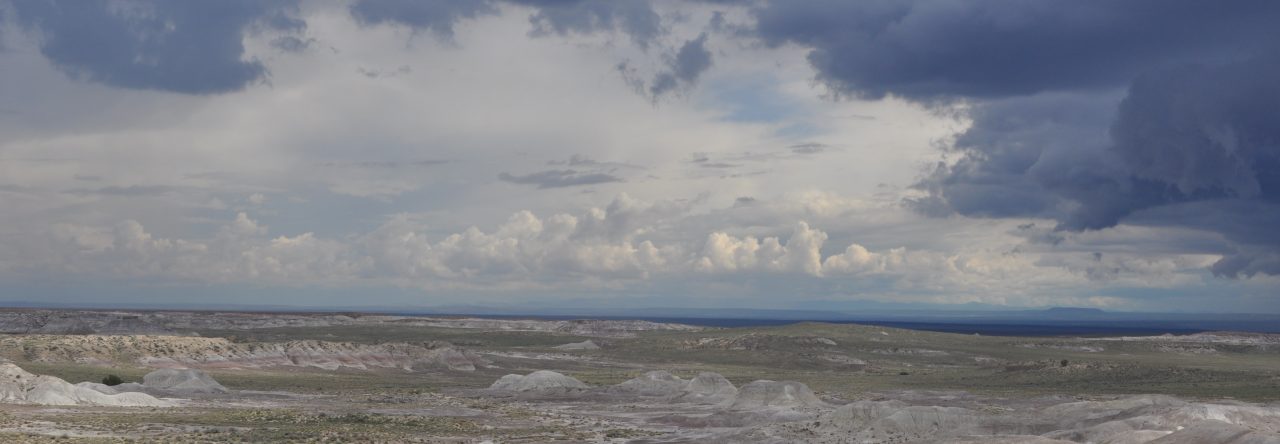
On October 27, 2010, the Navajo-Hopi Observer (NHO) reported that the “Hopi Tribal Council approved a resolution that will keep the Homolovi Ruins Historic Park opened, which will allow safeguard and protection of the cultural and religious site.” State officials closed the Park in February 2010 to help alleviate Arizona’s budget deficit. According to the report in the NHO, the Hopi Tribe has agreed to contribute $175,000 to subsidize the Park’s operating costs. To learn more about this important development, please visit the following website: http://www.navajohopiobserver.com/main.asp?SectionID=1&SubSectionID=1&ArticleID=12970




 BEYOND THE MESAS, LLC