Google Search Story for www.beyondthemesas.com

I want to extend a big kwakwha’ to my friend and colleague, Debbie Reese, for telling me about a free program called Google Search Stories. On Wednesday of this week she gave a lecture on her use of social media at the University of Illinois, which is where she told the audience about Google Search Stories.

This program allows people to make Google search engine videos on any topic. The search terms that I included in my video are terms that people often use to get to BEYOND THE MESAS. In case you’re wondering, Search Story videos are very easy to make. Just click on the following link for more information: http://www.youtube.com/user/searchstories

I hope you enjoy the video!

Dan Namingha: Seeking Center in Two Worlds

Last night I came across this 26 minute video on Tewa-Hopi artist Dan Namingha from Polacca titled “Seeking Center in Two Worlds.” From what I can tell, the video was produced in August 1992 and it was shown on various PBS affiliated stations. Here is the video summary on the KNME Chanel 5 (Albuquerque, NM) website:

Life is a balance for painted and sculptor Dan Namingha. Balance between the high stakes art world and his American Indian origins; balance between his distinctive abstract painting and sculpting, and his expression of the ideas and concepts of his native religion; and balance between his Hopi and Tewa origins and the dominant Anglo culture. Only thirty-four years old, Namingha uses traditional themes and concepts in his unique modern vision to communicate an essence of something beyond himself, something deeply spiritual and universally direct.

If “Seeking Center in Two Worlds” is of interest to you,  then I would suggest seeing Allan Holzman’s film “Beautiful Resistance,” which examines the Indian boarding school experience through contemporary American Indian art, including works by Hopi artist Michael Kabotie. I have written about this film in a previous post. Holzman was also the director and co-executive producer of “Beyond the Mesas.”

Providing Hopi tours since 1540

If you are thinking about visiting the Hopi Reservation, I would encourage you to go with a reputable Hopi tour company.  One of these companies is Hopi Tours, which is led by Hopi anthropologist Micah Loma’omvaya.  As I read about Hopi Tours on-line, I learned that the company has been giving tours on Hopi lands since 1540!

Of course, this was the year that Spanish conquistador Pedro de Tovar and a small group of soldiers, a few Zuni guides, and a Franciscan priest, came across the Hopi people on Antelope Mesa. After a bloody fight, and a “tour” of the villages on First Mesa, the Hopis promptly directed the Spaniards to go west toward the Grand Canyon. The Hopis did not want these “tourists” sticking around.

Today, tourism plays a very important economic role on the Hopi Reservation and it provides Hopis with opportunities to share their culture with visitors.  For more information about upcoming tours, including a special book tour on Hopi Summer by Carolyn O’Bagy Davis, please download the following brochures: Hopi Tours 2011 Brochure Rates / Book Tours Hopi Summer 2011

Matthew Sakiestewa Gilbert

Hopi Student Invitation: ESA SEEDS leadership meeting

To all Hopi students:

This invitation is open to Hopi students (high school, undergrad, graduate, or those enrolled in any institution on or near the Colorado Plateau). This leadership meeting is seeking Hopi student representatives that have a desire and interest in agriculture as well as “students interested in sustainability, environmental science, and ecology will benefit a great deal from this meeting; it is a wonderful group of positive students.”Below is an invitation for the Ecological Society of America’s SEEDS western leadership meeting. Attached is the agenda.  We are hoping to serve student representatives of the Hopi Nation to bring greater diversity into our meeting.

INVITATION

You are invited to the Ecological Society of America’s SEEDS western leadership meeting in Flagstaff, AZ from Thursday, April 7 (late afternoon arrival) to Sunday, April 10 (morning departure).  The leadership meeting theme is “Ecological Sustainability in our Nation’s West”.  SEEDS students and advisors in California and the Colorado Plateau are welcome to participate, with all expenses covered by the SEEDS program (transportation, housing, meals). If you would like to participate in this meeting, please reply to Melissa Armstrong at Melissa@esa.org by April 4.

Participants will be interacting with ESA Vice President Dr. Laura Huenneke, experts in sustainability and action such as Black Mesa Water Coalition, Grand Canyon Trust, and the Wilderness Society, and of course from one another!  We will be taking a half day field trip to nearby San Francisco Peaks (topping out at 12,000 feet elevation), to highlight a high-profile example of sustainability efforts and stakeholders, in addition to the dramatic elevational gradients of local ecosystems.

Forty students will participate in the meeting.  The format of the meeting is a workshop series for the whole group in addition to breakout groups focusing on specific topics.  Students will work collaboratively within the breakout group of their choice before, during, and after the leadership meeting to produce a joint product of the meeting.  Breakout group descriptions will be provided before the meeting so students can select the group most interesting to them.

We hope you will be able to participate in our SEEDS western leadership meeting where we will be thinking about promoting sustainable communities and the role of students in leading these efforts.  Please join us to help make positive and meaningful contributions to the ecological sustainability.

Sincerely,

Melissa

Melissa Armstrong

Diversity Programs Manager

Ecological Society of America

3450 N. Jamison Blvd. | Flagstaff, AZ 86004

Phone 928-214-7301 | Email:Melissa@esa.org
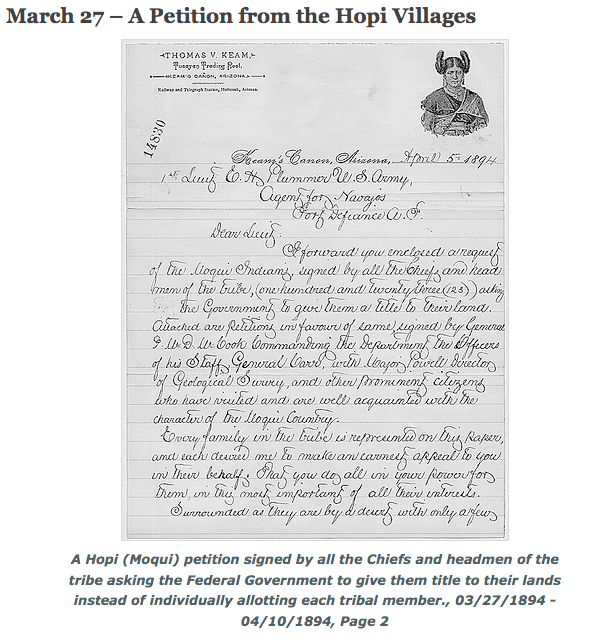
National Archives “Today’s Document” highlights 1894 Hopi request for title of lands and end to allotment

Click image for details. Image courtesy of http://blogs.archives.gov/todaysdocument/2011/03/27/march-27-a-petition-from-the-hopi-villages/


ASU News: ASU appoints Diane Humetewa to advise President on Indian Affairs

Click image for full story. Image courtesy of http://asunews.asu.edu/20110324_Humetewa


A Hopi statement on Japan crisis

Click image to download the statement


Homolovi State Park Video

On March 18, 2011, the Homolovi State Park (formerly the Homolovi Ruins State Park) was re-opened to the general public. Prior to this, the Arizona State Parks produced a short video on Homolovi to introduce people to the Park. As you watch the video, take special note of the remarks made by Hopi anthropologist Micah Lomaomvaya.  I should also point out that an excellent source for those interested in Homolovi is Homol’ovi: An Ancient Settlement Cluster by E. Charles Adams.  Adams is also featured in the video.

Matthew Sakiestewa Gilbert

See also BEYOND THE MESAS post: Navajo-Hopi Observer reports that Homolovi Ruins State Park will reopen

Hopi Organizations on Twitter and Facebook

[Updated April 1, 2011]

Below are three Hopi organizations that regularly use Twitter and Facebook. If you are familiar with other organizations, please let me know. I would like to update this list.

Hopi Education Endowment Fund (Twitter: http://twitter.com/HEEF / Facebook: https://www.facebook.com/KUYIRadio?ref=ts)

KUYI 88.1 FM (Twitter: http://twitter.com/kuyi / Facebook: https://www.facebook.com/pages/Hopi-Education-Endowment-Fund/108338002293?ref=ts

The Hopi Foundation (Twitter: http://twitter.com/Hopi_Foundation / Facebook: https://www.facebook.com/HopiFoundation?ref=ts

Hopi Tutskwa Permaculture (Facebook: http://www.facebook.com/pages/Hopi-Tutskwa-Permaculture/152816334745755)

The Natwani Coalition (Facebook: http://www.facebook.com/pages/The-Natwani-Coalition/186730393592)

HOPI Substance Abuse Prevention Center (Facebook: http://www.facebook.com/pages/HOPI-Substance-Abuse-Prevention-Center/169167022741

Owl and Panther: A Project of the Hopi Foundation (Facebook: http://www.facebook.com/pages/Owl-and-Panther-A-Project-of-The-Hopi-Foundation/131986090172266

Three Mesas Productions (Facebook: http://www.facebook.com/pages/Three-Mesas-Productions/111304518899326)

Hopi Leadership Program (Facebook: http://www.facebook.com/pages/Hopi-Leadership-Program/126703504007198)


I run because I’m Hopi

I have been running regularly for the past twelve months. This winter I found myself running in all kinds of wet and frigid conditions. Sometimes when I run, I imagine myself on the dirt trails out at Hopi, and not the city streets and paths of Champaign, Illinois. But Hopis have a long tradition of running beyond the mesas, and I like to think that this tradition still exists in the Midwest.

I am not the only one in my immediate family who runs.  My wife is an avid runner, and our daughters refer to themselves as “Hopi runners.”  They are also Irish on their mother’s side and I often remind them that the Irish are known for running long distances as well. I hope they will appreciate this more as they get older.

My daughter is already quite the runner.  I am constantly amazed by her running form and how effortlessly she makes running appear.  She and her sisters are sure to run cross-country in middle and high school.

Some people run to lose weight or to relieve stress.  Others run to lower their cholesterol or blood pressure. Although these are great benefits of running, I tend to focus less on these reasons. A friend once asked me why I run.  I simply replied, “I run because I’m Hopi, and that’s what Hopis do.”

Matthew Sakiestewa Gilbert