Hunting elk on Hopi lands

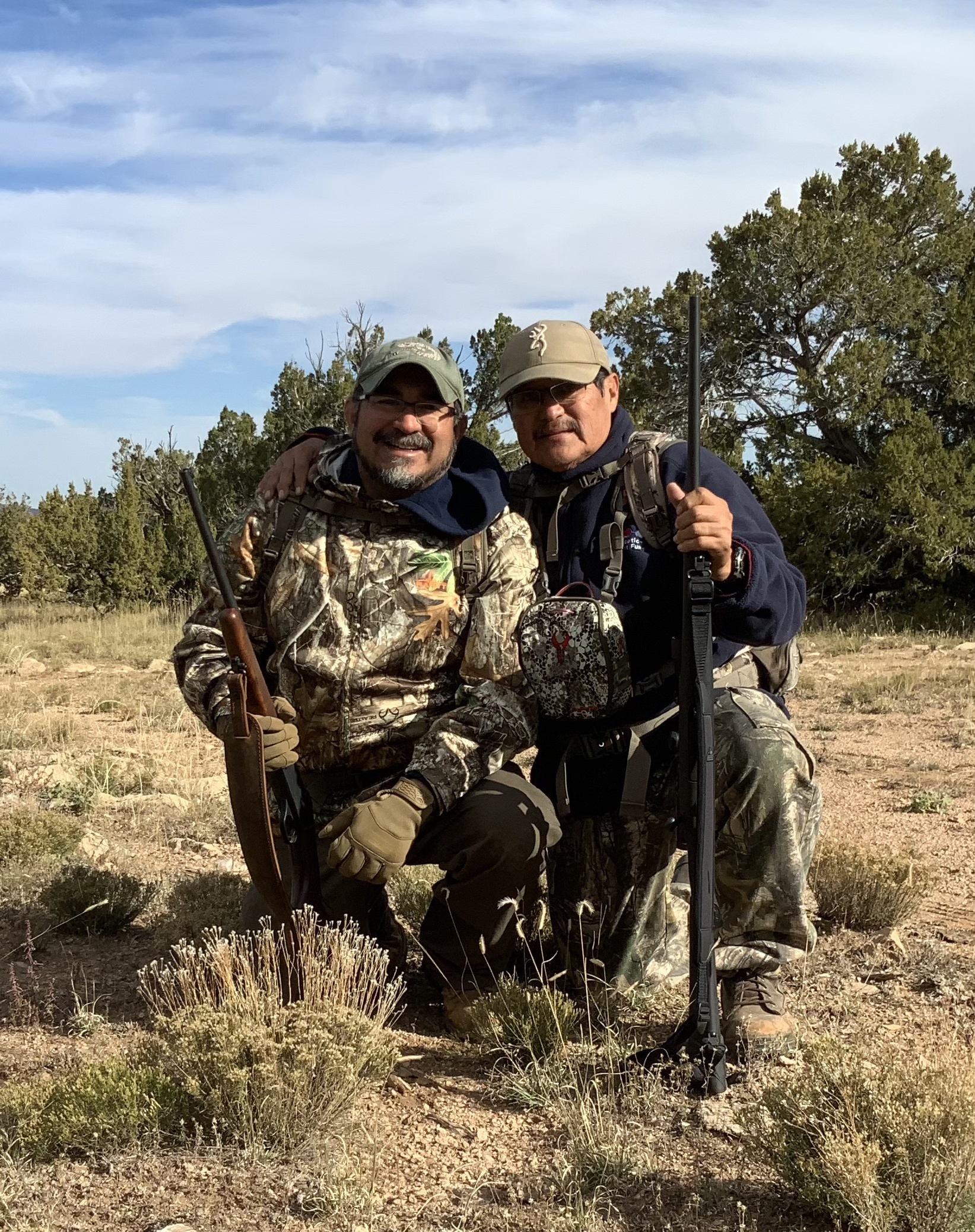
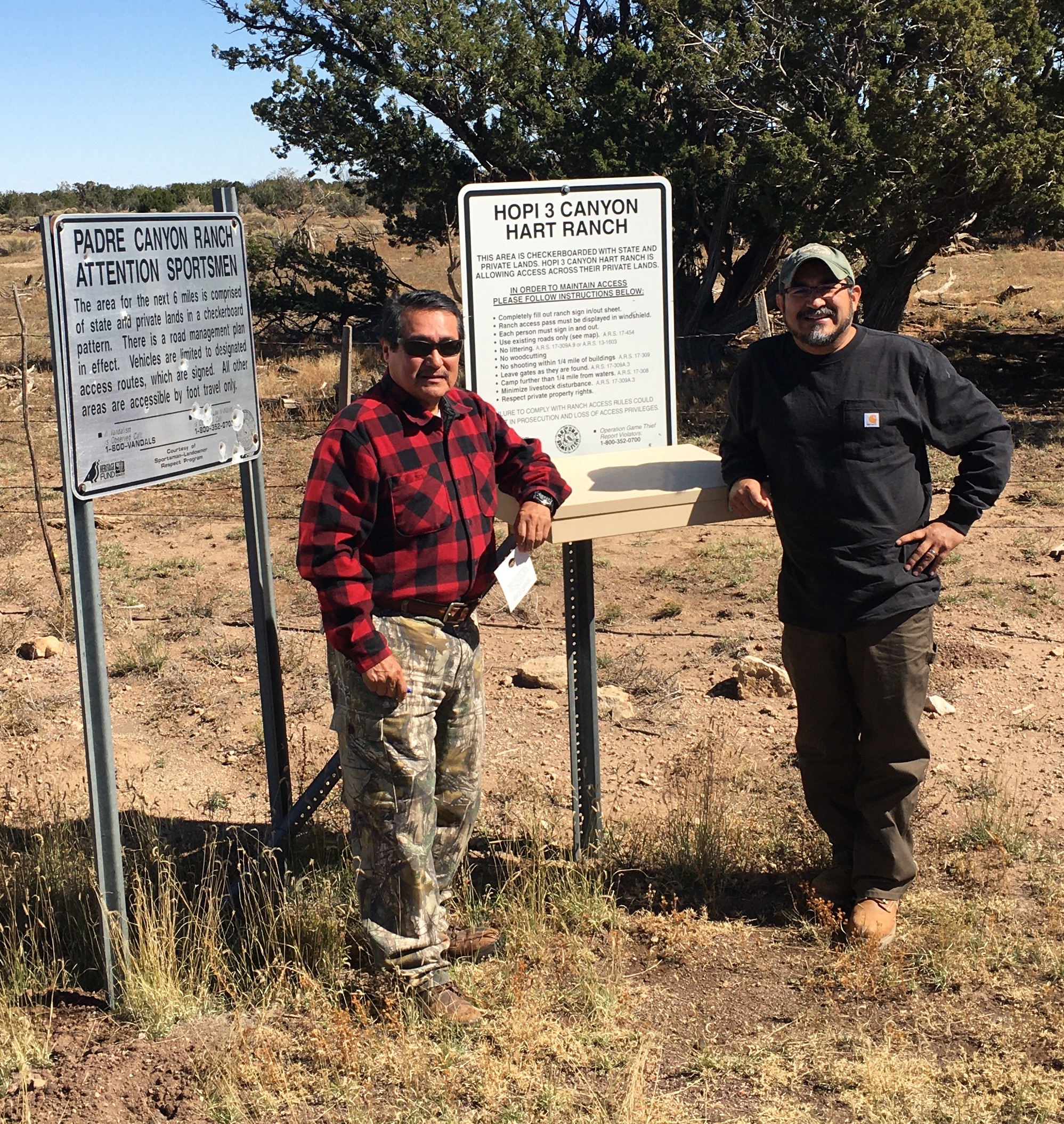
Author (right) standing next to his father, Willard Sakiestewa Gilbert (left). October 2021

My father and I drove east on Interstate 40 until we reached Exit 219, the Twin Arrows Navajo Casino turnoff.

After exiting the interstate, we headed south on a dirt road until we reached the first of two sign-in checkpoints, indicating that we had entered one of three ranches of the Hopi Three Canyon Ranch.

Since 2005, the Hopi Tribe has owned and managed the ranches near Twin Arrows. Consisting of 400,000 plus acres, the ranches are in the state’s hunting units 4A, 5A, and 5B North. Known for its beautiful hills and canyons, the region has attracted hunters for its elk, deer, and other wildlife.

Each year, the Hopi Tribe works with Arizona Game and Fish to reserve hunting permits for its members to hunt specific Hopi Trust Lands, including those comprising the Hopi Three Canyon Ranch. 

Before this trip, I had little experience hunting. My father taught me to fish when I was young, and I only occasionally hunted rabbits and squirrels. I had no previous knowledge hunting elk or any big game animal.

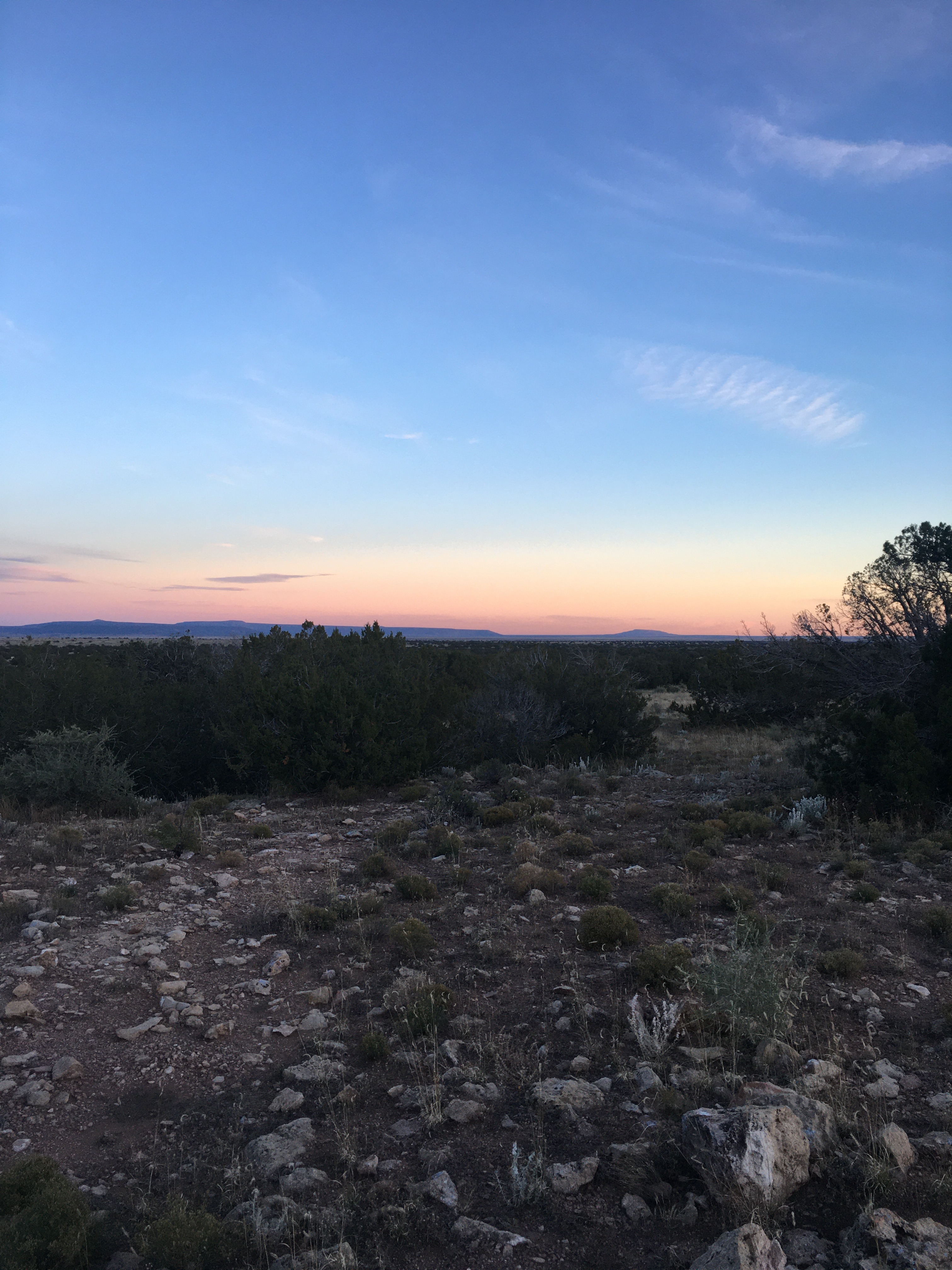
After driving for an hour, we reached our campsite, a secluded spot on a ridge overlooking a large valley. We set up camp and prepared for the next day’s hunt. Dinner that night was beef and potato stew and white rolls from Sam’s Club.

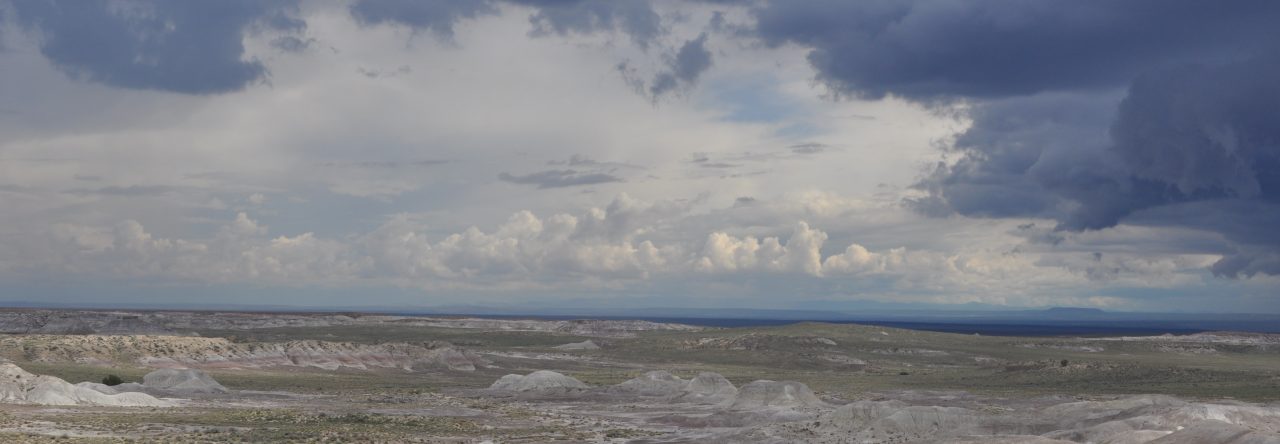
Hopi hunting grounds at sunset

There is something special and therapeutic about spending time outdoors and away from the hustle and bustle of city life. Here, on the Colorado Plateau, our cell phones, try as they may, could not acquire a signal: no calls, text messages, or internet. 

What normally consumes my time and dictates my day, my Apple smartphone became nothing more than a clock and camera. I felt free.

At night, the Milky Way and constellations I first learned about in grade school were visible. To the south, city lights from Phoenix glowed a golden hue, the same from Flagstaff in the northwest. And far in the distance, headlights from cars resembled a LED neon rope stretching from Winslow to Winona.

Each morning started the same. We woke up at 4:30, heated water for coffee, and talked about whether we heard elk during the night.

Elk bugling is a good sign for hunters. It means the herd is excited, and the seasonal rut is still on. Bugling bulls also imply the presence of female elk, referred to as cows. We had cow tags.

Last day of our 2021 Hopi Hunt

Slowly and carefully, we walked through a forest of cedar, stopping often to listen and paying close attention to movement near or far. Occasionally, if the wind was right, we caught the scent of elk urine. Although we encountered elk that first morning, we did not have a good or clean shot.

Hunting elk is hard work, physically and mentally exhausting. After three days, we packed our gear, broke down camp, and headed out. 

Sometimes, all one returns home with from a hunt are memories and experiences, and those are often more valuable than a freezer full of meat.

Indian Boarding Schools and the “Problem” They Were Meant to Solve

This summer David Skinner, editor of Humanities Magazine (published by the National Endowment for the Humanities) invited me to write an article reflecting on Larry C. Skogen’s excellent book To Educate American Indians: Select Writings from the National Educational Association’s Department of Indian Education, 1900-1904 (University of Nebraska Press, 2024). The article was part of a special edition of Humanities Magazine on Indigenous-related topics and edited by Shelly C. Lowe (Navajo), Chair of the NEH. I was honored to write this piece and have included the text and the link to the essay below.

*****

Indian Boarding Schools and the “Problem” They Were Meant to Solve by Matthew Sakiestewa Gilbert

“Originally published as “Education for the Indian Problem” in the Summer 2024 issue of Humanities magazine, a publication of the National Endowment for the Humanities.” 

Over the past 20 years, I have taught Native American history at community colleges, Christian schools, and large universities. I have encouraged my students to think critically, ask hard questions, and consult primary resources. “Don’t just read about what people said,” I tell them, “Do the hard work, go to the original source, and read them for yourself.”

In his edited collection of essays from the National Educational Association’s Department of Indian Education (1900–1904), Larry C. Skogen, a scholar long affiliated with Humanities North Dakota, has made that hard work a little easier. Skogen’s book, To Educate American Indians, includes speeches by white educators employed by the U.S. government’s Indian Service to teach Native American children. Some of the speeches resonated with me not only as a scholar but as a Hopi person, causing me to reflect on my family history and experiences as a teacher who has written extensively on the Indian boarding school experience.  

When I lecture on Indian education, I often first introduce my students to the so-called Indian Problem, providing a lens for students to understand how non-Native people viewed Indians—not as an asset or benefit, but as a “problem” that needed to be addressed and eliminated. Not eliminated by slaughter or outright genocide (the U.S. government had failed in those attempts) but eliminated in the sense of eradicating culture and identity.  

By the turn of the twentieth century, the U.S. government had stopped warring with Indian nations on the Great Plains and elsewhere, but the battle for the minds and affections of Indian youth continued at Indian schools. School officials, such as H. B. Frissell, principal at the Hampton Normal and Agricultural School in Virginia, believed schools played a major role in solving the Indian problem by making Indian youth discontent. “It is sometimes said of the schools off the reservation,” observed Frissell, “that when their students return they are not willing to live as their parents did. . . . A wholesome discontent is a most helpful sign.”  

For the Hopi, the most widely known example of this comes from the life of Polingaysi Qoyawayma. Polingaysi spent four years, from 1906 to 1910, at Sherman Institute, an off-reservation Indian boarding school in Riverside, California. When she returned home, she judged her parents for living according to Hopi ways and customs (No Turning Back is her autobiography). Young people, especially teenagers, are already disposed to be critical of their parents. School officials such as Frissell used this to their advantage to turn Indian youth against their families. 

Alienating Indian youth from their communities and cultures was accomplished by various means. At Indian schools, officials instructed students in math, science, history, and other disciplines. Teachers wanted their Indian pupils to see the supposed superiority of Western education while simultaneously becoming critical and doubtful of Indian teachings and worldviews. Male students learned trades and female students learned to be good housekeepers according to Western values. Some students also participated in sports and musical ensembles, while others used their skills in the English language to work in the print shop or as editors for the school newspaper.  

In my office, a prized possession sits on a bookcase: a complete ten-volume set of The Red Man, the official student-written newspaper of the Carlisle Indian Industrial School in Pennsylvania. Hardbound and organized by year, the books recall happenings throughout the school year, motivational speeches, Native American stories, and alumni news.  

“Every Indian school should have the newspaper,” William T. Harris, U.S. Commissioner of Education, remarked in his 1902 speech in Skogen’s collection. Telling his audience that Indian pupils should read “first that which interests him,” the commissioner further observed that the pupil will “go from that to the far-off events of the world, according as he grows in intellectual capacity.”  

School officials did not encourage Indian youth to listen to their parents back home on Indian reservations. They did not encourage them to seek wisdom from their tribal elders or other knowledge-keepers about the world beyond their homelands. Instead, they wanted them to learn from newspapers and considered the printed word far superior to the oral tradition often spoken in one’s Native language.  

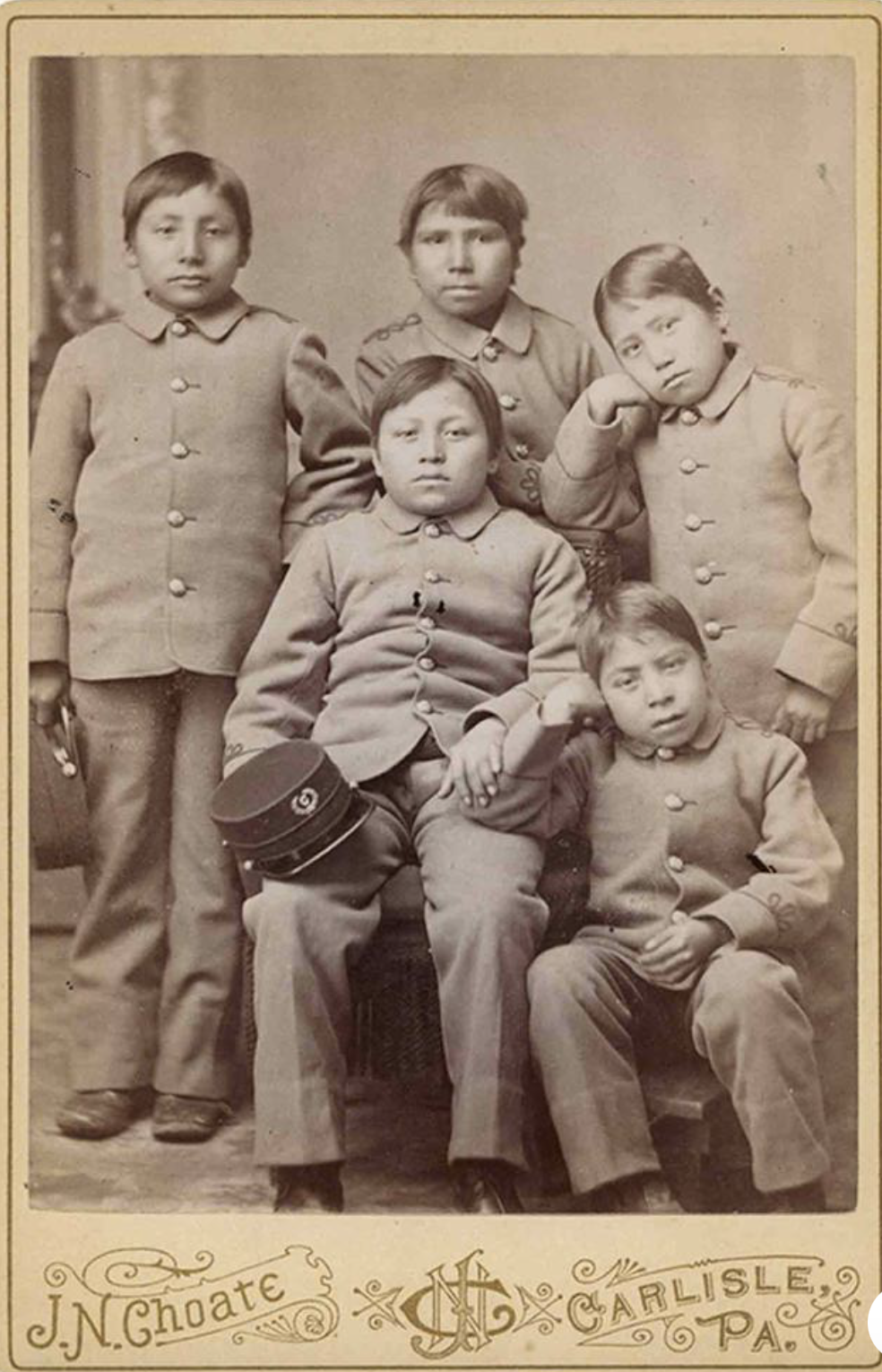
Photo caption

Studio portrait of Sioux students wearing their Carlisle boarding school uniforms in 1880, identified as, back row: David (Kills Without Wounding), Nathan (Ear), Pollock Spotted Tail; and front row: Marshall (Marshall Bad Milk) and Hugh (Running Horse).

—Photo by John N. Choate, Carlisle, Pennsylvania, Swedish National Museums of World Culture 

The U.S. government’s attempt to suppress Native languages took various forms. One especially interesting piece in Skogen’s volume is Emily S. Cook’s 1904 address titled “What’s in a Name?” Skogen notes that oftentimes Indian people had no say in the matter and that government officials changed Indian names, which they struggled to pronounce, to make it easier to keep records related to Indian affairs.  

The government’s name-changing policy sought to weaken Indian identities and eradicate the use of Indigenous languages. But not every individual in the Indian Service, especially those who lived and worked with Indian communities, saw the wisdom in eliminating Indian names.  

Cook was one of these people. “Why should Imogen be preferred to the Kiowa name Imguna, or Jack to Zapko?” Cook asked, “Why not have a few less Marys and Johns in the world and enrich our nomenclature by picking out gems from aboriginal matrices?” Cook knew the value of Indian culture in American society, and she considered it cruel and “short of criminal” to assign names to Indian children and adults that did not reflect their tribal identity and caused great confusion within the family.  

Reflecting on Cook’s advocacy for Indian names, I cannot help but think about my own family and how things could have been different for us had more school officials listened to Cook.

In the late 1940s, my grandfather, Lloyd Gilbert, attended the Phoenix Indian School in Arizona with his two siblings. The three arrived at the school with the surname Quache (pronounced Kwah-tsee), which means “friend” in the Hopi language. Officials at the Phoenix school, however, did not tolerate Indian names and told them they needed to consult with one another and replace theirs with an English name.  

The mandate likely caused my grandfather and his siblings great stress and a sense of loss. It also required them to think deeply about appeasing the government while not disconnecting themselves from their family. They ultimately chose “Gilbert,” their father’s first name. A disheartening and difficult position to be in, they nonetheless demonstrated agency and worked together to address a problem imposed upon them.  

While Indian students studied at government schools, prominent and influential employees in the Indian Service waxed eloquently on the state of Indian affairs, the challenges of training Indian youth, and their responsibility to “uplift” Indian pupils with Western education and values. Some did so with an air of arrogance or even ignorance. Others, such as Cook, did so with compassion and balanced foresight. Within this collection, Skogen exposes them all and provides an insightful resource to read their words within a larger historical and cultural context.  

As the late David Wallace Adams wrote in the foreword, the “historical gap” between all that has been written and taught about the history of Indian education and the documentation on how “leading educators of the day viewed the proper ends and means of Indian schooling . . . is now closed.” However, the opportunity for students and others to interpret these essays and critically analyze their recommendations for solving the Indian Problem is now open.  

https://www.neh.gov/article/indian-boarding-schools-and-problem-they-were-meant-solve

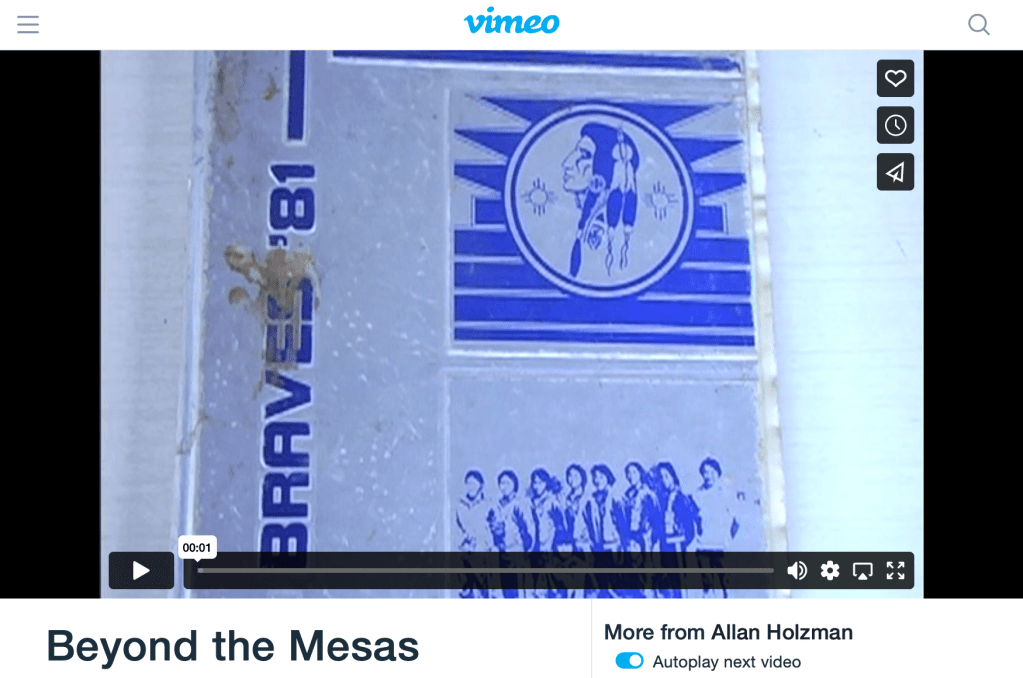
BEYOND THE MESAS film now available online (free)

Click here or image above to access the film.

Touching the face of God: Remembering the Space Shuttle Challenger Disaster

Photo courtesy of: https://www.ebay.com/itm/233310030679

My love for history was evidenced at an early age.

Growing up in the 1980s, I had a fascination for all things space and thought perhaps one day I would become an astronaut.

NASA (National Aeronautics and Space Administration) was a big deal in the ‘80s, and the launches and landings of its Space Shuttles during that decade always attracted national and international attention. 

When I was in third grade living in Albuquerque, New Mexico, NASA had created a special program called the Teacher in Space Project.  

Introduced by President Ronald Reagan, the program existed to “inspire students, honor teachers, and spur interest in mathematics, science, and space exploration.” 

To accomplish this, NASA trained civilian teachers to be Payload Specialists and to travel with the astronauts into space in NASA’s space shuttles.

While orbiting earth, the teachers would perform various science experiments and broadcast those lessons live to classrooms across the United States. 

The first teacher set to go in space was Christa McAuliffe, a high school social studies teacher from New Hampshire. 

All through Fall of 1985, my teacher prepared us for these space lessons, and my classmates and I eagerly anticipated the fast approaching launch date of January 28, 1986.

When that day finally came, I joined my teacher and classmates in our classroom to watch the launch of the Space Shuttle Challenger. 

I still remember the excitement in the TV announcer’s voice as the shuttle left the launchpad: “Lift off, lift off of the 25th space shuttle mission and it has cleared the tower…”

Less than seventy seconds later the unthinkable happened. The space shuttle exploded -it burst into flames, killing all seven crew members, including Mrs. McAuliffe. 

We cried. But our teacher wept. 

Later that night, on national television, President Reagan remarked: “We will never forget them, nor the last time we saw them, this morning, as they prepared for their journey and waved goodbye and ‘slipped the surly bonds of earth’ to ‘touch the face of God’” (from the poem “High Flight” by John Gillespie Magee).

The next day after school, I asked my mother to take me to the store to purchase a copy of the Albuquerque Tribune. Even as a 9-year-old, I knew some of the historical significance of that moment. 

A moment recorded in a newspaper. A newspaper that I saved (archived) and put in my special blue sticker album – two items that I still have today.

Thirty-six years have passed since that tragedy. Its anniversary comes and goes, and few people think much of it.

But ask someone who was raised in the ’80s where they were when the Challenger blew up, and many will respond similar to me:

I was in school, at my desk, watching in horror and with profound sadness.

The nationwide stay and the University of Arizona’s COVID vaccine mandate

[Update Dec 11, 2021): Twenty minutes after I published the below post, President Robert Robbins sent a mass email to campus that included a brief acknowledgement of Tuesday’s ruling in Georgia to halt the government’s COVID vaccine mandate. It simply read: “Many of you are aware of the ongoing litigation regarding federal executive orders that imposed vaccine requirements on federal contractors. The University will continue to monitor legal developments and provide guidance to affected employees. In the meantime, we continue to strongly encourage everyone to get vaccinated and for employees to verify their vaccination status.” Also, later the same day, Northern Arizona University announced that it had suspended its COVID vaccine mandate.]

*****

On Tuesday of this week, U.S. District Court Judge R. Stan Baker in Georgia issued a nationwide stay that placed a halt on the federal government’s ability to require the COVID-19 vaccine for its contractual workers.

Since then, colleges and university across the nation have also halted their vaccine mandates, including the University of Kansas, the University of Iowa, and the University of Mississippi. The number of universities that are following suit is growing by the hour.

In Arizona, the Maricopa Community College District, which comprises of 10 schools, stopped its vaccine mandate almost immediately after Tuesday’s ruling.

But what about the University of Arizona, or the other two big state universities, namely ASU and NAU? How will they respond?

Up until the writing of this post, UA campus administrators have yet to advise its employees on any changes to their mandate. A quick glance at UA’s vaccine mandate webpage shows that it has not been updated; business as usual.

If the ruling in Georgia prohibits university administrators from mandating the vaccine (which I believe it does), it would significantly hinder their practice of white paternalism on campus, as this would take power away from them – power to tell brown, black, and other white people what do with their bodies.

As I have mentioned elsewhere, white paternalism is alive and well at the University of Arizona. In fact, it now thrives here under the guise of “public health,” and yet few people on campus seem to be disturbed by it. Or are they?

Since publicly voicing my opposition in October, faculty, staff, and students at UA have expressed similar concerns to me. But for good reasons they have chosen to keep their concerns private. I (and they) understand the power dynamics of institutions of higher education. And I am cognizant of my role at UA and position in the academy.

I expect soon that President Robert Robbins will send a mass email to all campus employees regarding the recent ruling in Georgia and any changes to UA’s vaccine mandate. This will be a carefully worded email, as campus administrators do not let go of power easily.

One cannot live on Wonder Bread alone

“I am reminded of your sincere faith, a faith that dwelt first in your grandmother Lois and your mother Eunice and now, I am sure, dwells in you…”

II Timothy 1:5

When I was a child, I often visited my So’o (grandmother), Ethel, at her home in Flagstaff, Arizona. She and my Kwa’a (grandfather), Lloyd, lived in a small three bedroom house on the east side of town, not far from historic Route 66. 

Over the years I have reminisced with my siblings about those visits, laughing as we recount stories of us scurrying past So’o for the kitchen upon entering her home.  Never do I recall a time when So’o did not have in her refrigerator Wonder Bread, Oscar Mayer Bologna, and Sunny Delight. 

While happy to feed us, she realized that Christians also needed spiritual nourishment, and believed that her grandchildren could not live on Wonder Bread alone. 

For So’o, that nourishment came from the Bible and spiritual songs, all things she learned to appreciate as a young woman at the Ganado Mission School, a Mennonite Indian school in Ganado, Arizona. 

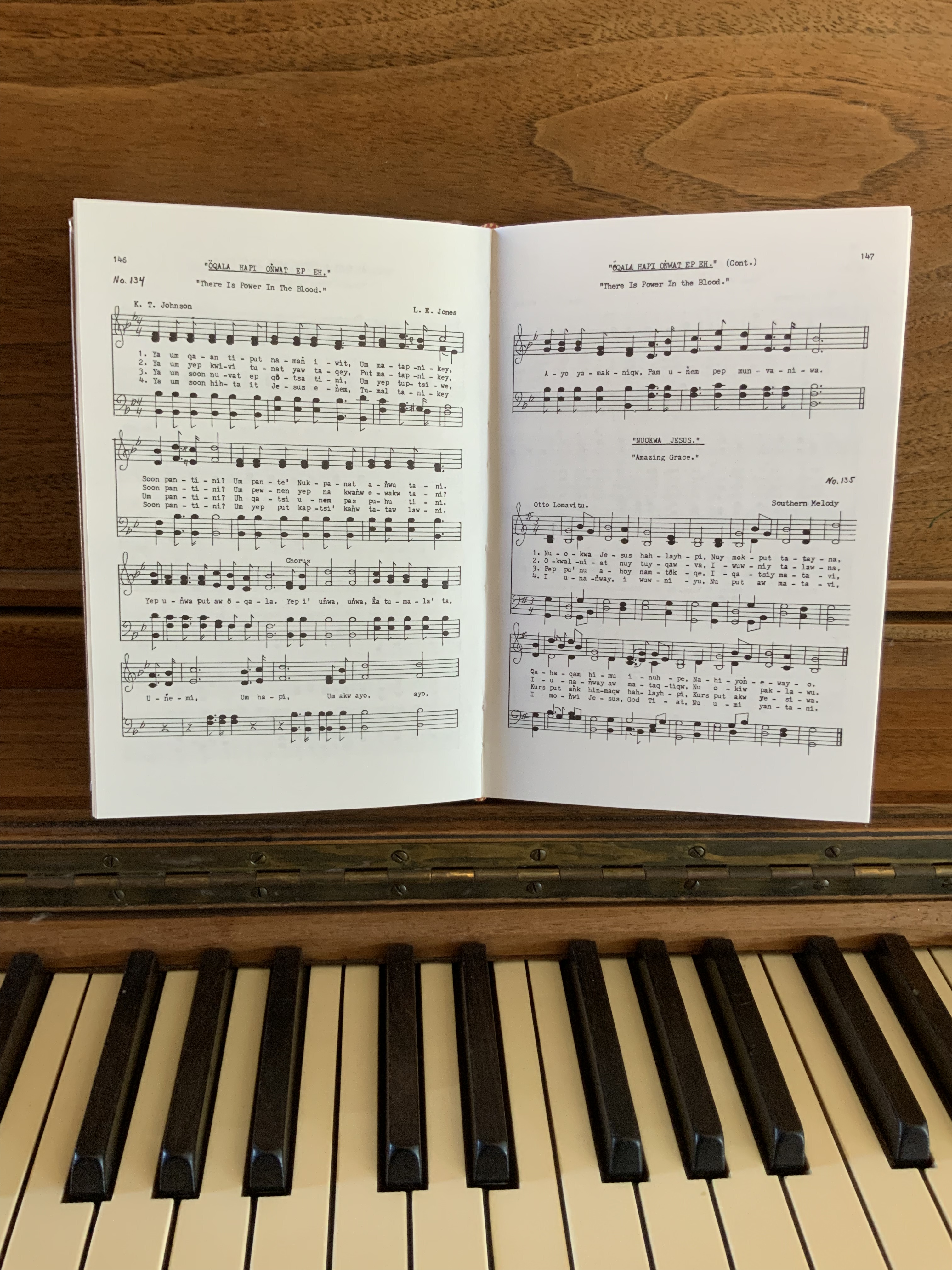
Visiting her home, I remember seeing So’o sitting at her piano, playing and singing Christian hymns in the Hopi language. One of the hymns that she played was “Amazing Grace” by John Newton, a song she sang with much heart and affection:

Nu-o-kwa Je-sus hah-layh-pi, Nuy mok-put ta-tay-na, Qa-ha-qam hi-mu i-nuh-pe, Na-hi-yon-e-way-o.

Translated in Hopi by Pastor Otto Lomavitu, the hymn speaks of mankind’s lost and sinful spiritual state, and God’s “amazing grace” of salvation through Jesus Christ.

“‘Twas grace that taught my heart to fear,” the hymn goes on to say in English, “And grace my fears relieved; How precious did that grace appear the hour I first believed.”

Having been introduced to Christianity at an early age, So’o knew the importance of the Bible and Christian songs, and she wanted her family to treasure both.

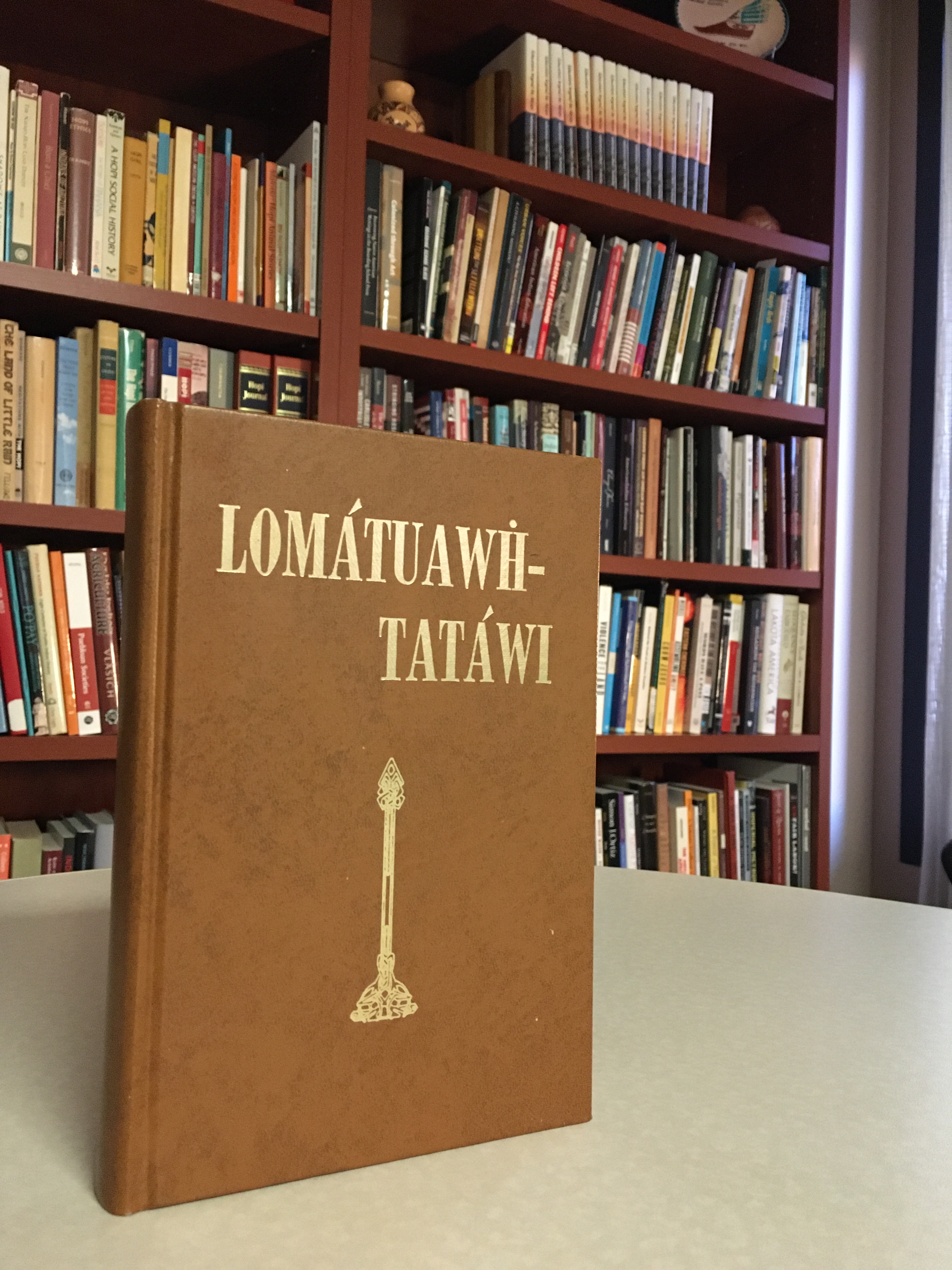
One year for Christmas, So’o gave me a rare 1st edition copy of the Hopi hymnal Lomatuawh-Tatawi: Hopi Gospel Songs for Church and Street Services in Hopi-land (1972). In the inside cover, she wrote:

“To Matthew…Learn to read Hopi and sing these songs…”

Now in her 90s, So’o no longer plays the piano, but her Christian faith remains strong.

“So’o, Um hin sa ki?” a question I ask when I first see her. She responds by telling me about the “Good Lord” and His many provisions, and assures me that she is always praying for me and my family. 

So’o’s Christian faith is my faith, her hymns are my hymns. And her Christian example means more to me than anything else. “I have always cherished your faith in the Bible and love for Jesus,” I once told her in a typed letter, “the best grandmother a grandson could ever wish or hope for.”

White Paternalism and the Attack on Native Agency and Indian Self-Determination at the University of Arizona

In October of this year, University of Arizona President Robert Robbins sent me and all campus employees a memo informing us that due to a recent Executive Order from President Biden, which requires “institutions that contract with the federal government” to comply with guidance from the Safer Federal Workforce Task Force, we must either be “fully vaccinated for COVID-19” or receive a “religious or disability” accommodation by December 8, 2021. 

A month prior, and knowing that this mandate would likely be forthcoming, I sent two campus administrators, N. Levi Esquerra and Karen Francis-Begay, a letter of concern and noted that such a mandate “may go against” Native people’s “religious or cultural beliefs, and may go against the counsel of their elders or healers in their communities.” 

In my letter, I also noted that the university’s decision to approach the COVID-19 situation from a purely Western scientific perspective, did not take into consideration the “long and painful history that Native people have endured involving the federal government’s mandatory inoculations, forced sterilizations, and racism and discrimination toward Natives under the guise of ‘public health.’”  

The below comments, which I gave during the School of Geography’s annual “My Arizona Lecture Series” event, revisits this letter and provides additional historical context to my concerns. I end my comments by offering four recommendations to President Robbins and other UA campus administrators, which I hope they will consider.

(I have slightly revised a portion of my introduction to better fit the flow of this post)

*****

“All Native Voices Matter: Addressing the COVID-19 Pandemic from the Field of American Indian Studies,” a lecture delivered for the “My Arizona Lecture Series,” School of Geography, Development, and Environment, University of Arizona, October 29, 2021.

Thank you, Dr. [Jeffrey] Banister, for that very gracious and kind introduction. And a big thank you to the Committee who organized this event. 

I also want to welcome and thank everyone for being here today. 

I know that this is a busy time of the semester, and yet you are here, and I want to thank you for that. 

When Dr. Banister invited me in August to be this year’s “My Arizona Lecture Series” speaker, I was, of course, thrilled and honored by the invitation. 

As an enrolled member of the Hopi Tribe from the northeastern part of the state, the idea of “My Arizona” is certainly meaningful to me, and my connection to the larger Hopi community is what grounds me in my talk this afternoon. 

At the time of Dr. Banister’s invitation, I had just sent an email of concern to two campus administrators, N. Levi Esquerra (Senior Vice President for Native American Advancement and Tribal Engagement) and Karen Francis-Begay (Assistant Vice Provost for Native American Initiatives), regarding UA President Robert Robbins’ COVID policies and how those policies related to American Indians at the University of Arizona. 

To better grasp the concerns of my letter, it is necessary for us to look to the past, which I believe will provide a critical lens to understand what is taking place at the University of Arizona in regards to Native people and its COVID-19 vaccine mandate. 

A good place to start, I think, is with Native people themselves.

Prior to Europeans arriving on this continent, Native people dealt with diseases and other forms of sickness with traditional remedies. They made medicine from plants, performed ceremonies, and called on the spiritual world to help in their time of need.

When new diseases such as smallpox, which had been introduced to the Indian world by Europeans in the early 1600s, the people approached these diseases as they had others for thousands of years, relying on the practices of their medicine men and women, seeking wisdom from elders, and recalling lessons from the ancient ones.  

Sometimes their traditional medicines brought the people relief from the devastating effects of smallpox, other times they did not. 

For my people, the most well-known smallpox outbreak on Hopi lands took place in 1898 and 1899. 

Mostly confined to the Hopi villages on first and second mesa, smallpox infected some 632 Hopi individuals, and killed 187. 

Although the federal government had launched a campaign to inoculate 1,000 Hopis with the smallpox vaccine, only 412 people initially “submitted to the government’s vaccination program.” 

The so-called traditional Hopis, still “clinging” to their old ways and ancient remedies, refused to comply with the government. Instead, they encouraged the people to rely on their Hopi methods, reject the white man’s medicine, and resist.

Furthermore, traditional Hopi individuals believed that smallpox entered their lands because the people had been neglecting the Hopi way of life, and embracing Western thinking and practices. In this regard, they understood smallpox to be a form of punishment.

The federal government, however, had little patience or sympathy for the Hopi resisters. Government officials forcefully removed them from their homes, burned their belongings, and arrested many of them. 

Concerning this time in Hopi history, noted historian of southwest American Indians Robert A. Trennert once observed:

“The Hopi smallpox epidemic of 1899 was a costly, sad tribute to cultural misunderstanding. Because of a decade of insensitive forced acculturation, many Hopi leaders believed that any government attempt to promote their welfare was simply a trick to destroy their culture and beliefs. In response, they resisted and refused to cooperate. The Indian Bureau tried to save lives, but cultural insensitivity and the desire to graft medical treatment onto the boarding-school issue made cooperation impossible. The result was an unplanned, unavoidable disaster that did nothing to alleviate the traditional Hopis’ suspicions of white government and contributed to the widening rift between tribal factions.”

Robert A. Trennert, “White Man’s Medicine Vs. Hopi Tradition,” Journal of Arizona History, Winter 1992, p. 364.

Of course, the government’s campaign to inoculate Indian people, which furthered Indian distrust of bureaucrats in Washington, did not begin with the Hopi in 1899, but it existed (in various forms) several years before. 

In 1832, for example, under President Andrew Jackson’s administration, Congress passed the Indian Vaccination Act which allowed funding for the federal government to vaccinate nearly 50,000 American Indians against the nation’s smallpox epidemic. 

While one may be tempted to conclude that the federal government had purely noble intentions in forcing Native people to be vaccinated, the opposite was true. 

In her article, “Lewis Cass and the Politics of Disease: The Indian Vaccination Act of 1832,” former AIS/UA Ph.D. student and Lecturer at UC Berkeley, J. Diane Pearson observed that:

 “As the largest program of its kind in the United States, protection of American Indians from a deadly disease was the ostensible goal of the program, though other federal agendas provided the real motivation. There was no input from American Indians during the conception, design, and implementation of the program, and vaccinations were used to enable Indian removal, to permit relocation of Native Americans to reservations, to consolidate and compact reservation communities, to expedite westward expansion of the United States, and to protect Indian nations viewed as friendly or economically important to the United States.” 

J. Diane Pearson, “Lewis Cass and the Politics of Disease,” Wicazo Sa Review, Autumn 2003, p. 9.

Considering this history, it is no wonder why many American Indian people today still distrust the federal government, and are among the first people to remind that government of its past.

That past, I should add, also and always gives meaning to the present. 

Less than a year ago in November 2020, shortly after Pfizer announced “positive results” following its COVID-19 vaccine trial tests, Dr. Anthony Fauci exclaimed on ABC’s Good Morning America, “if you think of it metaphorically, the cavalry is coming here.”

His reference to the U.S. cavalry, however, did not sit well with some Native people who associated soldiers on horseback with destroyed Native lives, wrecked Indigenous communities, and even genocide.

For example, Regis Pecos, a member and former Governor of the Cochiti Pueblo Nation in New Mexico remarked to the Washington Post that “To Indian people, it signifies the beginning of a massacre. It references the threat of soldiers on horseback during the Indian Wars.”

Fauci’s reference also takes me back to the Hopi smallpox outbreak in 1899 when the federal government sent the cavalry, armed with Hotchkiss guns and other small arms, to the Hopi villages to force the people to comply with its health mandates. 

Why?

Because the federal government was convinced that it knew what was best for the Hopi and other Indian people, and therefore believed it had good reason and the moral high ground to create and enforce its orders. 

If only this form of paternalism existed with the federal government and only existed in the past.  But it, too, is alive and well in our society and at the University of Arizona. 

For several months, campus administrators have hosted weekly online briefings to update the UA community on their COVID mitigation efforts.

Week after week the message from President Robbins and Dr. Richard Carmona, a former Surgeon General and Washington bureaucrat, to campus is the same: mask up, social distance, and get vaccinated. 

The briefings, while sometimes informative, reek of white privilege and paternalism. 

Throughout my career, I have spent considerable time critiquing and pushing back against the idea and practice of white paternalism, especially as it relates to Native people. 

Oftentimes, in my courses at UA and elsewhere I have lectured to my students on the racist attitudes of and the overt paternalism demonstrated by former U.S. presidents, including Andrew Jackson. 

Known for forcefully removing (and killing) thousands of Indians from their lands in the Georgia and the Mississippi region, he viewed Indian people as children, and himself as their all-knowing, all trusting father, who always had their best interests in mind. 

Take for example his letter to the “Cherokee Tribe of Indians East of the Mississippi” which he penned in March 1835, wherein he tells the Cherokee people that they have to leave their homelands in Georgia and move West:

“Listen to me, therefore as your fathers have listened, while I communicate to you my sentiments on the critical state of your affairs…I have no motive, my friends, to deceive you. I am sincerely desirous to promote your welfare. Listen to me, therefore, while I tell you that you cannot remain where you now are…You have but one remedy within your reach. And that is, to remove to the West and join your countrymen, who are already established there. And the sooner you do this, the sooner you will commence your career of improvement and prosperity…” 

Andrew Jackson, March 16, 1835, Digital Public Library of America

While the President has a number of disturbing things to say to the Cherokee, we should be careful not to overlook this important point in his letter: The President’s one “remedy” for the Cherokee people was for them to obey

Years later, when government officials forced the great grandchildren of these Cherokees to attend one of 25 federal off-reservation Indian boarding schools throughout the United States, the practice of paternalism continued.  

The federal government had created these institutions to assimilate Indian people into American society. 

Oftentimes forcing Indian youth to attend these schools, government officials, including school superintendents, constructed them to operate similar to military forts, and urged their Indian pupils to first think of themselves as individuals (future U.S. citizens) and not as members of a tribal nation.

In this regard, they encouraged Indian youth to no longer listen to their parents, or rely on their culture or ceremonies to solve problems, including famines, droughts, and diseases.

Instead, they wanted Indian youth to believe that the federal government, personified in school officials, including matrons and teachers, had the answers to their problems and knew what was best for them. 

While this history is rich, and I have certainly not done it justice here, I do want to move on and offer final comments about the present situation at UA before ending my talk today. 

At the University of Arizona, I am fortunate this semester to be teaching a graduate course in AIS on Teaching College Methods. I have 6 students in the course. All but one are new to the university. All bright and engaging, and each dedicated to the field of American Indian Studies. 

In this course, we spend considerable time talking about the foundational pillars of our field, including tribal sovereignty, nationhood, Native agency, self-determination, and decolonialism. 

And they can attest, that week after week, I also encourage them, I urge them, to be critical thinkers. And I remind them that each of us, regardless if we are a student, faculty, or staff, are fortunate, and yes “privileged” to be studying and working at the University of Arizona. 

“Your critical thinking should never stop,” I often tell my students, “regardless of the crisis, for this is the work that we do as scholars.” 

Earlier this semester, during one of his COVID-19 weekly updates, President Robbins once again encouraged everyone occupying space inside a campus building to social distance and wear a mask. 

Even admitting that the COVID-19 virus does not normally spread outdoors, he still encouraged everyone to wear a mask, noting that wearing a mask outdoors would help condition people to mask wearing, and would protect our faces from harmful rays of the sun.

“If wearing a mask is not about preventing the spread of the virus, then what exactly is it about?”, a question I asked my students.

For some Indigenous people, including myself, COVID masks are no longer about health, but have become symbols of colonization.

By colonization, I refer to when an outside force (usually a government) takes over, imposes laws, takes people’s land, dignity, agency, all meant to make everyone the same…to think the same, have the same language, practice the same religion, a new society structured on colonial norms… “the subjection of one people to another.”

In this regard, masks are indeed symbols of colonization, as they represent outside forces (the US government, county boards, governors, etc.) coming into our spaces (schools, classrooms, church buildings, parks, etc.), telling us what we can and cannot do, attempting to take away our dignity and agency, and wanting us to conform. 

And let’s not forget that the goal of colonialism has always been to DOMINATE.

In the upcoming weeks and months campus administration at the University of Arizona will process hundreds of COVID-19 vaccine mandate exemption applications. Some they will accept, others they will reject. 

For those who either refuse to comply with the mandate or whose exemption applications are rejected, what will happen to them? 

We don’t know for sure. In previous statements and interviews, President Robbins has said that he is waiting on the Biden administration to give him and other campus administrators guidance on what to do with non-compliant employees or those without an approved exemption. 

Will Robbins and other campus officials require them to undergo weekly COVID-19 testing at their expense? Will they not allow them to teach or work on campus? Will they decrease their salaries? 

Perhaps he will simply fire them or force them to resign, Native people and Non-Native people alike. Those who have faithfully served this institution as excellent scholars, teachers, staff, and administrators. None of that may matter. What will matter is compliance. 

Again, I remind you of my letter: “We know what is best for you. Obey us.”

Much more can and should be said about this topic, but at some point I need to start thinking about ending my talk, and this seems like a good place to do so. 

The University of Arizona has one angry Indian on its hands. And this Indian happens to be the Head of its Department of American Indian Studies, a senior scholar of Native American history, and a member of an Indian nation in Arizona. 

But this Indian also knows the value of working together to solve problems.

And so, I offer the following four recommendations to campus administration, which I hope they will consider:

First, keep your white privilege and paternalism in check. Stop using your positions of power in society and at UA to tell brown, black, and other white people what to do with their bodies. This is not a new mandate about academic excellence, it is about people’s health and a new experimental vaccine whose long-term effects have yet to be determined. 

Second, take Native agency and self-determination seriously. Listen to us when we speak up and push back. If you are going to acknowledge our land, then you need to also acknowledge our right to Native agency and self-determination. To deny us these rights is to encourage and further colonialism on this campus. 

Third, be understanding and compassionate with Native and non-Native people who choose not to comply or fail to secure an approved exemption to the COVID-19 vaccine mandate. You have already sent one of your Indian agents to the Native community at AU to urge us to comply or face consequences that could negatively affect our employment. As I told this individual recently: 

“The University’s covid-19 vaccine mandate is an attack on Native agency and Indian self-determination. Urging Native people to comply with this mandate or face possible ‘consequences that could impact [our] employment,’ only perpetuates this problem and furthers fear among Indian people at UA. Now is the time that we need allies in our campus administration to fight for us, not threaten us.” 

Matthew Sakiestewa Gilbert, personal email communication, October 28, 2021

Fourth, become less dependent on the federal government. Clearly, the timing of this vaccine mandate had little to do with health, and more to do with the threat of losing millions of dollars of federal funding. Because of the University’s dependence on federal monies, and failure to secure financial independence from Washington, people at UA will suffer, and some may even lose their jobs. That is not right. 

I am happy now to take your questions or comments.

*****

Matthew Sakiestewa Gilbert (Hopi)

Professor and Head

Department of American Indian Studies

University of Arizona
All Native Voices Matter: A Letter of Concern Regarding COVID and American Indians at the University of Arizona

On August 13, 2021, I wrote the following letter of concern to high level campus administrators at the University of Arizona, namely N. Levi Esquerra (Senior Vice President for Native American Advancement and Tribal Engagement), and Karen Francis-Begay (Assistant Provost for Native American Initiatives). The letter is deeply rooted in who I am as a Hopi person, and as a scholar in the fields of American Indian Studies and Native American history.

From:Gilbert, Matthew Sakiestewa – (sakiestewa)
Sent:Friday, August 13, 2021 4:50 PM
To:Esquerra, Nathan Levi – (levie) <levie@arizona.edu>; Francis-Begay, Karen R – (kfbegay) <kfbegay@arizona.edu>
Subject:All Native voices @ UA matter 

Dear Levi and Karen,

I hope that this email finds you well.

I write to express concern and inquire about whether campus administration is respecting and taking into consideration the differing opinions held by Native people at UA regarding the COVID vaccine and mask mandates.

I am especially concerned that President Robbins and UA officials will require Native people on campus to take the COVID vaccine, which may go against their religious or cultural beliefs, and may go against the counsel of their elders and healers in their communities.

For the past several months, campus administration has approached the COVID situation from a Western scientific perspective, understandably so. However, this approach does not take into account or give room for an appropriate Native response to the vaccine based on an individual’s cultural or spiritual beliefs. Nor does it consider the long and painful history that Native people have endured involving the federal government’s mandatory inoculations, forced sterilizations, and racism and discrimination toward Natives under the guise of “public health.” It goes without saying, then, that many Indian people have not forgotten about this past and still do not trust the federal government, the CDC (a federal government agency), or believe that the government has their best interests in mind.

What then do we say to Native students, faculty, and staff on campus who bring these concerns to our attention? Do we tell them that their past and the opinions of their elders do not matter? Do we tell them that the counsel and practices of their medicine people are backwards and not based on science? Do we tell them that the ancient ways of their people have no place in modern society? Perhaps instead we should simply tell them that the Great White Father in Washington insists that they get the vaccine and mask up, for he knows what is best for them.

Are we as Indian people no longer disturbed by such paternalism? Have we lost the will to push back for fear of being censored or cancelled? It is, after all, the America we now live in. And we would be amiss to think that this form of paternalism does not exist at UA. It certainly does. For example, during the most recent COVID briefing earlier this week, two older white men, medical doctors by profession, occupying the most powerful positions on campus, told each of us: Get vaccinated, mask up, and if it was up to me (President Robbins), I would “mandate” the COVID vaccine for every student, faculty, and staff.

Again, the message to Indian and other people of color is clear: We know what is best for you. Obey us.

But this “one size fits all” approach diminishes and/or ignores the very real cultural and historical differences and concerns among Native people, and other so-called ethnic minorities on campus. And it undermines our agency as people from Indigenous and other marginalized communities.

Not long after Monday’s COVID briefing, President Robbins and UA officials changed the campus policy on masks, mandating that everyone wear a mask indoors if they are not able to also social distance. As you know, some question whether this was legal or enforceable. Time will tell. Regardless, it would be good for President Robbins and other campus officials to take a step back and see the irony in their response, which appears to be this: While we have chosen to disobey state law (if this is indeed true), we nevertheless expect YOU to obey our laws.

Know that while I have concerns regarding President Robbins’ COVID response, I do have the utmost respect for him and acknowledge the tremendous responsibility and challenge he has to lead UA through this situation. We are, indeed, very fortunate at UA to have a medical doctor at the helm, especially now.

Two years ago, I came to UA to build bridges and not tear them down. And I came willing and able to assist campus administration to make UA a better place for Native people. But I am Head of a small department, with no power or real influence on campus. You, however, have the “ear” of the President and Provost. You have a seat at the table. And you have an opportunity here to support and be a voice and advocate for all Native people as we enter a new semester and era of COVID.

Thank you for all the good work you do on behalf of the Indian community at UA. I am honored to call you my colleagues and friends.

All best,

Matt

Matthew Sakiestewa Gilbert

Professor and Head

Department of American Indian Studies

University of Arizona
Ofc: 520-626-9772

Beyond the Mesas – A Conversation with Michael Adams (Hopi/Tewa)

Earlier this month I had an opportunity to interview counselor, jeweler, and author Michael Adams (Hopi/Tewa) from the village of Tewa on the Hopi reservation in northeastern Arizona. The interview covers a range of topics, including the role of family in one’s education and career paths, the process of overcoming challenges, schooling beyond the Hopi mesas, and the importance of positive thinking. The interview was conducted on June 10, 2020 via Zoom. To learn more about Michael Adams and his counseling resources and art, please visit:

www.nextwavewarrior.com (Next Wave Warrior)

www.gourdjewels.com (GourdJewels)

Youtube: (Michael Adams)

AIS@UA Alumni Highlight – A Conversation with Michelle Hale

Matthew Sakiestewa Gilbert, Professor and Head of the Department of American Indian Studies (AIS) at the University of Arizona, interviews former AIS M.A. and Ph.D. student, Michelle Hale (Dine’), now an Assistant Professor of American Indian Studies at Arizona State University (ASU). The interview covers a range of topics including teaching experiences at UA and ASU, federal Indian policies, work among tribal nations, and the Navajo Local Governance Act. The interview was conducted on June 9, 2020 via Zoom. 

For more information about the Department of American Indian Studies at UA, visit: WWW.AIS.ARIZONA.EDU