I’ve been meaning to write a brief post about a 5K event that my wife, Kylene, and I ran in April. The race was part of the 2011 Christie Clinic Illinois Marathon held in Champaign/Urbana. The course started on the southwest side of the University of Illinois and proceeded north to “campus town” on Green Street. It eventually made its way back south to the school’s Memorial Stadium. The race ended inside the stadium. The picture on the left is of me sprinting the last 100 yards to the finish. My time was 28:27, and Kylene completed the course in 27:46. We both did better than we expected. Some of my students came out to cheer me on. One student even made a sign that read “Go Professor Gilbert!” He received extra credit. You can read about his observations of the race on his blog. He writes about seeing a runner dressed up as the former University of Illinois mascot Chief Illiniwek. I also saw this individual before the beginning of the race. A lot of people wanted to take their photograph with him. He was decked out in feathers and a war bonnet. He liked the attention, but he wasn’t much of a runner. I never saw him again after the first 30 yards.
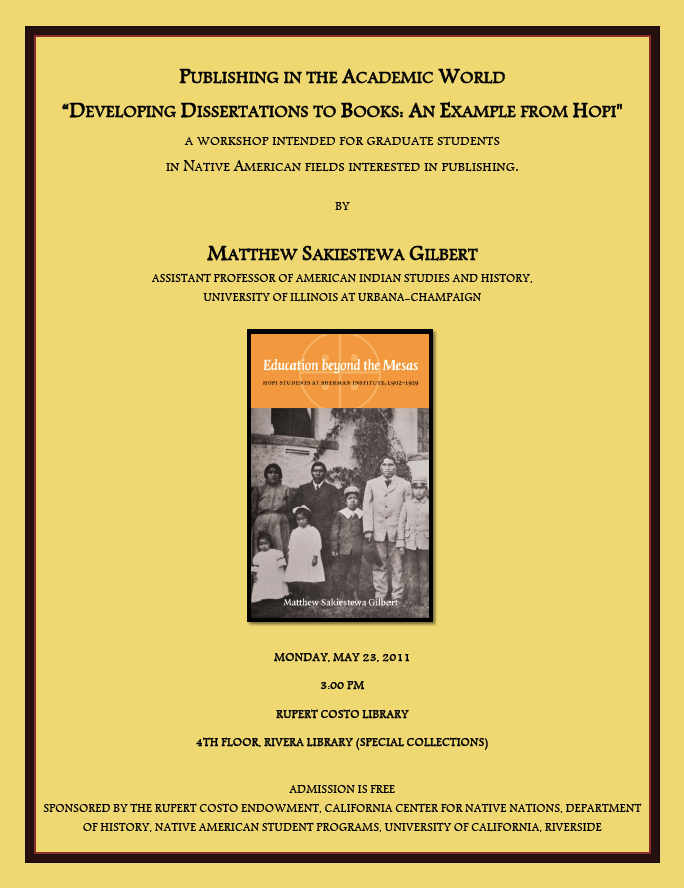
I recently returned from a trip to California where I presented a paper titled “Hopi Marathon Runner Louis Tewanima and the Olympic Games, 1908-1912” at the Native American and Indigenous Studies Association conference in Sacramento. I also heard a great presentation by Hopi educator and scholar Darold H. Joseph from Moencopi titled “Re-Centering Indigeneity: Culturally Responsive Schooling Practices for American Indian and Alaskan Native Youth.” Darold is a Ph.D. candidate in Special Education at the University of Arizona. After the conference ended on May, 22, I traveled to the University of California, Riverside, to give two talks, one of which was titled “Publishing in the Academic World: Developing Dissertations to Books, An Example from Hopi.” Both events were sponsored by the California Center for Native Nations. I spent my remaining time in Riverside conducting research at the Sherman Indian Museum.
Families of the 10 Hopi Code Talkers will be recognized and honored for their service during World War II in the United States Army and the United States Army Air Corps.
Speakers will include: Arizona Secretary of State Ken Bennett, Sen. Jack Jackson, Jr., (D-Window Rock), Colonel Joey Strickland, Director, Arizona Department of Veterans’ Services, along with Hopi Tribe Chairman LeRoy R. Shingoitewa, Hopi Vice Chairman Herman Honanie, VaNiesha Honani, U.S. Navy veteran & granddaughter of Code Talker Perry Honani, Sr., Clifford Qotsaquahu, a U.S. Army veteran, and Bruce Talawyma, U.S. Marine Corps veteran.
WHO:
The Hopi Code Talkers are:
United States Army
· Franklin Shupla
· Warren Koiyaquaptewa
· Frank Chapella
· Travis Yaiva
· Charles Lomakema
· Percival Navenma
· Perry Honani, Sr.
· Floyd Dann, Sr.
United States Army Air Corps
· Rex Pooyouma
· Orville Wadsworth
WHEN:
Monday, May 23, 2011
10 a.m. to noon. (MST)
WHERE:
Hopi Veterans’ Memorial Center
From Flagstaff : Take Highway 89A North to Townsend-Winona Street . Turn right and proceed about 10 miles to Leupp Road; turn left and continue north another 31 miles to the Kykotsmovi turn off (just past the Little Colorado River Bridge); continue north 48 miles to Kykotsmovi. Approximately 92 miles from Flagstaff . At junction turn right and continue approximately 5 miles on Highway 264 to Hopi Veterans’ Memorial Center .
From Tuba City : Take Highway 264 East approximately 55 miles to Kykotsmovi. Continue approximately 5 miles on Highway 264 to Hopi Veterans’ Memorial Center .
From Winslow: Take Highway 87 North approximately 60 miles to Second Mesa turnoff. At junction Hwy 264 & Highway 87, turn left and continue approximately 15 miles to Hopi Veterans Memorial Center.
In May 2011, the Hopi Tribe published its inaugural issue of The Hopi Tribal Newsletter. Most of the content in the Newsletter focuses on news and happenings on the Hopi Reservation. Click on the above image to download the Newsletter as a PDF document (8 pages).
San Francisco - Photograph by Matthew Sakiestewa Gilbert
A few weeks ago I traveled with my family to San Francisco for my sister-in-law’s wedding. We stayed in a house that overlooked the San Francisco Bay. Below are other photographs that I took of that trip. The last photograph is of Alcatraz Island. When I took this photo, I was reminded of an important and difficult time in Hopi history.
In November 1894, Hopi leaders at Orayvi refused to accept U.S. government policies, including the forced removal of Hopi children to government-run schools. Consequently, officials arrested 19 of these leaders and shortly thereafter transferred the Hopi prisoners to Alcatraz Island.
Separated from their families and village community, they remained on the Island from January 1895 to September of the same year. Although I wrote briefly about this topic in Education beyond the Mesas, historian Wendy Holliday has written much more on the Hopi prisoners in a two-part essay entitled “Hopi History: The Story of the Alcatraz Prisoners.”
Matthew Sakiestewa Gilbert at 2009 Native American House Congratulatory Ceremony. Photo courtesy of Muskogee Creek writer and photographer Durango Mendoza.
In the Spring of 2009, our Native students at the University of Illinois asked me to say the closing remarks for the Native American House Congratulatory Ceremony. The event took place on May 16, 2009. Since we are appoaching the end of the academic year, I thought that it would be fitting if I posted these remarks on my blog.
————————————
Returning to the Cottonwood Trees of Our Communities
Matthew Sakiestewa Gilbert
I have the privilege and honor of saying a few closing remarks to end our time together.
We are fortunate at the University of Illinois to have students who have not forgotten that the greatest “scholars” and teachers come from their own communities. These men and women have not published books for Oxford or Harvard University Press. They have not published articles in the esteemed journals of the academy. But they are known by people in their communities as the gatekeepers and protectors of intellectual property, and teachers of knowledge.
Among my people in northeastern Arizona, parents, grandparents, uncles, aunties, and other community members often told their children stories about the owl, the squirrel, and giant beasts that threatened to destroy the Hopi way of life. Hopi elders shared these stories with their children to teach them life lessons. Lessons that would help them to succeed in life, contribute to their communities, and to be passed on to their children and grandchildren.
At an early age, Hopi children were taught to value hard work, and to shun laziness. “Get up before Taawa, itana (the sun, our father) greets our village,” Hopi parents often told their children, “Taawa, itana has many things to accomplish throughout the day, and he need not waste his time and energy on getting you out of bed.”
The stories and teachings that have emerged in Hopi and other indigenous cultures have great meaning for people of the past, present, and future. They ground Native people in their communities, they connect us to our places of origin, and they forever remind us of who we are as Choctaw, Ho-Chunk, Kiowa, and other indigenous people.
I am reminded of a story that originates from my village of Moencopi that Hopi educator Dr. Noreen (Kewanwytewa) Sakiestewa once retold about a young girl who was lazy, and did absolutely nothing. She did not help her parents take care of her siblings, she refused to grind corn, and she had no desire to learn Hopi stories and songs. Seeing her laziness and apathy, people in the village called her kyena, which is Hopi slang for “ignorant one.”
Sakiestewa recounts that one day, as the girl wandered about near the wash by her village, she sat under a large cottonwood tree. The wise old cottonwood tree realized that her people, and even the animals, had become angry with her, and so he asked the young girl: “Why are you not a part of your people?” The girl did not respond, and so the wise old cottonwood tree told her to gather yucca plants and to bring them to him.
When she returned, the wise old cottonwood tree taught her how to weave a plaque with a coil design. But the girl became restless, and she wanted to learn other design patterns to incorporate in her plaques. So the wise old cottonwood tree told her to observe the things of nature. “Look at the sky, the mountains, and the animals, and they will show you new patterns for your plaques.”
After several days or traveling and searching, the young girl from Moencopi came across a rattlesnake who asked her why she had wandered so far from her village. “I am on a journey to find new designs,” she told him. And so the wise old snake said to her, “Look at the design on my back. I give you permission to use my design in your plaques.”
Soon the young girl came across other designs, and months later, she returned to her people with beautiful plaques and immediately started teaching her sisters, and other girls in the village how to make baskets. All that she had learned amazed the people at Moencopi. And from that day forward, they no longer called her kyena.
In her retelling of this story, Sakiestewa asks the question:
“At what point did the girl come out of not being kyena? Overwhelmingly, the response was when she learned to make baskets. The Hopi response to when she stopped being kyena was when she returned and taught the skill of basket making thereby completing her circle.” [Norene E. Kewanwytewa, “Being Hopi: A Collaborative Inquiry Into Culturally Responsive Education,” Ed.D. Dissertation, Northern Arizona University, 2002, pp. 2-4].
Today, as we gather together to honor our students, I close by urging our Native graduates to return to the cottonwood trees of their communities. Complete the circle, and take what you have learned at the University of Illinois and contribute something useful to your people. And never forget that long ago, our people held to and practiced indigenous ways of understanding that provided meaning, and continue to provide meaning, for every aspect of life.
CU on the Trails 2011 (I highlighted the wrong path I took in blue)
This morning my wife and I ran a 5K as part of the annual Champaign Park District’s CU on the Trails event. The idea behind the race is for people in the community to become familiar with the parks in Champaign and the running/walking trails that are associated with each one.
This was our third year participating in the race. The running conditions were not ideal, but they weren’t terrible either (40 degrees with rain).
Two years ago I ran in this event while pushing a double running stroller. I don’t recall my exact time, but I remember that it took me a while to run 3.1 miles. Today, only 15 or so runners showed up for the 5K. Everyone blamed the rain and wind for the low turnout.
Before the race, I thought I would do something different and try to keep up with the lead runners. For nearly two miles I was in third place, right behind the first and second runner. But then I ran out of steam and quickly realized that I needed to slow down.
At about this time, I approached a race volunteer and asked “how much longer?” He replied, “About two more miles, you’re almost halfway.” I had a hard time believing that I was “almost halfway,” but I kept going at my new (slower) pace.
When I crossed the finish line (a tree branch), nobody was there taking people’s times, and so I called out to the race organizers “Time?!” and one lady said, “9:37.” I smiled, but was too tired to laugh.
As I drank water and munched on a granola bar, my wife told me that some of us (she and I included) took the wrong “trail,” which put an additional 3/4 mile on the run. I think that information made us feel somewhat better about our times.
Our next 5K will be for the Christie Clinic Illinois Marathon in two weeks. However, I guarantee I won’t be able to keep up with the lead group in that event!
I want to extend a big kwakwha’ to my friend and colleague, Debbie Reese, for telling me about a free program called Google Search Stories. On Wednesday of this week she gave a lecture on her use of social media at the University of Illinois, which is where she told the audience about Google Search Stories.
This program allows people to make Google search engine videos on any topic. The search terms that I included in my video are terms that people often use to get to BEYOND THE MESAS. In case you’re wondering, Search Story videos are very easy to make. Just click on the following link for more information: http://www.youtube.com/user/searchstories
Last night I came across this 26 minute video on Tewa-Hopi artist Dan Namingha from Polacca titled “Seeking Center in Two Worlds.” From what I can tell, the video was produced in August 1992 and it was shown on various PBS affiliated stations. Here is the video summary on the KNME Chanel 5 (Albuquerque, NM) website:
If “Seeking Center in Two Worlds” is of interest to you, then I would suggest seeing Allan Holzman’s film “Beautiful Resistance,” which examines the Indian boarding school experience through contemporary American Indian art, including works by Hopi artist Michael Kabotie. I have written about this film in a previous post. Holzman was also the director and co-executive producer of “Beyond the Mesas.”
If you are thinking about visiting the Hopi Reservation, I would encourage you to go with a reputable Hopi tour company. One of these companies is Hopi Tours, which is led by Hopi anthropologist Micah Loma’omvaya. As I read about Hopi Tours on-line, I learned that the company has been giving tours on Hopi lands since 1540!
Of course, this was the year that Spanish conquistador Pedro de Tovar and a small group of soldiers, a few Zuni guides, and a Franciscan priest, came across the Hopi people on Antelope Mesa. After a bloody fight, and a “tour” of the villages on First Mesa, the Hopis promptly directed the Spaniards to go west toward the Grand Canyon. The Hopis did not want these “tourists” sticking around.
Today, tourism plays a very important economic role on the Hopi Reservation and it provides Hopis with opportunities to share their culture with visitors. For more information about upcoming tours, including a special book tour on Hopi Summer by Carolyn O’Bagy Davis, please download the following brochures: Hopi Tours 2011 Brochure Rates / Book Tours Hopi Summer 2011



 BEYOND THE MESAS, LLC