Through a partnership with Arizona Public Service (APS), the Hopi Education Endowment Fund (HEEF) and the Hopi Tribe Grants and Scholarship Program (HTGSP) we are pleased to announce a unique scholarship opportunity for Hopi students entitled the APS Hopi Scholars Program. The program will provide eight $3,500 scholarships for 3 seniors, 3 juniors, and 2 sophomores pursuing an AAS, AS, BA or BS at an accredited college or university for the Academic Year (AY) 2010-2011.
In addition to general eligibility requirements, students must submit a Special Scholarship Application and a 1 page essay regarding “Commitment to Community”. The selected students must also perform 40 hours of community service to the Hopi community before the start of the next AY. Applications will be competitive and will be reviewed and awarded by a Selection Committee. If you have any questions please contact the HTGSP at 1-800-762-9630. The deadline is October 1, 2010.
Under the Chancellor’s Postdoctoral Fellowship Program at the University of Illinois at Urbana-Champaign, the American Indian Studies Program seeks two Postdoctoral Fellows for the 2011-2012 academic year. This fellowship program provides a stipend, a close working association with AIS faculty, and assistance in furthering the fellow’s development as a productive scholar. Applicants should have an ongoing research project that promises to make a notable contribution to American Indian and Indigenous Studies. While fellows will concentrate on their research, they may choose to teach one course in American Indian Studies. Furthermore, fellows are encouraged to participate in the intellectual community of the American Indian Studies Program.
The Fellowship stipend for the 2011- 2012 academic year is $42,000, including health benefits. An additional $5,000 will be provided for the fellow’s research, travel, and related expenses. Candidates must have completed all degree requirements by August 15, 2011. Preference will be given to those applicants who have finished their degrees in the past five years. The one-year fellowship appointment period is from August 16, 2011, to August 15, 2012.
Candidates should submit a curriculum vitae, a thorough description of the research project to be undertaken during the fellowship year, two samples of their scholarly writing, and two letters of recommendation to Robert Warrior, Director, American Indian Studies, University of Illinois at Urbana-Champaign, 1204 West Nevada Street, Urbana, Illinois 61801-3818. Applications received by January 21, 2011 will receive full consideration. The review process will continue until the fellowships are filled. For further information, contact Matthew Sakiestewa Gilbert, Chair, Chancellor’s Postdoctoral Fellowship Committee, American Indian Studies: Phone: (217) 265-9870, Email: tewa@illinois.edu, or visit the Program’s website at www.ais.illinois.edu.
The University of Illinois at Urbana-Champaign is an Equal Opportunity Employer
On September 9, 2010, Victor Masayesva, Jr. from the village of Hotevilla screened a short film and gave a presentation at the University of Illinois at Urbana-Champaign. Masayesva’s visit was part of a university sponsored initiative titled “Sovereignty and Autonomy in the Western Hemisphere: National & Regional Struggles for Power, Identity and Space.” The American Indian Studies Program organized the event.
Masayesva is known throughout the world as an accomplished Hopi photographer and filmmaker. Some of his award winning films include Hopiit, Itam Hakim Hopiit, Ritual Clowns, Imagining Indians, and one of my favorites, Paatuwaqatsi: Water, Land & Life, a film on Hopi running, the sacredness of water, and Hopi relationship with the indigenous people of Mexico.
I arrived at the village of Shungopavi at 5:30 in the morning. A crowd of people gathered at the baseball field. An event volunteer welcomed everyone to the race and gave instructions to the runners.
“The 10K race will begin in 20 minutes” he announced.
A large camera and flash hung around my neck. “Hey, are you with the press?” one man asked. “No, ” I replied, “I am working on a project with the Hopi Cultural Preservation Office on runners. I’m here to photograph the event.”
“The 10K race will begin in 5 minutes” the person behind the megaphone announced.
The runners gathered around the start line. The race had officially begun. Ten seconds later, the runners were gone.
I made my way to the southeast side of the village. The sun had not yet risen over First Mesa. In the valley below, a running trail etched its way through the rocky landscape.
“Any sight of the runners” I asked. “Not yet” a man replied. Everyone waited.
After 25 minutes, the first runner appeared in the distance. It was Hopi runner Juwan Nuvayokva from Oraivi. He ran with ease and strength, showing few signs of fatigue.
On the opposite end of the village 5K runners were climbing their way up the mesa. I arrived to see my father make the final push to the top.
Back at the baseball field the 1 and 2 mile fun runs had started. Children of all ages ran toward the camera.
People clapped and cheered as the youngest runner approached the finish. It was a perfect way to end the race.
Matthew Sakiestewa Gilbert
———————————————
Throughout the week I will be adding more photographs to the slideshow, so be sure to check back.
If you or a family member are pictured in the above slideshow, and you would like a high resolution copy of the photograph, please email me at sakiestewa@gmail.com. I want to also extend a special thanks to Bonnie Talakte, Catherine Talakte, and other event organizers for granting me permission to photograph the 37th Annual Louis Tewanima Footrace on Second Mesa.
Over the past few days several people have visited my blog in search of photographs that I took at this year’s Louis Tewanima Footrace. This is just a quick note to let people know that I will post the photos on my blog no later than tomorrow, Wednesday September 8, at 6PM Hopi time.
Louis Tewanima standing with his many trophies and medals. He is wearing his Carlisle track suit. Photo courtesy of the American Indian Athletic Hall of Fame
In less than a week, family members of Hopi runner Louis Tewanima will host the 37th Annual Louis Tewanima Footrace at the village of Shungopavi on Second Mesa. Tewanima is one of the most celebrated runners in Hopi history and he is best known for winning a silver medal at the 1912 Olympic Games in Stockholm, Sweden. As I think about the upcoming footrace, I am reminded of another Hopi footrace on Second Mesa that involved Tewanima.
In a previous post, I wrote about a Hopi runner named Philip Zeyouma who competed for Sherman Institute at the same time Tewanima ran for the Carlisle Indian Industrial School in Pennsylvania. In April 1912, Zeyouma won the Los Angeles Times Modified Marathon of 12 miles, which earned him an opportunity to compete for the U.S. team in Stockholm. On the other side of the country, Tewanima, who by this time had won several running events, was also scheduled to run in the Olympics.
When news that the two Hopi runners would race against each other in Sweden, excitement spread among the students at both schools. Students at Sherman Institute gloried in the thought that one of their Hopi runners would defeat the famous Louis Tewanima, and the pupils at Carlisle had great confidence that Tewanima would outrun the Hopi runner from Sherman. But the showdown between Zeyouma and Tewanima at the Olympic Games in Sweden never took place.
Shortly before Zeyouma was supposed to leave for Sweden, his father expressed disapproval of his son’s participation in the Olympics. Not wanting to disappoint his father, Zeyouma honored his request and went back to the Hopi Reservation for the summer. However, in my article “Hopi Footraces and American Marathons, 1912-1930,” I note that the
rivalry between the two Hopi runners did not cease when Tewanima migrated back to the Hopi mesas as an Olympian. In September 1912, shortly before they returned to their schools, Tewanima and Zeyouma challenged each other to a race on the Hopi Reservation. On the day of the race, Hopis from the surrounding villages gathered around the starting line and anxiously watched as the two runners made their mark for the twelve-mile course. Zeyouma proudly wore his “Sherman colors,” while Tewanima “appeared in his Carlisle track suit.”
By wearing their running uniforms, the Hopi athletes saw the event as a race between the two schools and identified themselves according to their school affiliation. However, such a display of school loyalty did not go unchallenged by the other Hopi runners in the crowd. Seconds before the race began, some of the older Hopi men remarked that the “boys did not look like [Hopi] runners” at all, and teased Zeyouma and Tewanima for wearing their running outfits. A New York Times reporter noted that when Tewanima heard the men’s insults, Tewanima replied, “If you don’t like our looks get in, and show what you can do.”
The men promptly accepted his challenge and entered the race with no shoes or track suits, and wore “merely discarded” clothes. Six miles into the race, the older men proved too much for the young runners and Zeyouma and Tewanima quit and left the “race to the barefooted runners in the lead.” Coach Joe Shoulder recalled that the winner was about fifty years old, and he looked like he was “dying of consumption” (tuberculosis).
The outcome of the race provides a telling commentary on running in Hopi culture, as well as the relationship between older and younger runners. While the younger runners migrated to off reservation Indian boarding schools, the vast majority of the Hopi people, including older men who were known for the ability to run long distances, remained at home. Consequently, some of the best long-distance runners in U.S. history received little or no attention by those outside of the Hopi community. Although newspaper reporters seemed surprised that men in their fifties had the ability to defeat the younger athletes, the people knew that other Hopis could easily outrun the Hopi Olympian and the track star from Sherman Institute. [“Hopi Footraces and American Marathons, 1912-1930,” American Quarterly, March 2010, vol. 62, no. 1, p. 87, 88]
On Sunday September 5, 2010, runners of various ages will come together to run a footrace on Second Mesa. They will once again make their mark on the start line and run a course similar to the one taken by Tewanima, Zeyouma, and the older runners of the village. In honor of Tewanima, who still inspires thousands of individuals to run, the annual Louis Tewanima Footrace gives testimony to Tewanima’s legacy as an Olympic runner and the continuation of footraces among the people.
Matthew Sakiestewa Gilbert
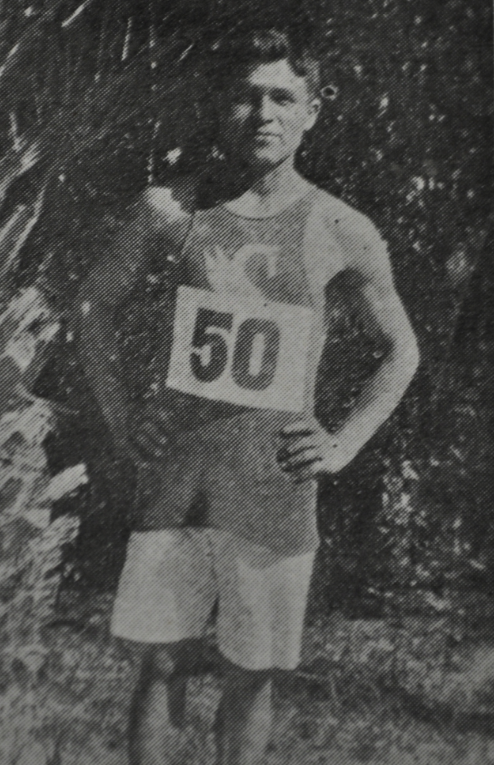
Philip Zeyouma after winning the 1912 Los Angeles Times Modified Marathon. Photo courtesy of the Sherman Indian Museum
During the first week of August I conducted research at the Haskell Indian Nations University in Lawrence, Kansas. The school use to be Haskell Institute, one of several off-reservation Indian boarding schools in the United States.
In the late 1890s and early 1900s, government officials usually sent Hopi students to the Phoenix Indian School in Arizona, Sherman Institute in California, the Albuquerque Indian School in New Mexico, or Stewart Indian School in Nevada. While fewer Hopis attended Haskell, the school and the surrounding community continues to have an important role in Hopi history.
When I was not examining documents at the Haskell Cultural Center and Museum, I walked around campus and photographed the school’s buildings, including the stadium (pictured above). I also dropped by the Department of American Indian Studies and spoke with Comanche professor Michael Tosee. We talked at length about the school’s cross-country program and Hopi long distance runners.
My research trip to Haskell was very productive and I am especially grateful to Bobbi Rahder, Archivist and Curator of the Museum, for her help in providing me with access to the archival collections. The documents that I uncovered will be very meaningful to Hopi people.
Dr. Thomas E. Sheridan and Dr. T.J. Ferguson, both from the University of Arizona, will be presenting information on the Moquis and Kastilam: The Hopi History Project. This project, which has been ongoing for the past seven years, has researched un-transcribed Spanish documents about their presence among the Hopi. Several Hopi interviews will be played as well and there will be time for interaction and viewpoints. This is a collaborative effort between the Hopi Cultural Preservation Office and the University of Arizona, Arizona State Museum. The search for Spanish archival documents have been conducted at the Mexico National Archives, Archives in various Museums in Spain and in Santa Fe, New Mexico. Come hear both scholars as they give an update on the many interesting research findings.
Where: Kykotsmovi Community Building
When: Monday, August 16, 2010
Time: 7:00 p.m. to 9:00 p.m.
For more information contact: (928) 734-3615
Come early to listen to Hopi Oral History interviews on the Hopi-Spanish era conducted by Hopi Cultural Preservation Office Staff. Doors open at 6:00 p.m.
Receive 20% off each copy of Education beyond the Mesas: Hopi Students at Sherman Institute, 1902-1929, if you order from the University of Nebraska Press. Mention promotion code 6AF10 to obtain the discount. For more information, please click on the following link to download the book’s promotional flyer: Education beyond the Mesas – flyer




 BEYOND THE MESAS, LLC