The search for Polingaysi Qoyawayma

When I started researching on the Hopi boarding school experience at Sherman Institute, I thought for sure that I would come across many references of Polingaysi Qoyawayma (Elizabeth Q. White) at the Sherman Indian Museum. She is, after all, one of the school’s most famous alums. I looked in the Sherman Bulletin, the school’s student-written newspaper. I examined various letterpress books and other school records, but I never came across her name.

While conducting research at the National Archives in Laguna Niguel, California, I uncovered a file with a name similar to Polingaysi Qoyawayma written on the tab. I thought I found the documents that I had been searching for. But when I examined the records closely I discovered that the file belonged to someone else.

In an attempt to find clues that would lead me to archival information on Qoyawayma, I reread Don Talayesva’s autobiography Sun Chief. Talayesva and Qoyawayma attended Sherman at the same time. They both came from Orayvi and likely traveled with each other to the school in November 1906. But nowhere in Talayesva’s book does he mention her name.

Fortunately, one does need to depend on Talayesva or an archive to learn about Qoyawayma’s experience at the Indian school in Riverside. Although the archival record may appear to be silent, at least in reference to her time at Sherman, her story remains with her family, others who knew her, and in her book No Turning Back.

The documents that I searched for may never surface. They may not even exist. But Qoyawayma has already shared with us about her school days at Sherman Institute. She has already provided us with the archive, the documents, and the narrative of her life.

Matthew Sakiestewa Gilbert

Hopi studies at the 2010 NAISA conference

There will be several Hopi presentations at this year’s Native American and Indigenous Studies Association (NAISA) conference hosted by the University of Arizona in Tucson. This event will take place on May 20-22. I have copied a list of Hopi presenters and Hopi related papers/panels to this post. To learn more about the conference and to access the complete program, please click on the following link: http://naisa.ais.arizona.edu/

—————————————

FRIDAY, MAY 21, 2010 10:00-11:45 am

76. Youth & Culture [S29]
Organizer: NAISA Program Committee
Chair: TBA
“The Good Life” and “The Fast Life”: Childhood and Youth among Algonquian Peoples at Mid-Century
Kim Anderson, Centre for Research in Inner City Health/ St. Michael’s Hospital, Toronto, Canada
Unintended Truths: The Paradoxes of Cultural Reconnection for Urban Native Youth
Tracy L. Friedel, University of British Columbia, Canada
Traditional Education Tools in Hopi and Dakota Communities
Sherrie L. Stewart, University of Arizona

Cultural Identity in Education
Roy Weasel Fat, Red Crow Community College
Comment: Audience

79. Attending to “Missing” Youth and Opportunities for Language Activism in Indigenous Language Contexts [P74]
Organizer & Chair: Leisy T. Wyman, University of Arizona
Indigenous Youth – The Missing Link in Language Revitalization Research and Praxis
Teresa L. McCarty, Arizona State University
Articulating a Critical Language Consciousness among New Mexico’s Indigenous Youth
Tiffany S. Lee, University of New Mexico
Hopi Youth “Wanting in Tradition”: Seeking the “Missing Piece” – The Heritage Language
Sheilah E. Nicholas, University of Arizona

Recognizing Youth Migration in Linguistic Ecologies and Educational Efforts: Yu’pik Examples
Leisy T. Wyman, University of Arizona
Comment: Perry Gilmore, University of Arizona

FRIDAY May 21, 2010 12:00-1:45 pm

87. ROUNDTABLE: Collaborating on Native American History: The Hopi History Project [R6]
Organizer: Anton Daughters, University of Arizona
Chair: Thomas E. Sheridan, University of Arizona
Participants: T.J. Ferguson, University of Arizona
Leigh Kuwanwisiwma, Hopi Cultural Preservation Office
Stewart Koyiyumptewa, Hopi Cultural Preservation Office
Lee Wayne Lomayestewa, Hopi Cultural Preservation Office

FRIDAY, MAY 21, 2010 2:00-3:45 pm

93. Displaying Common Unity: New Directions in the Exhibition of “Indigenous” and “Black” Lives in the Americas
[P21]
Organizer & Chair: Robert Keith Collins, San Francisco State University
Toward a Dynamic Ethnography of Common Unity between Africans and Native Americans: Evidence from WPA Slave
Narratives
Robert Keith Collins, San Francisco State University
Mulattos, Mongrels, and Mulgenons: Race, Ideology, and Public Policy in the Construction of American Indian and
African American Identity
Angela A. Gonzales, Cornell University

Our brethren by the ties of consanguinity, of suffering, and of wrongs: Narrating Crispus Attucks and Paul Cuffee
“Home”
Judy Kertész, North Carolina State University

101. Intellectual Property, Cultural Patrimony, and Museum Partnerships [S19]
Organizer: NAISA Program Committee
Chair: Kevin Gover, National Museum of the American Indian, Smithsonian Institution
Perspectives on Working Relationships and Contracts: Indigenous Intellectual Property and Museums
John R. Grimes, Cook Inlet Tribal Council and Merry Glosband, Peabody Essex Museum
Repatriation and Representation in Tribal Museums and Cultural Centers
Sunny K. Lybarger, University of Arizona
Returning Hopi Voices: Redefining Repatriation through Community Partnership
Trevor Reed, Columbia University

Iroquoia Collected: The Alienation of Haudenosaunee Cultural Patrimony
Scott Manning Stevens, Newberry Library McNickle Center
Comment: Audience

SATURDAY, MAY 22, 2010, 8:00-9:45 a.m.

103. Renewal of Indigenous Languages & Cultures: Up and Coming Indigenous Scholars’ Research Findings [P26]
Organizer & Chair: Candace K. Galla, University of Arizona
Reversing Language Shift in the Cheyenne River Sioux Tribe
Jesse Johnson, University of Arizona
Use of Ancestral Indigenous Languages to Promote Student Development within the Classroom Maxine R. Sam, University of Arizona
“Uma tuuqayi, umu sinmuy amungem lavaywisni” (When you have learned, advocate for your people)
Darold Joseph, University of Arizona

Revitalizing Our Languages: Towards Decolonizing Technologies for Indigenous Communities
Candace K. Galla, University of Arizona
Comment: Audience

SATURDAY, MAY 22, 2010 2:00-3:45 pm

129. New Directions in Hopi Arts: Incorporating the Past, Inventing the Future [P72]
Co-Organizers & Co-Chairs: Jessica Welton, Virginia Commonwealth University and Zena Pearlstone, California
State University, Fullerton
Picturing the Rational Mind: Archaeology Meets Michael Kabotie
Kelley Hayes-Gilpin, Museum of Northern Arizona & Northern Arizona University

Brian Honyouti: Send in the Clowns
Zena Pearlstone, California State University, Fullerton
New Directions and Change: Discomfort and Growth
Mark Tahbo (Hopi), Independent Scholar
New Directions from Ancient Roots: The Art and Philosophy of Michael Kabotie
Jessica Welton, Virginia Commonwealth University

Comment: Audience
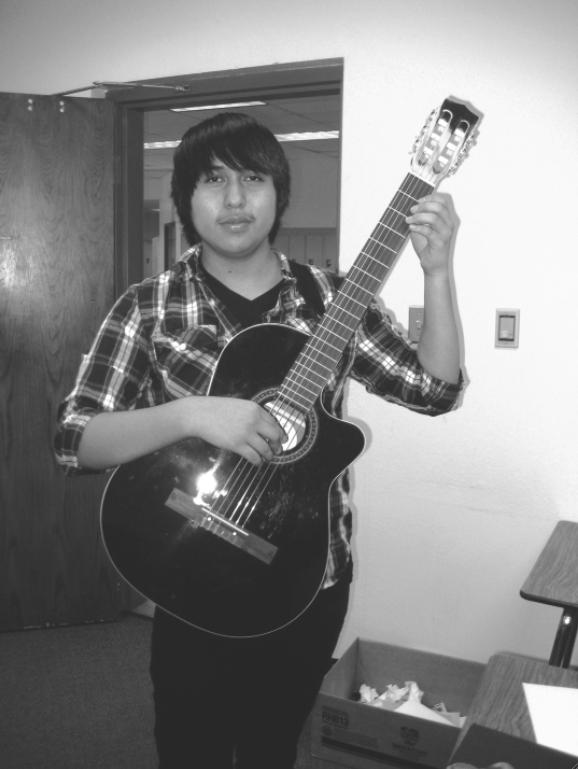
A classical guitarist from Kykotsmovi

When I was younger I studied classical guitar with Tom Sheeley at Northern Arizona University. I had dreams of becoming a professional Spanish classical guitarist, but that aspiration never came to be. Below is an article about a sixteen year old Hopi guitarist named Malcolm Mowa from Kykotsmovi. One of his compositions titled “Aerial Ice” was recently aired on National Public Radio. I am looking forward to hearing more about this Hopi musician in the future.

The story and photo are courtesy of Stan Bindell and the Navajo-Hopi Observer (NHO). Many thanks to Wells Mahkee Jr., Managing Editor of NHO, for granting me permission to republish this story on my blog. Here is the link to the original source: http://navajohopiobserver.com/main.asp?SectionID=74&subsectionID=111&articleID=12247

Matthew Sakiestewa Gilbert

————————

Hopi student’s music hits national airwaves

Stan Bindell, The Observer

Tuesday, February 02, 2010

POLACCA, Ariz. – A Hopi High School music student has hit the national airwaves. Malcolm Mowa had his musical composition, “Aerial Ice,” performed on National Public Radio. He wrote the piece, which was performed by Ethel, a four-string quartet.

Mowa, a 16-year old junior, said Ethel performed great and he was excited about having his piece aired nationally. He initially wrote the piece as part of the Grand Canyon Music Festival when artist in residence Raven Chacone came to Hopi High and taught six students how to compose.

Mowa learned about his piece being aired nationally when it was announced over the school’s intercom. “It motivates me to want to do more with music,” he said.

“I want to go to school for music composition and guitar.” He also wants to learn to play the piano. Mowa said his parents were excited and happy about his composition being aired nationally.

“Everybody wants to hear it, but nobody knows when it was played,” he said. Thomas Irwin, band teacher at Hopi High, was equally ecstatic about Mowa’s piece getting national airtime.

“It was great, cool,” he said. “There are new people at NPR working on programming.”

The new programming allows the top high school students from throughout the nation to have their pieces aired. One of Irwin’s former students at Monument Valley High School received a $10,000 endowment for his work.

Irwin said he hopes Mowa stays serious about his musical work because he can major in guitar or composition, and scholarships are available to him.

“I’m confident he can get scholarships,” Irwin said. “He’s a great example of what can happen when kids apply themselves. Chances are we’ll get more success stories.”

Irwin said Mowa’s fellow students were happy for him, although some teased him about his success.

Mowa said “Aerial Ice” was a happy tune about how he felt at the time. It’s classical music and it’s just instrumental; there are no words. He added that he likes classical music better than hip hop or rap.

“It’s better than a lot of the music that’s out there. It’s mellow, nice – not bad stuff,” he said.

Mowa likes alternative rock, classic rock and pop music.

Mowa is also part of the Hopi High guitar class, which recently performed at the Hopi Cultural Center and other places in the community.

“It was weird because we were playing off to the side while people were eating, but people were happy we were playing. They would put down their food and listen,” he said. Mowa, who also plays baseball, maintains a B average and hopes to get a music scholarship to college. He is the son of Uberta and Clifton Mowa from Kykotsmovi.

Navajo-Hopi Observer

—————————


Hopi runners in the audience

I recently returned from attending the American Indian Studies Association (AISA) Conference in Tempe, Arizona. I delivered a paper titled “Hopi Footraces and American Marathons, 1912-1930.” This paper, in its article form, will appear next month in American Quarterly. I was happy to see that some Hopis came to my talk, including two students from ASU. Since I first presented on this topic, I cannot recall the last time I had Hopi long distance runners in the audience. Both of these students were runners.

After the session I talked at length with the students about how the world focuses so much attention on Louis Tewanima, but back home our people realize that while Tewanima was good, other Hopi runners were just as good or better than the famous Olympian from Shungopavi. Although these students already knew about Tewanima, they had not heard of the other runners that I mentioned in my paper. I also did not know about these runners before I started this project.

One of the most rewarding aspects of being a faculty at the University of Illinois is the opportunity I have to make my research available and meaningful to the Hopi community. This has always been the driving force behind my work.

Matthew Sakiestewa Gilbert

Misrepresenting the Hopi with photos

Earlier this week I blogged about a tourist who took a photograph of a home at Orayvi and posted it to his blog. The tourist admitted that there were signs up that forbid people from taking photos, but he took one anyway. It appears from his post that the reason he published the photo was to show his readers how poor he perceived the Hopi to be.

In my earlier post I mentioned that some Hopis do not want tourists to take photos of their villages because they desire to protect their privacy. Still others post these signs at the entrance of the village so that tourists will not misrepresent them. The sandstone homes and the condition of the village may cause outsiders to conclude that the Hopi people are poor and in desperate need of help. But is this the message that the people of Orayvi want the world to believe or hear?

I wonder if the author of Boquete Panama Guide has ever been inside an Orayvi home? During his recent visit to the reservation, did he speak to the owner of this or other Hopi homes? Did he hear their stories about how members of their families/clans built these homes in the early 1900s or earlier? Did they tell him that people from the village once traveled by foot to Nuvadakovi (San Francisco Peaks) to cut down wood beams to use for their ceilings, and carried them back to the village? If so, did he see the pride in their faces when they told him that their families have lived in these homes for more than a hundred years? Did they explain to him that many years ago the people of the village decided to live without modern conveniences such as electricity and running water? Did he care enough to ask? Did he care enough to ask why?

Matthew Sakiestewa Gilbert

Spanish mission buildings and sandstone homes

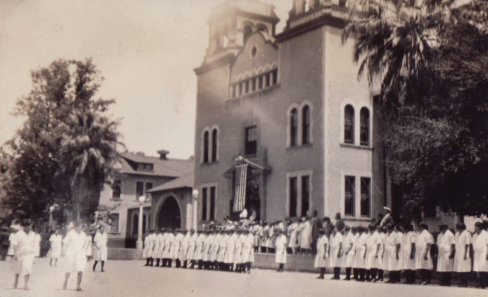
The producers of Beyond the Mesas were very fortunate that Marsah Balenquah from Bacavi on Third Mesa agreed to be interviewed for the film. In the documentary she explains that she attended Sherman for thirteen or fourteen years. At one point in the film she describes her impression of the school’s buildings. Built by Indian students in a Spanish Mission architectural style, the buildings did not resemble the sandstone homes she and other Hopis were familiar with on the reservation.

This photograph was taken when Marsah attended the Indian school in Riverside from 1920 to 1934. In the photo girls are standing in a line waiting for roll call and inspection. Everyday life at Sherman was very regimented. An American flag drapes from the portico of the school’s main building. Photo courtesy of the Sherman Indian Museum.

Matthew Sakiestewa Gilbert

Tourists, Cameras, and Hopi Privacy

Today I read a blog about an American who now lives in Boquete, Panama. This week he visited the Hopi Reservation and took a picture of a home at Orayvi on Third Mesa and posted it to his blog called Boquete Panama Guide. Here is what he writes:

It has been years since my last visit and I wanted to see if the life of the Hopi had changed. Everything was closed, the poverty obvious and although there were signs up not to take photos I took one of this dwelling.

Recently a friend asked me why Hopis post signs at the entrance of their villages that forbid tourists from taking photos. I told him that one of the reasons is because Hopis want to protect their privacy.

Think of it in this way…

Imagine that you live in a remote area of North America that receives thousands of tourists each year. Your house is unlike most homes in the United States. It is made of sandstones and situated close to a highway. Throughout the year tourists zoom by your house, abruptly stop their cars, roll down their windows, and snap photos of your home. Sometimes this happens when you are sitting out front drinking ice tea and visiting with members of your family. Other times your children are playing outside. But it does not matter to the tourists if anyone is home, or whether people are outside. All they want is a photo of your home, and to them, the photo is only enhanced if you and your children are part of it. You sometimes wonder what people do with these photos. You imagine that some people put the picture of your home in a photo album, a book, make postcards and calendars from it, or sell it.

Concerned about your family’s privacy, you decide that enough is enough and so you put a sign in your front yard that reads: “Please do not take photos of my home.” And then you wait. It does not take long for the next tourist to drive by. He slows down. He reads the sign, then looks at your home, then reads the sign again. A Nikon camera is laying on the passenger seat. He finds himself in a dilemma, but he decides to honor your request. Five minutes later, another car approaches your home. These people stop and read your sign, then look around to see if anyone is looking, roll down their window, take several photos of your home and speed away. This happens day after day and it will only increase during the summer months.

Matthew Sakiestewa Gilbert

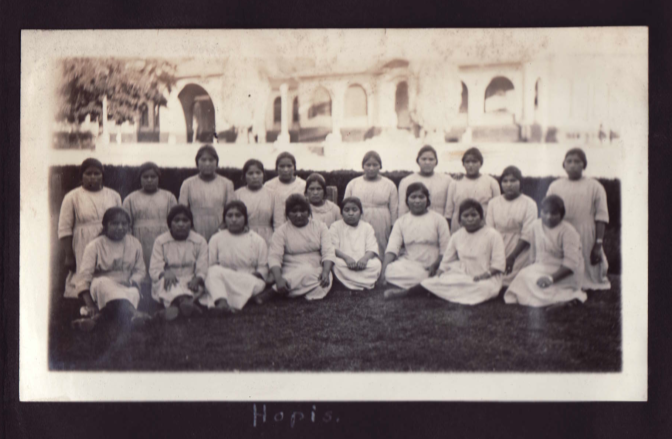
1920s photo of Hopi girls at Sherman Institute

I was once asked how many photos and other images we included in Beyond the Mesas. I do not know the exact number, but it had to have been over a hundred. Some of these photos came from people who we interviewed for the film, others we uncovered at various archives. One of these photos was of a group of Hopi girls at Sherman Institute during the 1920s. I came across this picture in the Veva Wight Collection at the Sherman Indian Museum in Riverside, California. Wight was a Protestant missionary who led Bible studies and other Christian activities at the school. She worked as a “Religious Worker” at Sherman for more than thirty years. Although government officials allowed Christianity at Sherman to encourage the assimilation of Indian students, some Hopi girls had a genuine committment or interest in the Christian faith.

Matthew Sakiestewa Gilbert

Beyond the Mesas to air locally and via internet

I am pleased to announce that UI-7, a local television station associated with the College of Media at the University of Illinois, will air Beyond the Mesas this week on the following days and times:

Tuesday, January 19 – 7:30pm and 9:00pm CST
Wednesday, January 20 – 1:00 pm CST
Friday, January 22 – 10:00 pm CST
Saturday, January 23 – 8:00 pm CST

UI-7 can be seen on Channel 7 for local Comcast subscribers.

On the same days/times, Beyond the Mesas will air simultaneously over the internet via a live stream at: http://www.media.illinois.edu/service/ui7live.html

If you are planning on watching the film on-line, remember to account for the different time zones. The above showings are listed in Central Standard Time (CST)

Beyond the Mesas Trailer

About the film:

Directed by Emmy Award winning director, Allan Holzman, and produced by Leigh J. Kuwanwisiwma, Stewart B. Koyiyumptewa, Matthew Sakiestewa Gilbert, and Gerald Eichner, Beyond the Mesas is a thirty-six minute documentary film on the removal of Hopis to on and off-reservation boarding schools and their experiences at schools such as Sherman Institute, Phoenix Indian School, Ganado Mission School, and Stewart Indian School. Topics covered in the film include Hopi understandings of education, early U.S. government attempts to assimilate Hopis, the Orayvi Split, Hopi language loss at American schools, and the future of the Hopi people. Produced with the cooperation and involvement of the Hopi Cultural Preservation Office in Kykotsmovi, Arizona, Beyond the Mesas is part I of a series of films on children and American Indian culture titled “Keeping the Culture Alive.”

The first public showing of the film was at the Hotevilla Bacavi Community School on the Hopi Reservation on November 8, 2006. Shortly afterwards, the Applied Indigenous Studies Department at Northern Arizona University and the Hopi Cultural Preservation Office hosted a screening at the Cline Library auditorium. Since November 2006, official screenings have taken place at other universities and schools, including the University of Illinois, University of California, Riverside, Cornell University, and Sherman Indian High School. The film has aired on several regional PBS stations throughout the United States.

Matthew Sakiestewa Gilbert

Tawaquaptewa and the Antiques Roadshow

In 2005, I published an article on a Hopi chief named Tawaquaptewa from Orayvi on Third Mesa. He was kikmongwi (village chief) at Orayvi during a very unstable time in Hopi history. In the early 1900s the village of Orayvi was divided over several issues. One of these issues was the mandatory enrollment of Hopi children at government schools.

In the past scholars have produced a great deal of material on Tawaquaptewa, but most of the scholarship focuses on Tawaquaptewa during this period. However, when I was writing my book on the Hopi boarding school experience I came across a fascinating article by Barry Walsh titled “Kikmongwi As Artist: The Katsina Dolls of Wilson Tawaquaptewa” in the American Indian Art Magazine (Winter 1998).

Walsh highlights an area of Tawaquaptewa’s life that has not received much attention. Tawaquaptewa was a carver and he sold his katsina dolls to tourists who visited the reservation between 1930 and 1960. Today his dolls are highly sought after by collectors. A website called TribalArtCollections.com has a photo gallery of his work.

In March 2008, the Antiques Roadshow (PBS) featured one of Tawaquaptewa’s katsina dolls. The segment is less than 3 minutes long, but I think you will find it interesting. To see the video click here. I have also pasted the appraisal transcript below.

Matthew Sakiestewa Gilbert

——————————————–

The following transcript was originally published on the Antiques Roadshow (PBS) website at: http://www.pbs.org/wgbh/roadshow/archive/200705A39.html

20th-Century Wilson Tawaquaptewa Kachina Doll

Aired: March 31, 2008

GUEST: It’s a kachina doll. It was my father’s. I got it after he passed away. He taught school in Southern Idaho. During the ’20s, when they relocated tribal people from different places, they sent the children all over the United States, and this young man became a friend of my father’s, and when he left school, he gave my dad the doll, so…

APPRAISER: Do you know where it came from?

GUEST: From hearing what my dad talked about and what he said, you know, that it was from… Southwest America somewhere.

APPRAISER: It’s from Northern Arizona.

GUEST: Northern Arizona?

APPRAISER: It is a kachina doll, but… there’s some different things about this one that makes it a little bit special. It’s not like most kachina dolls. We actually know who made this doll.

GUEST: Oh, really?

APPRAISER: Yeah. It was made by a guy named Wilson Tawaquaptewa.

GUEST: Oh, my goodness.

APPRAISER: And he was the Hopi chief at Oraibi, but there’s two Oraibi villages and I’m not sure which one it was.

GUEST: See, that name sounds familiar.

APPRAISER: Yeah, but… because he was the chief, he wasn’t going to do something traditional and sell it, and so he made these kachinas that are like no other kachinas.

GUEST: Really?

APPRAISER: You go through the books and you’re not going to find one of these, because they most often represent a badger, or they have characteristics of a mouse or some animal in his world out there that’s not a traditional kachina, and this is one of them. The way that we spotted it is he liked to use this indigo color, and… it’s this really faded blue here.

GUEST: I never noticed it.

APPRAISER: Yeah, we almost didn’t, too. Tawaquaptewa worked from about 1930 into the early 1960s. If it wasn’t one of his and it was a kachina that looked like it was from the ’30s like this one, that’s worth some pretty good money– $2,500…

GUEST: Oh, my goodness.

APPRAISER:…to $3,500, but because it’s a Wilson Tawaquaptewa, there’s a group of collectors now who recognize his work, who buy his work. On a bad day, this is worth $7,500 to $8,500. Uh… …if it’s a good day and the right collector’s in the room, $9,000.

GUEST: My goodness.

APPRAISER: So it’s something real special and it’s something real unique that you ended up with.

GUEST: Oh, no kidding, and to know that, you know, you can recognize the maker, you know…

APPRAISER: Yeah.

GUEST:…that is, that is amazing. That surprises me, surprises me a great deal.

APPRAISER: Great. Yeah.

GUEST: Yeah, it does.