Official Hopi Tribe Primary Election Results

Screenshot 2013-11-11 10.14.09
Click to download

Nuvamsa questions Hopi Tribe attorney payments

Below is a letter written by Benjamin H. Nuvamsa to the Hopi Tribal Council. This letter has been submitted to be published in the Hopi Tutuveni. Used with permission.

————————————–

November 6, 2013

Letter to the Hopi Tribal Council:

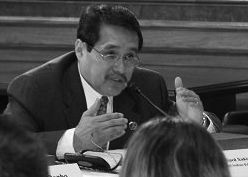
The startling news coming out of the Hopi Tribal Council meeting this week concerns the $22 million that Leroy Shingoitewa and you, Hopi Tribal Council, allowed Robert Lyttle to rack up on 45 of his attorney friends. We understand Shingoitewa and Lyttle advised the tribal council to not worry because they will “pay the tribe back” when they win the lawsuits. And we hear there is another $12 million more in invoices that still remain to be processed.

So why do you authorize the lawsuits, or do you? Is it so that Lyttle and friends can make money betting on the come that they will win the lawsuits? You know there are no guarantees that lawsuits will be won. The only guarantee is that Lyttle and his attorneys will get our money by racking up billable hours. And we lose.

While tribal members were surprised and aghast at the news, I was not surprised. Not at all! For some of us have been writing letters to you ever since Leroy Shingoitewa came into office and brought Robert Lyttle to the scene – around May 2010. We advised you of the excessive billings and all the attorneys that Lyttle brought to the tribe without the benefit of tribal council approval (council resolutions) and without attorney contracts. We know how Robert Lyttle works. We know what he did to several Arizona and California Indian tribes. Maybe you were not getting our letters, or maybe you were simply ignoring our advice, but this matter has now exploded into a very serious situation where there may be federal criminal violations committed. And our financial position is now in serious question. Certainly, the Hopi people are not happy.

We also advised you of the depletion of tribal accounts and the transferring of funds between accounts to pay the invoices because the other accounts ran dry. I advised you of the possible tax implications on the tribe (and Robert Lyttle and the attorneys). To this date, we don’t believe Lyttle has a legal contract with the tribe. Ask the question: is Lyttle and employee or is he a consultant? There is a big difference. Hard working and conscientious employees working in Finance have been summarily fired by Shingoitewa and Elward Edd for questioning the invoices. They were only doing their job. There are memos from Shingoitewa demanding the staff to pay the invoices. Our advice and complaints went into deaf ears.

The Hopi tribal constitution is very clear. It requires that attorney contracts be formally approved by the tribal council, by council resolution. The constitution also says the Tribal Treasurer cannot spend any money from the treasury unless authorized by tribal council resolution. We assume you, as council members, are aware of these provisions in our tribal constitution.

Because of our concerns about excessive payments to tribal attorneys and violation of tribal procurement policies by Shingoitewa, several of us exercised our right afforded us in the tribal constitution and requested to view the Treasurer’s financial records. As expected, we were denied our request so we filed a Writ of Mandamus in tribal court requesting the court to grant us access to the records. This matter is pending in tribal court.

So, now you have a decision to make. Your duty as tribal council members is to watch over our money. This obligation is spelled out in the tribal constitution. You are our fiduciaries. I advise you to hold off making any payments on the attorney invoices until and when you have completed an exhaustive investigation into this matter. In fact, I encourage you to withhold action on this matter until after the tribal election. But the questions remain the same: Are there authorizing tribal council resolutions for each attorney? Does each attorney have a legal contract with the tribe? Does each attorney contract have an identified (and approved) scope of work? Do the invoices contain the required information on what services were performed? Tribal accounts need a good look to see how much has been taken out and what the remaining balances are. I understand a tribal employee asked you the same questions at the October 29, 2013, tribal council meeting. He knows what he’s talking about.

We trust you will carry out your constitutional duties and protect our money; and hold people accountable.

Benjamin H. Nuvamsa

Village of Shungopavi 

Former Hopi Tribal Chairman

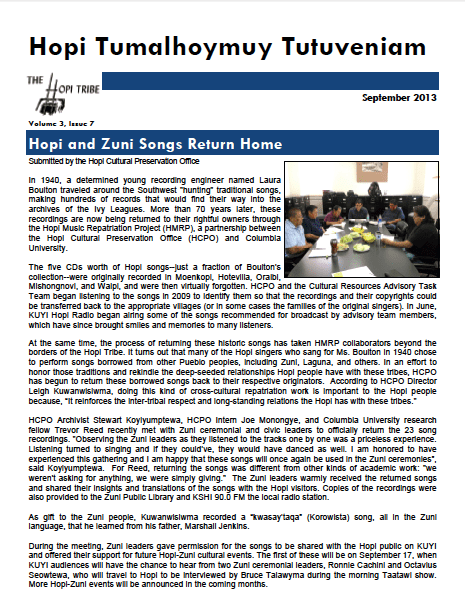
Hopi Tumalhoymuy Tutuveniam – November 2013

Screenshot 2013-11-08 09.41.46
Click to download (10 pages)

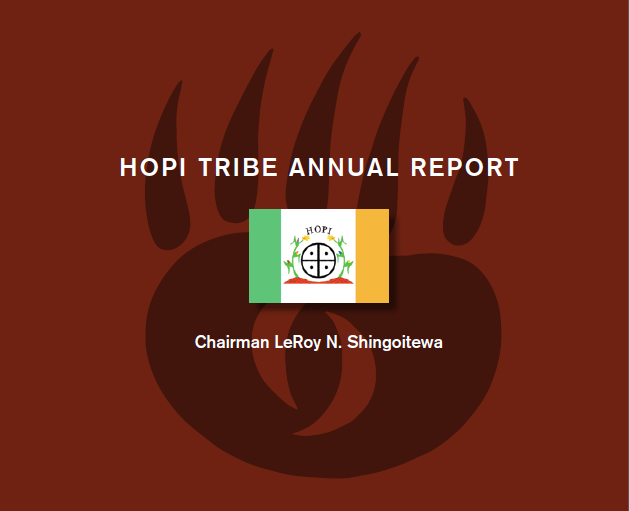
Hopi Tribe Annual Report – 2013

The following report by Hopi Tribe Chairman LeRoy N. Shingoitewa highlights his administration’s “major accomplishments over the past four years.” Click on the image to download the 10-page report.

Screenshot 2013-11-02 17.03.15
Click to download (10 pages)


University of Illinois seeks Assistant, Associate, or Full Professor of American Indian Studies

University of Illinois — Assistant, Associate, or Full Professor of American Indian Studies

The American Indian Studies Program at the University of Illinois, Urbana-Champaign (http://www.ais.illinois.edu) invites applications for an assistant, associate, or full professor position (full time tenure-track or tenured position).

American Indian Studies is searching for a scholar in interdisciplinary American Indian or Indigenous Studies with an emphasis on Native peoples from regions of North America where our campus is located, including the Lower Great Lakes, the Upper Mississippi, and the Mississippi cultural regions. The successful candidate will have a record of research excellence and publication in American Indian or Indigenous studies (tenured) or demonstrate potential to develop such a record (tenure-track). Along with research and publication, the position requires significant contributions to undergraduate teaching, graduate mentoring, in addition to program, university, and other forms of professional service. Current faculty in our unit conduct interdisciplinary research in a range of fields including comparative indigenous studies, media studies, expressive culture, intellectual history, literary history, educational history, sports, social and political theory, language revitalization, museum studies, governance, health, militarization, and performance. Candidates from all disciplinary backgrounds will be considered; however, the search committee is interested in candidates who complement the expertise of our current faculty, and we are particularly interested in candidates whose research focuses on design and fine arts, linguistics, language revitalization, environmental studies, landscape architecture, critical geographies, and disability studies. A joint appointment or teaching arrangement with another academic unit on campus is also likely.

Minimum qualifications include the PhD or equivalent by the start of appointment, clear knowledge and experience in American Indian and Indigenous Studies, scholarly achievement and promise, and evidence of teaching excellence. Experience working with American Indian or other Indigenous communities is a plus.

To ensure full consideration, create your candidate profile through http://go.illinois.edu/AISfaculty13 and submit your letter of application detailing current research plans, curriculum vitae, and contact information for three professional references by December 15, 2013.  The search committee may contact the applicant about soliciting letters of reference at a later point, after a first review of the files.  For inquiries regarding the position, contact search committee chair, Jodi Byrd (jabyrd@illinois.edu).  Target start date of August 16, 2014.  Salary is competitive and commensurate with experience.

Illinois is an Affirmative Action/Equal Opportunity Employer and welcomes individuals with diverse backgrounds, experiences, and ideas who embrace and value diversity and inclusivity. (www.inclusiveillinois.illinois.edu)

College of Education at the University of Arizona Announces an Open Rank Position in Indigenous Education

College of Education

The University of Arizona

The Department of Teaching, Learning and Sociocultural Studies

College of Education, University of Arizona

Announces an Open Rank Position in Indigenous Education

The internationally recognized Language, Reading and Culture (LRC) program in the department of Teaching, Learning and Sociocultural Studies (TLS) at the University of Arizona (UA) announces an open position in Indigenous Education effective August 2014. The UA not only lies in a dynamic transnational border region, but in close proximity to rich Native American cultures, including 22 federally recognized tribes in the state of Arizona. Native American students on the UA campus represent over 75 Native American tribes with the majority coming from Arizona tribes and reservations.  As a land grant institution, the UA has an important responsibility to Native American students and Nations. With the current open position, the College of Education at the UA seeks to further strengthen our undergraduate and graduate programs with the integration of Indigenous knowledge systems, epistemologies, and decolonizing research methodologies.

This position offers an opportunity to join a department comprised of two outstanding programs: Language Reading and Culture (LRC) and Teaching and Teacher Education (TTE). TLS faculty engage in interdisciplinary research and teaching, and demonstrate a deep commitment to social justice. TLS provides a collaborative work environment for faculty research and grant development and encourages cross-program and cross-departmental research initiatives, along with opportunities of collaboration across the college and the university. Existing faculty research and teaching interests in the area of Indigenous education include Indigenous youth language learning and practice; maintenance and revitalization of Indigenous language and culture; transnational Indigenous teacher education efforts; and Indigenous knowledge systems, including Traditional Ecological Knowledge (TEK) systems. Additional faculty areas of expertise and interest across the department include multicultural, multilingual and multiliteracy education; anthropology and education; immigrant education; applied linguistics; language policy and planning; literacy processes and pedagogy; early childhood education; world children’s and adolescent literature; STEM education; technology and literacy; teacher education; and environmental learning and sustainability education.

LRC attracts diverse and highly qualified students, including Native American students and Indigenous students from Latin America, to our master’s and doctoral programs. LRC is also engaged in transnational inter-university collaborations in Indigenous education, providing opportunities for faculty and students through courses, conferences, etc. with a global network of Indigenous scholars and students across Arizona and in Hawaii, Alaska, New Zealand, Canada, and Mexico. Faculty across the department are additionally working on incorporating Native American education-related offerings into our department’s early childhood, elementary and secondary teacher preparation programs and our undergraduate education non-teaching degree programs. Thus, LRC is committed to creating and supporting a community of Indigenous scholars engaged in critical exploration and redefinition of how research in Indigenous education gets done and how it is engaged in community, university, and other academic disciplines.

Our location in the southwestern United States and our long history of involvement with the education of Native American and minority youth throughout the state and in the border region offer many opportunities to conduct field-based research with diverse urban and rural populations. The position will provide opportunities to work with the UA’s distinguished American Indian Language Development Institute (AILDI), widely-recognized for its influential efforts in Indigenous language teaching, language revitalization and documentation. Teaching, research and outreach activities are also possible with SEED (Scholarships for Education and Economic Development), a vibrant, international Indigenous education exchange program that annually brings diverse Indigenous teachers and curriculum developers from Mexico for a year-long program in collaboration with institutions in Mexico. The College of Education offers additional opportunities for collaboration with Project SOAR, a service-learning experience that connects Native American undergraduate mentors with Native American middle school students in the Tucson area. The University of Arizona further provides opportunities for collaboration with renowned Native American faculty and programs in Linguistics, Indigenous Law and Policy, and American Indian Studies.

Qualifications:

Earned doctorate in education or in a closely related field.  Strong commitment to and experience in Indigenous and equity education, and a clear research and teaching agenda in Native American and Indigenous education, including one or more of areas such as the following:

*  Indigenous language maintenance, revitalization, planning and policy

*  Indigenous teacher preparation

*  Indigenous children’s/young adult literature

*  Indigenous education and new technologies

*  Indigenous knowledge systems including Traditional Ecological Knowledge, STEM education, and place-based education

Responsibilities:

*  Faculty load includes teaching, research and service

*  Develop a strong program of research, publication, and grant support

*  Teach graduate and undergraduate courses in areas of specialization

*  Advise masters and doctoral students, and participate on graduate student committees

Indigenous scholars are strongly encouraged to apply. Applicants with proficiency in one or more Indigenous languages and/or experience working with Indigenous populations in schools and/or communities are especially encouraged to apply.

Compensation:

Competitive salary plus opportunities for summer teaching and research support.

Application Process:  Please complete the electronic application form (Job 53712) and attach a letter of interest, a statement of research and teaching interests, your curriculum vitae, three representative publications/papers, and names and contact information for three professional references on-line at: http://www.hr.arizona.edu

Applications are now being accepted and will be reviewed starting on November 15, 2013. Review will continue until the position is filled.

For further information please call (520) 621-2928, or contact:

Dr. Leisy Wyman (lwyman@email.arizona.edu) Committee Chair

Department of Teaching, Learning and Sociocultural Studies

P. O. Box 210069

College of Education, University of Arizona

Tucson, AZ 85721-0069

Click here for the official job announcement.
Job shadowing my father, and my path to tenure

Earlier this summer the University of Illinois granted me promotion to associate professor with indefinite tenure in American Indian Studies & history. Since then, I’ve been thinking a lot about my path to tenure, and the road I took to get where I am now.

Thirty years ago I wanted to grow up to be an astronaut, a veterinarian, or a professional musician. I did not imagine that I would become a university professor or a “scholar.” But when I was a senior in high school, my perspective and desire changed.

At this time, I had a rare opportunity to “job shadow” my father* who was (and still is) a professor of education at Northern Arizona University (NAU).Picture 8

I clearly remember sitting in the back of the classroom as he taught his students from the front.

I had never seen my father in this type of setting, and I was amazed at his ability to communicate to his students, present his topic with much enthusiasm, and provide his students with a safe place to learn, disagree with each other, and to think analytically.

But there was more. My father also exemplified for me how powerful a skilled Native American instructor could be, both as someone who could offer unique insights into course material, and as someone who could be a model for others.

When he lectured on the integration of western science and Navajo and Hopi cultures, he did so with authority and confidence. His teaching was grounded in who he was as an indigenous person. His students understood this, and they benefited from the unique and personal perspective he brought to his lecture.

Although the class period lasted for only an hour, my experience observing my father had a major influence on my life.

In this brief moment, my father demonstrated to me the characteristics of a successful teacher. And he showed me how to excel as an American Indian faculty in a classroom of Native and non-Native students.

My observation job shadowing my father in the College of Education at NAU set in motion my eventual career as an academic.

It launched me on a path toward college and graduate school, and a tenure track faculty position at the University of Illinois.

As an assistant professor, I worked hard to fulfill my obligations  and responsibilities to the academy and my Hopi community. But I did not do it alone.

I had the support of my wife and children, my parents and other extended family members, colleagues and friends at Illinois and beyond, and many people back home.

Now on sabbatical, and on the other side of tenure, I find myself thinking a lot about the past seven years at Illinois.

But I also keep recalling the time when I job shadowed my father, and the significance this experience had, and continues to have, on my career and life.

——————————

*My father, Willard Sakiestewa Gilbert, is professor of Bilingual and Multicultural Education at Northern Arizona University (NAU). He grew up on the Hopi and Navajo Indian reservations in Arizona, and he received his Ed.D. (Doctor of Education) at the University of New Mexico. He has published a number of articles and book chapters, and once served as President of the National Indian Education Association (NIEA).

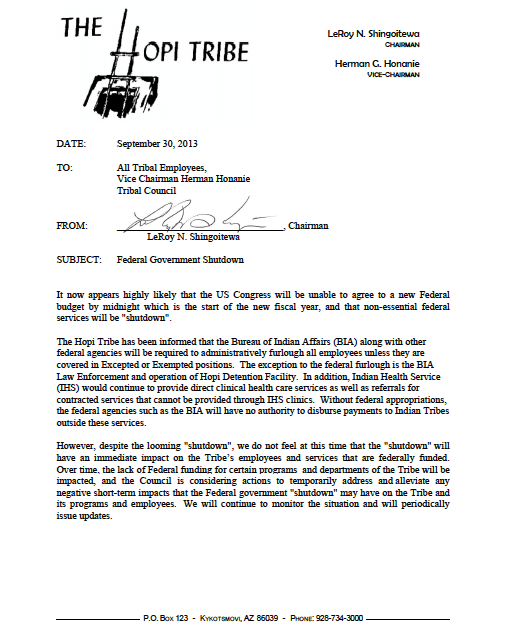
Hopi Tribe Memo Regarding Federal Government Shutdown

Screen Shot 2013-09-30 at 9.33.47 PM
Click to download

PRESS RELEASE: Mishongnovi Village Board of Directors Wins Landmark Case

Screen Shot 2013-09-30 at 8.34.31 AM
Click to download (2 pages)

Hopi Tumalhoymuy Tutuveniam – September 2013

Screen Shot 2013-09-24 at 8.28.21 AM