Letter to Hopi and Tewa people regarding Hopi Constitution Draft 24A by Benjamin H. Nuvamsa

January 21, 2011

To The Hopi and Tewa People:

On January 27, 2011, Hopi and Tewa people will be going to the polls to vote on a new tribal constitution that will replace our 1936 constitution, if the injunctions filed in tribal and federal courts by tribal members do not stop the election.  It is sad that many of the voters simply do not know what is contained in the proposed new constitution, Draft 24A, because the proponents failed to explain to them, in detail, the provisions of the proposed constitution.

The Hopi Tribal Council, on August 4, 2010, voted to allow the Secretarial Election to proceed, without knowing the full implications on our way of life.  The Hopi tribal leadership and council members that voted in favor of the action item failed to listen to tribal members who expressed grave concern over this draft.  Tribal members wanted to have input but were denied.  So once again, our tribal government has divided us.

A few of us who are concerned about the impacts the Draft 24A, took it upon ourselves to educate our people.  In our sessions, we found most, if not all are opposed to the proposed constitution.  We found that people are very angry at the tribal leadership for allowing this to happen without full consultation and their input.  Tribal members are adamant that we do what we can to preserve our traditional ways of life.

I cannot help but think of all the hard work and thought processes that the framers of our original 1936 constitution must have gone through to craft a document that has sustained us for over 75 years.  They were visionary people.  They were not divided and cared for the future of our people.  My grandfather, Peter Nuvamsa, Sr., our first tribal chairman, was one of the spokesmen along with Irving Pabanale, Albert Yava, and George Cochise.  Our village chiefs, Kikmomgnwit, throughout the villages were consulted, including Kutka and Tunewa (Sichomovi and Walpi), Sateli (Tewa), Talahevtewa (Shungopavi), Masaquaptewa (Sipaulovi), Komalevtewa (Mishongnovi), Lomavitu (Kykotsmovi), Tawakwaptewa (Oraibi), Kochongva (Hotevilla), Kiwanimptewa (Bacavi) and Siemptewa (Moenkopi).

The leaders and framers gave specific instructions to Oliver LaFarge to craft language that protected village sovereignty and our traditional ways.  They made sure the following provision was included: “Each village shall decide for itself how it shall be organized.  Until such a village shall decide to organize in another manner, it shall be considered as being under a traditional Hopi organization, and the Kikmongwi of such village shall be recognized as its leader”. (Emphasis added).  The leaders made sure the sovereign right of our villages was not delegated to the Hopi tribal council.  They made sure we did not simply adopt an Indian Reorganization Act template constitution.  But now, we are faced with a proposed constitution that is modeled after the Cheyenne-Arapaho Tribes’ constitution where Robert Lyttle participated in drafting their constitution.

Draft 24A destroys our traditional village governments because it contains the following replacement language: “Each village shall decide for itself how it shall be organized, including selection of its council representatives subject to section 3(b)(vi) below. Each form of village organization shall be consistent with the constitution”. (Emphasis added).  The new language eliminates a village’s decision-making right and eliminates them as “traditional organizations” and will require the villages to adopt new village constitutions that must be consistent with the new tribal constitution (Draft 24A).

There are many other things wrong with Draft 24A, including the complete elimination of Article XI – Taxation, from our current tribal constitution.   If 24A passes, the Hopi Tribe and villages can no longer impose taxes, fees, duties and assessments to produce revenues.  The tribe’s budget is heavily dependent on these revenues and will be impacted significantly.  Villages depend heavily, if not solely, on annual allocations from the tribe’s general fund.  Bringing our sovereign villages in as a fourth branch of tribal government is a foreign concept, even to how the United States and state governments are organized.  Draft 24A gives the tribal council and the president very broad powers and we lose the “balance-of-powers” controls.

The election process is also highly questionable.  While the Secretarial Election, by law and regulation, is the sole responsibility of the Bureau of Indian Affairs, we all know the tribal chairman and his staff is actually running the federal Secretarial Election while the local BIA offices stand by and allow it to happen.  Once the BIA assumed control and responsibility when it authorized the Secretarial Election on November 4, 2010, our voter registration and personal information came under the control of the federal government and protection under the federal Privacy Act, but the tribal staff gained direct and unauthorized access to our records.  As a result, some voters received a letter from the tribal chairman’s office in an attempt to sway their votes using the addresses of the registered voters.  Because of the breach of our privacy, I am no longer confident that we will, in fact, have a clean, legitimate election.

It is unfortunate the tribal council (the 8 members that voted in favor) did not consider the full impacts of Draft 24A and did not allow for full dialogue on this draft before they voted to approve the action item on that infamous day of August 4, 2010.

Federal rules require that only 30 per cent of the 1,488 registered voters are required to cast their votes to make this a legitimate election.  This means a minimum of 446 votes must be cast and a majority of those votes, or a minimum of about 227 votes, are required to approve Draft 24A.  We only hope and pray that Hopi and Tewa people will make an informed decision before casting their votes.

Benjamin H. Nuvamsa

Village of Shungopavi & Former Hopi Tribal Chairman


Hopi Youth Return to Mesa Verde – A film by Hopi Footprints of the Ancestors

A few weeks ago I passed along an announcement on my blog about 4 Hopi film screenings at the Museum of Northern Arizona. One of these films was Hopi Youth Return to Mesa Verde. This film examines a group of Hopis who traveled to a Hopi migration settlement called Mesa Verde in Colorado. As you watch the film, take note of the similarities that the youth bring up between Hopi ancestral ways and the practices of today’s Hopi people. Their remarks on the continuity of Hopi culture is an important theme in the film.

Matthew Sakiestewa Gilbert

Hopi Code Talker Rex Pooyouma

Today, as we consider the anniversary of the bombing of Pearl Harbor, I want to take a moment and remember Hopis who served their village communities and the United States in World War II. One of these individuals was Rex Pooyouma from the village of Hotevilla on Third Mesa. During the War, Mr. Pooyouma served in the Native American Code Talker Communications Network. He was one of at least 10 Hopi code talkers who used their language to transmit critical messages that saved the lives of countless people and helped to end the War.

In November 1945, Mr. Pooyouma received an honorable discharge from the military at the rank of Private First Class.  He was a decorated soldier and earned several medals, including the American Campaign Medal, the Philippine Liberation Medal, and a Bronze Star. In October of this year, Mr. Pooyouma, the last known surviving Hopi code talker, passed away at the age of 93. He will always be remembered as a hero among our people and one who ventured beyond the Hopi mesas to serve his community and nation.

For more information on Mr. Pooyouma’s involvement in World War II and his role as a Hopi code talker, please visit the following website: http://nhonews.com/Main.asp?SectionID=1&SubSectionID=1&ArticleID=12971

Matthew Sakiestewa Gilbert

Hopi Footprints of the Ancestors: Film Premiere and Discussion with Hopi Youth and Elders

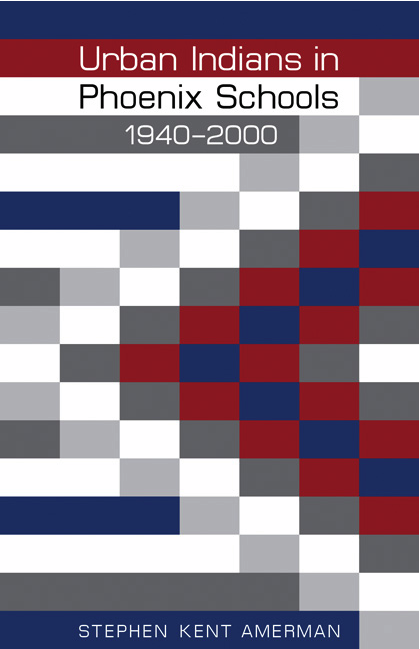
Urban Indians in Phoenix Schools, 1940-2000 by Stephen Kent Amerman

Image courtesy of University of Nebraska Press

Stephen Kent Amerman, an associate professor of history at Southern Connecticut State University, has published a book entitled Urban Indians in Phoenix Schools, 1940-2000. His book is part of the Indigenous Education Series with the University of Nebraska Press. Various studies have been written on the educational experiences of American Indian people. However, much of this literature has tended to focus on the Indian boarding school experience during the so-called assimilation period. Recent studies, such as Taos/Dine scholar Glenabah Martinez’s monograph, Native Pride: The Politics of Curriculum and Instruction in an Urban Public School and Amerman’s book, fill a major gap in the literature on the experiences of Native students who attended public high schools. Amerman also writes about Hopis who went to Phoenix urban schools, which is a topic not often examined by scholars of Hopi and Indian education history. Below is a brief synopsis of the book from the University of Nebraska Press website.

Matthew Sakiestewa Gilbert

In the latter half of the twentieth century, tens of thousands of Native American families moved to cities across the United States, some via the government relocation program and some on their own. In the cities, they encountered new forms of work, entertainment, housing, and education. In this study, Stephen Kent Amerman focuses on the educational experiences of Native students in urban schools in Phoenix, Arizona, a city with one of the largest urban Indian communities in the nation. The educational experiences of Native students in Phoenix varied over time and even in different parts of the city, but interactions with other ethnic groups and the experience of being a minority for the first time presented distinctive challenges and opportunities for Native students.
Using oral histories as well as written records, Amerman examines how Phoenix schools tried to educate and assimilate Native students alongside Hispanic, Asian, black, and white students and how Native children, their parents, and the Indian community at large responded to this new urban education and the question of their cultural identity. Reconciling these pressures was a struggle, but many found resourceful responses, charting paths that enabled them to acquire an urban education while still remaining Indian.
Stephen Kent Amerman is an associate professor of history at Southern Connecticut State University. His articles have appeared in American Indian Culture and Research Journal, American Indian Quarterly, and Journal of Arizona History.

Hopi runners article available for download

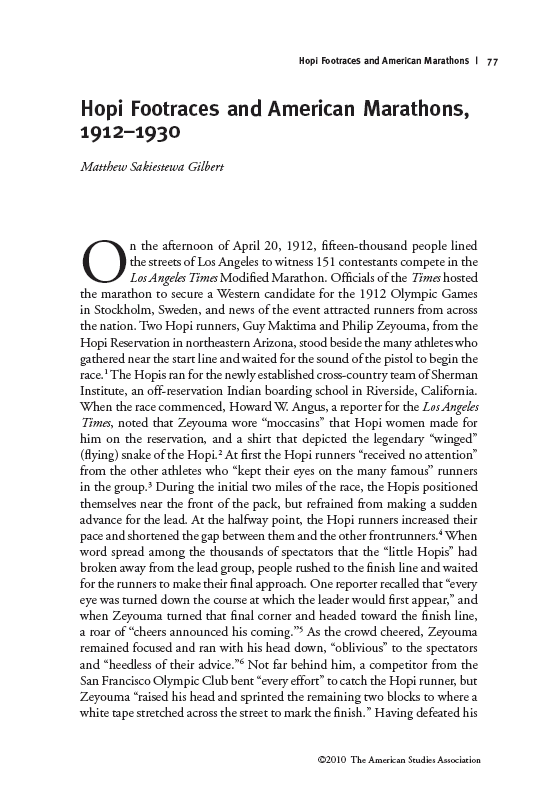
Over the past year, several people have stumbled across my blog looking for information on Hopi runners. For those who might be interested, I have made my article “Hopi Footraces and American Marathons, 1912-1930” (American Quarterly, March Issue 2010, Vol. 62, No. 1, pp. 77-101) available for download. Simply click on the above image to download the article as a PDF document.

Matthew Sakiestewa Gilbert

Education beyond the Mesas: Hopi Students at Sherman Institute, 1902-1929 (University of Nebraska Press)

On Monday of this week the University of Nebraska Press released my book Education beyond the Mesas. My book examines the Hopi experience at Sherman Institute in Riverside, California, from 1902 to 1929. It is a story of resistance, accommodation, and ways Hopi pupils navigated within their village communities, U.S. government policies, and an institution that was designed to destroy their identities as American Indian people. Furthermore, my book is a story of agency, and it demonstrates how Hopi students used their culture to succeed at school, and examines the challenges the pupils faced when they returned to their homes on the reservation.

Thirty one years ago historian David Wallace Adams remarked that a “ study on the federal Indian boarding school system does not exist.” Today the field of Indian boarding schools has grown substantially with contributions from scholars such as Adams, K. Tsianina Lomawaima, Brenda Child, Clyde Ellis, and many others. Recent studies have focused on Indian health, literature, education policies, and the ways Indian pupils “turned the power” at schools originally designed to destroy American Indian cultures. A term used by historians Clifford E. Trafzer, Jean Keller, and Lorene Sisquoc, “turning the power” describes the ability of Native students to turn their educational experiences to their advantage, which often included bringing helpful knowledge and skills back to their indigenous communities.

In my book I examine the ways Hopis “turned the power” at Sherman Institute, and I build upon the work of several scholars including those who have written about the mandatory enrollment of Hopi students at U.S. government schools. While many books on Indian boarding schools examine the experiences of Native students who came from several communities, Education beyond the Mesas is a community specific book that seeks to understand the Hopi experience at Sherman Institute through a Hopi historical and cultural framework.  In the book’s Introduction, I argue that a community specific book on the Hopi places

the history and culture of the Hopi people at the focal point of the narrative. It asks how a student’s culture and tribal history influenced their experience at an Indian school, and builds upon the contributions of other scholars to uncover the complex ways that Hopi history and culture intersected with U.S. government policies. Apart from providing the reader with a historical narrative, this book challenges the notion that a study on the Indian boarding school experience must be understood primarily through a defined framework of Indian education policies. Community-specific books begin with the history and culture of Native people and attempt to determine how students understood their unique experiences at Indian boarding schools as Zunis, Navajos, Apaches, or other Indian people. [Education beyond the Mesas, p. xxix]

I would not have been able to complete this book without the help and support of many individuals. I am especially thankful to my wife, Kylene, and our daughters Hannah, Meaghan and Noelle, and other family members. My colleagues at the University of Illinois, in both the American Indian Studies Program and the Department of History, have provided me with tremendous support since I arrived at Illinois in Fall 2006.

I further extend appreciation to the Hopi Cultural Preservation Office, the Hopi Education Endowment Fund, and the Hopi Tribe Grants and Scholarship Program who so generously made available resources for me to pursue an education beyond the mesas. There are also many Hopi and non-Hopi scholars, students, and community members who have helped and encouraged me along the way, which includes the incredible editorial staff at the University of Nebraska Press. Finally, I wish to acknowledge my grandfather, Victor Sakiestewa, Sr. from Upper Moencopi, who gave me the inspiration and reason to write on his alma mater, “dear ole Sherman.”

Matthew Sakiestewa Gilbert

Hopi educator Sahmie Sunshine Wytewa NIEA board of directors candidate

Sahmie Sunshine Wytewa, 2010 NIEA Board of Directors candidate

I am pleased to announce that Sahmie Sunshine Wytewa, an enrolled member of the Hopi Tribe and lifelong educator, is an official candidate for the National Indian Education Association (NIEA) board of directors.  Wytewa comes to the NIEA with an incredible amount of experience, a passion for the advancement of Indian education, a close connection to the Hopi community, and an impeccable work ethic. NIEA members will have the opportunity to vote for candidates at the upcoming NIEA Convention held in San Diego, California, on October 7-10, 2010. Below is Wytewa’s personal statement on the NIEA website: http://www.niea.org/events/board.php

Sahmie Sunshine Wytewa, Hopi: Ms. Wytewa is a prime candidate for NIEA board membership given her strengths as a practicing educator, educational background, and her strong desire to provide leadership in education. In addition to her professional qualities, she is also an involved community member of the Hopi tribe who has endured the challenges of balancing her culture and educational pursuits. As a mother, Sahmie has taken great care in providing the experiences of traditional values and real-life expectations for her children.

As an educator, Ms. Wytewa understands the significance of accountability in academic achievement and the inequalities that are reflected in the quality of education and misrepresentation of Native populations in regards to academic performance. Working in underperforming schools going through School Improvement, she has the working knowledge of current initiatives in educational reform. Her skills as a teacher have allowed her firsthand insight into the trends in achievement, learning modes of children, and research-based strategies that promote academic growth.

Ms. Wytewa’s continued professional growth is the direct result of her desire to improve the quality of education and learning experiences for all students. Channeling her efforts to further develop reform in Indian education, Sahmie has chosen the course of advancement through leadership. She is committed to working in collaboration with like-minded individuals or groups towards student-centered reform.

With strong ties to her community, Sahmie has an authentic link giving her the advantage of providing background in an otherwise vague theme of Indian education. It is with these combined strengths and efforts, that Ms. Wytewa can be a true asset to the NIEA board in providing many perspectives of education.

Hopi Footrace on Second Mesa

Louis Tewanima standing with his many trophies and medals. He is wearing his Carlisle track suit. Photo courtesy of the American Indian Athletic Hall of Fame

In less than a week, family members of Hopi runner Louis Tewanima will host the 37th Annual Louis Tewanima Footrace at the village of Shungopavi on Second Mesa. Tewanima is one of the most celebrated runners in Hopi history and he is best known for winning a silver medal at the 1912 Olympic Games in Stockholm, Sweden. As I think about the upcoming footrace, I am reminded of another Hopi footrace on Second Mesa that involved Tewanima.

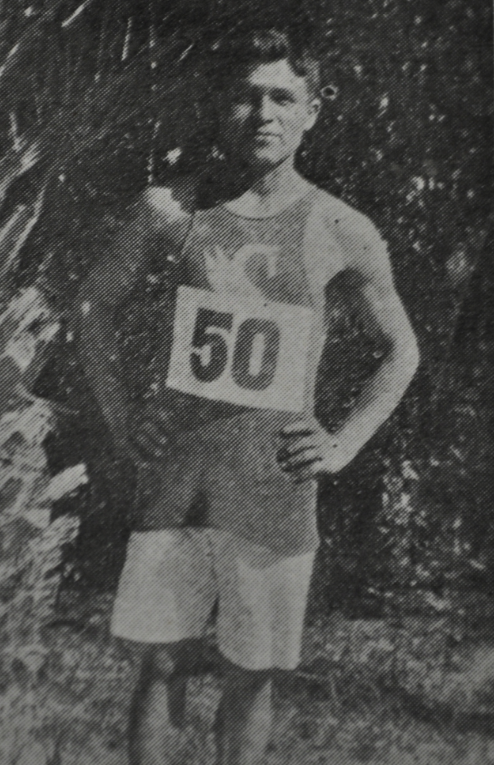
In a previous post, I wrote about a Hopi runner named Philip Zeyouma who competed for Sherman Institute at the same time Tewanima ran for the Carlisle Indian Industrial School in Pennsylvania. In April 1912, Zeyouma won the Los Angeles Times Modified Marathon of 12 miles, which earned him an opportunity to compete for the U.S. team in Stockholm. On the other side of the country, Tewanima, who by this time had won several running events, was also scheduled to run in the Olympics.

When news that the two Hopi runners would race against each other in Sweden, excitement spread among the students at both schools. Students at Sherman Institute gloried in the thought that one of their Hopi runners would defeat the famous Louis Tewanima, and the pupils at Carlisle had great confidence that Tewanima would outrun the Hopi runner from Sherman. But the showdown between Zeyouma and Tewanima at the Olympic Games in Sweden never took place.

Shortly before Zeyouma was supposed to leave for Sweden, his father expressed disapproval of his son’s participation in the Olympics. Not wanting to disappoint his father, Zeyouma honored his request and went back to the Hopi Reservation for the summer. However, in my article “Hopi Footraces and American Marathons, 1912-1930,” I note that the

rivalry between the two Hopi runners did not cease when Tewanima migrated back to the Hopi mesas as an Olympian. In September 1912, shortly before they returned to their schools, Tewanima and Zeyouma challenged each other to a race on the Hopi Reservation.  On the day of the race, Hopis from the surrounding villages gathered around the starting line and anxiously watched as the two runners made their mark for the twelve-mile course. Zeyouma proudly wore his “Sherman colors,” while Tewanima “appeared in his Carlisle track suit.”

By wearing their running uniforms, the Hopi athletes saw the event as a race between the two schools and identified themselves according to their school affiliation. However, such a display of school loyalty did not go unchallenged by the other Hopi runners in the crowd. Seconds before the race began, some of the older Hopi men remarked that the “boys did not look like [Hopi] runners” at all, and teased Zeyouma and Tewanima for wearing their running outfits. A New York Times reporter noted that when Tewanima heard the men’s insults, Tewanima replied, “If you don’t like our looks get in, and show what you can do.”

The men promptly accepted his challenge and entered the race with no shoes or track suits, and wore “merely discarded” clothes. Six miles into the race, the older men proved too much for the young runners and Zeyouma and Tewanima quit and left the “race to the barefooted runners in the lead.” Coach Joe Shoulder recalled that the winner was about fifty years old, and he looked like he was “dying of consumption” (tuberculosis).

The outcome of the race provides a telling commentary on running in Hopi culture, as well as the relationship between older and younger runners. While the younger runners migrated to off reservation Indian boarding schools, the vast majority of the Hopi people, including older men who were known for the ability to run long distances, remained at home. Consequently, some of the best long-distance runners in U.S. history received little or no attention by those outside of the Hopi community. Although newspaper reporters seemed surprised that men in their fifties had the ability to defeat the younger athletes, the people knew that other Hopis could easily outrun the Hopi Olympian and the track star from Sherman Institute. [“Hopi Footraces and American Marathons, 1912-1930,” American Quarterly, March 2010, vol. 62, no. 1, p. 87, 88]

On Sunday September 5, 2010, runners of various ages will come together to run a footrace on Second Mesa. They will once again make their mark on the start line and run a course similar to the one taken by Tewanima, Zeyouma, and the older runners of the village. In honor of Tewanima, who still inspires thousands of individuals to run, the annual Louis Tewanima Footrace gives testimony to Tewanima’s legacy as an Olympic runner and the continuation of footraces among the people.

Matthew Sakiestewa Gilbert

Philip Zeyouma after winning the 1912 Los Angeles Times Modified Marathon. Photo courtesy of the Sherman Indian Museum

Receive 20% off EDUCATION BEYOND THE MESAS

Receive 20% off each copy of Education beyond the Mesas: Hopi Students at Sherman Institute, 1902-1929, if you order from the University of Nebraska Press. Mention promotion code 6AF10 to obtain the discount. For more information, please click on the following link to download the book’s promotional flyer: Education beyond the Mesas – flyer

Matthew Sakiestewa Gilbert