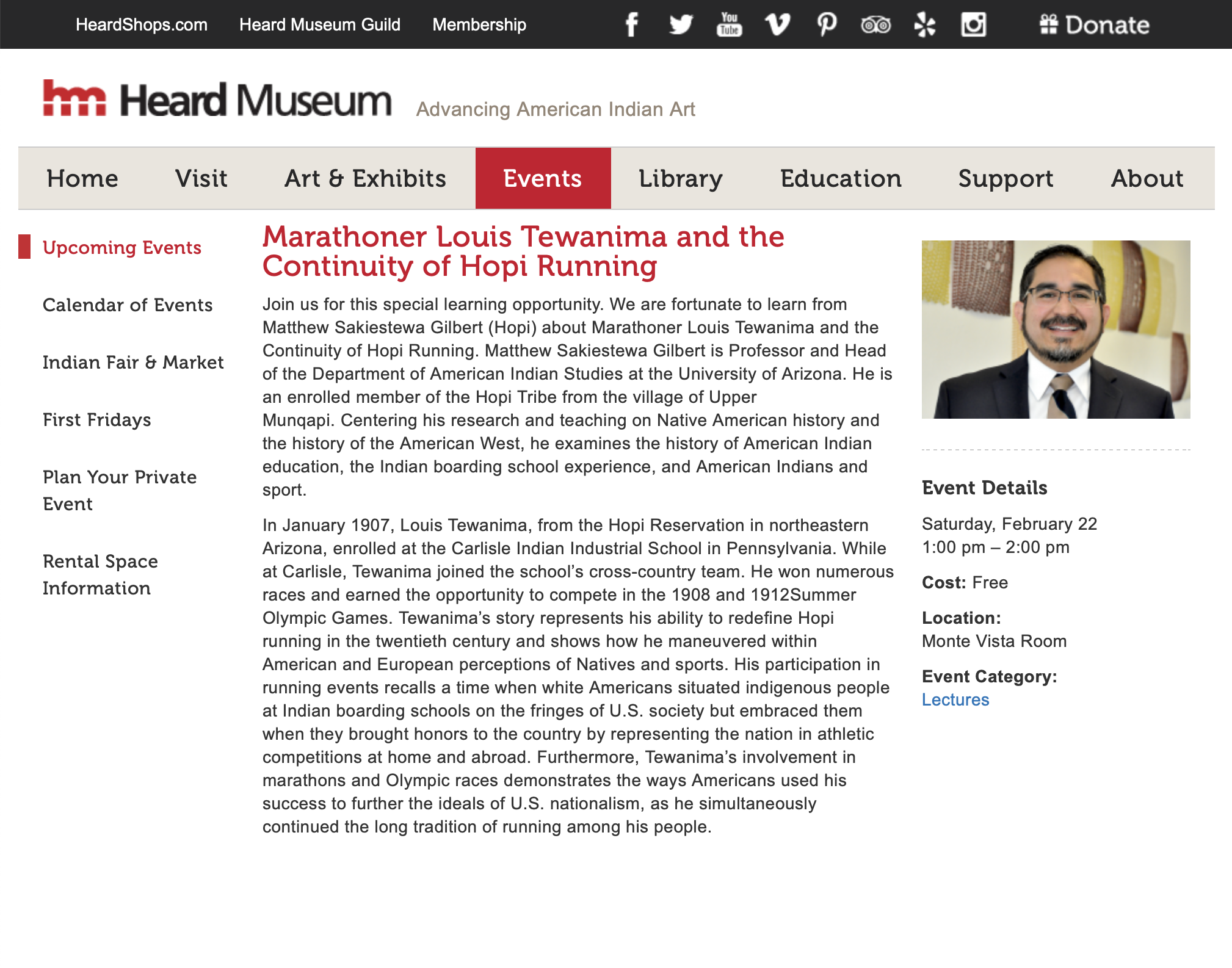
Below is a talk I gave at the Organization of American Historians conference (San Francisco, CA) on April 12, 2013. My talk was part of a panel discussion organized by Creek historian Donald Fixico on Native historians and the field of Native American history. At the time, I was an assistant professor of American Indian studies and history at the University of Illinois at Urbana-Champaign. It was an honor for me, especially so early in my career, to be invited to deliver a paper for this panel by such an esteemed Native historian.
********************************************
Native Historians and the Future of American Indian History
by Matthew Sakiestewa Gilbert
It’s an honor to be here today.
I want to thank my fellow panelists, Rose Stremlau and Paul Rosier, our Chair Sherry Smith, and a special thanks to Don Fixico, who invited us to participate in this morning’s panel.
As many of you would agree, it’s an exciting time to work on American Indian history.
I think back to much of the 20th century when Native history was predominantly written by white, male scholars.
Some here might say that not much has changed.
Perhaps this is true, and it likely is, but there are shifts in our field that encourage me as an indigenous person, and that are worth discussing in today’s forum.
This morning, I want to focus my comments, albeit very brief comments, on the work and role of Native historians.
I’m encouraged by the number of Native historians who recently completed their Ph. D.s, secured faculty appointments, and are actively publishing their work. I’m thinking here of Oneida historian Doug Kiel, Cherokee and Choctaw historian Kent Blansett, and Apache and Dakota historian Kiara Vigil.
These, and many other Native historians, are on my “radar.” And they should be on all of our “radars” as we think about the future of American Indian history.
Some of these historians, such as Doug Kiel, have chosen to write about their own people, and some have attempted to explain their people’s histories by using indigenous frameworks and Native ways of understanding.
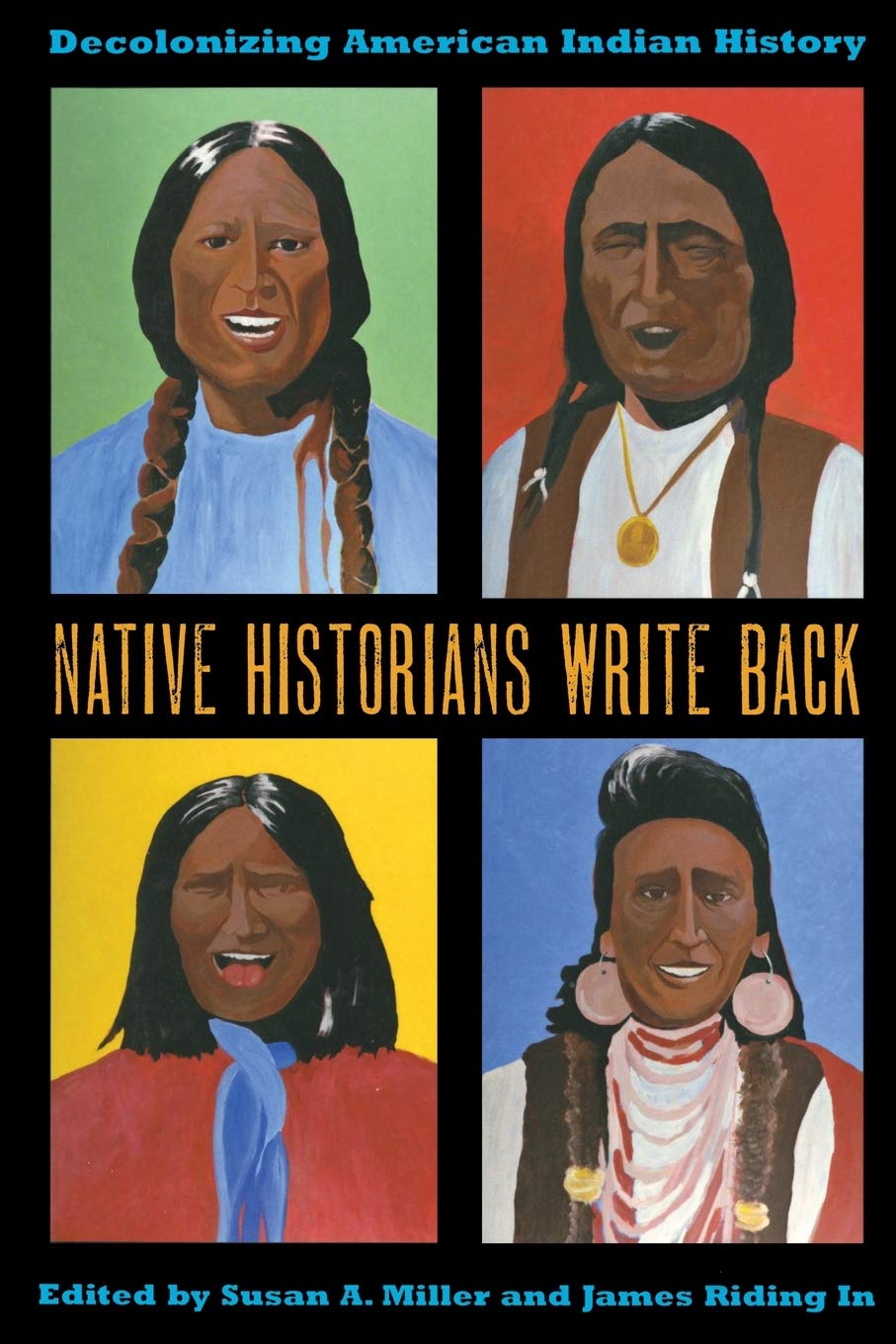
This, of course, reminds me of Seminole historian Susan Miller, who in her edited book Native Historians Write Back, keenly observed that Indigenous thinkers often prefer to “work within” their “own people’s specific worldview.”
Native historians understand this. We get it, but our use of indigenous frameworks (or epistemologies) in our work do not always clearly or convincingly translate with non-Native historians.
I experienced this most recently when I submitted an essay on Hopi runner Louis Tewanima to the Western Historical Quarterly.
I was surprised that one of the reviewers had noted that my essay lacked a theoretical frame or argument.
In my essay, I argued (in part) that when Tewanima competed and excelled in American and Olympic marathons, he followed in the tradition of ancient Hopi clan runners who once ran far beyond Hopi ancestral lands to bring blessings to the Hopi people.
I situated Hopi culture at the center of the narrative, and I used a Hopi frame to explain his participation and success in national and international running events.
I did not want to write just another article on running – or even Native running. Nor did I want to provide readers with another romantic portrayal of Tewanima.
Either my reviewer did not see the Hopi frame that I was employing, or he or she refused to accept it.
As Native historians, we need to continue asserting and introducing indigenous frameworks of understanding in so-called mainstream academic history journals.
We know that this approach to Native history will be welcomed in American Indian Studies journals, but we have a broader (history) audience to reach with our work.
And this audience needs to be reminded that there are ways of thinking of Native history that go beyond the theories and models so commonly used and accepted by Western historians.
Finally, some of us need to do a better job consulting the scholarship of Native historians and other thinkers when we research and publish on their indigenous communities.
When we write about the Choctaw or Kiowa, we ought to honor their people by citing and listening to their scholars and other writers. Of course, I’m thinking here of Choctaw historian Jacki Thompson Rand, Choctaw writer LeAnne Howe, and Kiowa historian Jenny Tone-Pah-Hote.
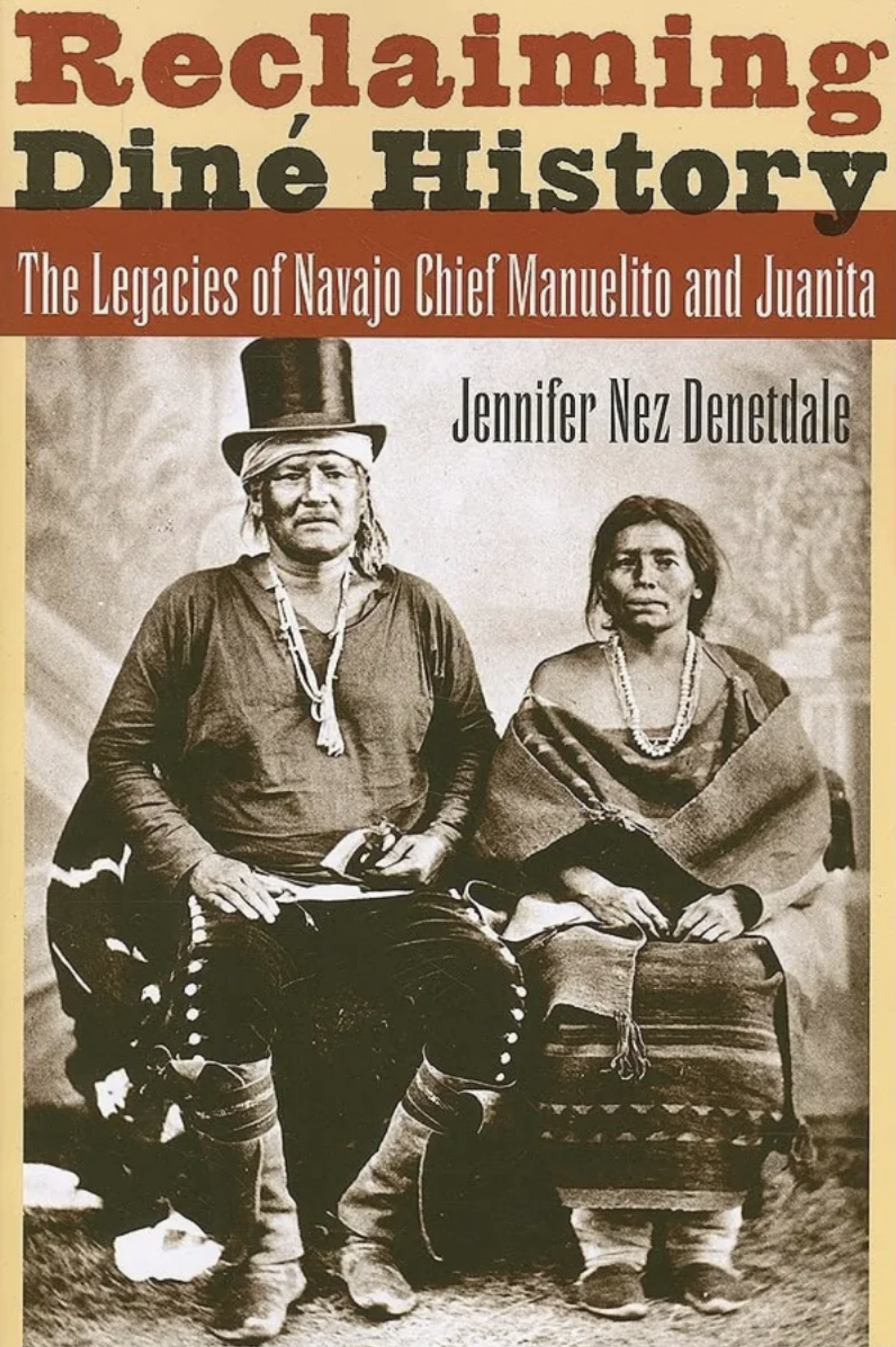
And when we write about the Dine’, we ought to ask ourselves how the work of Dine’ historians Jennifer Nez Denetdale, Lloyd Lee, and many others might enlighten our understanding of their people.
Some here might say that I am simply stating the obvious.
I wish this were the case, but having peer-reviewed numerous essays for journals and other academic publications in my relatively short academic year, I know that this remains a problem in our field.
Indigenous communities did not send us to academic institutions to receive Ph. D.s in history to simply increase the number of Native faculty at universities and colleges.
They did not send us to academic institutions to simply add a bit of color to a once predominantly white narrative.
We have a message to tell about our history and cultures. And we have a responsibility to tell these histories in ways that are meaningful and useful to our people.
When we write about our people, our voices matter. They have always mattered.
I know that I spent my time talking about Native historians, but there are also young non-Native scholars such as Kate Williams and Kevin Whalen who are making noteworthy contributions. We should be appreciative when our Non-Native colleagues do it right and honor Indian people with their work.
In conclusion, I want to emphasize again that this is an exciting time to research and write on the history of American Indian people. We have a bright future ahead of us, and I look forward to seeing how the field will evolve and improve as Indian people take greater ownership of their past and write histories that originate from their communities and perspectives.
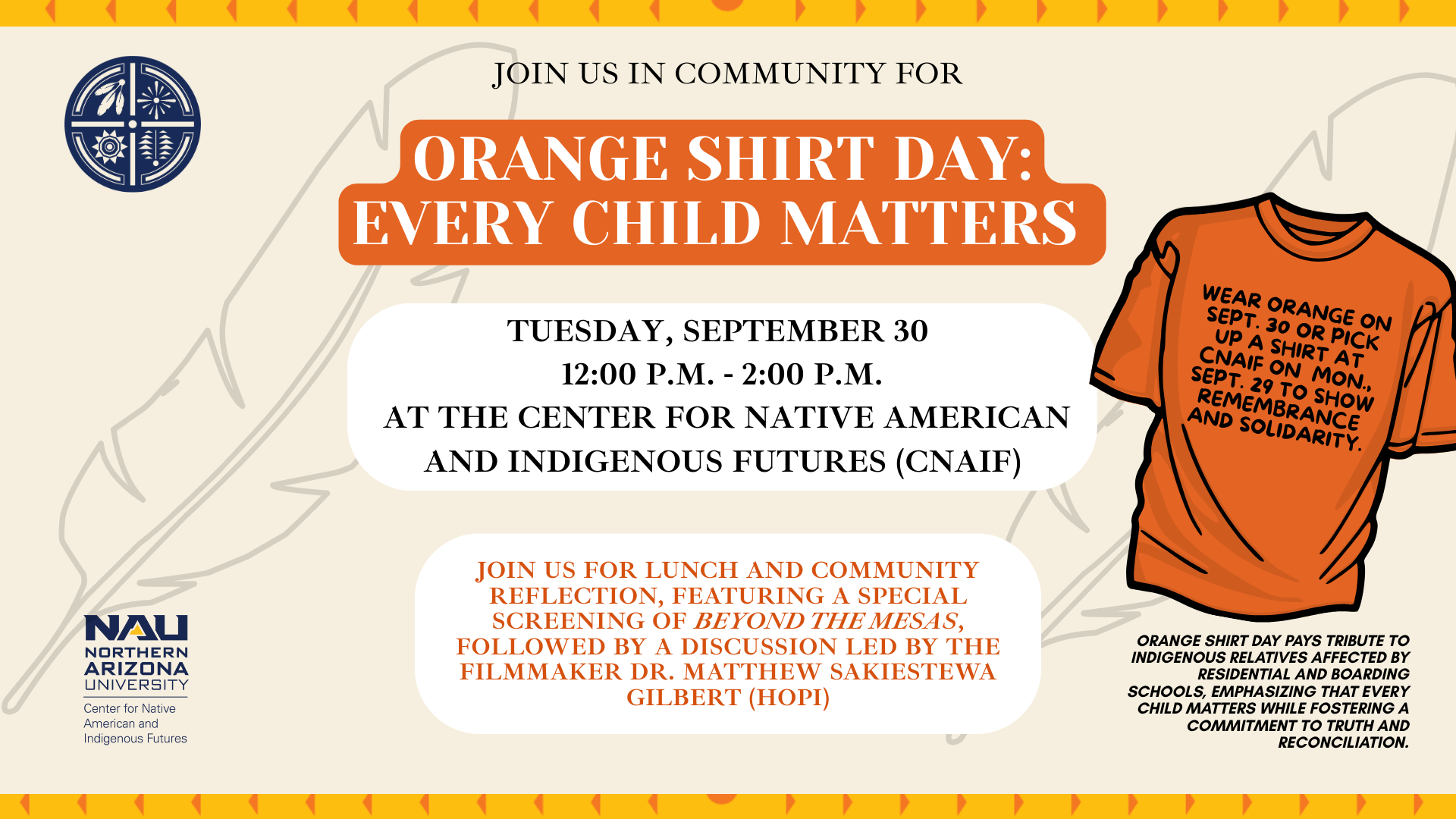
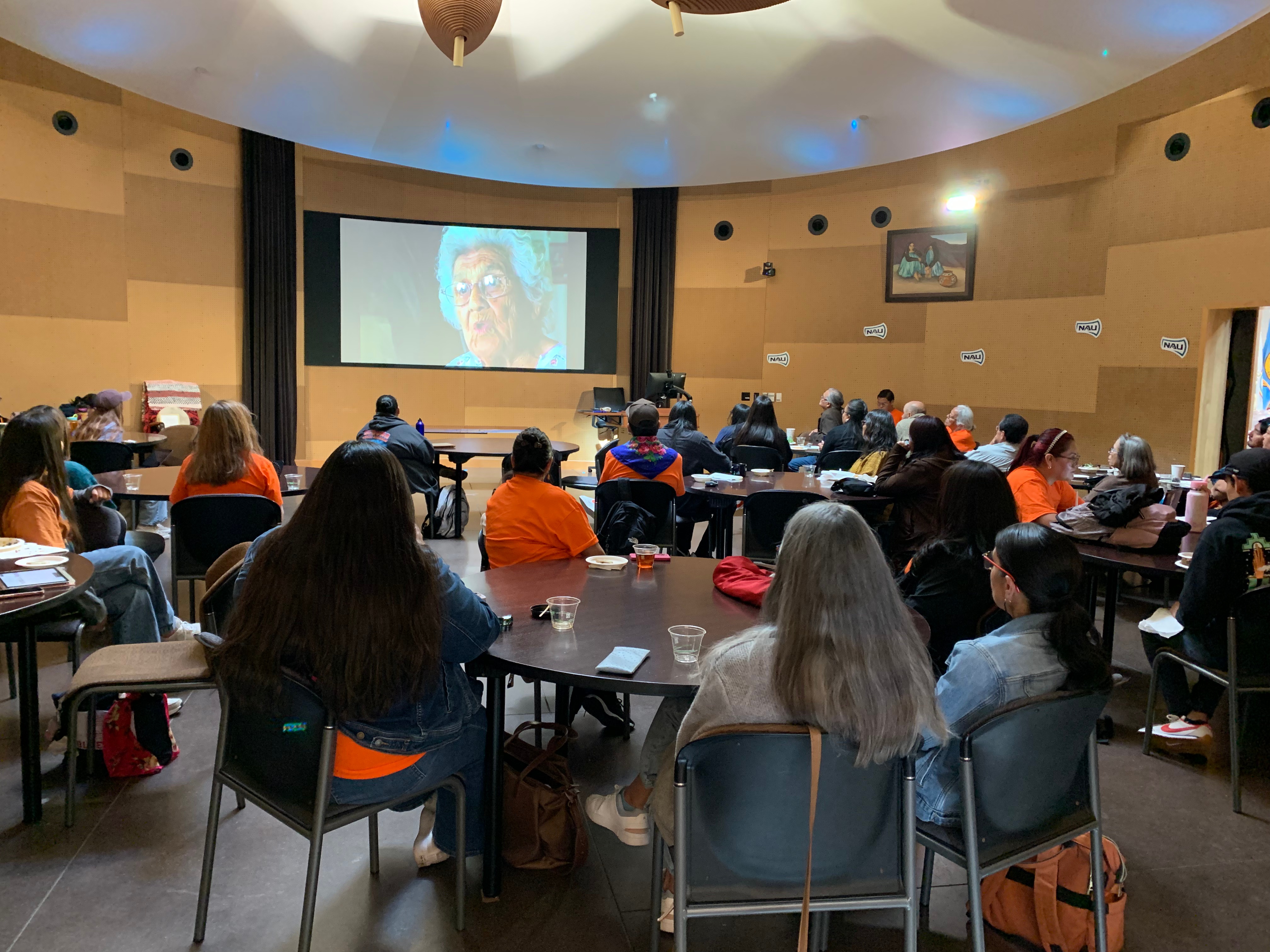
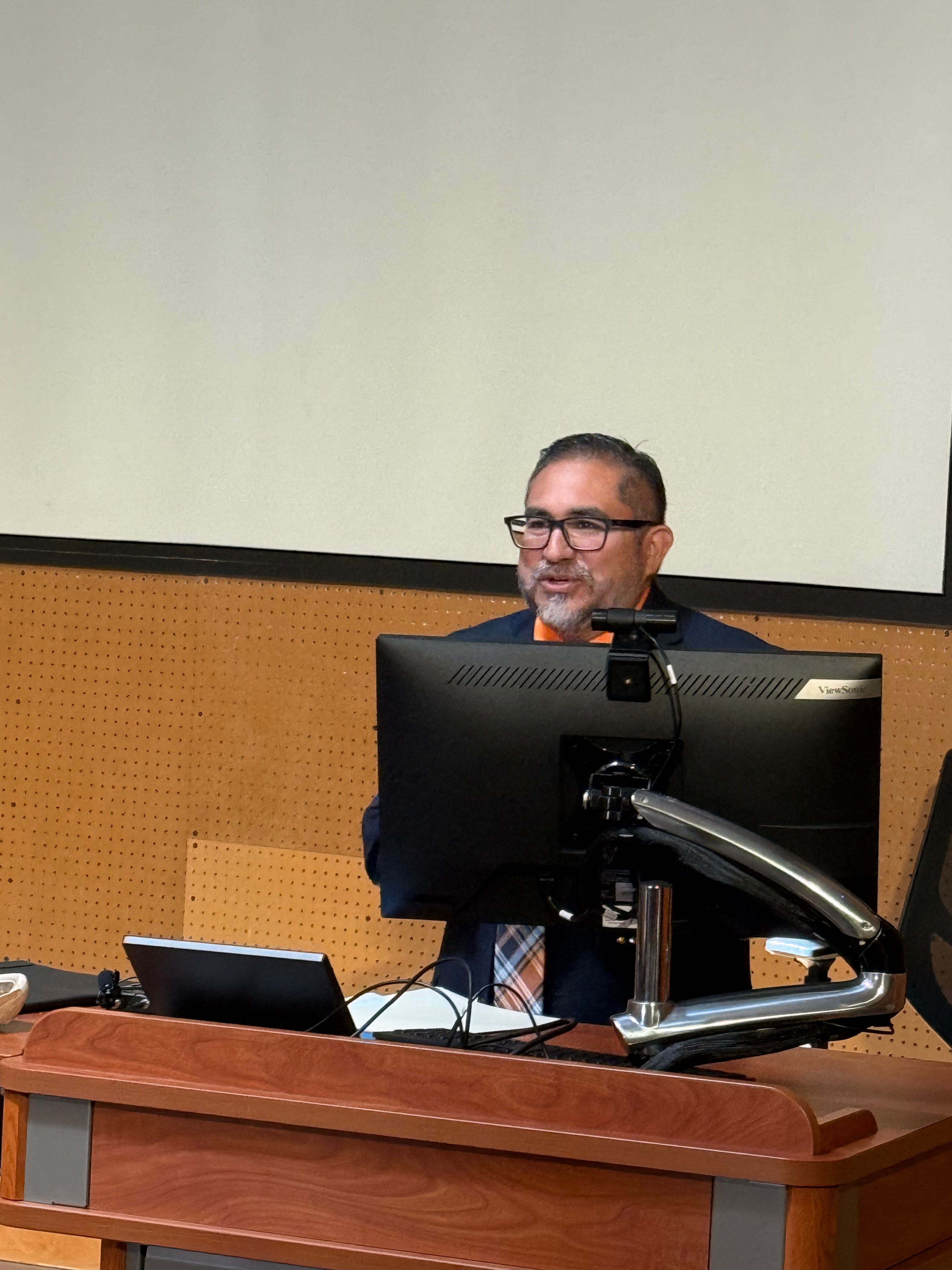
On September 30, 2025, the Center for Native American and Indigenous Futures (CNAIF) at Northern Arizona (NAU) invited me to screen Beyond the Mesas and say a few words before the screening. The event was part of CNAIF’s annual Orange Shirt Day to pay tribute to those who have been affected by the Indian boarding school experience. A special thanks to Sheena Hale, Director of the CNAIF, for this opportunity. Below is the text of my talk.
**************
Good afternoon, everyone,
Thank you for that kind and generous introduction.
It is such an honor to be here.
I have fond memories of Northern Arizona University.
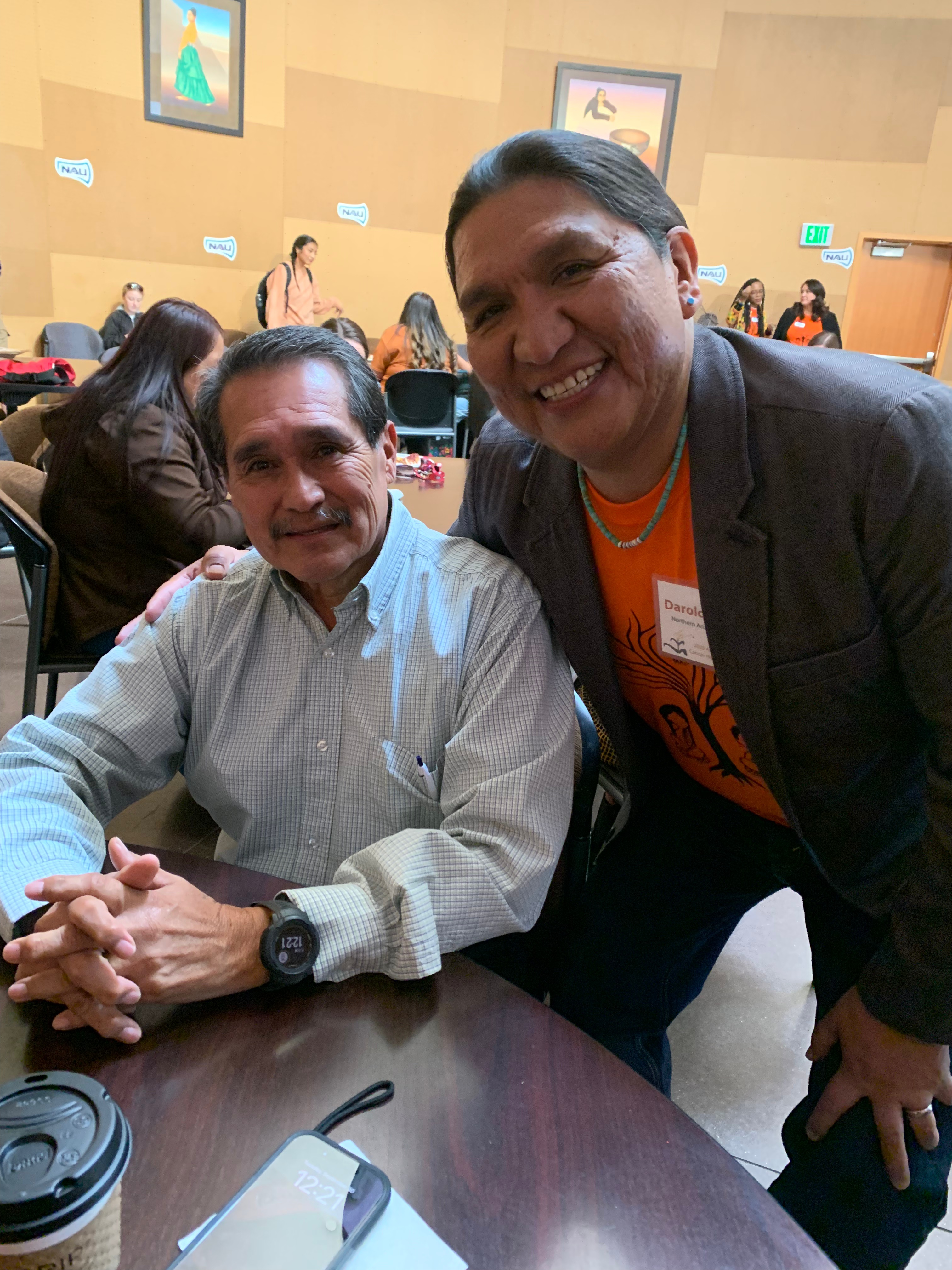
When I was ten years old, my father, Willard Sakiestewa Gilbert (who is here today), accepted a faculty position in the College of Education as an Assistant Professor of Curriculum and Instruction. He remained at NAU for 32 years, retiring in 2019 at the age of 67.
My father (left) with his former student, Dr. Darold H. Joseph (Hopi)
Needless to say, I spent a lot of time on this campus, especially when I was younger. Running around the track at the old Athletic Center building, swimming laps at the Aquatic Center, and one time I even got the day off from school (I attended Flag High) to job shadow my father, learning all about what he did as a professor at NAU.
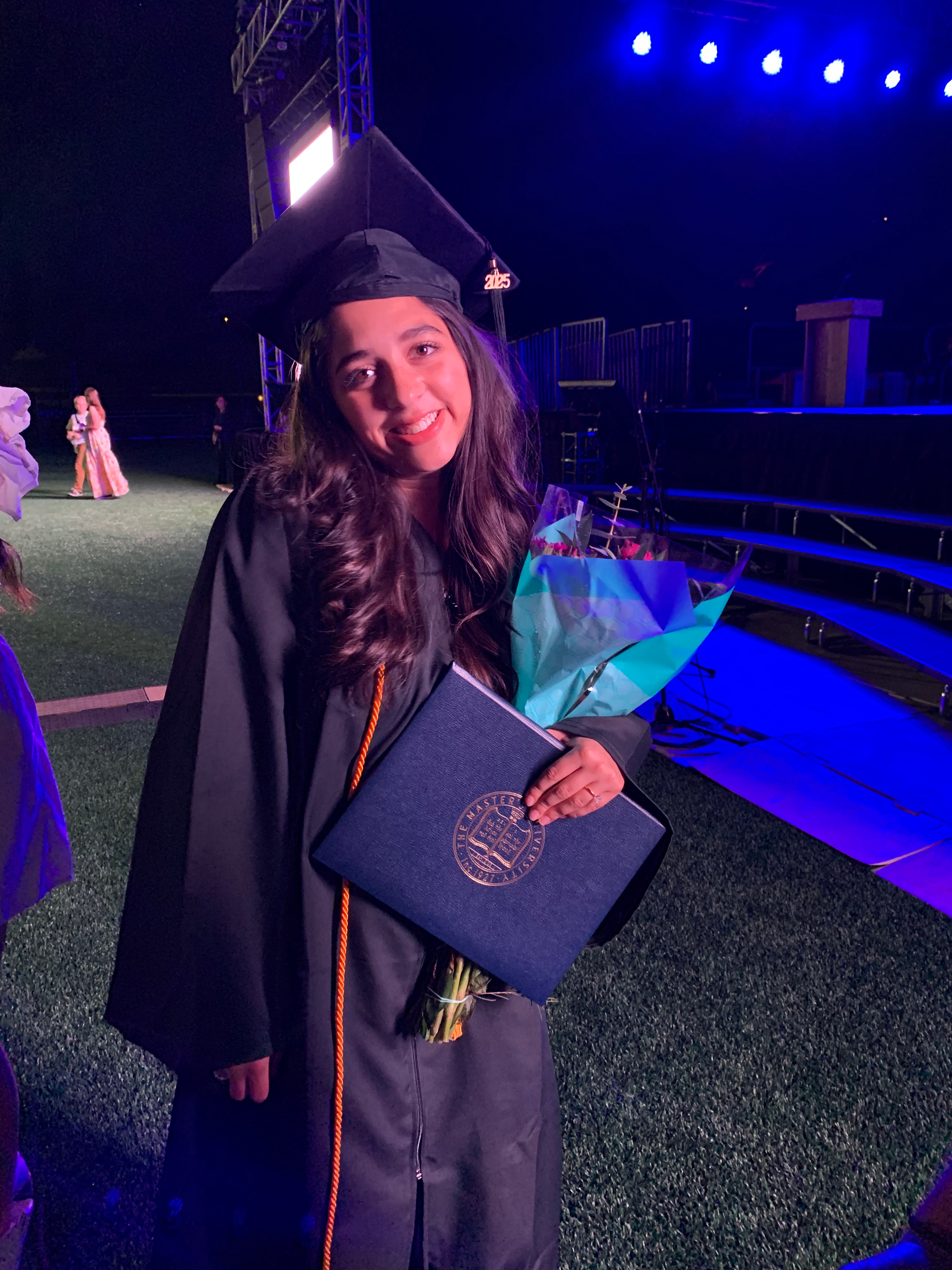
From an early age, my parents instilled in me an appreciation for education and a desire to pursue college beyond the mesas. I attended a small Christian school in Southern California called The Master’s College, now The Master’s University. And with the generous help of the Hopi Tribe Grants and Scholarship Program, I graduated in 1999, but my daughter, Hannah, also graduated from TMU earlier this year, and my other daughter, Meaghan, just started as a freshman there in August.
My daughter, Hannah, who graduated with a Business degree from The Master’s University
Any parent can tell you that sending your child away to school is not easy, especially when he or she is your first to go. You worry about their safety, whether they will quickly find good friends, who will care for them if they get sick, and a host of other things. And our children experience challenges, too. They often think of home, sometimes crying themselves to sleep (I know I did), missing their loved ones and longing for the day when they will be with their families. Life away from home can be full of uncertainties and insecurities, and yet (thankfully) it tends to get better over time.
As you are aware, the Hopi people, and I would add all Indian people, have a long history of having their children sent away to school, sometimes voluntarily, sometimes by force. Beginning in the late 1800s, the government began sending Hopi youth to off-reservation boarding schools in Albuquerque, Phoenix, and Riverside, to name a few. Most scholars who approach this topic interpret the Indian boarding school experience through federal Indian policies, including government attempts to assimilate them into American society. All are helpful and true, but there is another way of understanding it from an indigenous or Hopi perspective.
Ten or so years before he passed, the late Hopi historian Lomayumtewa C. Ishii described to me over lunch that the Hopi boarding school era was part of a second wave of Hopi migration. He reminded me that our clan people were once great travelers, traveling west to the Pacific Ocean, north into present-day Colorado, east into New Mexico, and far south into Central America.
And it was the late Ferrell Secakuku, while pursuing a Master of Science degree in anthropology at NAU, who taught me how these ancient travelers learned from their experiences, met other indigenous people on their journeys, and took that knowledge back to their ancestral lands to form the essence of Hopi society. In this regard, beginning in the late 1800s, the Hopi people once again ventured beyond the mesas, traveling to schools to receive an education, experience life away from home, and return to their villages with skills that were supposed to be useful to their communities.
CNAIF Film Screening of Beyond the Mesas
While Hopi students returned to the reservation with new skills, many remained unlearned in some Hopi ways and customs back home due to being away at school. Students often stayed three years or more at off-reservation Indian boarding schools without returning home. Absent from home, Hopi students at Indian schools did not participate in various religious ceremonies and other cultural events throughout the year. This affected not only the students themselves but also their children.
Hence, the negative consequences of being away from home had a generational effect on the Hopi people. Lois Pooyouma, a Hopi student at Sherman Institute in the 1970s, remarked in the film: “I missed out…I never learned really how to do piki. I didn’t know really too much about Hopi weddings. I don’t remember being initiated and doing what these kids are doing now because I was gone. So that was the bad part about being in a boarding school that you didn’t learn what you were supposed to learn as you were growing up. And therefore I couldn’t really teach my daughter what she should do, and I think in a lot of ways we are both learning, or all of us are learning.”
Far from home for long periods of time, Lois and other Hopi students “missed out” on receiving a Hopi education in their homes and village communities. Instead of learning Hopi ways and customs and a worldview according to Hopi understandings, they learned about the superiority of Western society. In this regard, while they returned to the Hopi mesas as stronger American citizens, they came home as weaker Hopi individuals. And weaker individuals who lacked Hopi knowledge and skills made for a weaker Hopi society.
Author speaking at the CNAIF event
Perhaps the most detrimental consequence of being away from home, and one that had the longest negative effect on Hopi society, was that the off-reservation Indian boarding schools, including Catholic mission schools, did not teach Hopi youth to become good parents. Separated from their mothers and fathers, Hopi students received instruction and discipline from their teachers, matrons, and other school officials, including Catholic nuns.
Although they each took a parental role in the lives of Hopi youth, they did not parent them according to Hopi ways. Nor did they show love, instill confidence, or counsel them, including how to solve life’s problems, according to Hopi customs. As former Hopi Tribe Chairman Ivan Sidney noted in the film: “Being raised in the boarding school really did not teach us parenting, and some of that is carried on when we became parents. I know for a long time I had a difficult time telling my children that I love them and supporting their school because nobody ever said that to me.”
Sidney’s observation that boarding schools did not make for good parents is important for several reasons. In Hopi culture, parents are responsible for teaching and nurturing their children. They are responsible for preparing their children to learn knowledge and skills that will best prepare them for success on and beyond the mesas. The adolescent and later teenage years are challenging for young people. Becoming young adults and the hormonal and physical changes that come with it, older youth often struggle with anxiety, depression, and a lack of confidence.
In Hopi society, parents are supposed to be present for their children during these difficult and impressionable years; there to give counsel, instruction, and comfort during life’s hardships. And parents and other family members are to be there to instill in their children assurance of Hopi ways and confidence in their identity as clan and village members.
Instead, at boarding schools, officials wanted Hopi and other Indian students to see their cultures (and even their parents) as hindrances to their success. They did not provide Hopi youth with what they desperately needed, that is, parenting according to Hopi ways and customs. Instead, they modeled parenting from Western perspectives, which left the youth confused and feeling inadequate to parent their children on the reservation.
Perhaps, your very own Professor Alisse Ali-Joseph and Kelly McCue, in their insightful chapter in Indigenous Justice and Gender, said it best: “While boarding schools were the most prominent site of assimilation, policies outside of these schools further functioned to isolate youth from their families and communities. These policies left children without their mothers, traumatized by the horrific sexual, physical and emotional abuses they endured, and mothers without children, leading to generations of depression, substance use, domestic violence, and the inability to parent.”
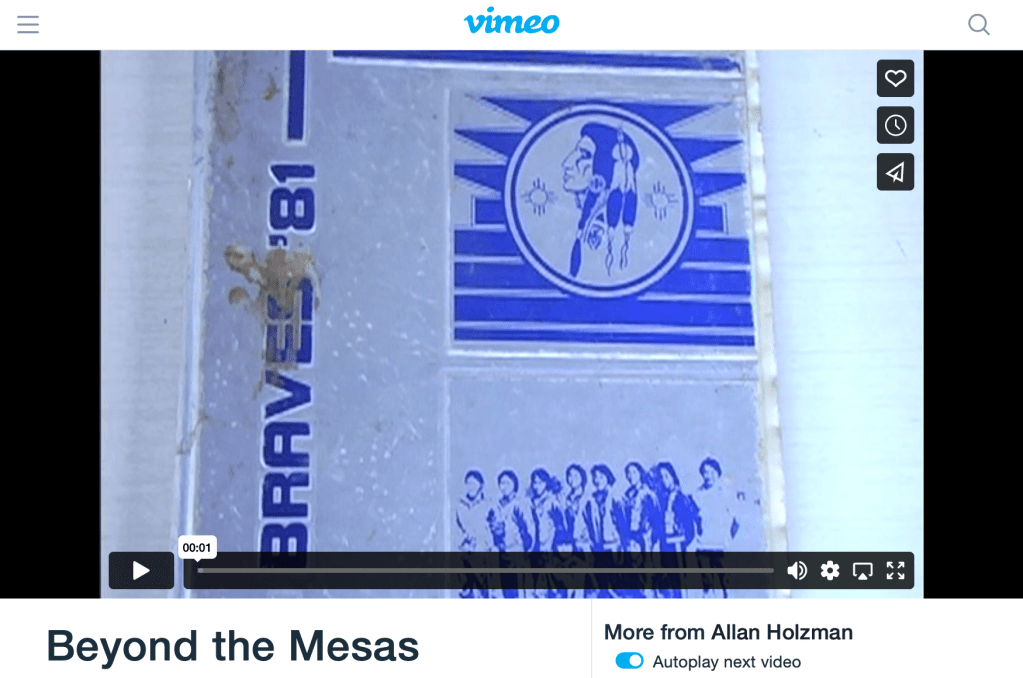
I want to close my comments by retelling a story about an experience I had filming Beyond the Mesas, which speaks to the reason why I, and others, including the Hopi Cultural Preservation Office, produced this film.
Over the years, I often said that the “star” of the film was Marsah Balenquah from the Village of Paaqavi. Although I have written at length about Marsah in the Journal of American Indian Education, I thought I would close my talk this afternoon with her story, as a way to honor her memory and remind us of the sacrifices she and others made to get us where we are today.
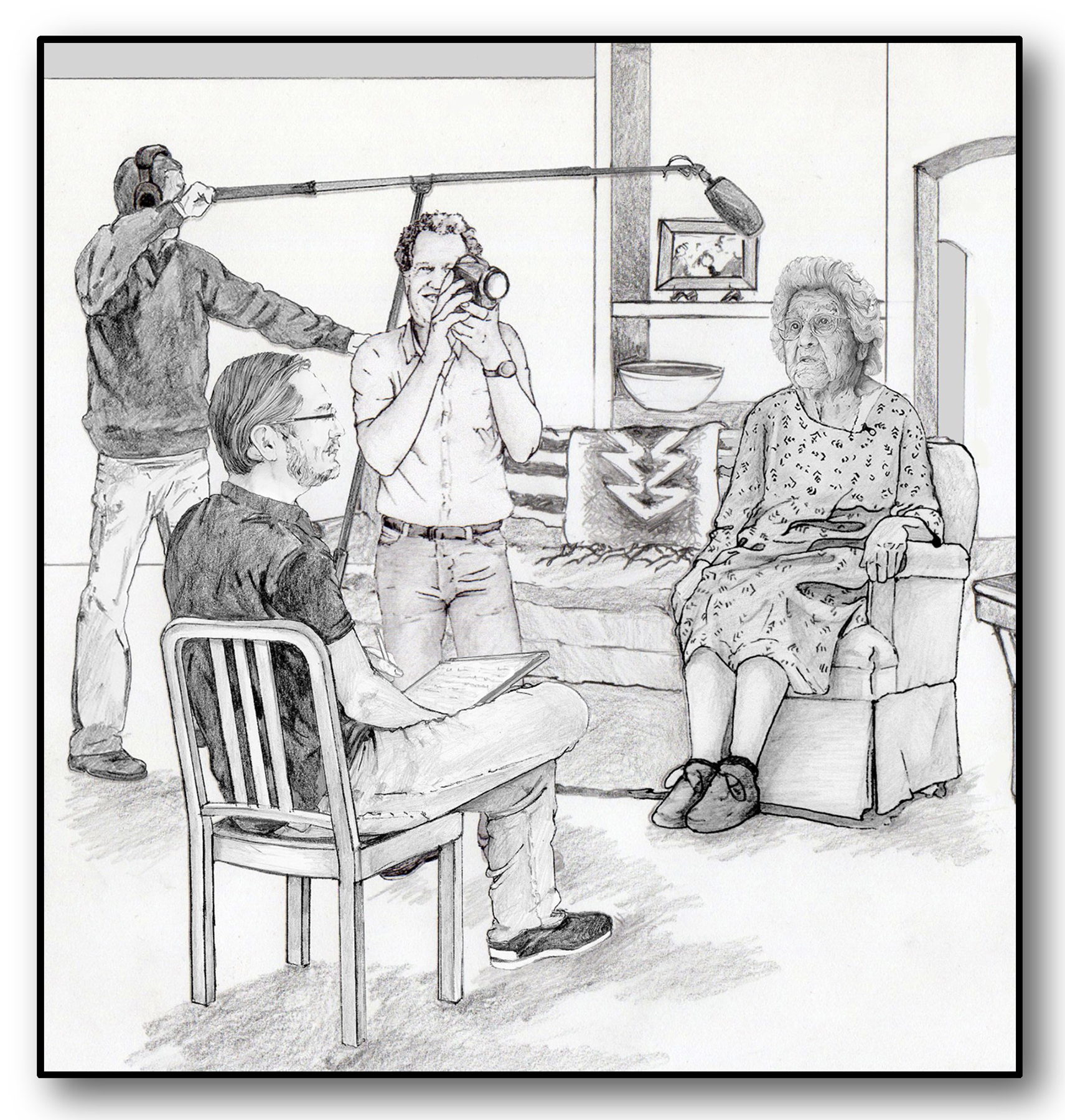
To film Beyond the Mesas, I, along with a small crew from 716 Productions, spent nearly a week at Hopi meeting individuals and talking with former boarding school students. Although we interviewed a number of people during that trip, an interview with Marsah will always remain special to me. We had been interviewing Eileen Randolph from the village of Bacavi, and her granddaughter, Leslie Robledo.
We spoke at length about Eileen’s mother, Bessie Humetewa, and her experience at Sherman during the 1920s (two years earlier, I interviewed Bessie, but shortly before this second visit she passed away). During their interview, Eileen and Leslie kept referring to a woman named Marsah Balenquah from the same village, who attended Sherman with Bessie. Even though my grandmother once told me about Marsah and how we are related, I had never met her. “She lives right across the road,” Eileen said to me, “you should interview her!” With their help, we made plans to visit Marsah at her home the next day.
Beyond the Mesas Interview with Marsah Balenquah. Drawing by Neil Logan. To be published in Modern Encounters of the Hopi Past by Matthew Sakiestewa Gilbert
When we arrived at the house, an elderly woman wearing an apron greeted me at the door, somewhat bewildered why I was standing on her porch. After telling her my name, I told her the reason for my unannounced visit. I explained that Eileen and Leslie had suggested that I interview her for my film on the Hopi boarding school experience. “Oh,” she said to me, “come in, come in.” She gestured for me to sit down on the couch, while she quickly prepared traditional Hopi tea for us called Hohoysi on her gas stove.
As we waited for the tea to brew, I told her that my So’oh (grandmother) Ethel from Upper Munqapi had sent her greetings. “I know Ethel” she exclaimed, “we are related to each other!” “Yes,” I said to her, glad and relieved that in determining Marsah’s familial connection to my grandmother, my family and clan connection to Marsah had also been established.
When our tea was ready, Marsah sat down next to me on the couch and immediately began telling about her school days at Sherman Institute. We must have talked for thirty minutes, all the while the film crew waited patiently outside. At one point in our conversation, Marsah recalled the first time she felt an earthquake. She explained that it was a frightening experience for all of the Hopi kids at Sherman, and she described how the walls in her dorm swayed back and forth until the quake stopped.
“Marsah,” I said to her, “I want to hear more about this and your other experiences at Sherman, but I need you to tell me these stories on camera. We cannot include your stories in our film if we are not able to record them.” The moment I said, “camera,” Marsah’s countenance and behavior changed. “I don’t want to do it,” she said to me, “I don’t want to be on camera.”
Marsah lived in a small village community. Perhaps worried about village gossip, or bashful of her story, she was reluctant to draw unnecessary attention to herself. I did not know how to respond. The last thing I wanted to do was make her feel uncomfortable. I respected her wishes, and her right to privacy, but maybe there was something I could say that would ease her mind? Perhaps I could help her see the situation and opportunity from a different, less threatening perspective?
I continued thinking about this as we finished our conversation, but no words or persuasive arguments came to mind. After we finished our tea, I collected my notes and headed toward the front door. Feeling somewhat hopeless and disappointed, I turned and asked one last question. “Have you ever told your children or grandchildren these stories about your school days?” She did not respond. “If you allow us to film you,” I said to her, “your family will have these stories forever.” She took five or so seconds to consider my words, and then she said, “Okay, I’ll do it.”
I think we would all agree that we are so thankful that she did.
This week I am lecturing on the Pueblo Revolt of 1680. Here, in this short clip, I talk about how the Hopi participated in the so-called Indian uprising by forcing Catholic priests off the mesa edge. Part of a class I am teaching, this is our last week learning about the Spaniards and ways Natives resisted to survive as a people (total run time 4 min and 37 sec).
Matthew Sakiestewa Gilbert lectures on Hopi involvement in the Pueblo Revolt. This lecture took place at the University of Arizona on February 3, 2025, as part of a class titled HIST 236: Indians in U.S. History.
This afternoon I lectured on initial encounters between Natives and Europeans. In one section of my lecture I focused on the Hopi who first encountered the Spanish when Pedro de Tovar and a small group of men arrived uninvited on Hopi lands in 1540. In this lecture clip, I speak about this event and Hopi attempts to understand it from Hopi cultural perspectives (total run time 4 min and 40 sec.).
Matthew Sakiestewa Gilbert lectures on the first encounter between the Hopi and Spaniards. The lecture takes place at the University of Arizona on January 27, 2025 in HIST 236 Indians in U.S. History (run time 4 min and 40 sec).
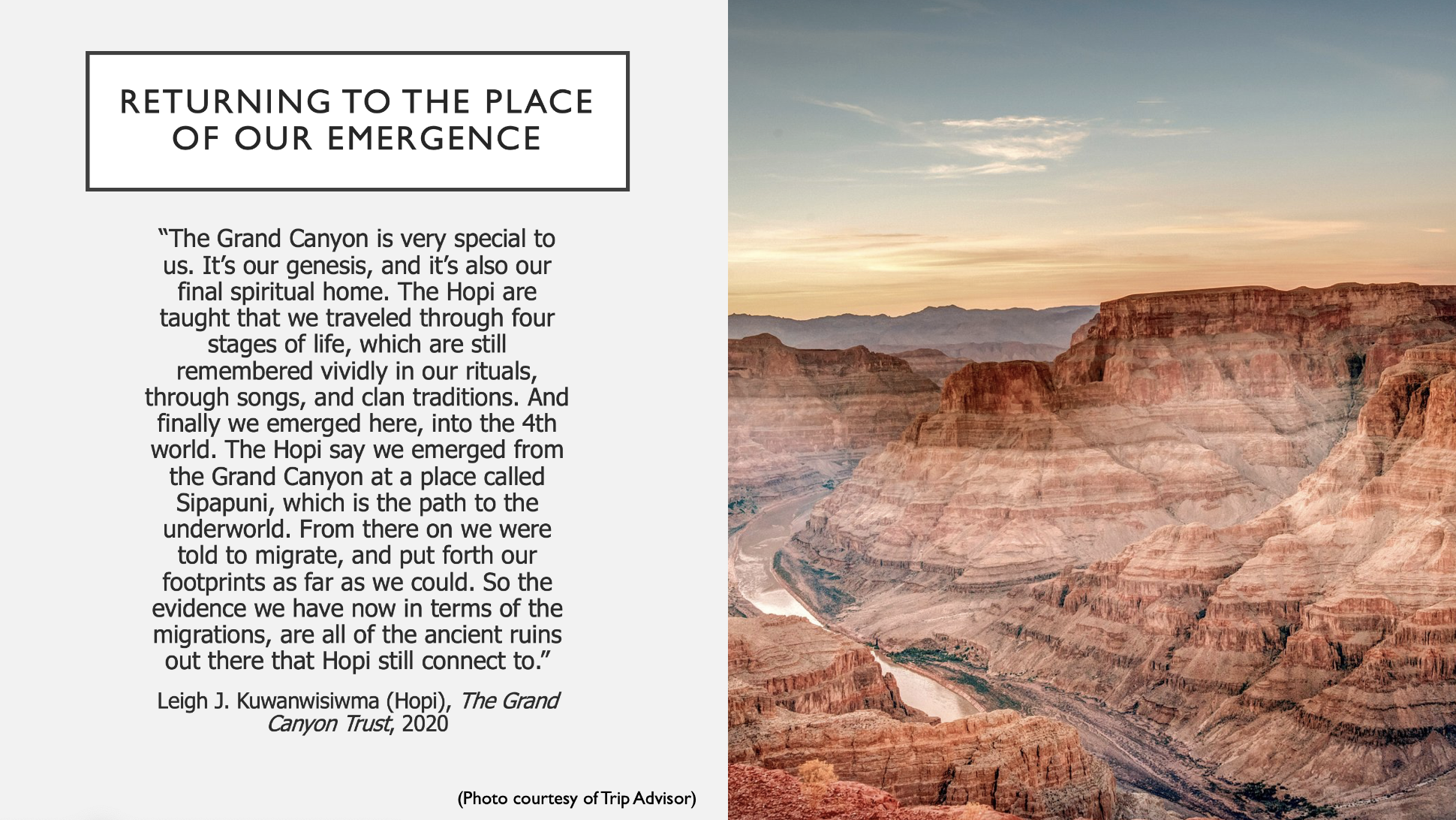
This semester I am teaching an undergraduate course titled HIST 236 Indians in U.S. History. Throughout the semester I will upload short lecture clips that may be of interest to readers of this blog. The first clip takes place at the end of class where I close my lecture (on Native American oral history and tradition) talking briefly on Hopi emergence and migration. I have inlcuded the PowerPoint slide that I am discssing above, and the video below (video and sound quality are not the best…I will make necessary improvements for next time).
Matthew Sakiestewa Gilbert lectures on Hopi emergence and migration. The lecture takes place at the University of Arizona, January 22, 2025, in the course: HIST 236 Indians in U.S. History (video run time 2min 35 sec).
This summer David Skinner, editor of Humanities Magazine (published by the National Endowment for the Humanities) invited me to write an article reflecting on Larry C. Skogen’s excellent book To Educate American Indians: Select Writings from the National Educational Association’s Department of Indian Education, 1900-1904 (University of Nebraska Press, 2024). The article was part of a special edition of Humanities Magazine on Indigenous-related topics and edited by Shelly C. Lowe (Navajo), Chair of the NEH. I was honored to write this piece and have included the text and the link to the essay below.
*****
Indian Boarding Schools and the “Problem” They Were Meant to Solve by Matthew Sakiestewa Gilbert
“Originally published as “Education for the Indian Problem” in the Summer 2024 issue of Humanities magazine, a publication of the National Endowment for the Humanities.”
Over the past 20 years, I have taught Native American history at community colleges, Christian schools, and large universities. I have encouraged my students to think critically, ask hard questions, and consult primary resources. “Don’t just read about what people said,” I tell them, “Do the hard work, go to the original source, and read them for yourself.”
In his edited collection of essays from the National Educational Association’s Department of Indian Education (1900–1904), Larry C. Skogen, a scholar long affiliated with Humanities North Dakota, has made that hard work a little easier. Skogen’s book, To Educate American Indians, includes speeches by white educators employed by the U.S. government’s Indian Service to teach Native American children. Some of the speeches resonated with me not only as a scholar but as a Hopi person, causing me to reflect on my family history and experiences as a teacher who has written extensively on the Indian boarding school experience.
When I lecture on Indian education, I often first introduce my students to the so-called Indian Problem, providing a lens for students to understand how non-Native people viewed Indians—not as an asset or benefit, but as a “problem” that needed to be addressed and eliminated. Not eliminated by slaughter or outright genocide (the U.S. government had failed in those attempts) but eliminated in the sense of eradicating culture and identity.
By the turn of the twentieth century, the U.S. government had stopped warring with Indian nations on the Great Plains and elsewhere, but the battle for the minds and affections of Indian youth continued at Indian schools. School officials, such as H. B. Frissell, principal at the Hampton Normal and Agricultural School in Virginia, believed schools played a major role in solving the Indian problem by making Indian youth discontent. “It is sometimes said of the schools off the reservation,” observed Frissell, “that when their students return they are not willing to live as their parents did. . . . A wholesome discontent is a most helpful sign.”
For the Hopi, the most widely known example of this comes from the life of Polingaysi Qoyawayma. Polingaysi spent four years, from 1906 to 1910, at Sherman Institute, an off-reservation Indian boarding school in Riverside, California. When she returned home, she judged her parents for living according to Hopi ways and customs (No Turning Back is her autobiography). Young people, especially teenagers, are already disposed to be critical of their parents. School officials such as Frissell used this to their advantage to turn Indian youth against their families.
Alienating Indian youth from their communities and cultures was accomplished by various means. At Indian schools, officials instructed students in math, science, history, and other disciplines. Teachers wanted their Indian pupils to see the supposed superiority of Western education while simultaneously becoming critical and doubtful of Indian teachings and worldviews. Male students learned trades and female students learned to be good housekeepers according to Western values. Some students also participated in sports and musical ensembles, while others used their skills in the English language to work in the print shop or as editors for the school newspaper.
In my office, a prized possession sits on a bookcase: a complete ten-volume set of The Red Man, the official student-written newspaper of the Carlisle Indian Industrial School in Pennsylvania. Hardbound and organized by year, the books recall happenings throughout the school year, motivational speeches, Native American stories, and alumni news.
“Every Indian school should have the newspaper,” William T. Harris, U.S. Commissioner of Education, remarked in his 1902 speech in Skogen’s collection. Telling his audience that Indian pupils should read “first that which interests him,” the commissioner further observed that the pupil will “go from that to the far-off events of the world, according as he grows in intellectual capacity.”
School officials did not encourage Indian youth to listen to their parents back home on Indian reservations. They did not encourage them to seek wisdom from their tribal elders or other knowledge-keepers about the world beyond their homelands. Instead, they wanted them to learn from newspapers and considered the printed word far superior to the oral tradition often spoken in one’s Native language.
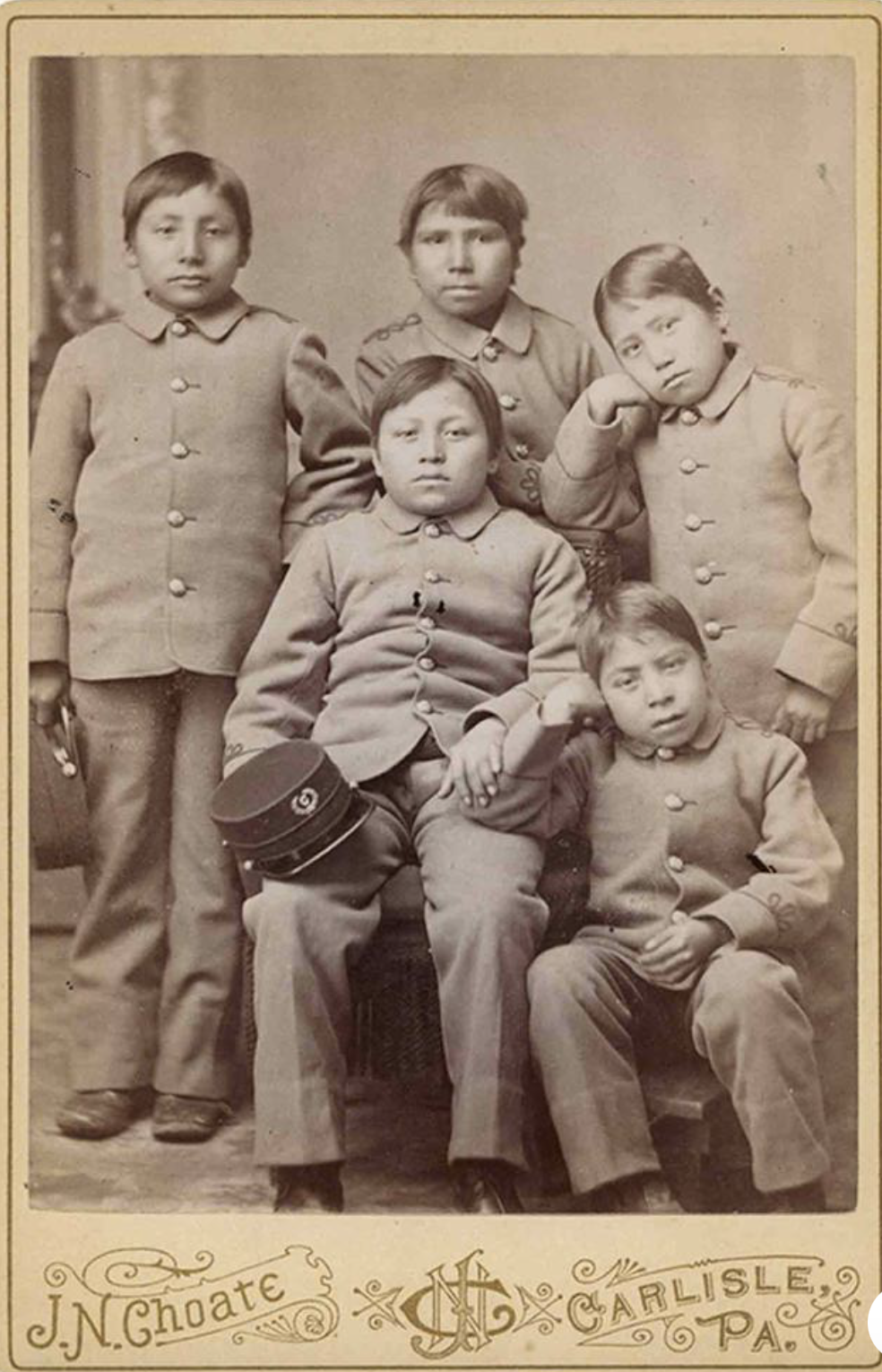
Photo caption
Studio portrait of Sioux students wearing their Carlisle boarding school uniforms in 1880, identified as, back row: David (Kills Without Wounding), Nathan (Ear), Pollock Spotted Tail; and front row: Marshall (Marshall Bad Milk) and Hugh (Running Horse).
—Photo by John N. Choate, Carlisle, Pennsylvania, Swedish National Museums of World Culture
The U.S. government’s attempt to suppress Native languages took various forms. One especially interesting piece in Skogen’s volume is Emily S. Cook’s 1904 address titled “What’s in a Name?” Skogen notes that oftentimes Indian people had no say in the matter and that government officials changed Indian names, which they struggled to pronounce, to make it easier to keep records related to Indian affairs.
The government’s name-changing policy sought to weaken Indian identities and eradicate the use of Indigenous languages. But not every individual in the Indian Service, especially those who lived and worked with Indian communities, saw the wisdom in eliminating Indian names.
Cook was one of these people. “Why should Imogen be preferred to the Kiowa name Imguna, or Jack to Zapko?” Cook asked, “Why not have a few less Marys and Johns in the world and enrich our nomenclature by picking out gems from aboriginal matrices?” Cook knew the value of Indian culture in American society, and she considered it cruel and “short of criminal” to assign names to Indian children and adults that did not reflect their tribal identity and caused great confusion within the family.
Reflecting on Cook’s advocacy for Indian names, I cannot help but think about my own family and how things could have been different for us had more school officials listened to Cook.
In the late 1940s, my grandfather, Lloyd Gilbert, attended the Phoenix Indian School in Arizona with his two siblings. The three arrived at the school with the surname Quache (pronounced Kwah-tsee), which means “friend” in the Hopi language. Officials at the Phoenix school, however, did not tolerate Indian names and told them they needed to consult with one another and replace theirs with an English name.
The mandate likely caused my grandfather and his siblings great stress and a sense of loss. It also required them to think deeply about appeasing the government while not disconnecting themselves from their family. They ultimately chose “Gilbert,” their father’s first name. A disheartening and difficult position to be in, they nonetheless demonstrated agency and worked together to address a problem imposed upon them.
While Indian students studied at government schools, prominent and influential employees in the Indian Service waxed eloquently on the state of Indian affairs, the challenges of training Indian youth, and their responsibility to “uplift” Indian pupils with Western education and values. Some did so with an air of arrogance or even ignorance. Others, such as Cook, did so with compassion and balanced foresight. Within this collection, Skogen exposes them all and provides an insightful resource to read their words within a larger historical and cultural context.
As the late David Wallace Adams wrote in the foreword, the “historical gap” between all that has been written and taught about the history of Indian education and the documentation on how “leading educators of the day viewed the proper ends and means of Indian schooling . . . is now closed.” However, the opportunity for students and others to interpret these essays and critically analyze their recommendations for solving the Indian Problem is now open.
On Saturday September 12, I gave a presentation on my book Hopi Runners: Crossing the Terrain between Indian and American (University Press of Kansas). The event was hosted by Amerind Museum in Dragoon, Arizona. I have the privilege of serving on Amerind’s Board of Directors. It is a terrific organization that does a lot of good work with and for Native communities in the Southwest. Below is the video of my talk, with 660 people in attendance!
*Interested in purchasing Hopi Runners? Right now, until October 31, 2020, the University Press of Kansas is running a special if you purchase through their website. Use Promotion Code HOPI30 to receive 30% Off plus FREE Shipping!
My library. A mix of books on the Hopi, Indian education, American sport studies, Southwest Indian studies, American Indian studies, American West, and Native American history (broadly).
Over the years I have amassed a large collection of books on the Hopi. My bookcases give evidence of this obsession.
Even as I write, I am looking at these books, and they are looking back at me. Some are on Hopi religious ceremonies, language, and history. Two of them I wrote.
Still others are biographical accounts, written during a bygone time in American history. Regardless of topic or genre, they are a reminder of those who came before and after me.
A canon that I have contributed to and have grown to appreciate. A foundation that I have built on, but that has also shaped and built me.

 BEYOND THE MESAS, LLC