“Hopi Footraces and American Marathons, 1912-1930” (American Quarterly, March 2010)

For the past three years I have been working on a book on Hopi long distance runners and the American sport republic. Part of this project includes an article that I wrote titled “Hopi Footraces and American Marathons, 1912-1930.” This article recently appeared in the March 2010 Issue of American Quarterly (Vol. 62, No. 1, pp. 77-101). The American Quarterly is the flagship journal of the American Studies Association.

The photograph featured on the cover of the journal (pictured above) is of two trophy cups that Hopi runner Philip Zeyouma won at Sherman Institute. I took this photo at the Sherman Indian Museum in Riverside, California. Not long after the school established its cross-country team, Zeyouma won the Los Angeles Times Modified Marathon in April 1912. His victory also gave him an opportunity to compete in the 1912 Olympic Games in Stockholm, Sweden.

When Hopis such as Zeyouma, Harry Chaca, Guy Maktima and Franklin Suhu competed on the Sherman cross-country team, and Louis Tewanima ran for the Carlisle Indian Industrial School, their cultural identities challenged white American perceptions of modernity and placed them in a context that had national and international dimensions. These dimensions linked Hopi runners to other athletes from different parts of the world, including Ireland and Japan, and they caused non-Natives to reevaluate their understandings of sports, nationhood, and the cultures of American Indian people.

This article is also a story about Hopi agency, and the complex and various ways Hopi runners navigated between tribal dynamics, school loyalties, and a country that closely associated sports with U.S. nationalism. It calls attention to certain cultural philosophies of running that connected Hopi runners to their village communities, and the internal and external forces that strained these ties when Hopis competed in national and international running events.

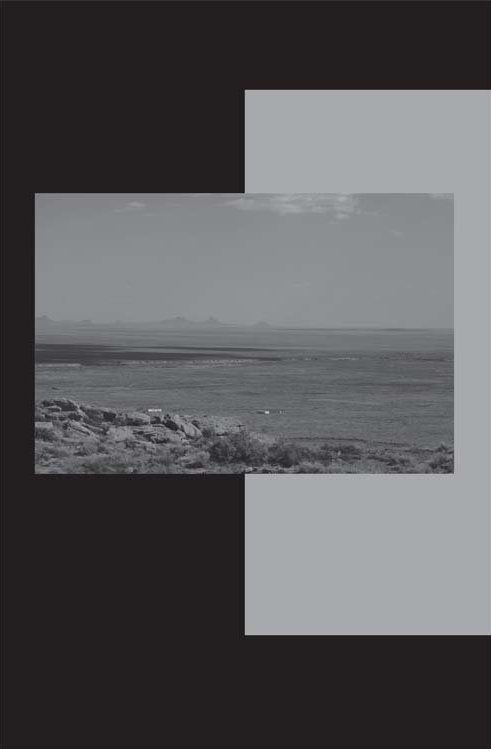
The back cover of the journal (pictured below) features a photograph that I took on the edge of Third Mesa near the village of Orayvi. At one point in the article I describe how one can stand in this location and see for miles in all directions:

To the south, the land extends beyond the Hopi mesas and the silhouette of Nuvatukiyaovi, or the San Francisco Peaks, is visible in the distance. In the valleys below, corn, melon, and bean fields stand out as green patches against a backdrop of earth and sandstone. From on top of the mesa one can enjoy the sweet smell of burning cedar, hear and feel the wind blowing over the mesa edge, and behold a breathtaking landscape surrounded by a canopy of deep blue sky. Looking east toward the village of Shungopavi on Second Mesa, running trails stretch from Orayvi like veins that connect and bring life to each of the Hopi villages. The trails near Orayvi give testimony to the tradition of running in Hopi culture and the continuance of running among today’s Hopi people. [p. 79]

I am indebted to several individuals who helped me revise this essay, including my colleagues at the University of Illinois, various Hopi and non-Hopi scholars, the Hopi Cultural Preservation Office, Lorene Sisquoc of the Sherman Indian Museum, and American Quarterly editors Curtis Marez, Jeb Middlebrook and Stacey Lynn.

If you would like a PDF copy of this article, please feel free to email me at sakiestewa@gmail.com, or submit a comment to this post.

Matthew Sakiestewa Gilbert

See also BEYOND THE MESAS post: Hopi runners article available for download
A bronze coin for a Hopi alumna

Photo by Matthew Sakiestewa Gilbert

In 2001, the Sherman Indian Museum had this bronze coin designed to commemorate the 100 year anniversary of Sherman Institute (now called Sherman Indian High School). Before I conducted research on the Hopi Reservation, Lorene Sisquoc, director of the Sherman Indian Museum, gave me several of these coins to give to the Hopi alumni that I interviewed.

One of these former students was Bessie Humetewa from the village of Bacavi. She attended the school from 1920 to 1928.  Bessie also appears in Beyond the Mesas where she recalls that she stayed at Sherman “all eight years without coming home.”

At the time of the interview Bessie was blind, and so when I gave her the coin she examined it with her hands. Before I could tell her what was depicted on the coin, she said to me, “this is Sherman.”

She was able to discern the raised design of the school’s main building, the palm tree, and the superintendent’s office. The bronze coin reconnected Bessie to her alma mater. It took her back seventy-six years to when she last attended the Indian school in Riverside, California.

Matthew Sakiestewa Gilbert

Hopis and the Outing System at Sherman Institute

OUTING SYSTEM

As part of the school plan the outing system is practiced each year. Students have no difficulty securing positions, the girls in the best families in Southern California and the boys on ranches or other industrial lines.  The extensive production of oranges, berries, and other fruits, cantaloupes, and grain furnish employment for the boys at all seasons.  The practice of sending out students for experience and to earn a little money during vacation is an advantage to the students, but it is not compulsory.  The wishes of the individual and of parents, if necessary, are always consulted.  – Sherman Institute Booklet (1908), Sherman Indian Museum, Riverside, California

One of the gaps in the historiography of Indian boarding schools is a book length study on the Outing System. Government officials established Outing programs at off-reservation Indian boarding schools to create an Indian working class. At Sherman Institute, the boys labored on farms and ranches, while the girls worked in homes in the greater Riverside community.

Although school officials wanted the girls to be exposed to the  so-called civilizing influences of white Americans, the system ultimately “trained” girls to become domestic servants. The girls often spent their days cleaning, making food, and taking care of children who belonged to white families.

In BEYOND THE MESAS, Eilene Randolph and Leslie Robledo from the village of Bacavi on Third Mesa note that Hopi girls at Sherman did not have trouble securing work in the school’s Outing program.  Hopis had a reputation of being “hard workers,” and the people in the community routinely “hired up” the girls to work in their homes.

Local farmers were also eager to employ Hopi boys to work in their fields and orchards. The boys had come from an agricultural based society and used their knowledge of planting and harvesting in Southern California.

While I have written more about the Outing System in my book Education beyond the Mesas: Hopi Students at Sherman Institute, 1902-1929, and other scholars have examined the topic in their works, a comprehensive study (book) devoted entirely to this important program has yet to be published.

Matthew Sakiestewa Gilbert

The search for Polingaysi Qoyawayma

When I started researching on the Hopi boarding school experience at Sherman Institute, I thought for sure that I would come across many references of Polingaysi Qoyawayma (Elizabeth Q. White) at the Sherman Indian Museum. She is, after all, one of the school’s most famous alums. I looked in the Sherman Bulletin, the school’s student-written newspaper. I examined various letterpress books and other school records, but I never came across her name.

While conducting research at the National Archives in Laguna Niguel, California, I uncovered a file with a name similar to Polingaysi Qoyawayma written on the tab. I thought I found the documents that I had been searching for. But when I examined the records closely I discovered that the file belonged to someone else.

In an attempt to find clues that would lead me to archival information on Qoyawayma, I reread Don Talayesva’s autobiography Sun Chief. Talayesva and Qoyawayma attended Sherman at the same time. They both came from Orayvi and likely traveled with each other to the school in November 1906. But nowhere in Talayesva’s book does he mention her name.

Fortunately, one does need to depend on Talayesva or an archive to learn about Qoyawayma’s experience at the Indian school in Riverside. Although the archival record may appear to be silent, at least in reference to her time at Sherman, her story remains with her family, others who knew her, and in her book No Turning Back.

The documents that I searched for may never surface. They may not even exist. But Qoyawayma has already shared with us about her school days at Sherman Institute. She has already provided us with the archive, the documents, and the narrative of her life.

Matthew Sakiestewa Gilbert

Hopi studies at the 2010 NAISA conference

There will be several Hopi presentations at this year’s Native American and Indigenous Studies Association (NAISA) conference hosted by the University of Arizona in Tucson. This event will take place on May 20-22. I have copied a list of Hopi presenters and Hopi related papers/panels to this post. To learn more about the conference and to access the complete program, please click on the following link: http://naisa.ais.arizona.edu/

—————————————

FRIDAY, MAY 21, 2010 10:00-11:45 am

76. Youth & Culture [S29]
Organizer: NAISA Program Committee
Chair: TBA
“The Good Life” and “The Fast Life”: Childhood and Youth among Algonquian Peoples at Mid-Century
Kim Anderson, Centre for Research in Inner City Health/ St. Michael’s Hospital, Toronto, Canada
Unintended Truths: The Paradoxes of Cultural Reconnection for Urban Native Youth
Tracy L. Friedel, University of British Columbia, Canada
Traditional Education Tools in Hopi and Dakota Communities
Sherrie L. Stewart, University of Arizona

Cultural Identity in Education
Roy Weasel Fat, Red Crow Community College
Comment: Audience

79. Attending to “Missing” Youth and Opportunities for Language Activism in Indigenous Language Contexts [P74]
Organizer & Chair: Leisy T. Wyman, University of Arizona
Indigenous Youth – The Missing Link in Language Revitalization Research and Praxis
Teresa L. McCarty, Arizona State University
Articulating a Critical Language Consciousness among New Mexico’s Indigenous Youth
Tiffany S. Lee, University of New Mexico
Hopi Youth “Wanting in Tradition”: Seeking the “Missing Piece” – The Heritage Language
Sheilah E. Nicholas, University of Arizona

Recognizing Youth Migration in Linguistic Ecologies and Educational Efforts: Yu’pik Examples
Leisy T. Wyman, University of Arizona
Comment: Perry Gilmore, University of Arizona

FRIDAY May 21, 2010 12:00-1:45 pm

87. ROUNDTABLE: Collaborating on Native American History: The Hopi History Project [R6]
Organizer: Anton Daughters, University of Arizona
Chair: Thomas E. Sheridan, University of Arizona
Participants: T.J. Ferguson, University of Arizona
Leigh Kuwanwisiwma, Hopi Cultural Preservation Office
Stewart Koyiyumptewa, Hopi Cultural Preservation Office
Lee Wayne Lomayestewa, Hopi Cultural Preservation Office

FRIDAY, MAY 21, 2010 2:00-3:45 pm

93. Displaying Common Unity: New Directions in the Exhibition of “Indigenous” and “Black” Lives in the Americas
[P21]
Organizer & Chair: Robert Keith Collins, San Francisco State University
Toward a Dynamic Ethnography of Common Unity between Africans and Native Americans: Evidence from WPA Slave
Narratives
Robert Keith Collins, San Francisco State University
Mulattos, Mongrels, and Mulgenons: Race, Ideology, and Public Policy in the Construction of American Indian and
African American Identity
Angela A. Gonzales, Cornell University

Our brethren by the ties of consanguinity, of suffering, and of wrongs: Narrating Crispus Attucks and Paul Cuffee
“Home”
Judy Kertész, North Carolina State University

101. Intellectual Property, Cultural Patrimony, and Museum Partnerships [S19]
Organizer: NAISA Program Committee
Chair: Kevin Gover, National Museum of the American Indian, Smithsonian Institution
Perspectives on Working Relationships and Contracts: Indigenous Intellectual Property and Museums
John R. Grimes, Cook Inlet Tribal Council and Merry Glosband, Peabody Essex Museum
Repatriation and Representation in Tribal Museums and Cultural Centers
Sunny K. Lybarger, University of Arizona
Returning Hopi Voices: Redefining Repatriation through Community Partnership
Trevor Reed, Columbia University

Iroquoia Collected: The Alienation of Haudenosaunee Cultural Patrimony
Scott Manning Stevens, Newberry Library McNickle Center
Comment: Audience

SATURDAY, MAY 22, 2010, 8:00-9:45 a.m.

103. Renewal of Indigenous Languages & Cultures: Up and Coming Indigenous Scholars’ Research Findings [P26]
Organizer & Chair: Candace K. Galla, University of Arizona
Reversing Language Shift in the Cheyenne River Sioux Tribe
Jesse Johnson, University of Arizona
Use of Ancestral Indigenous Languages to Promote Student Development within the Classroom Maxine R. Sam, University of Arizona
“Uma tuuqayi, umu sinmuy amungem lavaywisni” (When you have learned, advocate for your people)
Darold Joseph, University of Arizona

Revitalizing Our Languages: Towards Decolonizing Technologies for Indigenous Communities
Candace K. Galla, University of Arizona
Comment: Audience

SATURDAY, MAY 22, 2010 2:00-3:45 pm

129. New Directions in Hopi Arts: Incorporating the Past, Inventing the Future [P72]
Co-Organizers & Co-Chairs: Jessica Welton, Virginia Commonwealth University and Zena Pearlstone, California
State University, Fullerton
Picturing the Rational Mind: Archaeology Meets Michael Kabotie
Kelley Hayes-Gilpin, Museum of Northern Arizona & Northern Arizona University

Brian Honyouti: Send in the Clowns
Zena Pearlstone, California State University, Fullerton
New Directions and Change: Discomfort and Growth
Mark Tahbo (Hopi), Independent Scholar
New Directions from Ancient Roots: The Art and Philosophy of Michael Kabotie
Jessica Welton, Virginia Commonwealth University

Comment: Audience

Hopi runners in the audience

I recently returned from attending the American Indian Studies Association (AISA) Conference in Tempe, Arizona. I delivered a paper titled “Hopi Footraces and American Marathons, 1912-1930.” This paper, in its article form, will appear next month in American Quarterly. I was happy to see that some Hopis came to my talk, including two students from ASU. Since I first presented on this topic, I cannot recall the last time I had Hopi long distance runners in the audience. Both of these students were runners.

After the session I talked at length with the students about how the world focuses so much attention on Louis Tewanima, but back home our people realize that while Tewanima was good, other Hopi runners were just as good or better than the famous Olympian from Shungopavi. Although these students already knew about Tewanima, they had not heard of the other runners that I mentioned in my paper. I also did not know about these runners before I started this project.

One of the most rewarding aspects of being a faculty at the University of Illinois is the opportunity I have to make my research available and meaningful to the Hopi community. This has always been the driving force behind my work.

Matthew Sakiestewa Gilbert

Misrepresenting the Hopi with photos

Earlier this week I blogged about a tourist who took a photograph of a home at Orayvi and posted it to his blog. The tourist admitted that there were signs up that forbid people from taking photos, but he took one anyway. It appears from his post that the reason he published the photo was to show his readers how poor he perceived the Hopi to be.

In my earlier post I mentioned that some Hopis do not want tourists to take photos of their villages because they desire to protect their privacy. Still others post these signs at the entrance of the village so that tourists will not misrepresent them. The sandstone homes and the condition of the village may cause outsiders to conclude that the Hopi people are poor and in desperate need of help. But is this the message that the people of Orayvi want the world to believe or hear?

I wonder if the author of Boquete Panama Guide has ever been inside an Orayvi home? During his recent visit to the reservation, did he speak to the owner of this or other Hopi homes? Did he hear their stories about how members of their families/clans built these homes in the early 1900s or earlier? Did they tell him that people from the village once traveled by foot to Nuvadakovi (San Francisco Peaks) to cut down wood beams to use for their ceilings, and carried them back to the village? If so, did he see the pride in their faces when they told him that their families have lived in these homes for more than a hundred years? Did they explain to him that many years ago the people of the village decided to live without modern conveniences such as electricity and running water? Did he care enough to ask? Did he care enough to ask why?

Matthew Sakiestewa Gilbert

Spanish mission buildings and sandstone homes

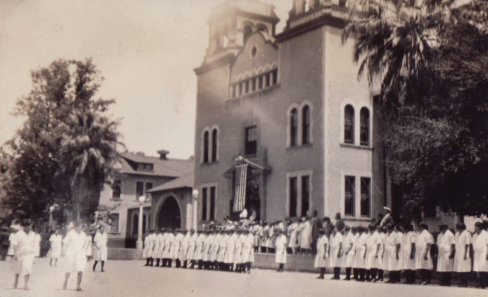
The producers of Beyond the Mesas were very fortunate that Marsah Balenquah from Bacavi on Third Mesa agreed to be interviewed for the film. In the documentary she explains that she attended Sherman for thirteen or fourteen years. At one point in the film she describes her impression of the school’s buildings. Built by Indian students in a Spanish Mission architectural style, the buildings did not resemble the sandstone homes she and other Hopis were familiar with on the reservation.

This photograph was taken when Marsah attended the Indian school in Riverside from 1920 to 1934. In the photo girls are standing in a line waiting for roll call and inspection. Everyday life at Sherman was very regimented. An American flag drapes from the portico of the school’s main building. Photo courtesy of the Sherman Indian Museum.

Matthew Sakiestewa Gilbert

Tourists, Cameras, and Hopi Privacy

Today I read a blog about an American who now lives in Boquete, Panama. This week he visited the Hopi Reservation and took a picture of a home at Orayvi on Third Mesa and posted it to his blog called Boquete Panama Guide. Here is what he writes:

It has been years since my last visit and I wanted to see if the life of the Hopi had changed. Everything was closed, the poverty obvious and although there were signs up not to take photos I took one of this dwelling.

Recently a friend asked me why Hopis post signs at the entrance of their villages that forbid tourists from taking photos. I told him that one of the reasons is because Hopis want to protect their privacy.

Think of it in this way…

Imagine that you live in a remote area of North America that receives thousands of tourists each year. Your house is unlike most homes in the United States. It is made of sandstones and situated close to a highway. Throughout the year tourists zoom by your house, abruptly stop their cars, roll down their windows, and snap photos of your home. Sometimes this happens when you are sitting out front drinking ice tea and visiting with members of your family. Other times your children are playing outside. But it does not matter to the tourists if anyone is home, or whether people are outside. All they want is a photo of your home, and to them, the photo is only enhanced if you and your children are part of it. You sometimes wonder what people do with these photos. You imagine that some people put the picture of your home in a photo album, a book, make postcards and calendars from it, or sell it.

Concerned about your family’s privacy, you decide that enough is enough and so you put a sign in your front yard that reads: “Please do not take photos of my home.” And then you wait. It does not take long for the next tourist to drive by. He slows down. He reads the sign, then looks at your home, then reads the sign again. A Nikon camera is laying on the passenger seat. He finds himself in a dilemma, but he decides to honor your request. Five minutes later, another car approaches your home. These people stop and read your sign, then look around to see if anyone is looking, roll down their window, take several photos of your home and speed away. This happens day after day and it will only increase during the summer months.

Matthew Sakiestewa Gilbert

1920s photo of Hopi girls at Sherman Institute

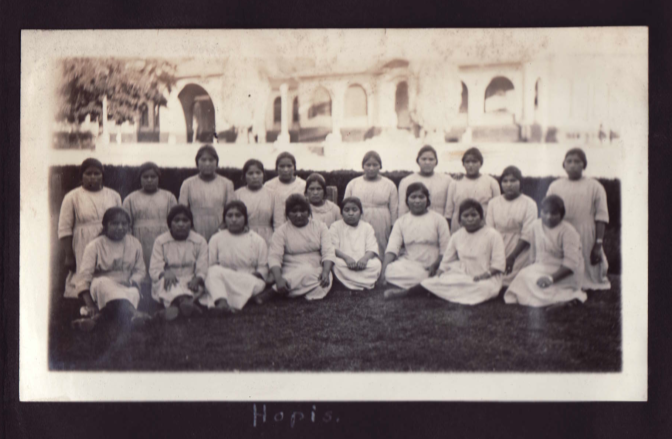
I was once asked how many photos and other images we included in Beyond the Mesas. I do not know the exact number, but it had to have been over a hundred. Some of these photos came from people who we interviewed for the film, others we uncovered at various archives. One of these photos was of a group of Hopi girls at Sherman Institute during the 1920s. I came across this picture in the Veva Wight Collection at the Sherman Indian Museum in Riverside, California. Wight was a Protestant missionary who led Bible studies and other Christian activities at the school. She worked as a “Religious Worker” at Sherman for more than thirty years. Although government officials allowed Christianity at Sherman to encourage the assimilation of Indian students, some Hopi girls had a genuine committment or interest in the Christian faith.

Matthew Sakiestewa Gilbert