Receive 20% off EDUCATION BEYOND THE MESAS

Receive 20% off each copy of Education beyond the Mesas: Hopi Students at Sherman Institute, 1902-1929, if you order from the University of Nebraska Press. Mention promotion code 6AF10 to obtain the discount. For more information, please click on the following link to download the book’s promotional flyer: Education beyond the Mesas – flyer

Matthew Sakiestewa Gilbert

Behind the camera at the Oraivi Footrace

This slideshow requires JavaScript.

Photographs by Matthew Sakiestewa Gilbert

For the past five years, Juwan Nuvayokva, an accomplished Hopi long distance runner, has organized the Oraivi 8K Footrace and 2 Mile Fun Run and Walk on the Hopi Reservation. Both races begin and end in the village of Oraivi on Third Mesa.

Last summer I received permission from Nuvayokva to take pictures of the Oraivi Footrace, which was held on August 9, 2009. When I arrived at the venue, I was informed that the person scheduled to photograph the race was unable to attend, and so the organizers designated me as the “official photographer” for the event.

Some of my pictures are posted on the Oraivi Footrace website, including other photos by George Silas and Lavanya Polacca. The above slideshow includes 41 of the nearly 1,800 photographs that I took of the race.

This year’s Oraivi 8K Footrace and 2 Mile Fun Run and Walk will take place on Sunday August 8, 2010. All individuals are encouraged to participate. There will also be a new race called the 1/2 Mile Kids Dash. For more information, please visit the Oraivi Footrace website at http://oraivifootrace.com/1.html

If you are pictured in the slideshow, and you would like a high-resolution copy of the photograph, feel free to contact me and I will send you the picture via email:   sakiestewa@gmail.com

Matthew Sakiestewa Gilbert

BEYOND THE MESAS film screening at the University of Iowa – April 14, 2010

“Hopi Footraces and American Marathons, 1912-1930” (American Quarterly, March 2010)

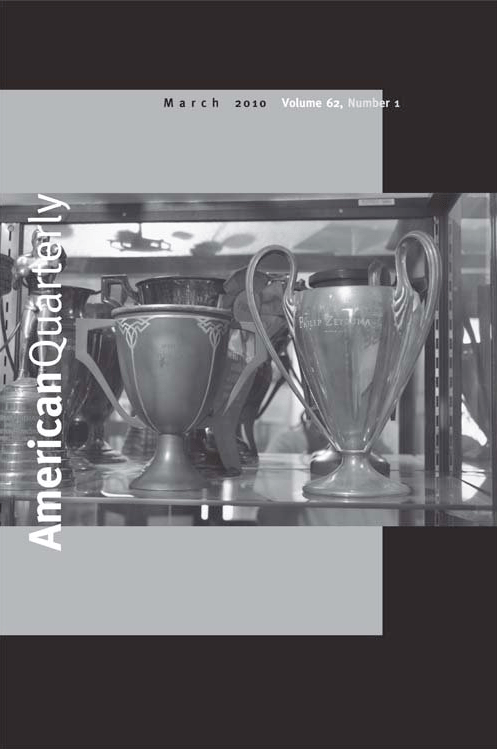
For the past three years I have been working on a book on Hopi long distance runners and the American sport republic. Part of this project includes an article that I wrote titled “Hopi Footraces and American Marathons, 1912-1930.” This article recently appeared in the March 2010 Issue of American Quarterly (Vol. 62, No. 1, pp. 77-101). The American Quarterly is the flagship journal of the American Studies Association.

The photograph featured on the cover of the journal (pictured above) is of two trophy cups that Hopi runner Philip Zeyouma won at Sherman Institute. I took this photo at the Sherman Indian Museum in Riverside, California. Not long after the school established its cross-country team, Zeyouma won the Los Angeles Times Modified Marathon in April 1912. His victory also gave him an opportunity to compete in the 1912 Olympic Games in Stockholm, Sweden.

When Hopis such as Zeyouma, Harry Chaca, Guy Maktima and Franklin Suhu competed on the Sherman cross-country team, and Louis Tewanima ran for the Carlisle Indian Industrial School, their cultural identities challenged white American perceptions of modernity and placed them in a context that had national and international dimensions. These dimensions linked Hopi runners to other athletes from different parts of the world, including Ireland and Japan, and they caused non-Natives to reevaluate their understandings of sports, nationhood, and the cultures of American Indian people.

This article is also a story about Hopi agency, and the complex and various ways Hopi runners navigated between tribal dynamics, school loyalties, and a country that closely associated sports with U.S. nationalism. It calls attention to certain cultural philosophies of running that connected Hopi runners to their village communities, and the internal and external forces that strained these ties when Hopis competed in national and international running events.

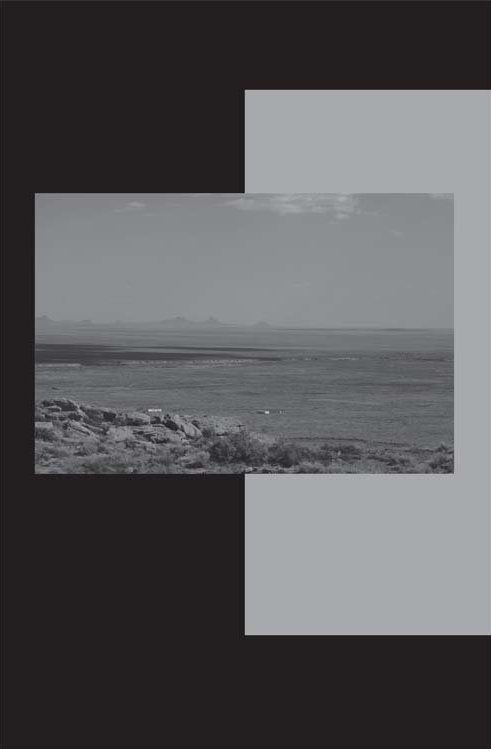
The back cover of the journal (pictured below) features a photograph that I took on the edge of Third Mesa near the village of Orayvi. At one point in the article I describe how one can stand in this location and see for miles in all directions:

To the south, the land extends beyond the Hopi mesas and the silhouette of Nuvatukiyaovi, or the San Francisco Peaks, is visible in the distance. In the valleys below, corn, melon, and bean fields stand out as green patches against a backdrop of earth and sandstone. From on top of the mesa one can enjoy the sweet smell of burning cedar, hear and feel the wind blowing over the mesa edge, and behold a breathtaking landscape surrounded by a canopy of deep blue sky. Looking east toward the village of Shungopavi on Second Mesa, running trails stretch from Orayvi like veins that connect and bring life to each of the Hopi villages. The trails near Orayvi give testimony to the tradition of running in Hopi culture and the continuance of running among today’s Hopi people. [p. 79]

I am indebted to several individuals who helped me revise this essay, including my colleagues at the University of Illinois, various Hopi and non-Hopi scholars, the Hopi Cultural Preservation Office, Lorene Sisquoc of the Sherman Indian Museum, and American Quarterly editors Curtis Marez, Jeb Middlebrook and Stacey Lynn.

If you would like a PDF copy of this article, please feel free to email me at sakiestewa@gmail.com, or submit a comment to this post.

Matthew Sakiestewa Gilbert

See also BEYOND THE MESAS post: Hopi runners article available for download

A bronze coin for a Hopi alumna

Photo by Matthew Sakiestewa Gilbert

In 2001, the Sherman Indian Museum had this bronze coin designed to commemorate the 100 year anniversary of Sherman Institute (now called Sherman Indian High School). Before I conducted research on the Hopi Reservation, Lorene Sisquoc, director of the Sherman Indian Museum, gave me several of these coins to give to the Hopi alumni that I interviewed.

One of these former students was Bessie Humetewa from the village of Bacavi. She attended the school from 1920 to 1928.  Bessie also appears in Beyond the Mesas where she recalls that she stayed at Sherman “all eight years without coming home.”

At the time of the interview Bessie was blind, and so when I gave her the coin she examined it with her hands. Before I could tell her what was depicted on the coin, she said to me, “this is Sherman.”

She was able to discern the raised design of the school’s main building, the palm tree, and the superintendent’s office. The bronze coin reconnected Bessie to her alma mater. It took her back seventy-six years to when she last attended the Indian school in Riverside, California.

Matthew Sakiestewa Gilbert

Hopis and the Outing System at Sherman Institute

OUTING SYSTEM

As part of the school plan the outing system is practiced each year. Students have no difficulty securing positions, the girls in the best families in Southern California and the boys on ranches or other industrial lines.  The extensive production of oranges, berries, and other fruits, cantaloupes, and grain furnish employment for the boys at all seasons.  The practice of sending out students for experience and to earn a little money during vacation is an advantage to the students, but it is not compulsory.  The wishes of the individual and of parents, if necessary, are always consulted.  – Sherman Institute Booklet (1908), Sherman Indian Museum, Riverside, California

One of the gaps in the historiography of Indian boarding schools is a book length study on the Outing System. Government officials established Outing programs at off-reservation Indian boarding schools to create an Indian working class. At Sherman Institute, the boys labored on farms and ranches, while the girls worked in homes in the greater Riverside community.

Although school officials wanted the girls to be exposed to the  so-called civilizing influences of white Americans, the system ultimately “trained” girls to become domestic servants. The girls often spent their days cleaning, making food, and taking care of children who belonged to white families.

In BEYOND THE MESAS, Eilene Randolph and Leslie Robledo from the village of Bacavi on Third Mesa note that Hopi girls at Sherman did not have trouble securing work in the school’s Outing program.  Hopis had a reputation of being “hard workers,” and the people in the community routinely “hired up” the girls to work in their homes.

Local farmers were also eager to employ Hopi boys to work in their fields and orchards. The boys had come from an agricultural based society and used their knowledge of planting and harvesting in Southern California.

While I have written more about the Outing System in my book Education beyond the Mesas: Hopi Students at Sherman Institute, 1902-1929, and other scholars have examined the topic in their works, a comprehensive study (book) devoted entirely to this important program has yet to be published.

Matthew Sakiestewa Gilbert

Misrepresenting the Hopi with photos

Earlier this week I blogged about a tourist who took a photograph of a home at Orayvi and posted it to his blog. The tourist admitted that there were signs up that forbid people from taking photos, but he took one anyway. It appears from his post that the reason he published the photo was to show his readers how poor he perceived the Hopi to be.

In my earlier post I mentioned that some Hopis do not want tourists to take photos of their villages because they desire to protect their privacy. Still others post these signs at the entrance of the village so that tourists will not misrepresent them. The sandstone homes and the condition of the village may cause outsiders to conclude that the Hopi people are poor and in desperate need of help. But is this the message that the people of Orayvi want the world to believe or hear?

I wonder if the author of Boquete Panama Guide has ever been inside an Orayvi home? During his recent visit to the reservation, did he speak to the owner of this or other Hopi homes? Did he hear their stories about how members of their families/clans built these homes in the early 1900s or earlier? Did they tell him that people from the village once traveled by foot to Nuvadakovi (San Francisco Peaks) to cut down wood beams to use for their ceilings, and carried them back to the village? If so, did he see the pride in their faces when they told him that their families have lived in these homes for more than a hundred years? Did they explain to him that many years ago the people of the village decided to live without modern conveniences such as electricity and running water? Did he care enough to ask? Did he care enough to ask why?

Matthew Sakiestewa Gilbert

Spanish mission buildings and sandstone homes

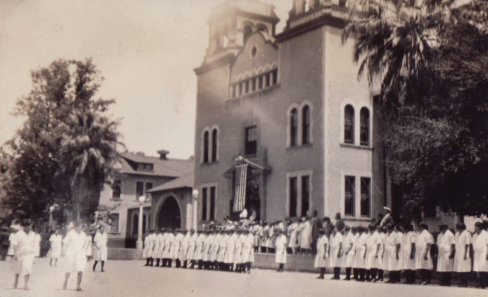
The producers of Beyond the Mesas were very fortunate that Marsah Balenquah from Bacavi on Third Mesa agreed to be interviewed for the film. In the documentary she explains that she attended Sherman for thirteen or fourteen years. At one point in the film she describes her impression of the school’s buildings. Built by Indian students in a Spanish Mission architectural style, the buildings did not resemble the sandstone homes she and other Hopis were familiar with on the reservation.

This photograph was taken when Marsah attended the Indian school in Riverside from 1920 to 1934. In the photo girls are standing in a line waiting for roll call and inspection. Everyday life at Sherman was very regimented. An American flag drapes from the portico of the school’s main building. Photo courtesy of the Sherman Indian Museum.

Matthew Sakiestewa Gilbert

Remembering Polingaysi Qoyawayma

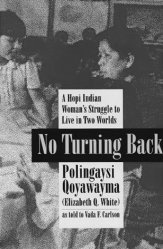
Nineteen years ago on December 6, 1990, Polingaysi Qoyawayma (Elizabeth Q. White), passed away with family at her side in Phoenix, Arizona. Born in 1892, Polingaysi was from the village of Orayvi on Third Mesa, and she is perhaps best known for her book (as told to Vada Carlson) No Turning Back: A Hopi Woman’s Struggle to Live in Two Worlds. I never had the honor of meeting Polingaysi, but her story is often told among our people. In November 1906, shortly after an internal dispute in her village, Polingaysi left by wagon with a group of Hopi children to the small town of Winslow, Arizona. From there she boarded a Santa Fe train to San Bernardino, California, then traveled south to Sherman Institute in Riverside. She experienced a different life in the “land of oranges,” and she wrote at length about her time at Sherman in No Turning Back. After spending almost three years at the school, Polingaysi returned to Orayvi and found it difficult to acclimate to reservation life. She eventually became the first Hopi to teach at a Hopi day school, and she encouraged her students to take the best of Hopi and American culture to succeed as a people. Although Polingaysi is often associated with No Turning Back, she also wrote a second book in 1941 titled The Sun Girl, which was illustrated by Hopi artist Komoki. In this children’s book, Polingaysi retells a story of a young girl named Dawamana (“Sun Maiden” or “Sun Girl”) from Orayvi who learns the Butterfly Dance at the village of Moencopi. In the foreword to the book’s 1978 edition, Robert Breunig of the Museum of Northern Arizona notes that “Mrs. Qoyawayma told this story many times to her school children. They became so enthralled with it that they asked that it be repeated again and again, and they learned it almost word for word, correcting deviations from one telling to the next. Finally, Mrs. Qoyawayma wrote the story down in the hope that all children would enjoy it.” Nineteen years after her passing, Polingaysi’s life and work are still remembered. She is one of the most revered teachers and writers in Hopi history, and her example and words continue to have great meaning and relevance for those in the present.

Matthew Sakiestewa Gilbert