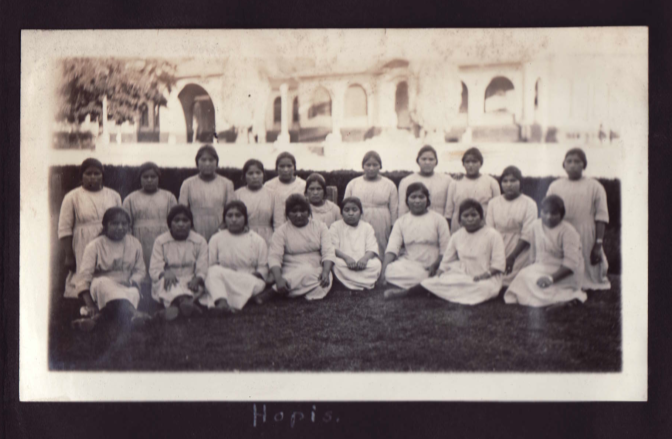
1920s photo of Hopi girls at Sherman Institute

I was once asked how many photos and other images we included in Beyond the Mesas. I do not know the exact number, but it had to have been over a hundred. Some of these photos came from people who we interviewed for the film, others we uncovered at various archives. One of these photos was of a group of Hopi girls at Sherman Institute during the 1920s. I came across this picture in the Veva Wight Collection at the Sherman Indian Museum in Riverside, California. Wight was a Protestant missionary who led Bible studies and other Christian activities at the school. She worked as a “Religious Worker” at Sherman for more than thirty years. Although government officials allowed Christianity at Sherman to encourage the assimilation of Indian students, some Hopi girls had a genuine committment or interest in the Christian faith.

Matthew Sakiestewa Gilbert

Beyond the Mesas to air locally and via internet

I am pleased to announce that UI-7, a local television station associated with the College of Media at the University of Illinois, will air Beyond the Mesas this week on the following days and times:

Tuesday, January 19 – 7:30pm and 9:00pm CST
Wednesday, January 20 – 1:00 pm CST
Friday, January 22 – 10:00 pm CST
Saturday, January 23 – 8:00 pm CST

UI-7 can be seen on Channel 7 for local Comcast subscribers.

On the same days/times, Beyond the Mesas will air simultaneously over the internet via a live stream at: http://www.media.illinois.edu/service/ui7live.html

If you are planning on watching the film on-line, remember to account for the different time zones. The above showings are listed in Central Standard Time (CST)

Beyond the Mesas Trailer

About the film:

Directed by Emmy Award winning director, Allan Holzman, and produced by Leigh J. Kuwanwisiwma, Stewart B. Koyiyumptewa, Matthew Sakiestewa Gilbert, and Gerald Eichner, Beyond the Mesas is a thirty-six minute documentary film on the removal of Hopis to on and off-reservation boarding schools and their experiences at schools such as Sherman Institute, Phoenix Indian School, Ganado Mission School, and Stewart Indian School. Topics covered in the film include Hopi understandings of education, early U.S. government attempts to assimilate Hopis, the Orayvi Split, Hopi language loss at American schools, and the future of the Hopi people. Produced with the cooperation and involvement of the Hopi Cultural Preservation Office in Kykotsmovi, Arizona, Beyond the Mesas is part I of a series of films on children and American Indian culture titled “Keeping the Culture Alive.”

The first public showing of the film was at the Hotevilla Bacavi Community School on the Hopi Reservation on November 8, 2006. Shortly afterwards, the Applied Indigenous Studies Department at Northern Arizona University and the Hopi Cultural Preservation Office hosted a screening at the Cline Library auditorium. Since November 2006, official screenings have taken place at other universities and schools, including the University of Illinois, University of California, Riverside, Cornell University, and Sherman Indian High School. The film has aired on several regional PBS stations throughout the United States.

Matthew Sakiestewa Gilbert

Tawaquaptewa and the Antiques Roadshow

In 2005, I published an article on a Hopi chief named Tawaquaptewa from Orayvi on Third Mesa. He was kikmongwi (village chief) at Orayvi during a very unstable time in Hopi history. In the early 1900s the village of Orayvi was divided over several issues. One of these issues was the mandatory enrollment of Hopi children at government schools.

In the past scholars have produced a great deal of material on Tawaquaptewa, but most of the scholarship focuses on Tawaquaptewa during this period. However, when I was writing my book on the Hopi boarding school experience I came across a fascinating article by Barry Walsh titled “Kikmongwi As Artist: The Katsina Dolls of Wilson Tawaquaptewa” in the American Indian Art Magazine (Winter 1998).

Walsh highlights an area of Tawaquaptewa’s life that has not received much attention. Tawaquaptewa was a carver and he sold his katsina dolls to tourists who visited the reservation between 1930 and 1960. Today his dolls are highly sought after by collectors. A website called TribalArtCollections.com has a photo gallery of his work.

In March 2008, the Antiques Roadshow (PBS) featured one of Tawaquaptewa’s katsina dolls. The segment is less than 3 minutes long, but I think you will find it interesting. To see the video click here. I have also pasted the appraisal transcript below.

Matthew Sakiestewa Gilbert

——————————————–

The following transcript was originally published on the Antiques Roadshow (PBS) website at: http://www.pbs.org/wgbh/roadshow/archive/200705A39.html

20th-Century Wilson Tawaquaptewa Kachina Doll

Aired: March 31, 2008

GUEST: It’s a kachina doll. It was my father’s. I got it after he passed away. He taught school in Southern Idaho. During the ’20s, when they relocated tribal people from different places, they sent the children all over the United States, and this young man became a friend of my father’s, and when he left school, he gave my dad the doll, so…

APPRAISER: Do you know where it came from?

GUEST: From hearing what my dad talked about and what he said, you know, that it was from… Southwest America somewhere.

APPRAISER: It’s from Northern Arizona.

GUEST: Northern Arizona?

APPRAISER: It is a kachina doll, but… there’s some different things about this one that makes it a little bit special. It’s not like most kachina dolls. We actually know who made this doll.

GUEST: Oh, really?

APPRAISER: Yeah. It was made by a guy named Wilson Tawaquaptewa.

GUEST: Oh, my goodness.

APPRAISER: And he was the Hopi chief at Oraibi, but there’s two Oraibi villages and I’m not sure which one it was.

GUEST: See, that name sounds familiar.

APPRAISER: Yeah, but… because he was the chief, he wasn’t going to do something traditional and sell it, and so he made these kachinas that are like no other kachinas.

GUEST: Really?

APPRAISER: You go through the books and you’re not going to find one of these, because they most often represent a badger, or they have characteristics of a mouse or some animal in his world out there that’s not a traditional kachina, and this is one of them. The way that we spotted it is he liked to use this indigo color, and… it’s this really faded blue here.

GUEST: I never noticed it.

APPRAISER: Yeah, we almost didn’t, too. Tawaquaptewa worked from about 1930 into the early 1960s. If it wasn’t one of his and it was a kachina that looked like it was from the ’30s like this one, that’s worth some pretty good money– $2,500…

GUEST: Oh, my goodness.

APPRAISER:…to $3,500, but because it’s a Wilson Tawaquaptewa, there’s a group of collectors now who recognize his work, who buy his work. On a bad day, this is worth $7,500 to $8,500. Uh… …if it’s a good day and the right collector’s in the room, $9,000.

GUEST: My goodness.

APPRAISER: So it’s something real special and it’s something real unique that you ended up with.

GUEST: Oh, no kidding, and to know that, you know, you can recognize the maker, you know…

APPRAISER: Yeah.

GUEST:…that is, that is amazing. That surprises me, surprises me a great deal.

APPRAISER: Great. Yeah.

GUEST: Yeah, it does.

Hopi Music Repatriation Project

The Hopi of northeastern Arizona are among the most researched indigenous people groups in North America. Over the years anthropologists, historians, psychologists, ethnographers and many others have conducted research on the Hopi Reservation.  Their scholarship has appeared in journals, books, internet websites, and even films. Some of these scholars collaborated with Hopi people, followed research protocols established by the Hopi Tribe, and sought ways to give back to the Hopi community. Others did not. But the purpose of today’s post is not for me to write about people who have exploited Hopis of their intellectual property or conducted research on the reservation without permission from the Hopi Tribe. Instead I want to introduce you to someone whom I believe has done the complete opposite.

While a graduate student in the Arts Administration program at Columbia University, Trevor Reed from the Hopi village of Hotevilla developed a research project called the “Hopi Music Repatriation Project” (HMRP). This project focuses on field recordings of Hopi songs that ethnomusicologists conducted during the 1930s and 1940s. The recordings are now archived at Columbia University’s Center for Ethnomusicology. As Reed points out on his blog Hopi Music Repatriation Project: “On one hand, these recordings are invaluable research tools for ethnomusicologists, anthropologists, and for the American public, who ideally should be educated in the indigenous heritage of the land on which they live. On the other hand, the recordings are an important link to Hopi past and identity, and contain highly sensitive material.” So what are the questions that this project seeks to answer? Again, Reed notes: “based on Hopi and U.S. concepts of intellectual property, to whom do these recordings rightfully belong and what should be done with them?”

I urge you to visit Reed’s blog and learn more about this important project. His current post, “Repatriation Initiative Receives Endorsement from Hopi Elders,” describes a recent meeting that he had with the Hopi Cultural Preservation Office and the Hopi Cultural Resources Advisory Task Team. At this meeting Reed gave a update on his project and played some of the Hopi songs that he uncovered at the University’s Center for Ethnomusicology. As Reed recalls, a highlight for him was when he played a particular song at the meeting and those in attendance joined in the singing. To visit Reed’s blog, click here.

Matthew Sakiestewa Gilbert

Hopi professor earns tenure and promotion

It gives me great pleasure to announce that Hopi professor Angela A. Gonzales from Shungopavi on Second Mesa has received tenure and promotion to Associate Professor at Cornell University. This truly is an incredible accomplishment. Gonzales received her undergraduate degree from UC Riverside and her MA, EdM, and PhD in Sociology form Harvard University. Her first academic post was at San Francisco State University where she served as an assistant professor and acting chair of American Indian Studies from 1997 to 2000. In 2002 she joined the faculty in the Department of Development Sociology at Cornell where she also teaches in the American Indian Program. As an assistant professor Gonzales has had a prolific and remarkable career.

In addition to publishing chapters in many books, her articles have appeared in the Social Sciences Journal, the Public Historian, the American Indian Culture and Research Journal, and the International Social Sciences Journal. Alongside her faculty appointments, she was the director of the Hopi Tribe Grants and Scholarship Program on the Hopi Reservation from 1994 to 1995, and from 2005 to 2007 she held a postdoctoral fellowship at the University of Colorado at Denver Health Sciences Center, Native Elder Research Center, and the American Indian and Alaska Native Program.

In 2009 she was awarded the Ford Foundation Diversity Fellowship for her project titled “Racializing American Indians: The Politics of Identity, Displacement, and Dispossession.” Gonzales’ tenure and promotion is a proud moment for Hopi people. She is only one of a few Hopi professors in the academy with indefinite tenure.

Matthew Sakiestewa Gilbert

University of Illinois at Urbana-Champaign

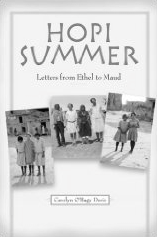
Review of Hopi Summer: Letters from Ethel to Maud (Rio Nuevo Publishers, 2007)

Carolyn O’Bagy Davis, Hopi Summer: Letters from Ethel to Maud. Tucson: Rio Nuevo Publishers, 2007. 160pp. paper, $15.95.

In January 1927, Carey E. Melville, a mathematics professor at Clark University in Worchester, Massachusetts, his wife Maud and their three children, left the comforts of their suburban home for a nine month adventure across the United States. Traveling in a newly purchased Model T Ford, the Melvilles drove south to Florida and then made their journey out West. In the summer of 1927, the Melvilles arrived at the Hopi villages of Sichomovi, Walpi, and Polacca in northeastern Arizona. At Polacca, Maud Melville met several Hopi artists, including a Hopi-Tewa pottery maker named Ethel Salyah Muchvo, her husband, Wilfred, and their children Minerva and Clifford. Unlike other tourist who had visited the Hopi villages in the past, Maud remained in contact with Ethel and her family after the Melvilles returned to their home in New England. In Hopi Summer, historian and biographer Carolyn O’Bagy Davis uses Maud’s journal entries, Ethel’s letters to Maud, letters written by Christian missionaries, and Hopi oral interviews to tell the story of Ethel’s friendship with Maud. However, Hopi Summer is more than a story about a friendship between two very different people. It is a story about survival, death, life, and a Hopi woman’s determination to care for her family and ill husband.

In the late 1920s and 1930s, diseases killed many Hopis on the reservation. Ethel’s husband, Wilfred, suffered from tuberculosis and his illness had a devastating effect on their children. Having experienced the pain and sorrow of losing eleven children to the disease, Ethel reached out to her pahaana (“white person”) friend, Maud, for comfort and compassion, while Maud responded with charitable acts and words of kindness. On several occasions Ethel wrote and asked Maud if she would send her extra clothes, winter coats, and blankets. In return Ethel sent Maud her pottery, Wilfred’s katsina dolls, and other pieces of Hopi craftmanship as gifts. After the Melvilles returned home Maud gave several lectures about the Hopis, and sold Wilfred’s art to people she had met at various speaking events. Maud sent the earnings from the sales to Ethel and Wilfred and the family used the money to purchase food and needed supplies. Ethel’s friendship with Maud had a business element to it that reflected Ethel’s commitment to provide for her family.

Although other women have written about the Hopi people during this period, including the Christian missionary Abigail E. Johnson and the Christian biographer, Florence Crannell Means, Davis masterfully highlights the Hopi “voice” and provides the reader with a deep sense of Hopi ways and customs. Davis’s’ ability to write about the Hopi people, while at the same time not lead the reader into the “kiva” (metaphorically speaking), stands as a testimony to her sensitivity to certain aspects of Hopi religious culture. Davis’s research methodology is highly commendable, and serves as an example for individuals who desire to conduct research with an indigenous community. In this regard, Davis follows in the footsteps of Hopi scholars Sheilah E. Nicholas, Angela A. Gonzales, Patricia Sekaquaptewa, Lomayumtewa C. Ishii, and anthropologists Peter M. Whiteley and Wesley Bernardini. Each of these individuals have conducted extensive research on the Hopi Reservation and did so with the involvement and cooperation of the Hopi Tribe. Furthermore, Hopi Summer supports the understanding that Hopi intellectual property belongs with the Hopi people. In addition to sharing letters and pictures with Ethel’s family, including Ethel’s daughter, Vivian, Davis provided the Hopi Cultural Preservation Office with copies of her research and sought the assistance of Hopi scholars Hartman Lomawaima, former director of the Arizona State Museum, and Emory Sekaquaptewa.

Hopi Summer is beautifully written and illustrated with several previously unpublished photographs, maps, and letters. Scholars, students, and people who are interested in Native American history, the history of the West, women’s history, cultural history, and American Indian Studies, will certainly gain from Davis’s work on the Hopi people. While readers could have benefited from a deeper interaction with the literature on Hopis during this era, Hopi Summer remains a fascinating account of a “bygone time in Hopi history.”

Matthew Sakiestewa Gilbert

University of Illinois at Urbana-Champaign

Portions of this review originally appeared in American Indian Quarterly (Winter 2009, vol. 33:1, pp. 163-64)
“Kwa’a, kwakwha’ um nuy siiva maqa”: Speaking Hopi to Grandpa

When I received my advanced degree in history from UC Riverside my grandparents made the trip from Moencopi to Southern California to see me graduate. We had a big celebration and one of the gifts my grandparents gave me was a card with a check inside. After opening the card I immediately thanked my grandmother, but I waited to thank my grandfather until I was able to do so in Hopi. As my grandfather was sitting in his truck, ready to make the trip back to the reservation, I said to him: “Kwa’a, kwakwha’ um nuy siiva maqa” (“Grandpa, thank you for the money that you gave me”). He looked up at me and said one word: “owi’.” The literal English translation of “owi'” is “yes,” but in this context it meant much more. At that very moment I connected with my grandfather at a level that would have been impossible in English. Hopi was his first language and it is the language that he prefers.

Growing up in the mountain community of Flagstaff, I thought my grandfather was a man of few words. I do not recall having long conversations with him when I was a child. But as I got older I realized that my grandfather was a man of few words in English and not Hopi. I sometimes wonder how my relationship with my grandfather would be different if I knew how to speak more Hopi. In my immediate family we say that kwa’a only listens to my dad, because my dad speaks to him in Hopi. We say this jokingly, but there is truth to it. Even today when our family gets together my dad and his father can be heard conversing in the Hopi language.

A lifelong goal of mine is to be able to speak fluent Hopi. I have a long way to go before I reach this goal. Hopis are proud that much of our culture remains intact. Many of our ceremonies continue, we remain on portions of our ancestral lands, and Hopi is still spoken. But our parents and grandparents will tell you that fewer and fewer Hopis are able to speak their language. Fortunately, efforts are being made by people such as Sheilah E. Nicholas of the Hopilavayi Project and many others to encourage and help Hopis reverse this problem.

On a related note, Louellyn White, one of our American Indian Studies postdoctoral fellows at the University of Illinois, and Teresa McCarty of Arizona State University, recently informed me about a new story that National Public Radio (NPR) released on Hopi language and youth. The title of this program is “Hopi Teens Worry About Loss of Culture.” This program briefly examines Hopi language loss at U.S. government schools and the issues Hopi youth face as they try to live as Hopis in today’s world. It is a fascinating story. If you would like to listen to the 5 minute program and/or view the transcript, click here.

Matthew Sakiestewa Gilbert

Hopis and Christmas at Indian schools

Over the years I have come across several documents and other sources, including children’s books and newspaper accounts, that involve Hopi students and Christmas at Sherman Institute and the Phoenix Indian School. Many Hopis at off-reservation Indian boarding schools looked forward to Christmas, but not every Hopi enthusiastically celebrated the holiday.

In the children’s book Climbing Sun (1980), Marjorie Thayer and Elizabeth Emanuel note that prior to Hubert Honanie’s first Christmas at Sherman in the late 1920s, the school’s superintendent, Frank M. Conser, mandated that students attend church the Sunday before Christmas day. While Hubert sat in the chapel service, he listened carefully to what the minister said about the birth of Jesus, but he did not see why this baby was so important. Hubert concluded that Christmas held little significance. Although he liked having the day off from school and he enjoyed eating the traditional Christmas food of turkey and cranberries, he would have “preferred stewed rabbit or mutton and corn” prepared according to Hopi custom.

By the 1930s the tradition of Christmas had become very popular among Hopi children on the reservation. In The Hopi Indians of Old Oraibi (1972), anthropologist Mischa Titiev observed that in December 1933, Hopi women walked to Kykotsmovi at the foot of Third Mesa to purchase Christmas presents for the Orayvi children. Titiev noted that several children had taken part in “Christmas programs” at places such as Sherman and the Phoenix Indian School, and several of their parents enjoyed giving them presents on Christmas. Afraid that the children would be disappointed if they did not receive gifts, the women purchased enough presents for each child in the village.

Although the Christmas tradition continues with many Hopis today, Hopis incorporate their culture into the holiday as well. Hopi artists demonstrate this through their art, and some Hopis, particularly those who belong to church congregations on the reservation, still sing Christmas carols in the Hopi language.

Matthew Sakiestewa Gilbert

——————————————————

[Portions of this post were adapted from a newspaper article that I wrote titled “Christmas experiences at Sherman Institute and Phoenix Indian School”, Hopi Tutuveni, December 21, 2005, Issue 26, p. 6]

“I is for Indian Village” – Photographs and Hopi protocols

[UPDATE: Dec. 20, 2:36PM CST – The blog post that I refer to below has been removed from the Craftista website]

This morning I received a Google Alert that directed me to a blog called Craftista. The author of the blog belongs to a blogging group that is currently doing a A to Z meme, and so the author decided that “I” would stand for “Indian Village.” In November, the author visited the Hopi Reservation, took a picture of a village, and posted it to the author’s blog. The photo does not have a caption, but the author refers to the village as a “quaint Indian village.” The picture is of Lower Moencopi near Tuba City, Arizona. A kiva is clearly visible in the photo. About a hundred yards from where this picture was taken, a sign welcomes visitors to the village. The sign reads:

WELCOME TO MOENKOPI VILLAGE, TO ALL VISITORS, YOU ARE WELCOME TO RESPECTFULLY VISIT OUR VILLAGE AND OBSERVE OUR CEREMONIES = ABSOLUTELY NOT PERMITTED = 1. NO SOUND RECORDINGS, 2. NO SKETCHING, 3. NO PHOTOGRAPHY OF ANY KIND, 4. NO REMOVAL OF ANY OBJECTS, 5. NO VIDEO TAKING

The purpose of this post is not to blast the author of Craftista for posting a photo of Moencopi on the author’s blog. Many people who visit our village do so respectfully. Rather, I want to inform people about protocols that Hopi villages ask visitors to follow and respect. Hopis established these protocols to protect their intellectual property, privacy, and to keep people from publishing photographs of village structures, shrines, and ceremonies.

The producers of BEYOND THE MESAS received permission from the Hopi Cultural Preservation Office to include old black and white photos of Hopi villages in the documentary, but we did not film or photograph exterior shots of present-day villages, kivas, or other religious sites.

Matthew Sakiestewa Gilbert

Beyond the Mesas co-executive producer publishes new book

Stewart B. Koyiyumptewa, Carolyn O’Bagy Davis, Hopi Cultural Preservation Office. The Hopi People. Arcadia Publishing, 2009. 128pp. paper, $21.99

This past summer Stewart B. Koyiyumptewa, archivist for the Hopi Tribe and co-executive producer of Beyond the Mesas, published a book along with Carolyn O’Bagy Davis and the Hopi Cultural Preservation Office (HCPO) titled The Hopi People. The book was released by Arcadia Publishing as part of its “Images of America” series. With nearly two hundred black and white photos and several pencil drawings and paintings, The Hopi People provides a concise introduction to Hopi history and culture. Consistent with other books in the “Images of America” series, The Hopi People utilizes photographs and captions to tell a historical narrative. In this book the narrative centers on Hopi life, religion, art, farming, and current issues. One of the chapters is dedicated entirely to Hopi schooling. In Chapter 5, “We Got Real Homesick”, the authors describe the ways Hopis resisted the U.S. government’s policy that required Hopi children to attend schools on and off the reservation. Topics in this chapter include the Hopi day school system, industrial and domestic training, curriculums based on Hopi culture, the Keams Canyon Boarding School, Polingaysi Qoyawayma, and former Senator Barry Goldwater’s support of education efforts on the Hopi mesas. Accompanied by a number of previously unpublished photographs, Chapter 5 is primarily about Hopi schooling on the reservation and not at off-reservation Indian boarding schools. Published with the cooperation and involvement of the HCPO, and several Hopis who provided photos and information on specific pictures, The Hopi People is truly a remarkable publication and it is sure to receive high praise from other reviewers. To learn how you can order a copy of The Hopi People, click here.

Matthew Sakiestewa Gilbert