The following report by Hopi Tribe Chairman LeRoy N. Shingoitewa highlights his administration’s “major accomplishments over the past four years.” Click on the image to download the 10-page report.
The following report by Hopi Tribe Chairman LeRoy N. Shingoitewa highlights his administration’s “major accomplishments over the past four years.” Click on the image to download the 10-page report.
Earlier this summer the University of Illinois granted me promotion to associate professor with indefinite tenure in American Indian Studies & history. Since then, I’ve been thinking a lot about my path to tenure, and the road I took to get where I am now.
Thirty years ago I wanted to grow up to be an astronaut, a veterinarian, or a professional musician. I did not imagine that I would become a university professor or a “scholar.” But when I was a senior in high school, my perspective and desire changed.
At this time, I had a rare opportunity to “job shadow” my father* who was (and still is) a professor of education at Northern Arizona University (NAU).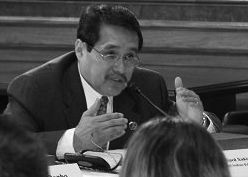
I clearly remember sitting in the back of the classroom as he taught his students from the front.
I had never seen my father in this type of setting, and I was amazed at his ability to communicate to his students, present his topic with much enthusiasm, and provide his students with a safe place to learn, disagree with each other, and to think analytically.
But there was more. My father also exemplified for me how powerful a skilled Native American instructor could be, both as someone who could offer unique insights into course material, and as someone who could be a model for others.
When he lectured on the integration of western science and Navajo and Hopi cultures, he did so with authority and confidence. His teaching was grounded in who he was as an indigenous person. His students understood this, and they benefited from the unique and personal perspective he brought to his lecture.
Although the class period lasted for only an hour, my experience observing my father had a major influence on my life.
In this brief moment, my father demonstrated to me the characteristics of a successful teacher. And he showed me how to excel as an American Indian faculty in a classroom of Native and non-Native students.
My observation job shadowing my father in the College of Education at NAU set in motion my eventual career as an academic.
It launched me on a path toward college and graduate school, and a tenure track faculty position at the University of Illinois.
As an assistant professor, I worked hard to fulfill my obligations and responsibilities to the academy and my Hopi community. But I did not do it alone.
I had the support of my wife and children, my parents and other extended family members, colleagues and friends at Illinois and beyond, and many people back home.
Now on sabbatical, and on the other side of tenure, I find myself thinking a lot about the past seven years at Illinois.
But I also keep recalling the time when I job shadowed my father, and the significance this experience had, and continues to have, on my career and life.
——————————
*My father, Willard Sakiestewa Gilbert, is professor of Bilingual and Multicultural Education at Northern Arizona University (NAU). He grew up on the Hopi and Navajo Indian reservations in Arizona, and he received his Ed.D. (Doctor of Education) at the University of New Mexico. He has published a number of articles and book chapters, and once served as President of the National Indian Education Association (NIEA).
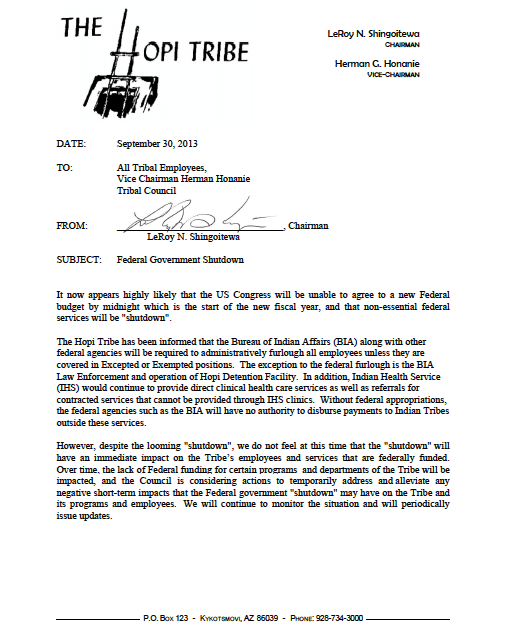

 In April of this year, Susan Bundock, C-SPAN’s American History TV Producer, interviewed me at the 2013 Organization of American Historians conference in San Francisco, CA. At the end of June, the interview aired on national television and streamed on-line. Bundock asked me a number of questions about Hopi and Native American history. She also asked about my family history, and the American Indian Studies Program, and Department of History, at the University of Illinois at Urbana-Champaign. The interview is just over 20 minutes long, and can be viewed at the following address: http://www.c-spanvideo.org/program/312267-6

Be sure to check out a relatively new Hopi-authored blog by VaNiesha Honani of Walpi entitled “1000 Words and a Cup of Coffee.” So far VaNiesha has written on a handful of topics, including the Hopi Code Talkers, and the recent auction of 71 Hopi ceremonial items in France.
Here’s an excerpt from a post that she wrote entitled “This Little House on Walpi”. I think you will find her writing style and perspective to be quite engaging.
This past summer, I was in a mood and set on sitting in that little house during our Home Dance, moping and eating stew. I sat still. Little girls ran in and out, screaming with laughter and the boys chased each other around with bows in the summer.
As the day passed, they got dirtier. I held my little niece and talked to her. “You see this craziness?” She smiled. All the girls were dressed in traditional dresses. Even in my grumpiness, as I held my niece and had random one-sided conversations with her, my breath was taken away. The memories multiplied to the present. I looked at all my sisters, my nieces and aunts, in the same traditional clothes as 1000 years ago. The corn stalks and kachina dolls. The random small toy arrow that would come flying through the door. How beautiful.
I smile because when I hear somebody in an L.A. gallery wonder, “I can’t imagine growing up there, I wonder if people still live there or did they leave because it’s hard living.” I muse. Yes, we do still live there. No matter where or how far. Technology and all. It’s home. I smile as I stand next to them pondering over my house, this little house on Walpi.
Want to read more? Head on over to her blog: www.1000wordsandacupofcoffee.com


In June I had a great opportunity to speak at the Wings of America organization’s annual American Indian Running Coaches’ Clinic in Albuquerque, New Mexico.
Wings of America exists to “enhance the quality of life for American Indian youth” by promoting running and pride in one’s “cultural identity.”
I spoke to a group of nearly 50 Native high school runners, and a number of coaches, including Hopi coach Rick Baker. I don’t often get a chance to speak to such a well-informed audience!
However, the highlight for me was listening to Hopi runner Wendi Lewis from Kykotsmovi, who gave a wonderful talk on running through the “trials and tribulations of life.”
Other presenters included Navajo scholar Lloyd Lee, Anthropologist Peter Nabakov, who once published a remarkable book entitled Indian Running, Jemez Pueblo runner Steve Gachupin, and many others.
Although I was not able to listen to Steve Gachupin’s talk, I have great respect for him as a runner.
Known for winning six consecutive Pikes Peak Marathons in the late 1960s and early 1970s, he is a strong advocate for running among Native youth.
I first learned about Gachupin and his running accomplishments from an excellent article by historian Brian S. Collier entitled “’To Bring Honor to My Village’: Steve Gachupin and the Community of Jemez Running and the Pikes Peak Marathon” (Journal of the West, Fall 2007).
If you are at all interested in running, be sure to read this article (it’s an article that I often cite in my work).
I should also note that the beautiful plate above was given to everyone who presented at the Clinic. It was made by Jemez Pueblo potter Bernice Gachupin, Steve Gachupin’s wife.
Finally, I want to give a special thanks to Wings of America Program Director Dustin Quinn Martin and other organizers for their hard work in making this terrific event possible.
Kwakwha’!
FOR IMMEDIATE RELEASE
Contact: Matt Lazier
805-756-7109; mlazier@calpoly.edu
Cal Poly to Confer Three Honorary Doctorate Degrees at Commencement June 15, 16
SAN LUIS OBISPO — Rodeo icon Cotton Rosser, agricultural industry leader James W. Boswell, and engineer-turned-artist Alfred Qöyawayma — all Cal Poly alumni — will receive honorary Doctor of Science degrees at the university’s spring commencement ceremonies Saturday and Sunday, June 15 and 16.
Qöyawayma will deliver the keynote address at Saturday’s event, and Boswell will give the keynote Sunday.
Qöyawayma, whose name is Hopi for “Grey Fox Walking at Dawn,” studied mechanical engineering at Cal Poly. He graduated in 1961 and began his career developing guidance systems for military and commercial applications, including the X-5, the F-15, the 747, and even Air Force One. He then worked for Arizona’s utility industry, leading a team of scientists and engineers in solving challenges to the state’s power and water systems.
He co-founded the American Indian Science and Engineering Society, serving as the first chairman of an organization that has helped more than 12,000 students graduate in the critical STEM (science, technology, engineering and mathematics) disciplines. In 1988 he received a White House appointment to become vice chairman of the Institute of American Indian Art, and he became a full-time artist and published researcher on native culture in the Western Hemisphere. He has been a Fullbright Scholar and a featured artist at the Smithsonian’s permanent Archives of American Art, and his “Corn Mother” sculpture is on permanent display at Cal Poly.
Boswell — a 1977 graduate with a bachelor’s in business administration — is chairman and CEO of J.G. Boswell Co., an agriculture and real estate development firm his family founded in 1925. The company owns and operates farms in California and Australia, producing, processing and marketing a variety of crops and developing innovative practices in plant biotechnology and livestock operations. The real estate arm of the company develops planned communities and business parks throughout the Western U.S.
As head of J.G. Boswell, he is also the president of the James G. Boswell Foundation, which supports agricultural education and has helped more than 1,200 graduates. He is a major supporter of Cal Poly’s College of Agriculture, Food and Environmental Sciences. Through the foundation, he has established an endowed chair in the Horticulture and Crop Sciences Department, invested in the Agribusiness Management Club, and contributed to the college’s Learn by Doing Fund for Agricultural Education. He has also served on the Cal Poly President’s Cabinet, sharing his real-world insight to help the university continue to educate resourceful leaders in California agriculture.
As a student at Cal Poly, Rosser led the university’s rodeo team to the forefront of intercollegiate rodeo competition, launching a winning tradition that would garner 41 national championships. After graduating in 1952, he purchased the Flying U Rodeo Co. and began producing rodeos and making his mark on the industry.
Rosser’s rodeo events are known for their colorful pageantry, innovative showmanship and energetic patriotism. He was instrumental in bringing high school rodeo to California and has been a longtime Cal Poly Rodeo booster and Cal Poly Alumni Association supporter. For his contributions to rodeo culture in the Western U.S., Rosser has been inducted into several rodeo halls of fame and Western museums.
About 4,000 students are eligible to graduate in Cal Poly’s spring commencement.
# # #
See also: http://www.calpolynews.calpoly.edu/news_releases/2013/May/doctorate.html
 BEYOND THE MESAS, LLC