Wings of America 15th Annual American Indian Running Coaches’ Clinic

Screen Shot 2013-07-07 at 2.52.46 PM
Plate by Jemez Pueblo potter Bernice T. Gachupin

In June I had a great opportunity to speak at the Wings of America organization’s annual American Indian Running Coaches’ Clinic in Albuquerque, New Mexico.

Wings of America exists to “enhance the quality of life for American Indian youth” by promoting running and pride in one’s “cultural identity.”

I spoke to a group of nearly 50 Native high school runners, and a number of coaches, including Hopi coach Rick Baker. I don’t often get a chance to speak to such a well-informed audience!

However, the highlight for me was listening to Hopi runner Wendi Lewis from Kykotsmovi, who gave a wonderful talk on running through the “trials and tribulations of life.”

Other presenters included Navajo scholar Lloyd Lee, Anthropologist Peter Nabakov, who once published a remarkable book entitled Indian Running, Jemez Pueblo runner Steve Gachupin, and many others.

Although I was not able to listen to Steve Gachupin’s talk, I have great respect for him as a runner.

Known for winning six consecutive Pikes Peak Marathons in the late 1960s and early 1970s, he is a strong advocate for running among Native youth.

I first learned about Gachupin and his running accomplishments from an excellent article by historian Brian S. Collier  entitled “’To Bring Honor to My Village’: Steve Gachupin and the Community of Jemez Running and the Pikes Peak Marathon” (Journal of the West, Fall 2007).

If you are at all interested in running, be sure to read this article (it’s an article that I often cite in my work).

I should also note that the beautiful plate above was given to everyone who presented at the Clinic. It was made by Jemez Pueblo potter Bernice Gachupin, Steve Gachupin’s wife.

Finally, I want to give a special thanks to Wings of America Program Director Dustin Quinn Martin and other organizers for their hard work in making this terrific event possible.

Kwakwha’!

Hopi engineer and artist to receive honorary doctorate

FOR IMMEDIATE RELEASE

Contact: Matt Lazier
805-756-7109; mlazier@calpoly.edu

Cal Poly to Confer Three Honorary Doctorate Degrees at Commencement June 15, 16

SAN LUIS OBISPO — Rodeo icon Cotton Rosser, agricultural industry leader James W. Boswell, and engineer-turned-artist Alfred Qöyawayma — all Cal Poly alumni — will receive honorary Doctor of Science degrees at the university’s spring commencement ceremonies Saturday and Sunday, June 15 and 16.

Qöyawayma will deliver the keynote address at Saturday’s event, and Boswell will give the keynote Sunday.

Qöyawayma, whose name is Hopi for “Grey Fox Walking at Dawn,” studied mechanical engineering at Cal Poly. He graduated in 1961 and began his career developing guidance systems for military and commercial applications, including the X-5, the F-15, the 747, and even Air Force One. He then worked for Arizona’s utility industry, leading a team of scientists and engineers in solving challenges to the state’s power and water systems.

He co-founded the American Indian Science and Engineering Society, serving as the first chairman of an organization that has helped more than 12,000 students graduate in the critical STEM (science, technology, engineering and mathematics) disciplines. In 1988 he received a White House appointment to become vice chairman of the Institute of American Indian Art, and he became a full-time artist and published researcher on native culture in the Western Hemisphere. He has been a Fullbright Scholar and a featured artist at the Smithsonian’s permanent Archives of American Art, and his “Corn Mother” sculpture is on permanent display at Cal Poly.

Boswell — a 1977 graduate with a bachelor’s in business administration — is chairman and CEO of J.G. Boswell Co., an agriculture and real estate development firm his family founded in 1925. The company owns and operates farms in California and Australia, producing, processing and marketing a variety of crops and developing innovative practices in plant biotechnology and livestock operations. The real estate arm of the company develops planned communities and business parks throughout the Western U.S.

As head of J.G. Boswell, he is also the president of the James G. Boswell Foundation, which supports agricultural education and has helped more than 1,200 graduates. He is a major supporter of Cal Poly’s College of Agriculture, Food and Environmental Sciences. Through the foundation, he has established an endowed chair in the Horticulture and Crop Sciences Department, invested in the Agribusiness Management Club, and contributed to the college’s Learn by Doing Fund for Agricultural Education. He has also served on the Cal Poly President’s Cabinet, sharing his real-world insight to help the university continue to educate resourceful leaders in California agriculture.

As a student at Cal Poly, Rosser led the university’s rodeo team to the forefront of intercollegiate rodeo competition, launching a winning tradition that would garner 41 national championships. After graduating in 1952, he purchased the Flying U Rodeo Co. and began producing rodeos and making his mark on the industry.

Rosser’s rodeo events are known for their colorful pageantry, innovative showmanship and energetic patriotism. He was instrumental in bringing high school rodeo to California and has been a longtime Cal Poly Rodeo booster and Cal Poly Alumni Association supporter. For his contributions to rodeo culture in the Western U.S., Rosser has been inducted into several rodeo halls of fame and Western museums.

About 4,000 students are eligible to graduate in Cal Poly’s spring commencement.

# # #

See also: http://www.calpolynews.calpoly.edu/news_releases/2013/May/doctorate.html

Yale University Press to publish second edition of Don C. Talayesva’s book Sun Chief: The Autobiography of a Hopi Indian

Sun Chief 2nd edition

Several months ago Yale University Press asked me to write the new Foreword to the second edition of Don C. Talayesva’s book Sun Chief: The Autobiography of a Hopi Indian. The book was originally published in 1942. Yale will release the second edition in December of this year.

Talayesva was from the village of Old Oraibi (Orayvi) on Third Mesa. As a young man, he had been educated in western schools, including Sherman Institute, but eventually returned home to live according to Hopi ways and customs.

In the 1930s and early 1940s, he worked alongside a white anthropologist named Leo W. Simmons to write and publish his autobiography.

In the new Foreword, I situate Sun Chief within contemporary Hopi studies, and explore the ways scholars have used the book since its publication more than seventy years ago.

The Hopi Tawa image on the cover is of a mural by Hopi artist Fred Kabotie of Shungopavi. I collaborated with Kabotie’s grandson, Ed Kabotie, the Hopi Cultural Preservation Office, the National Parks Service, and the Press to help get this image on the cover.

If you are interested in obtaining a copy of the book, it is now available for pre-order through several distributors, including Amazon and Barnes & Noble.

Hopi Tumalhoymuy Tutuveniam – April 2013

Click to download (10 pages)

Museum of Northern Arizona director condemns Paris auction of Hopi and other Native ceremonial objects

The following post was taken from the Facebook page of the Museum of Northern Arizona. I thank Director Dr. Robert Breunig for granting me permission to repost his letters (English and French versions) on BeyondtheMesas.com. Please distribute widely.

______________________________________________

Museum of Northern Arizona Facebook page:

An auction house in Paris, France, Neret-Minet Tessier & Sarrou, plans to auction off 70 ceremonial katsina friends, improperly translated into English as “masks,” on April 12. Below is an open letter in both English and French to the auction house, in which Museum of Northern Arizona Director Dr. Robert Breunig voices his condemnation of this planned sale of significant religious objects, adding MNA to the public opposition to this sale by the Hopi and Zuni tribal members, the Heard Museum, and many individuals.

______________________________________________
March 29, 2013

Étude Neret-Minet Tessier & Sarrou
Commissaires-Priseurs
8, Rue Saint-Marc
75002 Paris FRANCE

To the Directors,

I am the director of the Museum of Northern Arizona in Flagstaff, Arizona. If the name of the museum is familiar to you, it is because this museum was founded by Harold S. Colton, my predecessor and the author of “Hopi Kachina Dolls,” the book you have cited as an authoritative source in the listing of 70 Hopi, Zuni, Acoma, and Jemez “masques katsinam,” properly called “katsina friends” and advertised for an auction by your firm on April 12, 2013.

I am writing to request that you cancel this auction, withdraw the katsina friends from sale, and that they be returned by the “owner” to the Hopi, Zuni, Acoma, and Jemez people. I have placed quotation marks around the word “owner,” because no one can “own” them but the Hopi, Zuni, Acoma, and Jemez people. Although katsina friends can be held and cared for by individuals, they belong to the communities from which they come or to specific ceremonial societies. Under tribal custom and law they cannot be sold or given away by an individual.

I can tell you from personal knowledge that the proposed sale of these katsina friends, and the international exposure of them, is causing outrage, sadness, and stress among members of the affected tribes. For them katsina friends are living beings; that is why they are called “friends” (kwatsi) in the Hopi language. The friends are loved, cared for, and ceremonially fed. They are a connection between the human world and the spirits of all living things and the ancestors. To be displayed disembodied in your catalogue and on the internet is sacrilegious and offensive. If one claims to value these katsina friends as “works of art,” one must also respect the people who made them and the native traditions that govern their use. And, as fellow human beings, it is my hope that you will offer understanding and empathy to the tribal people who are so deeply affected by this proposed sale. You cannot honor and value these katsina friends while dishonoring their makers. These are universal principles of cross-cultural human conduct.

On behalf of the Museum of Northern Arizona, I appeal to your sense of decency and humanity, and request that you terminate the auction and send these katsina friends to their proper homes among the native people in Arizona and New Mexico.

Sincerely,
Robert G. Breunig, Ph.D.
Director, Museum of Northern Arizona

_______________________________________________
Ce 29 mars 2013, Flagstaff

Étude Neret-Minet Tessier & Sarrou
Commissaires-Priseurs
8, Rue Saint-Marc
75002 Paris FRANCE

Messieurs les Directeurs:

C’est dans ma capacité de Directeur du Museum of Northern Arizona (Flagstaff, Arizona, États-Unis) que je me permets de vous contacter. Le nom de notre musée vous est connu : son fondateur, mon prédécesseur Harold S. Colton, fut l’auteur du livre Hopi Kachina Dolls que vous citez comme source d’autorité dans votre catalogue de 70 “masques katsinam” – plus correctement nommés des amis katsinam – présentés pour une vente aux enchères de votre établissement, prévue pour ce 12 avril 2013.

Je vous écris pour demander dès aujourd’hui l’annulation de cette vente ; le retrait desdits amis katsinam de toute vente présente ou future ; et surtout, que ceux-ci puissent être restitués aux peuples Hopi, Zuni, Acoma et Jemez par leur « propriétaire ». Si je mets entre guillemets ce dernier, c’est que nul ne peut être en « possession » des amis katsinam, à part les peuple Hopi, Zuni, Acoma, et Jemez dont ils proviennent. Je tiens par ailleurs à vous assurer par ma propre expérience récente et personnelle, que cette vente annoncée des amis katsinam, ainsi que leur exposition publique et internationale, est source d’outrage, tristesse et angoisse – profonds et réels – parmi les membres des tribus concernées. Pour eux, les amis katsinam sont des êtres vivants : raison pour laquelle la langue Hopi les dénomme « amis » (kwatsi). Les kwatsi sont aimés, chéris, nourris de façon rituelle. Ils incarnent le lien entre le monde humain, les esprits de tout ce qui vit, et les ancêtres. Se trouver ainsi exposés – désincarnés – dans votre catalogue et sur Internet, est une offense profonde, un sacrilège. Si les amis katsina peuvent être soignés et tenus entre mains humaines, ils appartiennent seules aux communautés dont ils sont issus, spécifiquement à leurs sociétés cérémonielles. Par coutume et par loi tribale, leur vente, donation ou dation par qui que ce soit, est proscrite.

Quiconque prétend estimer ces amis katsina comme « œuvres d’art » se doit en parallèle de respecter les peuples qui les ont crées, et les traditions amérindiennes qui gouvernent leur utilisation. Aussi, sur un plan purement humain, devriez-vous étendre votre compréhension, voire votre empathie, envers les peuples tribaux si profondément affectés par cette vente dont vous êtes l’organisateur. On ne peut apprécier et estimer ces amis katsina tout en déshonorant leurs créateurs. Il s’agit de principes universels, et d’une conduite humaine digne de ce nom…

Au nom du Museum of Northern Arizona, je fais appel à votre sens de décence et d’humanité en vous priant de supprimer cette vente, et de faire parvenir ces amis katsina à leur seul vrai lieu d’appartenance : chez les peuples amérindiens de l’Arizona et New Mexico, afin que ceux-ci puissent en disposer selon leur rite et coutume.

Je vous prie, Messieurs les Directeurs, de recevoir l’expression mon sentiment respectueux et profondément déconcerté.

Robert G. Breunig, Ph.D.
Director, Museum of Northern Arizona
Arizona Daily Sun: Auction Offends Hopi

Auction Offends Hopi

April 2, 2013 5:05am – CYNDY COLE – Sun Staff Reporter

More than 70 sacred artifacts from tribes in the Southwest, mostly from Hopi, are slated to head to auction in Paris next week over tribal objections.

The Hopi items are mostly worn on the head in religious ceremonies that continue today. They are widely held as living beings that connect people to ancestors and the spirits of other living things.

The artifacts at issue in this case date from the 1800s and 1900s and are typically handed down from one generation to the next.

“These are items that should be home with our people, and that’s where they rightfully belong,” said Hopi Chairman LeRoy Shingoitewa.

The Hopi tribal government is asking the Paris auction house, Neret-Minet, to return them.

It is slated to auction them April 12.

Items from the Jemez Tribe, of New Mexico, are also up for bidding.

Shingoitewa is also working with embassies, he said, and does not know how the artifacts wound up in Europe, other than to guess they long ago were acquired by an individual outside the tribe.

“All we’re doing is trying to find a way to stop that auction … we’re asking for them to honor Hopi by not doing any selling of any kind,” Shingoitewa said.

He has instructed members of his government not to comment on the issue.

The items are worn about the face or head, but use of the word “mask” is deeply offensive to some Hopis, Shingoitewa said.

The keepsakes are kept in kivas and most often worn by Hopi men, who sometimes fast for days before the ceremonies.

Museum of Northern Arizona Director Robert Breunig posted a letter online Friday calling on the auction house to return the items.

“… they belong to the communities from which they come or to specific ceremonial societies. Under tribal custom and law they cannot be sold or given away by an individual,” Breunig wrote.

His letter had received nearly 13,000 reads as of Monday.

“I guess to use a common term, it went viral,” he said.

Cyndy Cole can be reached at 913-8607 or at ccole@azdailysun.com.

Originally published at: http://azdailysun.com/news/local/auction-offends-hopi/article_36ae0624-5233-527e-be1a-f94c5720125a.html

——————–

See also:

“French plan to auction Hopi masks stirs furor” by Dennis Wagner, The Republic, April 2, 2013

“Hopis seek return of artifacts at auction” by Felicia Fonseca, The Associated Press, April 3, 2013

“Museums join Hopi Tribe to oppose Paris artifact sale” by Agence France-Presse, April 3, 2013

“71 Hopi and Zuni Masks to be Auctioned in Paris” by ICTMN Staff, March 7, 2013

Hopi Fact Sheet: Grand Canyon Escalade Project

Screen shot 2013-02-22 at 12.34.15 PM

FOR IMMEDIATE RELEASE: APS Foundation donates nearly $60,000 to Lowell’s Navajo-Hopi Program

FOR IMMEDIATE RELEASE / January 30, 2013

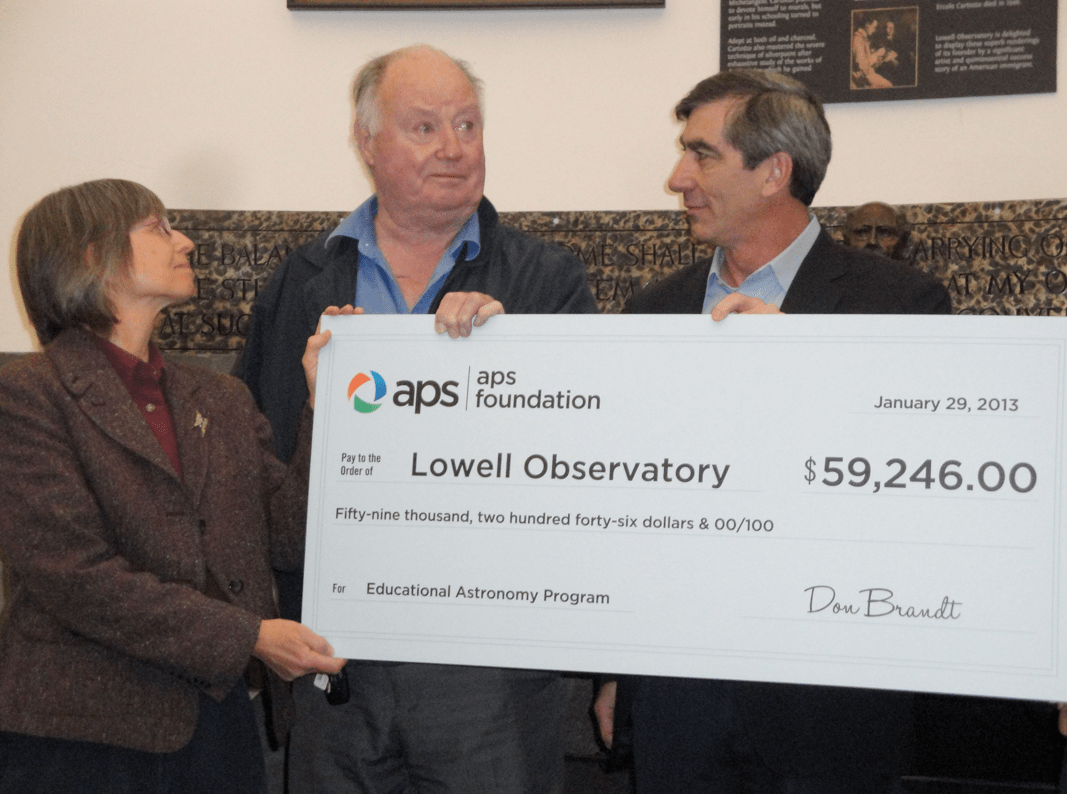
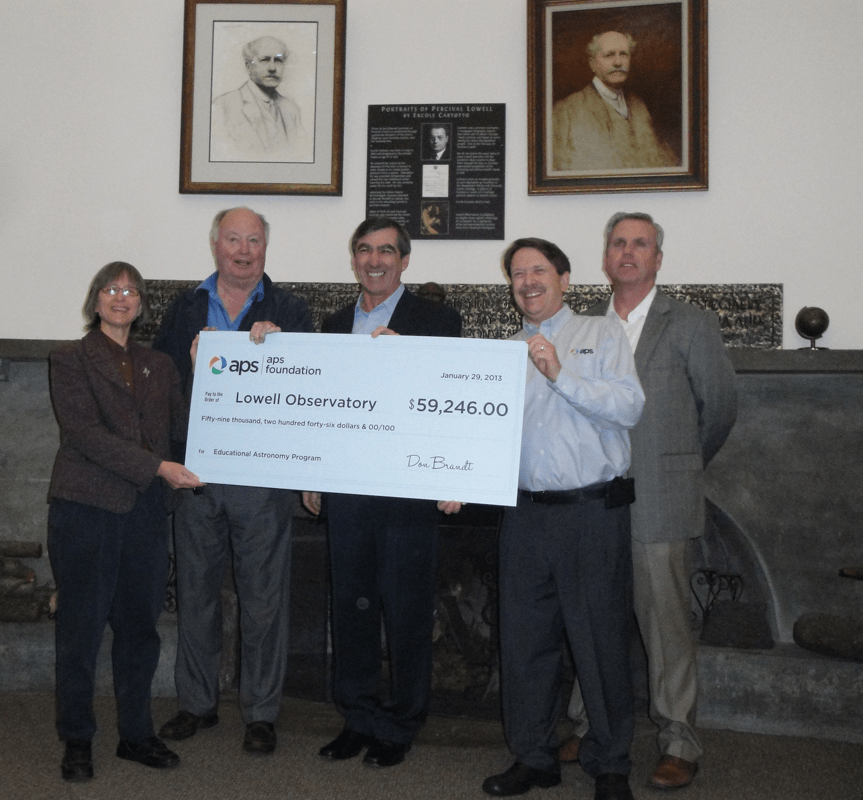
Lowell Observatory is proud to announce a generous gift of nearly $60,000 from the APS Foundation to support the Observatory’s Navajo-Hopi Astronomy Outreach Program. The $59,246 donation will go directly towards supporting this groundbreaking, 17-year-old STEM (science, technology, engineering, mathematics) program.

“APS has been a long-time supporter of Lowell’s education programs, and we are very grateful for this generous gift in support of our outreach to Navajo and Hopi middle schoolers,” said Lowell Director Dr. Jeffrey Hall.

“We very much appreciate not only the APS Foundation’s financial support but their enthusiasm for our program,” added Dr. Deidre Hunter, Deputy Director for Science, Program manager and Program co-founder.

Mr. Mark Schiavoni, Arizona Public Service Executive Vice-President of Operations and APS Foundation Board Member, echoed the sentiments. “We are proud to continue our longstanding partnership with Lowell Observatory, which plays a critical role in educating our youth about astronomy and science. This grant will enable the Navajo-Hopi Outreach Program to further support STEM education that invests in today’s youth, developing future leaders for Arizona,” he said.

The goals of the Navajo-Hopi Astronomy Outreach Program are twofold: 1) to use astronomy to help teachers get Navajo and Hopi children excited about astronomy and science in general, encouraging a life-long understanding of science for all and advanced study for some, and 2) to help teachers of Navajo and Hopi students learn about astronomy and astronomy activities so that they will be better able to incorporate astronomy in their classrooms.

The Program was initiated in 1996 by Dr. Hunter and Dr. Amanda Bosh (Lowell/MIT).

For more about the Program, visit lowell.edu/news

APS Bill tears up

APSFoundationNHdonation

Image descriptions:

-Lowell Trustee Bill Putnam (center) gets a bit emotional as he and Dr. Deidre Hunter, Deputy Director for Science and the Program’s co-founder, receive the ceremonial check from Mr. Mark Schiavoni (right), Arizona Public Service Executive Vice-President of Operations and APS Foundation Board Member.

-Lowell’s Dr. Deidre Hunter and Trustee Bill Putnam (left) receive the ceremonial check from Mr. Mark Schiavoni, Arizona Public Service Executive Vice-President of Operations and APS Foundation Board Member; Mr. Bruce Nordstrom , Pinnacle West Board of Directors; and Mr. Richard Nicosia, Arizona Public Service Energy Delivery Manager, Flagstaff.
Tom Vitron
Media and Communications Coordinator
Lowell Observatory
(928) 233-3260
(928) 853-5233 cell
www.lowell.edu
facebook.com/lowellobservatory
Twitter: @PercivalLowell

New website to be launched on Hopi runners

HopiRunners.com logo

I have been working hard to develop a new website on Hopi runners: http://www.HopiRunners.com. The website will highlight the long tradition of running among the Hopi people of northeastern Arizona.

Here the public will find material on individual runners, links to photographs and videos, and articles and other sources related to Hopi running.

Every week, several people stumble upon BEYOND THE MESAS in search of information on Hopi runners. It seemed clear to me that an entire website ought to be dedicated to this topic.

I also want to highlight that the logo (above) for HopiRunners.com was designed by Wendell Sakiestewa of WenSaksDesigns. Wendell is Hopi, and he’s also a relative of mine.

The logo represents the continuity of Hopi running by depicting the transition of a traditional Hopi clan runner (far left) to a Hopi runner in modern running attire (far right).

I hope to have the website up and “running” at some point in February.

Hopi Tumalhoymuy Tutuveniam – January 2013

Picture 11
Click to download the Newsletter (10 pages)