CQ Field Day

WA7AZ, Field Day 2011

Not many people who read this blog know that one of my hobbies is amateur (“ham”) radio.  I’ve been a ham radio operator for almost 19 years.  My interest in ham radio began when I was a kid.

In 1986, a couple named Marvin and Regina Goodfellow stayed a week with us in our home in Albuquerque, New Mexico. During the 1st night of their stay, Marvin asked me and my siblings if we would help him put up a large antenna in our backyard.

Later that night, Marvin (WA2FMD) set up a transceiver radio on our dining room table. He showed us how the radio worked. We listened to him talk to friends across the United States.  He even let us talk on the radio. I remember having a conversation with someone from Los Angeles who worked at Disneyland.

When Marvin turned the dial on the radio, sounds became distorted and new sounds emerged.  I heard people talking in Spanish and English, and I listened in wonder about the “dit” and “dah” sounds coming from the radio.  Marvin told us that the sounds were called Morse code.

He showed us how to say our names in this new language, and we practiced that night on his Morse code key.

I was fascinated with everything having to do with amateur radio.

Six years later in the summer of 1992, I took the Federal Communication Commission written exam and 5 words per-minute Morse code competency test to receive the Novice class Amateur radio license.  My first call sign was KB7QAW. After I upgraded my radio license, I chose the call sign WA7AZ.

Throughout my sophomore, junior, and senior year in high school, I spent hundreds of hours talking and “pounding brass” (sending Morse code) on my radio, which was a Kenwood TS-511s.

While many of my peers spent their free time playing video games, I was on the radio talking to people in the U.S., or places such as Hawaii, Colombia, New Zealand, Sweden, Mexico, and the Island of Aruba.

Today, I dusted off (literally) my Morse code key and brought out the radios to participate in the Amateur Radio Relay League Field Day event.  Field Day is an annual contest where people operate their equipment from batteries charged by a solar panel or a gas generator. Some people simply use the power that comes from the outlets in their homes.

The idea behind the contest is to make contact and exchange information with as many operators within a specified 24 hour period.

At about 2:00 this afternoon, I “fired up” the radio on our backyard patio, pressed down on the mic, and called “CQ Field Day, CQ Field Day, CQ Field Day, this is Whiskey, Alpha, Seven, Alpha Zulu, Whiskey, Alpha, Seven, Alpha, Zulu, Field Day”

I waited a few seconds and then I heard a strong signal reply saying: “WA7AZ, this is Whiskey, Zero, Romeo, Romeo, Whiskey, Zero, Romeo, Romeo (W0RR).”  The station was from Missouri, and within a matter of minutes I had made contact with people in Pennsylvania, Mississippi, Maine, Colorado, and Ohio.

The above picture is of me talking to KT5J in Austin, Texas. My wife, Kylene, took this photograph for the blog. Nearly 10 years ago, I convinced her to get the Technician class amateur radio license.

Marvin passed away in 1998 at the age of 91.  Just prior to his passing, I had my only QSO (radio conversation) with him. The QSO took place as I drove to Albuquerque from Flagstaff, Arizona. I don’t recall specific details about the conversation, but I know he was glad that I continued my interest in ham radio.

Matthew Sakiestewa Gilbert, WA7AZ

Running through exhaust

Illinois cornfield and rural road - Photograph by Matthew Sakiestewa Gilbert

On Friday of last week I went on a run that brought me to the middle of corn fields outside the city of Champaign, Illinois. As I plugged away on a country road, a large truck drove by and I got a mouth full of exhaust. This is one of my least favorite parts about running on rural roads.

But it reminded me of Hopis during the 1910s and 1920s who “ate exhaust” in many marathons that they competed in. It was not uncommon for newspaper reporters or race officials to drive their automobiles 10 or 15 feet in front of the lead runners.  Some runners were so overcome with exhaust that they quit.

Back out at Hopi, runners did not have to contend with automobile exhaust, but when they competed in events beyond the mesas, it became a serious issue for them to manage.

It’s difficult enough to run long distances with high heat and humidity, and sore legs and feet, but adding the heavy exhaust element to running must have seemed unbearable.

And yet the vast majority of Hopi runners pressed on to complete (and sometimes win) the marathons that they started.

For the runners, the exhaust was simply another obstacle for them to overcome. It was one more hurdle for them to navigate through when they ran beyond their homelands in northeastern Arizona.

Matthew Sakiestewa Gilbert

Outrunning Chief Illiniwek

Photo courtesy of Action Sports International

I’ve been meaning to write a brief post about a 5K event that my wife, Kylene, and I ran in April. The race was part of the 2011 Christie Clinic Illinois Marathon held in Champaign/Urbana. The course started on the southwest side of the University of Illinois and proceeded north to “campus town” on Green Street. It eventually made its way back south to the school’s Memorial Stadium.  The race ended inside the stadium.  The picture on the left is of me sprinting the last 100 yards to the finish. My time was 28:27, and Kylene completed the course in 27:46. We both did better than we expected. Some of my students came out to cheer me on. One student even made a sign that read “Go Professor Gilbert!” He received extra credit. You can read about his observations of the race on his blog.  He writes about seeing a runner dressed up as the former University of Illinois mascot Chief Illiniwek. I also saw this individual before the beginning of the race. A lot of people wanted to take their photograph with him. He was decked out in feathers and a war bonnet.  He liked the attention, but he wasn’t much of a runner. I never saw him again after the first 30 yards.

May travels and events

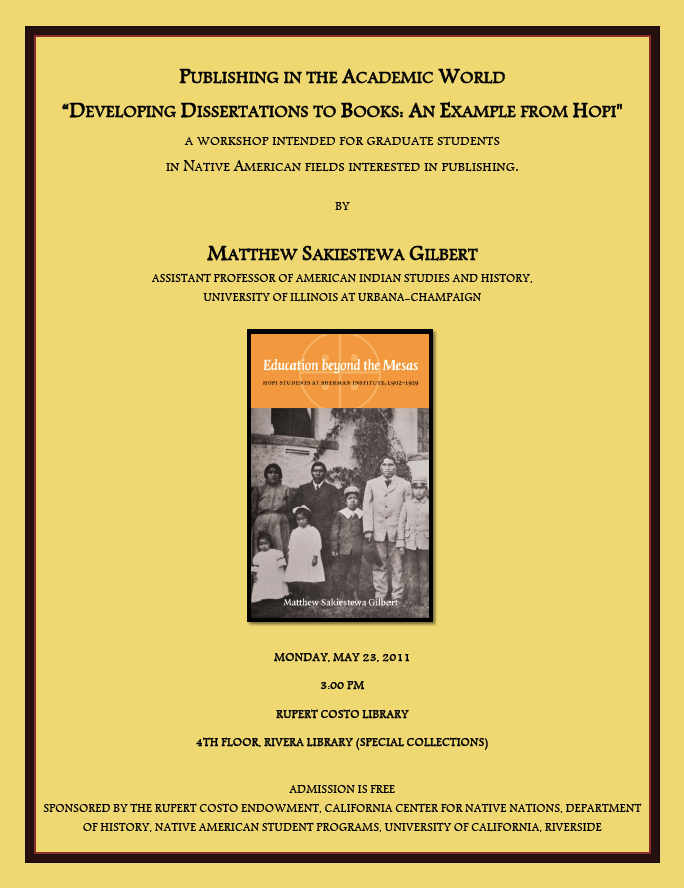
I recently returned from a trip to California where I presented a paper titled “Hopi Marathon Runner Louis Tewanima and the Olympic Games, 1908-1912” at the Native American and Indigenous Studies Association conference in Sacramento. I also heard a great presentation by Hopi educator and scholar Darold H. Joseph from Moencopi titled  “Re-Centering Indigeneity: Culturally Responsive Schooling Practices for American Indian and Alaskan Native Youth.” Darold is a Ph.D. candidate in Special Education at the University of Arizona. After the conference ended on May, 22, I traveled to the University of California, Riverside, to give two talks, one of which was titled “Publishing in the Academic World: Developing Dissertations to Books, An Example from Hopi.”  Both events were sponsored by the California Center for Native Nations. I spent my remaining time in Riverside conducting research at the Sherman Indian Museum.

Returning to the Cottonwood Trees of Our Communities

Matthew Sakiestewa Gilbert at 2009 Native American House Congratulatory Ceremony. Photo courtesy of Muskogee Creek writer and photographer Durango Mendoza.

In the Spring of 2009, our Native students at the University of Illinois asked me to say the closing remarks for the Native American House Congratulatory Ceremony. The event took place on May 16, 2009. Since we are appoaching the end of the academic year, I thought that it would be fitting if I posted these remarks on my blog.

————————————

Returning to the Cottonwood Trees of Our Communities

Matthew Sakiestewa Gilbert

I have the privilege and honor of saying a few closing remarks to end our time together.

We are fortunate at the University of Illinois to have students who have not forgotten that the greatest “scholars” and teachers come from their own communities.  These men and women have not published books for Oxford or Harvard University Press.  They have not published articles in the esteemed journals of the academy. But they are known by people in their communities as the gatekeepers and protectors of intellectual property, and teachers of knowledge.

Among my people in northeastern Arizona, parents, grandparents, uncles, aunties, and other community members often told their children stories about the owl, the squirrel, and giant beasts that threatened to destroy the Hopi way of life. Hopi elders shared these stories with their children to teach them life lessons.  Lessons that would help them to succeed in life, contribute to their communities, and to be passed on to their children and grandchildren.

At an early age, Hopi children were taught to value hard work, and to shun laziness.   “Get up before Taawa, itana (the sun, our father) greets our village,” Hopi parents often told their children, “Taawa, itana has many things to accomplish throughout the day, and he need not waste his time and energy on getting you out of bed.”

The stories and teachings that have emerged in Hopi and other indigenous cultures have great meaning for people of the past, present, and future.  They ground Native people in their communities, they connect us to our places of origin, and they forever remind us of who we are as Choctaw, Ho-Chunk, Kiowa, and other indigenous people.

I am reminded of a story that originates from my village of Moencopi that Hopi educator Dr. Noreen (Kewanwytewa) Sakiestewa once retold about a young girl who was lazy, and did absolutely nothing.  She did not help her parents take care of her siblings, she refused to grind corn, and she had no desire to learn Hopi stories and songs.  Seeing her laziness and apathy, people in the village called her kyena, which is Hopi slang for “ignorant one.”

Sakiestewa recounts that one day, as the girl wandered about near the wash by her village, she sat under a large cottonwood tree.  The wise old cottonwood tree realized that her people, and even the animals, had become angry with her, and so he asked the young girl: “Why are you not a part of your people?”  The girl did not respond, and so the wise old cottonwood tree told her to gather yucca plants and to bring them to him.

When she returned, the wise old cottonwood tree taught her how to weave a plaque with a coil design.  But the girl became restless, and she wanted to learn other design patterns to incorporate in her plaques.  So the wise old cottonwood tree told her to observe the things of nature.  “Look at the sky, the mountains, and the animals, and they will show you new patterns for your plaques.”

After several days or traveling and searching, the young girl from Moencopi came across a rattlesnake who asked her why she had wandered so far from her village. “I am on a journey to find new designs,” she told him.  And so the wise old snake said to her, “Look at the design on my back. I give you permission to use my design in your plaques.”

Soon the young girl came across other designs, and months later, she returned to her people with beautiful plaques and immediately started teaching her sisters, and other girls in the village how to make baskets.  All that she had learned amazed the people at Moencopi.  And from that day forward, they no longer called her kyena.

In her retelling of this story, Sakiestewa asks the question:

“At what point did the girl come out of not being kyena?  Overwhelmingly, the response was when she learned to make baskets.  The Hopi response to when she stopped being kyena was when she returned and taught the skill of basket making thereby completing her circle.” [Norene E. Kewanwytewa, “Being Hopi: A Collaborative Inquiry Into Culturally Responsive Education,” Ed.D. Dissertation, Northern Arizona University, 2002, pp. 2-4].

Today, as we gather together to honor our students, I close by urging our Native graduates to return to the cottonwood trees of their communities.  Complete the circle, and take what you have learned at the University of Illinois and contribute something useful to your people.  And never forget that long ago, our people held to and practiced indigenous ways of understanding that provided meaning, and continue to provide meaning, for every aspect of life.

Hopi runners article available for download

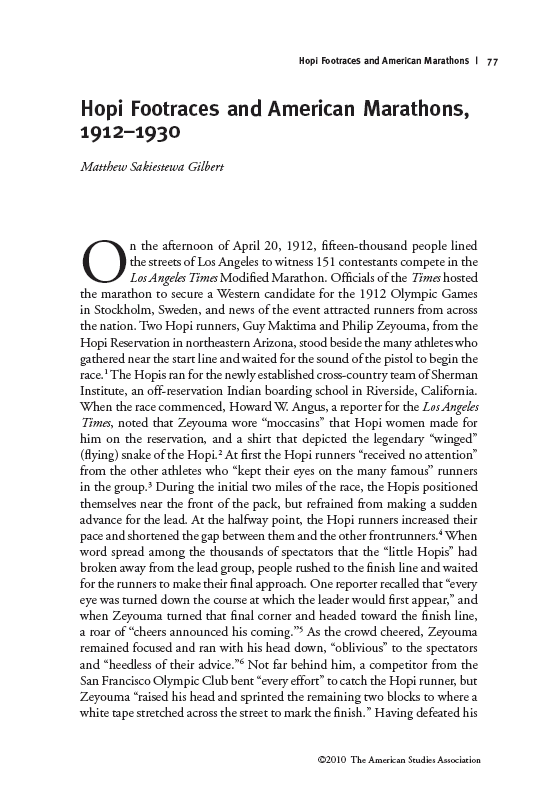
Over the past year, several people have stumbled across my blog looking for information on Hopi runners. For those who might be interested, I have made my article “Hopi Footraces and American Marathons, 1912-1930” (American Quarterly, March Issue 2010, Vol. 62, No. 1, pp. 77-101) available for download. Simply click on the above image to download the article as a PDF document.

Matthew Sakiestewa Gilbert