
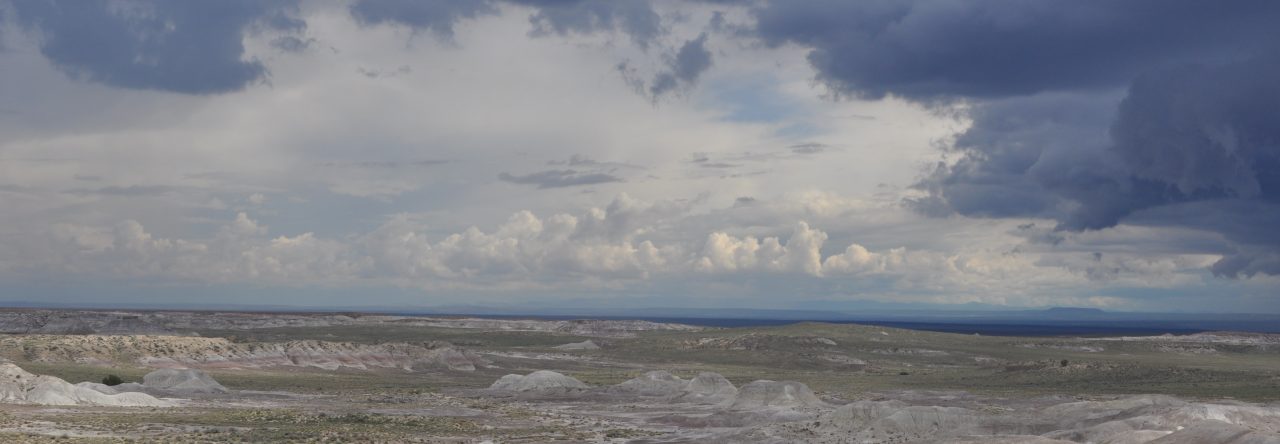
A few weeks ago I passed along an announcement on my blog about 4 Hopi film screenings at the Museum of Northern Arizona. One of these films was Hopi Youth Return to Mesa Verde. This film examines a group of Hopis who traveled to a Hopi migration settlement called Mesa Verde in Colorado. As you watch the film, take note of the similarities that the youth bring up between Hopi ancestral ways and the practices of today’s Hopi people. Their remarks on the continuity of Hopi culture is an important theme in the film.
Matthew Sakiestewa Gilbert
Today, as we consider the anniversary of the bombing of Pearl Harbor, I want to take a moment and remember Hopis who served their village communities and the United States in World War II. One of these individuals was Rex Pooyouma from the village of Hotevilla on Third Mesa. During the War, Mr. Pooyouma served in the Native American Code Talker Communications Network. He was one of at least 10 Hopi code talkers who used their language to transmit critical messages that saved the lives of countless people and helped to end the War.
In November 1945, Mr. Pooyouma received an honorable discharge from the military at the rank of Private First Class. He was a decorated soldier and earned several medals, including the American Campaign Medal, the Philippine Liberation Medal, and a Bronze Star. In October of this year, Mr. Pooyouma, the last known surviving Hopi code talker, passed away at the age of 93. He will always be remembered as a hero among our people and one who ventured beyond the Hopi mesas to serve his community and nation.
For more information on Mr. Pooyouma’s involvement in World War II and his role as a Hopi code talker, please visit the following website: http://nhonews.com/Main.asp?SectionID=1&SubSectionID=1&ArticleID=12971
Matthew Sakiestewa Gilbert
I am pleased to report that Hopi scholars Sheilah E. Nicholas of the University of Arizona and Lomayumtewa C. Ishii of Northern Arizona University recently published the following articles:
Nicholas, Sheilah E., “Language, Epistemology, and Cultural Identity: ‘Hopiqatsit Aw Unanguakiwyungwa‘ (‘They Have Their Heart in the Hopi Way of Life’)”, American Indian Culture and Research Journal, 2010, Vol. 34, No. 2, pp. 125-144.
This article provides an in-depth “on the ground” look at the Hopi language shift—“becoming accustomed to speaking English”—through the lenses of the study participants who represent the youth, parent, and grandparent generations. The article also gives attention to Hopi oral tradition and the Hopi identity-formation process in order to articulate the link among language, epistemology, and identity, spotlighting what of the traditions, practices, and religion remain salient and why they remain salient. [p. 127]
Ishii, Lomayumtewa C., “Western Science Comes to the Hopis: Critically Deconstructing the Origins of an Imperialist Canon,” Wicazo Sa Review, Fall 2010, Vol. 24, No. 2, pp. 65-88.
The number of western texts written about Hopi culture is enormous. The work of Jesse Walter Fewkes, beginning in the 1890s, marks a key starting point in the articulation of a western perspective of Hopi culture, initiating a canon rooted in nineteenth-century anthropological thought. Fewkes’s work also illustrates how the establishment of a “cultural archive” was pragmatically related to his research, which included excavations of Hopi sites (notably the village of Awatovi), as well as through his personal commentary. This article examines nineteenth-century anthropological theory, Fewkes’s employment of that theoretical orientation, and how his work established the foundation of a “cultural archive” that constitutes a canon in the study of Hopi culture. But more importantly, by critically reading these texts a decolonization process reveals a western imperialistic mind at work. [p. 65]
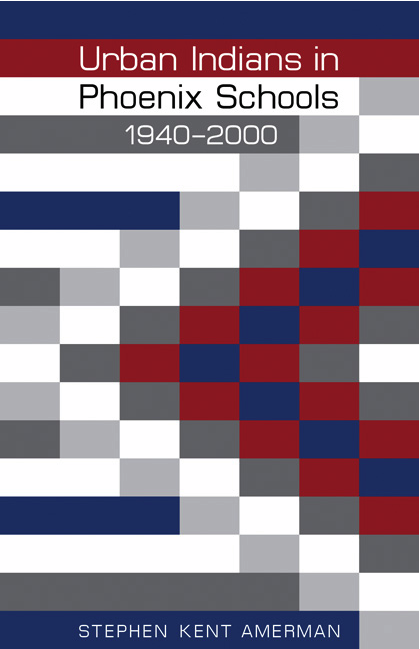
Stephen Kent Amerman, an associate professor of history at Southern Connecticut State University, has published a book entitled Urban Indians in Phoenix Schools, 1940-2000. His book is part of the Indigenous Education Series with the University of Nebraska Press. Various studies have been written on the educational experiences of American Indian people. However, much of this literature has tended to focus on the Indian boarding school experience during the so-called assimilation period. Recent studies, such as Taos/Dine scholar Glenabah Martinez’s monograph, Native Pride: The Politics of Curriculum and Instruction in an Urban Public School and Amerman’s book, fill a major gap in the literature on the experiences of Native students who attended public high schools. Amerman also writes about Hopis who went to Phoenix urban schools, which is a topic not often examined by scholars of Hopi and Indian education history. Below is a brief synopsis of the book from the University of Nebraska Press website.
Matthew Sakiestewa Gilbert
In the latter half of the twentieth century, tens of thousands of Native American families moved to cities across the United States, some via the government relocation program and some on their own. In the cities, they encountered new forms of work, entertainment, housing, and education. In this study, Stephen Kent Amerman focuses on the educational experiences of Native students in urban schools in Phoenix, Arizona, a city with one of the largest urban Indian communities in the nation. The educational experiences of Native students in Phoenix varied over time and even in different parts of the city, but interactions with other ethnic groups and the experience of being a minority for the first time presented distinctive challenges and opportunities for Native students.Using oral histories as well as written records, Amerman examines how Phoenix schools tried to educate and assimilate Native students alongside Hispanic, Asian, black, and white students and how Native children, their parents, and the Indian community at large responded to this new urban education and the question of their cultural identity. Reconciling these pressures was a struggle, but many found resourceful responses, charting paths that enabled them to acquire an urban education while still remaining Indian.Stephen Kent Amerman is an associate professor of history at Southern Connecticut State University. His articles have appeared in American Indian Culture and Research Journal, American Indian Quarterly, and Journal of Arizona History.
On this Thanksgiving Day 2010, I am thankful for all the people who have visited my blog in the past year. Since I launched BEYOND THE MESAS in November 2009, the blog has received 13,070 “hits” and readers have posted 104 comments on 68 posts. The most visited posts this year have been about Hopi policies on photography, Hopi runners, and Hopi educator Polingaysi Qoyawayma.
Kwakwha, (“Thank you”)
Matthew Sakiestewa Gilbert

This past summer I took my family to Walnut Canyon National Monument in northern Arizona. When we entered the visitor center gift shop, my girls immediately ran to the shelves with children’s books and “oohed” and “aahed” over the glossy pages with colorful illustrations. At least half of the books in the gift shop were for young readers, and some of them were on the Hopi.
At Walnut Canyon, park officials mostly had books about the Hopi that non-Hopi people wrote. One of these books was Heather Irbinskas The Lost Kachina. While The Lost Kachina was written by a non-Hopi, the book was illustrated by Hopi artist Robert Albert (Sahkomenewa) from Moencopi. There was at least one Hopi-authored children’s book on the shelves, namely Michael Lomatuway’Ma’s The Magic Hummingbird, which he co-wrote with Ekkert Malotki, a non-Hopi linguist. There are other Hopi-written children’s books that park officials did not include in the shop such as Polingaysi Qoyawayma’s The Sun Girl and Emory Sekaquaptewa’s (et. al.) Coyote and Little Turtle: Iisaw Niqw Yongospnhoy.
For the past several months my friend and colleague Debbie Reese from Nambe Pueblo has encouraged me to write a children’s book on the Hopi. Debbie authors a very successful blog titled American Indians in Children’s Literature. On her blog she critically examines children’s books about American Indians and challenges authors to portray Native people in accurate and respectful ways. If you are not familiar with Debbie’s blog, be sure to visit it at the following address: http://americanindiansinchildrensliterature.blogspot.com/
My post is not intended to critique the books in the Walnut Canyon gift shop. Sahkomenewa’s illustrations in The Lost Kachina are quite remarkable, and I assume that he would not illustrate a book on the Hopi that he did not approve of himself. Perhaps one day I will take up Debbie’s challenge and write a children’s book of my own. We certainly need more Hopis today writing and illustrating children’s books. And we need more publishers, school librarians, teachers, and even federal park officials to make Hopi authored books available to children.
Matthew Sakiestewa Gilbert
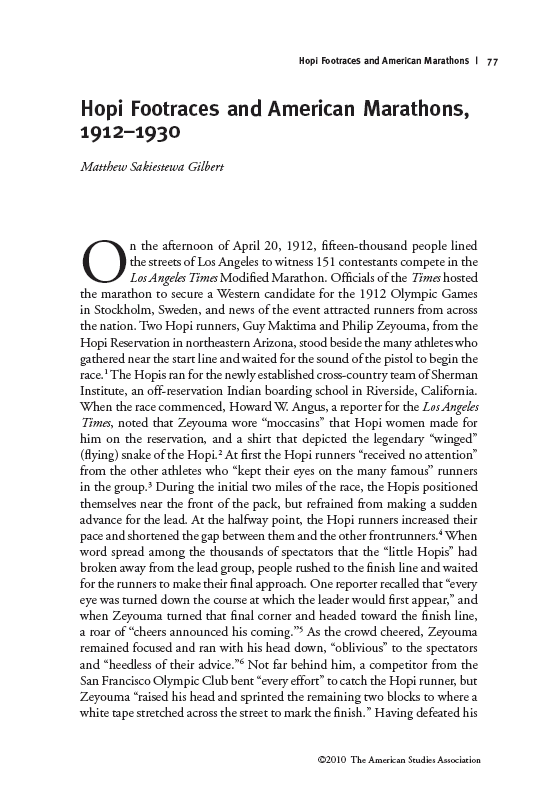
Over the past year, several people have stumbled across my blog looking for information on Hopi runners. For those who might be interested, I have made my article “Hopi Footraces and American Marathons, 1912-1930” (American Quarterly, March Issue 2010, Vol. 62, No. 1, pp. 77-101) available for download. Simply click on the above image to download the article as a PDF document.
Matthew Sakiestewa Gilbert


 BEYOND THE MESAS, LLC