Hopi High Cross Country Team Wins 21st Straight State Championship

I want to congratulate our Hopi High boys cross country team for winning their 21st straight Class 2A State Championship. This is a remarkable achievement. In an article in The Arizona Republic, reporter Jose M. Romero noted that Hopi runner Justin Secakuku won the Division IV meet for the team yesterday in Phoenix, Arizona. Congratulations to the Hopi High runners and their coaches for once again bringing honors to our people. Be sure to check out the following link for more information about this story: http://www.azcentral.com/sports/preps/articles/2010/11/06/20101106hopi-boys-cross-country-titles.html

Matthew Sakiestewa Gilbert

Navajo-Hopi Observer reports that Homolovi Ruins State Park will reopen

Photograph by Matthew Sakiestewa Gilbert

On October 27, 2010, the Navajo-Hopi Observer (NHO) reported that the “Hopi Tribal Council approved a resolution that will keep the Homolovi Ruins Historic Park opened, which will allow safeguard and protection of the cultural and religious site.” State officials closed the Park in February 2010 to help alleviate Arizona’s budget deficit. According to the report in the NHO, the Hopi Tribe has agreed to contribute $175,000 to subsidize the Park’s operating costs.  To learn more about this important development, please visit the following website: http://www.navajohopiobserver.com/main.asp?SectionID=1&SubSectionID=1&ArticleID=12970

Matthew Sakiestewa Gilbert

Education beyond the Mesas: Hopi Students at Sherman Institute, 1902-1929 (University of Nebraska Press)

On Monday of this week the University of Nebraska Press released my book Education beyond the Mesas. My book examines the Hopi experience at Sherman Institute in Riverside, California, from 1902 to 1929. It is a story of resistance, accommodation, and ways Hopi pupils navigated within their village communities, U.S. government policies, and an institution that was designed to destroy their identities as American Indian people. Furthermore, my book is a story of agency, and it demonstrates how Hopi students used their culture to succeed at school, and examines the challenges the pupils faced when they returned to their homes on the reservation.

Thirty one years ago historian David Wallace Adams remarked that a “ study on the federal Indian boarding school system does not exist.” Today the field of Indian boarding schools has grown substantially with contributions from scholars such as Adams, K. Tsianina Lomawaima, Brenda Child, Clyde Ellis, and many others. Recent studies have focused on Indian health, literature, education policies, and the ways Indian pupils “turned the power” at schools originally designed to destroy American Indian cultures. A term used by historians Clifford E. Trafzer, Jean Keller, and Lorene Sisquoc, “turning the power” describes the ability of Native students to turn their educational experiences to their advantage, which often included bringing helpful knowledge and skills back to their indigenous communities.

In my book I examine the ways Hopis “turned the power” at Sherman Institute, and I build upon the work of several scholars including those who have written about the mandatory enrollment of Hopi students at U.S. government schools. While many books on Indian boarding schools examine the experiences of Native students who came from several communities, Education beyond the Mesas is a community specific book that seeks to understand the Hopi experience at Sherman Institute through a Hopi historical and cultural framework.  In the book’s Introduction, I argue that a community specific book on the Hopi places

the history and culture of the Hopi people at the focal point of the narrative. It asks how a student’s culture and tribal history influenced their experience at an Indian school, and builds upon the contributions of other scholars to uncover the complex ways that Hopi history and culture intersected with U.S. government policies. Apart from providing the reader with a historical narrative, this book challenges the notion that a study on the Indian boarding school experience must be understood primarily through a defined framework of Indian education policies. Community-specific books begin with the history and culture of Native people and attempt to determine how students understood their unique experiences at Indian boarding schools as Zunis, Navajos, Apaches, or other Indian people. [Education beyond the Mesas, p. xxix]

I would not have been able to complete this book without the help and support of many individuals. I am especially thankful to my wife, Kylene, and our daughters Hannah, Meaghan and Noelle, and other family members. My colleagues at the University of Illinois, in both the American Indian Studies Program and the Department of History, have provided me with tremendous support since I arrived at Illinois in Fall 2006.

I further extend appreciation to the Hopi Cultural Preservation Office, the Hopi Education Endowment Fund, and the Hopi Tribe Grants and Scholarship Program who so generously made available resources for me to pursue an education beyond the mesas. There are also many Hopi and non-Hopi scholars, students, and community members who have helped and encouraged me along the way, which includes the incredible editorial staff at the University of Nebraska Press. Finally, I wish to acknowledge my grandfather, Victor Sakiestewa, Sr. from Upper Moencopi, who gave me the inspiration and reason to write on his alma mater, “dear ole Sherman.”

Matthew Sakiestewa Gilbert
Sherman Indian Museum and UC Riverside

I recently returned from the 25th Anniversary California Indian Conference held at the University of California, Irvine. My former graduate advisor from UC Riverside, Cliff Trafzer, organized a panel on Sherman Institute titled “Out of the Vault.” In addition to myself, the panel members included Lorene Sisquoc, Director of the Sherman Indian Museum, Galen Townsend, Sherman Indian Museum Volunteer, Kevin Whalen, a graduate student in history at UCR, and Leleua Loupe of California State University, Fullerton.

Sisquoc began the panel by talking about the unique relationship between UCR and the Museum. For the past 10 or so  years, UCR history graduate students have worked alongside Sisquoc as researchers, volunteers, and interns. Beginning with Jean A. Keller, author of the first book on Sherman Institute, Empty Beds, graduate students have utilized the Museum’s collections to write two monographs, and several master theses, dissertations, and articles. Today, the mutually beneficial relationship between UCR and the Museum continues, and provides an excellent model of collaboration and community.

Matthew Sakiestewa Gilbert

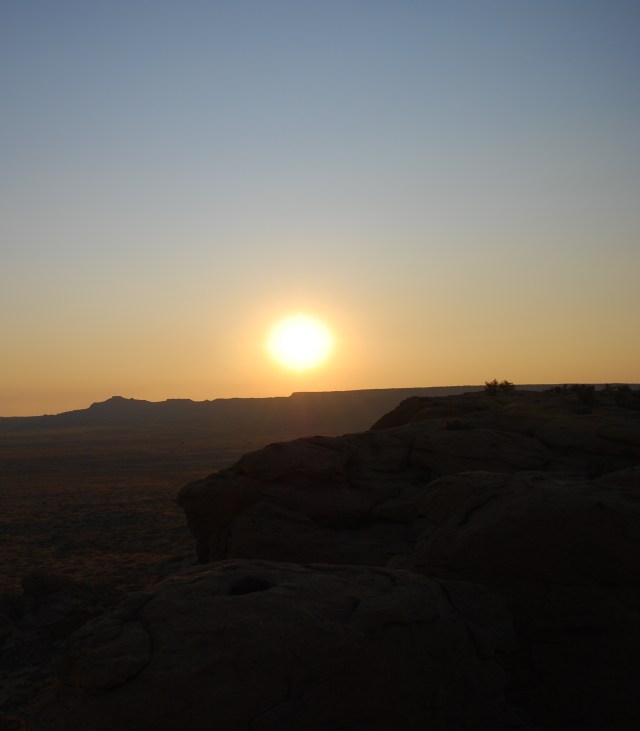
Hopi sunset over Third Mesa

Hopi sunset over Third Mesa, August 7, 2009, Photograph by Matthew Sakiestewa Gilbert

2010 Hopilavayi Forum – Hopilavayit Itam Qasuutokyani

Hopi educator Sahmie Sunshine Wytewa NIEA board of directors candidate

Sahmie Sunshine Wytewa, 2010 NIEA Board of Directors candidate

I am pleased to announce that Sahmie Sunshine Wytewa, an enrolled member of the Hopi Tribe and lifelong educator, is an official candidate for the National Indian Education Association (NIEA) board of directors.  Wytewa comes to the NIEA with an incredible amount of experience, a passion for the advancement of Indian education, a close connection to the Hopi community, and an impeccable work ethic. NIEA members will have the opportunity to vote for candidates at the upcoming NIEA Convention held in San Diego, California, on October 7-10, 2010. Below is Wytewa’s personal statement on the NIEA website: http://www.niea.org/events/board.php

Sahmie Sunshine Wytewa, Hopi: Ms. Wytewa is a prime candidate for NIEA board membership given her strengths as a practicing educator, educational background, and her strong desire to provide leadership in education. In addition to her professional qualities, she is also an involved community member of the Hopi tribe who has endured the challenges of balancing her culture and educational pursuits. As a mother, Sahmie has taken great care in providing the experiences of traditional values and real-life expectations for her children.

As an educator, Ms. Wytewa understands the significance of accountability in academic achievement and the inequalities that are reflected in the quality of education and misrepresentation of Native populations in regards to academic performance. Working in underperforming schools going through School Improvement, she has the working knowledge of current initiatives in educational reform. Her skills as a teacher have allowed her firsthand insight into the trends in achievement, learning modes of children, and research-based strategies that promote academic growth.

Ms. Wytewa’s continued professional growth is the direct result of her desire to improve the quality of education and learning experiences for all students. Channeling her efforts to further develop reform in Indian education, Sahmie has chosen the course of advancement through leadership. She is committed to working in collaboration with like-minded individuals or groups towards student-centered reform.

With strong ties to her community, Sahmie has an authentic link giving her the advantage of providing background in an otherwise vague theme of Indian education. It is with these combined strengths and efforts, that Ms. Wytewa can be a true asset to the NIEA board in providing many perspectives of education.

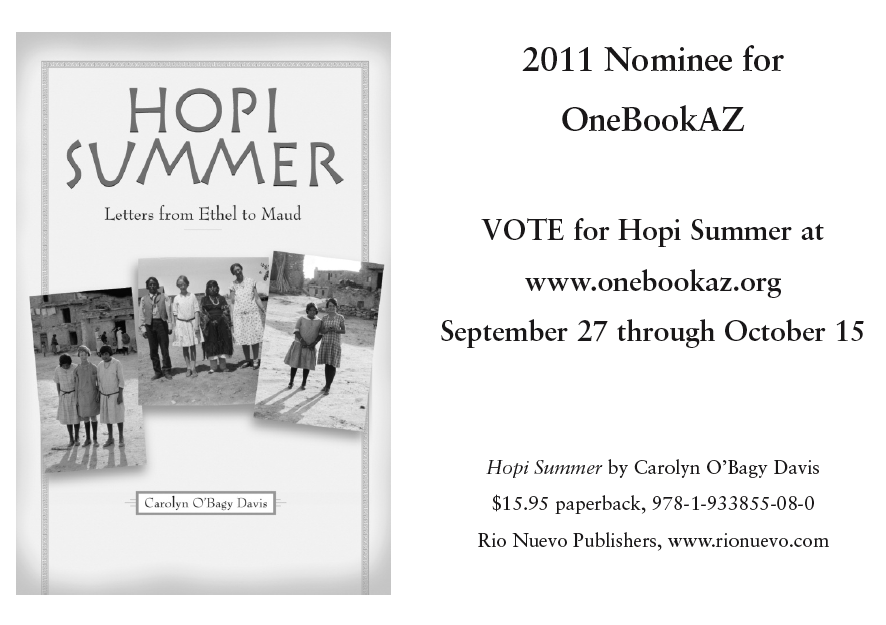
Hopi Summer, 2011 Nominee for OneBookAZ

Several months ago I posted a very positive review of a book by Carolyn O’Bagy Davis titled Hopi Summer: Letters from Ethel to Maud (Rio Nuevo Publishers, 2007). Her book is currently a finalist for the OneBookAZ 2011 award. I have always been supportive of Davis and her work, and Hopi Summer is certainly worthy of this and other awards. If you are a resident of Arizona, and you would like to vote for Hopi Summer, you can do so between September 27 and October 15 at the following website: http://www.onebookaz.org

Matthew Sakiestewa Gilbert

Screening BEYOND THE MESAS at Upper Moencopi

Photograph by Matthew Sakiestewa Gilbert

On Saturday September 18, 2010, I had a special opportunity to screen BEYOND THE MESAS and give a presentation to my family at the village of Upper Moencopi’s Community Center. The screening and presentation were part of the Sakiestewa/Honanie Annual Family Reunion. About 60 people attended the event.

I have screened BEYOND THE MESAS at several universities in the United States, and I have shown it at other locations on the Hopi Reservation, but this was the first time the documentary was screened at Upper Moencopi. The film was well received and it led into a discussion on the benefits and negative consequences of Hopi attendance at off-reservation Indian boarding schools.

After the screening I passed out student case files that I collected at the National Archives in Laguna Niguel, California (now located in Perris, California). The files belong to members of the Sakiestewa and Honanie families who attended Sherman Institute or the Phoenix Indian School from 1906 to the 1940s. Most of the files included school applications, report cards, and handwritten and typed letters.

As a Hopi professor at the University of Illinois I am thankful for the opportunities that I have to bring my research back to the Hopi community. This has always been a driving force behind my work.

Matthew Sakiestewa Gilbert

Beginnurz Hoyam Hopilavayi Pilot Program

***ANNOUNCEMENT***
Beginnurz Hoyam Hopilavayi Pilot Program presents Hopi Language courses for Hopi adults with little to no Hopi fluency
There are three 6-week courses available:
Immersion 1 begins on Tuesday, September 28 and will meet on Tuesdays and Thursdays from 6:00 p.m. – 7:30 p.m. at Hopi Day School in Kykotsmovi
Literacy 1 begins on Tuesday, September 28 and will meet on Tuesdays from 6:00 p.m. – 8:30 p.m. at Northland Pioneer College
Interactive 1 begins on Friday, October 1st with an orientation from 6:30 p.m. – 7:30 p.m. at the Tuuwanasavi Heritage Consulting Office in Kykotsmovi and regular classes begin on Monday, October 4th and will meet on Mondays from 6:30 p.m. – 8:30 p.m. at the Sipaulovi Community Building
Each course is limited to 15 students, registration is required for participation and is processed on a first-come, first-served basis.  The fee for each course is $50.00 and is due at registration.
Please see the attached registration packet for more information.  You may return your registration c/o:  Vermetta Quanimptewa, Northland Pioneer College by fax at 928-738-2267 or hand deliver to NPC (928-738-2265) or you may contact Troy Lomavaya (928-226-3830) or Vernon Kahe (928-734-2275).
The Beginnurz Hoyam Hopilavayi Pilot Program also receives funding from the Hopi Education Endowment Fund/Hopi Foundation Community Grant Program and the Hopi Foundation Leadership Program 2008-2009 Alumni.  In-kind partners include:  Hopi Day School, Northland Pioneer College and Sipaulovi Village.
Please feel free to forward to others who might be interested.