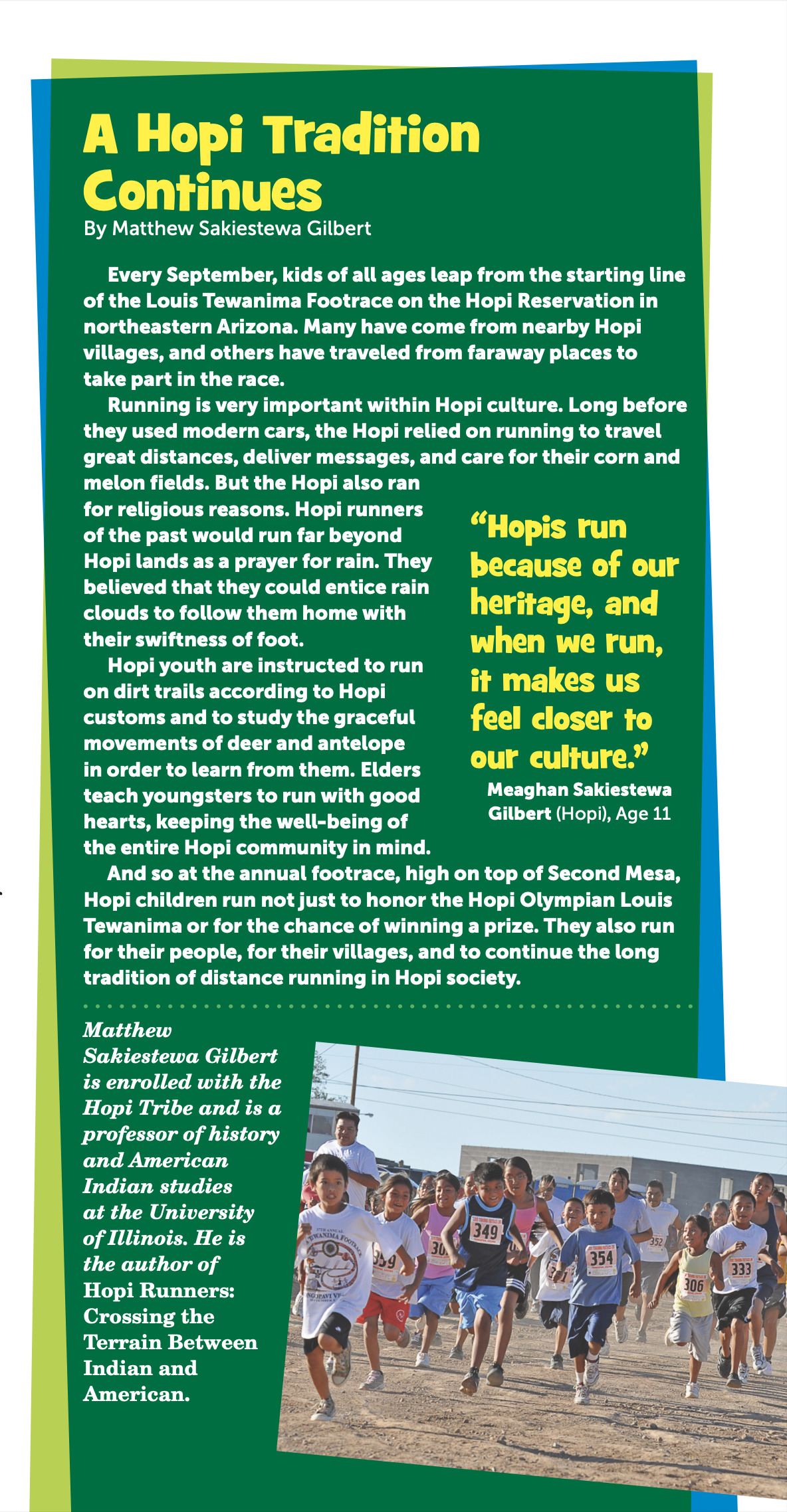
Seven years ago, editors from Highlights, a magazine for children, asked if I would be willing to write a short piece on Hopi running. I was thrilled to do so. The piece, titled “A Hopi Tradition Continues,” was part of a larger story on Hopi runner Louis Tewanima called “Miles from Home” by Kim Valice.
When I was young, my parents (and school) subscribed to Highlights, and I, along with my siblings, spent hours reading its stories, fascinated by the many colorful drawings and other images gracing its pages. Taking place before children could “surf” the internet, we waited for the arrival of each new edition with great anticipation. The magazine became our gateway to the world.
As I reflect on my childhood, this contribution will always remain special to me. It is not a “heavy-hitting” scholarly piece, published in one of the academy’s esteemed journals. It is not something that would significantly enhance a faculty’s tenure and promotion case. However, it is more meaningful than that. It was written for children, most of whom had never heard about the Hopi people, where we come from, or our long tradition of distance running.
Ten years ago, while serving as the Dean’s Diversity Fellow in the College of Liberal Arts and Sciences (LAS) at the University of Illinois at Urbana-Champaign, I was asked to write a brief statement on diversity and inclusivity in the classroom. My views on diversity and inclusivity are primarily based on my Christian beliefs, values I received from my parents, and belonging in the Hopi community. My opinions here are not comprehensive; others have written many books about the topic. They are, however, principles that guide each class that I teach. I have included the statement below and adapted it to reflect my teaching at the University of Arizona.
********
Every Person Matters
Every person has an important role in furthering diversity and inclusivity at the University of Arizona. For some, “diversity” speaks only to one’s gender, racial or ethnic background. While representing these areas is crucial for any environment to be diverse, a fuller understanding of diversity includes much more.
Over the semester, you will sit next to students from different regions of the United States and other parts of the world. And you will learn alongside individuals from different social, cultural, or religious backgrounds. Some of your peers will hold views that are vastly different or perhaps even very similar to yours.
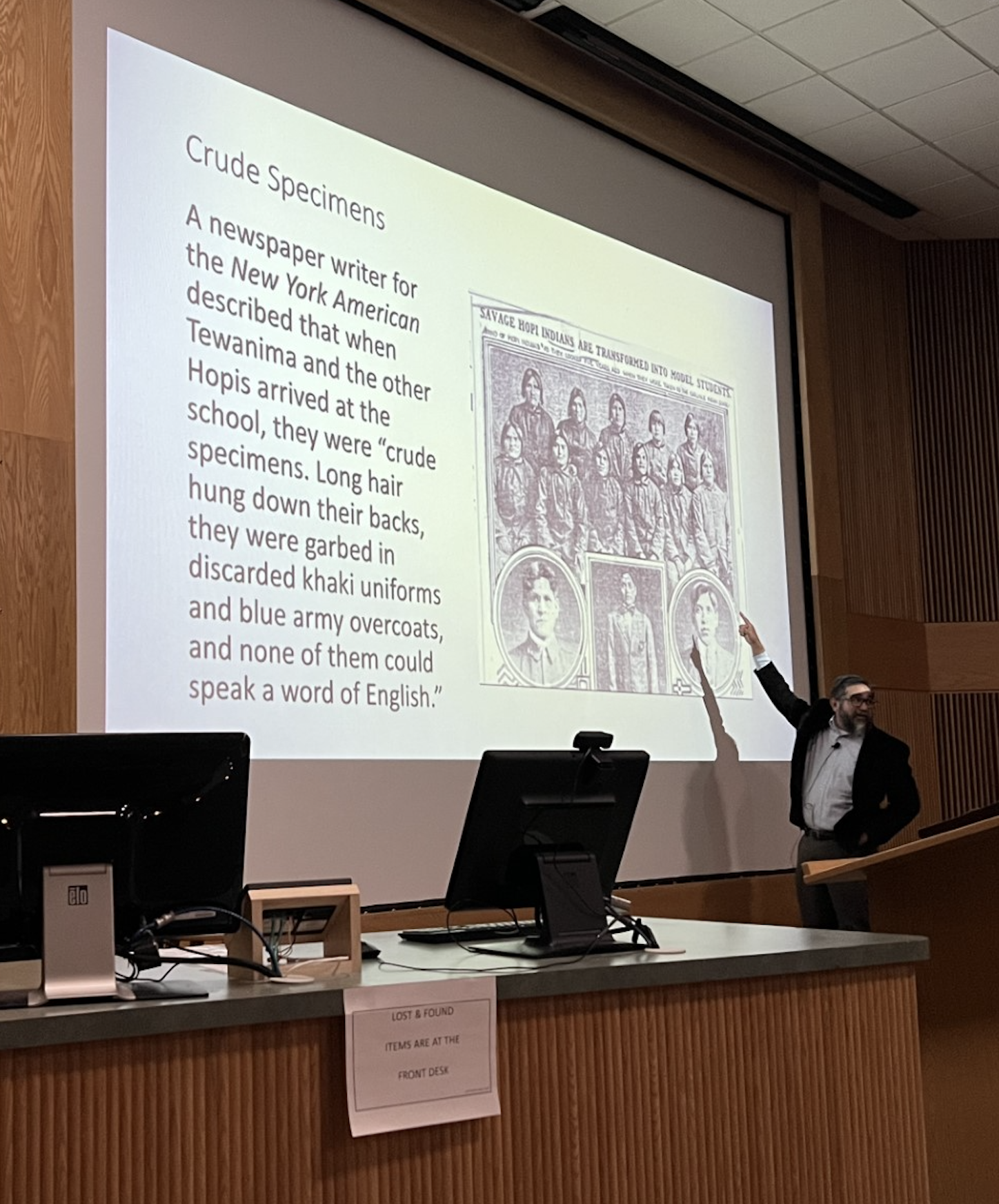
Author lecturing at the UofA. Photo by Faraz Saberi
But as long as people from the same cultures or other commonalities keep only to themselves or only value the opinions of those who are like-minded, then a truly inclusive community will never be achieved. Having a diverse group of people in any one place is not enough. A diverse environment is not always an inclusive one.
Inclusivity begins when diverse people, which includes all people, acknowledge each other’s presence. It happens when individuals converse with one another and when they care enough to appreciate their differences.
A classroom committed to inclusivity functions with the understanding that every person matters. It does not require people to agree with one another or to see the world in the same or similar manner. But it is a space where everyone’s perspectives and opinions are valued and where people’s presence and participation are encouraged.
From the moment you walk into the classroom, you will already enter a very diverse space. In this regard, obtaining a diverse environment in class is the easy part. The challenge and excitement come when each person works together to transform that space into an inclusive one.
Matthew Sakiestewa Gilbert, Professor and Head of the Department of American Indian Studies (AIS) at the University of Arizona, interviews former AIS M.A. and Ph.D. student, Michelle Hale (Dine’), now an Assistant Professor of American Indian Studies at Arizona State University (ASU). The interview covers a range of topics including teaching experiences at UA and ASU, federal Indian policies, work among tribal nations, and the Navajo Local Governance Act. The interview was conducted on June 9, 2020 via Zoom.
For more information about the Department of American Indian Studies at UA, visit: WWW.AIS.ARIZONA.EDU
Matthew Sakiestewa Gilbert, Professor and Head of the Department of American Indian Studies (AIS) at the University of Arizona, interviews former AIS Ph.D. student, Michael Lerma, now Dean of the School of Business and Social Science at Diné College in Tsaile, Arizona.
The interview covers a range of topics including Navajo political philosophies of governance, the role of family and mentors in one’s education and career pursuits, graduate studies in AIS at UA, and Indigenous water rights and COVID-19.
The interview was conducted on May 26, 2020.
For more information about the Department of American Indian Studies at UA, please visit: www.ais.arizona.edu
[The following post includes the first few pages of a new book that I am writing entitled Modern Encounters of the Hopi Past]
Introduction – One More for the Hopi
Emory Sekaquaptewa, Photo courtesy of the Navajo-Hopi Observer
When I was a young scholar, I had the opportunity to speak with Hopi elder Emory Sekaquaptewa, who at the time was professor of Anthropology at the University of Arizona in Tucson. I had traveled to campus to interview for a faculty position in the Department of American Indian Studies, and he graciously took time out of his busy schedule to visit with me. He inquired about my family, and I shared with him school records that I uncovered about his father at the Sherman Indian Museum in Riverside, California.
He spoke to me as my elder. He was gracious, welcoming, and kind, but he was also very direct. He seemed disappointed that I wanted to return to Arizona so early in my career, explaining positive reasons for our people to spend time away from home. We discussed several topics during our visit. But there was one that proved especially meaningful to me and serves as the intellectual energy behind this book: “I want to write a history book with you that we can use back home,” he said to me, “for our teachers and students.”
Emory knew the significance for Hopi people to write their own history. And he knew the importance for Hopi scholars to share that knowledge with a wide audience, including those in our village communities. Emory had grown up in the village of Hotevilla on the Hopi Reservation in northeastern Arizona. His willingness to receive an education beyond the mesas and teach at a university, paved the way for other Hopi academics such as myself. He showed us how to excel at a research institution. And he demonstrated the importance for us to meet scholarly expectations while remaining closely connected to home.
Having navigated the world of our people and that of an American university, Emory was familiar with the academic and cultural terrain that lay before me and other Hopi scholars. He realized that for us to excel in the academy, we needed to publish our work. And he knew that for me to succeed as a Hopi historian, I needed to provide research that was meaningful and useful to my people.
The co-author of books and numerous articles, Emory also understood the power of the printed word, and of its ability to carry the Hopi voice to a diverse and sometimes unexpected audience. Not long after I started working at the University of Illinois in Urbana-Champaign, I taught a class on Native American religious traditions. Among the readings that I assigned to my students was a chapter by Emory entitled “One More Smile for a Hopi Clown.” In it, Emory explains the meaning of clowning in Hopi culture. He describes in great detail skits between the clowns, katsina dancers, and spectators in a village plaza.
University of Illinois, Photo courtesy of E. Jason Wambsgangs, Chicago Tribune
The drama unfolding in the plaza and on the pages of Emory’s chapter captivated the minds of my students. Emory likely never imagined that forty years after he published the essay, students and a Hopi professor in Illinois would be contemplating his every word. He took us with him to a different world, a world of Hopi ceremony, laughter, and clowning. He forced us to consider the value of lightheartedness and the role of humor and self-awareness. And through story and by his example he taught us to not take life or ourselves too seriously. For as Emory so aptly reminds us, the “heart of the concept of Hopi clowning is that we are all clowns.”
This would not have been possible without the support of many people over the years who encouraged me as I wrote and completed the book. To them, I extend a heartfelt Kwakwha!
I am excited to announce that I will be leaving the University of Illinois soon to begin a new appointment as Professor and Head of the Department of American Indian Studies at the University of Arizona!
After 13 years at the UofI, I am finally making my way back to the Southwest and closer to family and the larger Hopi community.
I will be leaving wonderful colleagues and friends in the American Indian Studies Program and the Department of History, terrific students, and a very supportive College and campus administration.
But I will be joining a highly respected and established AIS department, a community of outstanding faculty and students, and a university (and program) that I have always wanted to work at.
Needless to say, I am thrilled to be making this run for the desert and taking part (once again) in the second wave of Hopi migration.

 on the Hopi Reservation in northeastern Arizona. His willingness to receive an education beyond the mesas and teach at a university, paved the way for other Hopi academics such as myself. He showed us how to excel at a research institution. And he demonstrated the importance for us to meet scholarly expectations while remaining closely connected to home.
 BEYOND THE MESAS, LLC