
Launch of new Hopi Petroglyph Sites web portal
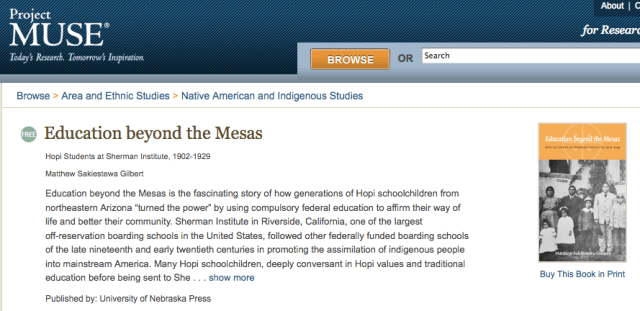
I am pleased to announce that Education beyond the Mesas: Hopi Students at Sherman Institute, 1902-1929 (University of Nebraska Press, 2010) is temporarily available for free download through Project MUSE.
It has always been my desire that people on and off the Hopi Reservation will have access to my research, and the University of Nebraska Press’s decision to allow my book to be featured on Project MUSE, is a major step in that direction.
However, free access to Education beyond the Mesas via Project MUSE will only last until January 2012. See the Project MUSE website for more details.
To download Education beyond the Mesas, please click on the above image or visit the following link: http://beta.muse.jhu.edu/books/9780803234444
Matthew Sakiestewa Gilbert
Kevin Taylor wrote a very moving article in the latest edition of Indian Country Today about Hopi soldier and mother Lori Piestewa and Jessica Lynch. Earlier this month, Lynch traveled to the Nez Perce Indian Reservation in Idaho to honor Piestewa at a gathering for Native veterans. Lynch talked at length about her admiration for Piestewa, and highlighted the Hopi soldier’s bravery and courage. I hope everyone who visits my blog will take the time to read this story. Here are the first two paragraphs:
The route leading to this longtime campsite amid the pines on the Nez Perce reservation in Idaho includes several miles of gravel road swooping through hilly farm country. Green with crops, it looks nothing like Iraq, but still gave Jessica Lynch a moment of flashback. “It was the dust,” Lynch says.
A car ahead of the one bearing Lynch to Talmaks Camp on Monday morning kicked up a cloud of dust that carried her back to March of 2003, when she was a 19-year-old supply clerk and private first-class in the U.S. Army driving a truck in the enormous military convoy racing across the desert to Baghdad during the invasion of Iraq by coalition forces. “All you were seeing was dust and sand and you had to follow the person in front of you by their taillights,” Lynch recalls. “We were exhausted and tired and hungry… ”
To access the complete article, please visit the following website: http://indiancountrytodaymedianetwork.com/2011/07/america%E2%80%99s-most-famous-pow-jessica-lynch-honors-the-hopi-woman-who-saved-her-life/

A few weeks ago I traveled with my family to San Francisco for my sister-in-law’s wedding. We stayed in a house that overlooked the San Francisco Bay. Below are other photographs that I took of that trip. The last photograph is of Alcatraz Island. When I took this photo, I was reminded of an important and difficult time in Hopi history.
In November 1894, Hopi leaders at Orayvi refused to accept U.S. government policies, including the forced removal of Hopi children to government-run schools. Consequently, officials arrested 19 of these leaders and shortly thereafter transferred the Hopi prisoners to Alcatraz Island.
Separated from their families and village community, they remained on the Island from January 1895 to September of the same year. Although I wrote briefly about this topic in Education beyond the Mesas, historian Wendy Holliday has written much more on the Hopi prisoners in a two-part essay entitled “Hopi History: The Story of the Alcatraz Prisoners.”
For those interested in learning more about the Hopi leaders who were imprisoned on Alcatraz Island, you can access both parts of this article by clicking on the following links:http://www.nps.gov/archive/alcatraz/tours/hopi/hopi-h1.htm and http://www.nps.gov/archive/alcatraz/tours/hopi/hopi-h2.htm
Matthew Sakiestewa Gilbert


If you are thinking about visiting the Hopi Reservation, I would encourage you to go with a reputable Hopi tour company. One of these companies is Hopi Tours, which is led by Hopi anthropologist Micah Loma’omvaya. As I read about Hopi Tours on-line, I learned that the company has been giving tours on Hopi lands since 1540!
Of course, this was the year that Spanish conquistador Pedro de Tovar and a small group of soldiers, a few Zuni guides, and a Franciscan priest, came across the Hopi people on Antelope Mesa. After a bloody fight, and a “tour” of the villages on First Mesa, the Hopis promptly directed the Spaniards to go west toward the Grand Canyon. The Hopis did not want these “tourists” sticking around.
Today, tourism plays a very important economic role on the Hopi Reservation and it provides Hopis with opportunities to share their culture with visitors. For more information about upcoming tours, including a special book tour on Hopi Summer by Carolyn O’Bagy Davis, please download the following brochures: Hopi Tours 2011 Brochure Rates / Book Tours Hopi Summer 2011
Matthew Sakiestewa Gilbert
A few weeks ago I passed along an announcement on my blog about 4 Hopi film screenings at the Museum of Northern Arizona. One of these films was Hopi Youth Return to Mesa Verde. This film examines a group of Hopis who traveled to a Hopi migration settlement called Mesa Verde in Colorado. As you watch the film, take note of the similarities that the youth bring up between Hopi ancestral ways and the practices of today’s Hopi people. Their remarks on the continuity of Hopi culture is an important theme in the film.
Matthew Sakiestewa Gilbert
Today, as we consider the anniversary of the bombing of Pearl Harbor, I want to take a moment and remember Hopis who served their village communities and the United States in World War II. One of these individuals was Rex Pooyouma from the village of Hotevilla on Third Mesa. During the War, Mr. Pooyouma served in the Native American Code Talker Communications Network. He was one of at least 10 Hopi code talkers who used their language to transmit critical messages that saved the lives of countless people and helped to end the War.
In November 1945, Mr. Pooyouma received an honorable discharge from the military at the rank of Private First Class. He was a decorated soldier and earned several medals, including the American Campaign Medal, the Philippine Liberation Medal, and a Bronze Star. In October of this year, Mr. Pooyouma, the last known surviving Hopi code talker, passed away at the age of 93. He will always be remembered as a hero among our people and one who ventured beyond the Hopi mesas to serve his community and nation.
For more information on Mr. Pooyouma’s involvement in World War II and his role as a Hopi code talker, please visit the following website: http://nhonews.com/Main.asp?SectionID=1&SubSectionID=1&ArticleID=12971
Matthew Sakiestewa Gilbert
I am pleased to report that Hopi scholars Sheilah E. Nicholas of the University of Arizona and Lomayumtewa C. Ishii of Northern Arizona University recently published the following articles:
Nicholas, Sheilah E., “Language, Epistemology, and Cultural Identity: ‘Hopiqatsit Aw Unanguakiwyungwa‘ (‘They Have Their Heart in the Hopi Way of Life’)”, American Indian Culture and Research Journal, 2010, Vol. 34, No. 2, pp. 125-144.
This article provides an in-depth “on the ground” look at the Hopi language shift—“becoming accustomed to speaking English”—through the lenses of the study participants who represent the youth, parent, and grandparent generations. The article also gives attention to Hopi oral tradition and the Hopi identity-formation process in order to articulate the link among language, epistemology, and identity, spotlighting what of the traditions, practices, and religion remain salient and why they remain salient. [p. 127]
Ishii, Lomayumtewa C., “Western Science Comes to the Hopis: Critically Deconstructing the Origins of an Imperialist Canon,” Wicazo Sa Review, Fall 2010, Vol. 24, No. 2, pp. 65-88.
The number of western texts written about Hopi culture is enormous. The work of Jesse Walter Fewkes, beginning in the 1890s, marks a key starting point in the articulation of a western perspective of Hopi culture, initiating a canon rooted in nineteenth-century anthropological thought. Fewkes’s work also illustrates how the establishment of a “cultural archive” was pragmatically related to his research, which included excavations of Hopi sites (notably the village of Awatovi), as well as through his personal commentary. This article examines nineteenth-century anthropological theory, Fewkes’s employment of that theoretical orientation, and how his work established the foundation of a “cultural archive” that constitutes a canon in the study of Hopi culture. But more importantly, by critically reading these texts a decolonization process reveals a western imperialistic mind at work. [p. 65]

 BEYOND THE MESAS, LLC