Beyond the Mesas to air tonight on KVCR Channel 24.2 – San Bernardino/Riverside

For those who live in the San Bernardino/Riverside area, Beyond the Mesas will air tonight at 9PM PST on KVCR, Digital Channel 24.2, First Nations Experience, a new Native American channel. See below for additional information.

———————–

Indian Boarding Schools: Keeping the Culture Alive: Beyond the Mesas #101

Wednesday, September 28, 09:00 pm PST on FNX (First Nations Experience) Digital 24.2

Broadcast In: English

Description: Produced with the full participation of The Hopi Cultural Preservation Office, Beyond The Mesas tells the stories of the federal government’s efforts to assimilate and acculturate Hopis, the visit by four Hopi chiefs to Washington, the subsequent Oraibi split, and the forced removal and experiences of Hopi children in off-reservation boarding schools such as the Sherman Institute and the Phoenix and Stewart Indian Schools. Faced with the enforced loss of their language in their children, vastly outnumbered by a technologically advanced military that had the power to annihilate them, enlightened Hopi leadership sought a peaceful middle ground that would preserve the best of Hopi culture and combine it with the best of the white man’s culture. Both federal policies and pressure to resist from within the Hopi community challenged this strategy.

Run Time: 0:26:45
Captions: 608 Captions

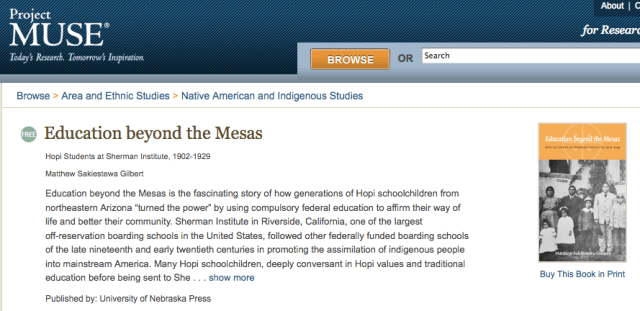
Education beyond the Mesas temporarily available for FREE download

I am pleased to announce that Education beyond the Mesas: Hopi Students at Sherman Institute, 1902-1929 (University of Nebraska Press, 2010) is temporarily available for free download through Project MUSE.

It has always been my desire that people on and off the Hopi Reservation will have access to my research, and the University of Nebraska Press’s decision to allow my book to be featured on Project MUSE, is a major step in that direction.

However, free access to Education beyond the Mesas via Project MUSE will only last until January 2012. See the Project MUSE website for more details.

To download Education beyond the Mesas, please click on the above image or visit the following link: http://beta.muse.jhu.edu/books/9780803234444

Matthew Sakiestewa Gilbert

Sherman Indian Museum and UC Riverside

I recently returned from the 25th Anniversary California Indian Conference held at the University of California, Irvine. My former graduate advisor from UC Riverside, Cliff Trafzer, organized a panel on Sherman Institute titled “Out of the Vault.” In addition to myself, the panel members included Lorene Sisquoc, Director of the Sherman Indian Museum, Galen Townsend, Sherman Indian Museum Volunteer, Kevin Whalen, a graduate student in history at UCR, and Leleua Loupe of California State University, Fullerton.

Sisquoc began the panel by talking about the unique relationship between UCR and the Museum. For the past 10 or so  years, UCR history graduate students have worked alongside Sisquoc as researchers, volunteers, and interns. Beginning with Jean A. Keller, author of the first book on Sherman Institute, Empty Beds, graduate students have utilized the Museum’s collections to write two monographs, and several master theses, dissertations, and articles. Today, the mutually beneficial relationship between UCR and the Museum continues, and provides an excellent model of collaboration and community.

Matthew Sakiestewa Gilbert

Screening BEYOND THE MESAS at Upper Moencopi

Photograph by Matthew Sakiestewa Gilbert

On Saturday September 18, 2010, I had a special opportunity to screen BEYOND THE MESAS and give a presentation to my family at the village of Upper Moencopi’s Community Center. The screening and presentation were part of the Sakiestewa/Honanie Annual Family Reunion. About 60 people attended the event.

I have screened BEYOND THE MESAS at several universities in the United States, and I have shown it at other locations on the Hopi Reservation, but this was the first time the documentary was screened at Upper Moencopi. The film was well received and it led into a discussion on the benefits and negative consequences of Hopi attendance at off-reservation Indian boarding schools.

After the screening I passed out student case files that I collected at the National Archives in Laguna Niguel, California (now located in Perris, California). The files belong to members of the Sakiestewa and Honanie families who attended Sherman Institute or the Phoenix Indian School from 1906 to the 1940s. Most of the files included school applications, report cards, and handwritten and typed letters.

As a Hopi professor at the University of Illinois I am thankful for the opportunities that I have to bring my research back to the Hopi community. This has always been a driving force behind my work.

Matthew Sakiestewa Gilbert

A Hopi runner and his marathon trophy

Photograph by Matthew Sakiestewa Gilbert

Most people who visit the Sherman Indian Museum in Riverside, California, see this first place trophy without knowing who won it. Marathon officials did not engrave the athlete’s name on the trophy, but they did include the date and the event, which was the Vallejo Pre-Olympic National Marathon held in California on December 22, 1929.

At one point in the school’s history, the student’s at Sherman Institute knew who won this award. But as time passed, the trophy, one of the largest in the Museum’s collection, became disassociated from its owner.

The trophy belongs to Hopi runner Harry Chaca from the village of Polacca on First Mesa. He was among the great Hopi runners of the twentieth century. Chaca attended Sherman in the 1920s and early 1930s and he earned several marathon honors while a student at the school.

I wrote about Chaca and his victory of the 1929 Vallejo Pre-Olympic National Marathon in my article “Hopi Footraces and American Marathons, 1912-1930” (American Quarterly, March 2010). I note that prior to this event, Chaca had won other prestigious marathons and his reputation as a great runner spread far beyond the United States.

In Japan, for example, a runner named Yoshikio Sudsuki heard that Chaca was the best runner in America and so he traveled to the U.S. for the sole purpose of competing against the Hopi from Polacca. But at the 1929 Vallejo Pre-Olympic National Marathon, Chaca’s speed and endurance proved too much for the forty-nine year old runner from Tokyo. In my article I write that the

Hopi runner ran at a “killing pace to win” the full marathon in two hours, forty-one minutes, and twenty-five seconds, a “full second better than the performance of Alpien Stenroos” in the 1924 Olympic Games in Paris. One of the fifty thousand spectators of the marathon recalled that Chaca’s “victory” was “all the more noteworthy for his sensational finish. After trailing for twenty-three miles it was at that mark that he applied a final burst of speed that sent him ahead” of Hopi runner Franklin Suhu. In addition to winning the race, Chaca set a new American marathon record, which immediately confirmed his place as the top long-distance runner in the nation. [p. 91]

Shortly after Chaca’s marathon victory, school officials took his trophy and displayed it in a large cabinet located in Sherman’s administration building (now the Sherman Indian Museum). According to school administrators, all individually won trophies belonged to the school.

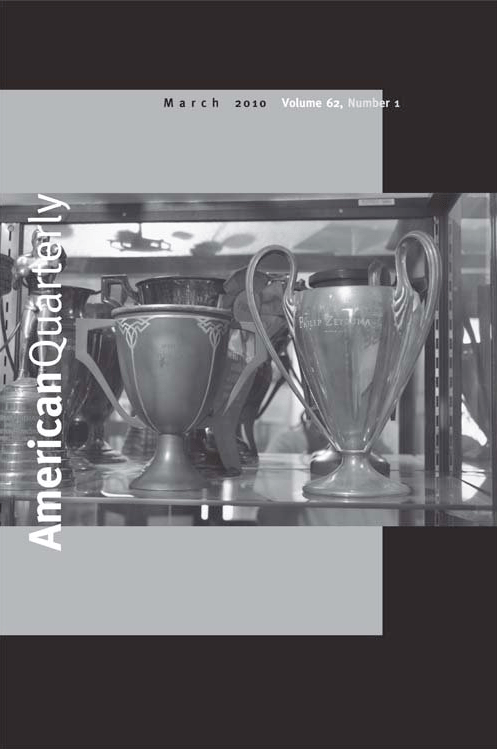
At times Hopi students attempted to obtain their trophy cups after their terms at Sherman had expired.  During the 1940s, for example, Hopi runner Philip Zeyouma asked the school’s superintendent if he could reclaim his trophies (pictured on the front cover of American Quarterly), but school officials refused to honor his request.

More than eighty years after Chaca won the Vallejo Pre-Olympic National Marathon, his trophy remains at the Sherman Indian Museum. Although government officials consider the award to be property of the Bureau of Indian Affairs, the trophy will always belong to Harry Chaca and his family.

Matthew Sakiestewa Gilbert

“Hopi Footraces and American Marathons, 1912-1930” (American Quarterly, March 2010)

For the past three years I have been working on a book on Hopi long distance runners and the American sport republic. Part of this project includes an article that I wrote titled “Hopi Footraces and American Marathons, 1912-1930.” This article recently appeared in the March 2010 Issue of American Quarterly (Vol. 62, No. 1, pp. 77-101). The American Quarterly is the flagship journal of the American Studies Association.

The photograph featured on the cover of the journal (pictured above) is of two trophy cups that Hopi runner Philip Zeyouma won at Sherman Institute. I took this photo at the Sherman Indian Museum in Riverside, California. Not long after the school established its cross-country team, Zeyouma won the Los Angeles Times Modified Marathon in April 1912. His victory also gave him an opportunity to compete in the 1912 Olympic Games in Stockholm, Sweden.

When Hopis such as Zeyouma, Harry Chaca, Guy Maktima and Franklin Suhu competed on the Sherman cross-country team, and Louis Tewanima ran for the Carlisle Indian Industrial School, their cultural identities challenged white American perceptions of modernity and placed them in a context that had national and international dimensions. These dimensions linked Hopi runners to other athletes from different parts of the world, including Ireland and Japan, and they caused non-Natives to reevaluate their understandings of sports, nationhood, and the cultures of American Indian people.

This article is also a story about Hopi agency, and the complex and various ways Hopi runners navigated between tribal dynamics, school loyalties, and a country that closely associated sports with U.S. nationalism. It calls attention to certain cultural philosophies of running that connected Hopi runners to their village communities, and the internal and external forces that strained these ties when Hopis competed in national and international running events.

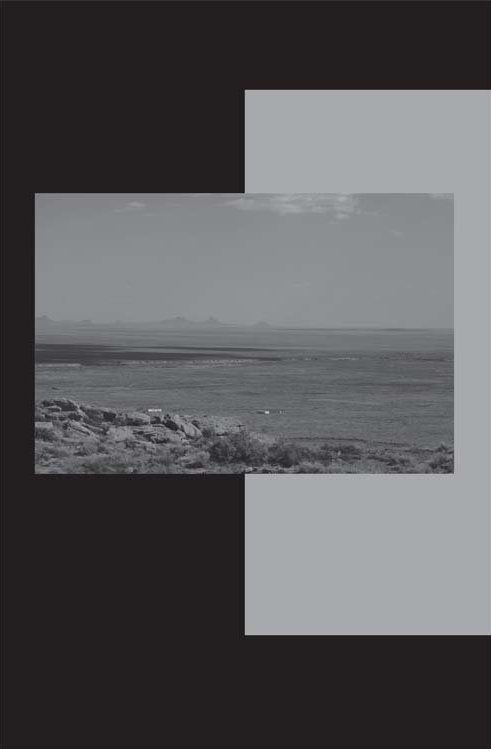
The back cover of the journal (pictured below) features a photograph that I took on the edge of Third Mesa near the village of Orayvi. At one point in the article I describe how one can stand in this location and see for miles in all directions:

To the south, the land extends beyond the Hopi mesas and the silhouette of Nuvatukiyaovi, or the San Francisco Peaks, is visible in the distance. In the valleys below, corn, melon, and bean fields stand out as green patches against a backdrop of earth and sandstone. From on top of the mesa one can enjoy the sweet smell of burning cedar, hear and feel the wind blowing over the mesa edge, and behold a breathtaking landscape surrounded by a canopy of deep blue sky. Looking east toward the village of Shungopavi on Second Mesa, running trails stretch from Orayvi like veins that connect and bring life to each of the Hopi villages. The trails near Orayvi give testimony to the tradition of running in Hopi culture and the continuance of running among today’s Hopi people. [p. 79]

I am indebted to several individuals who helped me revise this essay, including my colleagues at the University of Illinois, various Hopi and non-Hopi scholars, the Hopi Cultural Preservation Office, Lorene Sisquoc of the Sherman Indian Museum, and American Quarterly editors Curtis Marez, Jeb Middlebrook and Stacey Lynn.

If you would like a PDF copy of this article, please feel free to email me at sakiestewa@gmail.com, or submit a comment to this post.

Matthew Sakiestewa Gilbert

See also BEYOND THE MESAS post: Hopi runners article available for download

A bronze coin for a Hopi alumna

Photo by Matthew Sakiestewa Gilbert

In 2001, the Sherman Indian Museum had this bronze coin designed to commemorate the 100 year anniversary of Sherman Institute (now called Sherman Indian High School). Before I conducted research on the Hopi Reservation, Lorene Sisquoc, director of the Sherman Indian Museum, gave me several of these coins to give to the Hopi alumni that I interviewed.

One of these former students was Bessie Humetewa from the village of Bacavi. She attended the school from 1920 to 1928.  Bessie also appears in Beyond the Mesas where she recalls that she stayed at Sherman “all eight years without coming home.”

At the time of the interview Bessie was blind, and so when I gave her the coin she examined it with her hands. Before I could tell her what was depicted on the coin, she said to me, “this is Sherman.”

She was able to discern the raised design of the school’s main building, the palm tree, and the superintendent’s office. The bronze coin reconnected Bessie to her alma mater. It took her back seventy-six years to when she last attended the Indian school in Riverside, California.

Matthew Sakiestewa Gilbert

Hopis and the Outing System at Sherman Institute

OUTING SYSTEM

As part of the school plan the outing system is practiced each year. Students have no difficulty securing positions, the girls in the best families in Southern California and the boys on ranches or other industrial lines.  The extensive production of oranges, berries, and other fruits, cantaloupes, and grain furnish employment for the boys at all seasons.  The practice of sending out students for experience and to earn a little money during vacation is an advantage to the students, but it is not compulsory.  The wishes of the individual and of parents, if necessary, are always consulted.  – Sherman Institute Booklet (1908), Sherman Indian Museum, Riverside, California

One of the gaps in the historiography of Indian boarding schools is a book length study on the Outing System. Government officials established Outing programs at off-reservation Indian boarding schools to create an Indian working class. At Sherman Institute, the boys labored on farms and ranches, while the girls worked in homes in the greater Riverside community.

Although school officials wanted the girls to be exposed to the  so-called civilizing influences of white Americans, the system ultimately “trained” girls to become domestic servants. The girls often spent their days cleaning, making food, and taking care of children who belonged to white families.

In BEYOND THE MESAS, Eilene Randolph and Leslie Robledo from the village of Bacavi on Third Mesa note that Hopi girls at Sherman did not have trouble securing work in the school’s Outing program.  Hopis had a reputation of being “hard workers,” and the people in the community routinely “hired up” the girls to work in their homes.

Local farmers were also eager to employ Hopi boys to work in their fields and orchards. The boys had come from an agricultural based society and used their knowledge of planting and harvesting in Southern California.

While I have written more about the Outing System in my book Education beyond the Mesas: Hopi Students at Sherman Institute, 1902-1929, and other scholars have examined the topic in their works, a comprehensive study (book) devoted entirely to this important program has yet to be published.

Matthew Sakiestewa Gilbert

The search for Polingaysi Qoyawayma

When I started researching on the Hopi boarding school experience at Sherman Institute, I thought for sure that I would come across many references of Polingaysi Qoyawayma (Elizabeth Q. White) at the Sherman Indian Museum. She is, after all, one of the school’s most famous alums. I looked in the Sherman Bulletin, the school’s student-written newspaper. I examined various letterpress books and other school records, but I never came across her name.

While conducting research at the National Archives in Laguna Niguel, California, I uncovered a file with a name similar to Polingaysi Qoyawayma written on the tab. I thought I found the documents that I had been searching for. But when I examined the records closely I discovered that the file belonged to someone else.

In an attempt to find clues that would lead me to archival information on Qoyawayma, I reread Don Talayesva’s autobiography Sun Chief. Talayesva and Qoyawayma attended Sherman at the same time. They both came from Orayvi and likely traveled with each other to the school in November 1906. But nowhere in Talayesva’s book does he mention her name.

Fortunately, one does need to depend on Talayesva or an archive to learn about Qoyawayma’s experience at the Indian school in Riverside. Although the archival record may appear to be silent, at least in reference to her time at Sherman, her story remains with her family, others who knew her, and in her book No Turning Back.

The documents that I searched for may never surface. They may not even exist. But Qoyawayma has already shared with us about her school days at Sherman Institute. She has already provided us with the archive, the documents, and the narrative of her life.

Matthew Sakiestewa Gilbert

Spanish mission buildings and sandstone homes

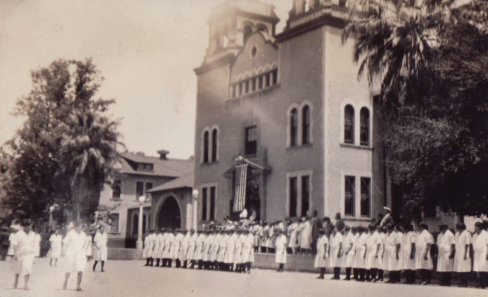
The producers of Beyond the Mesas were very fortunate that Marsah Balenquah from Bacavi on Third Mesa agreed to be interviewed for the film. In the documentary she explains that she attended Sherman for thirteen or fourteen years. At one point in the film she describes her impression of the school’s buildings. Built by Indian students in a Spanish Mission architectural style, the buildings did not resemble the sandstone homes she and other Hopis were familiar with on the reservation.

This photograph was taken when Marsah attended the Indian school in Riverside from 1920 to 1934. In the photo girls are standing in a line waiting for roll call and inspection. Everyday life at Sherman was very regimented. An American flag drapes from the portico of the school’s main building. Photo courtesy of the Sherman Indian Museum.

Matthew Sakiestewa Gilbert