Nuvamsa letter to Hopi Tribal Council and PowerPoint to “Water is Life” forum

Peabody Coal Leases PowerPoint / Nov 12, 2011 / Click to download (24 pages)

                                                                                               November 14, 2011

Honorable Hopi Tribal Council Members:

Enclosed is a copy of a presentation on Peabody Coal Leases that was presented at our recent “Water is Life” forum on November 12, 2011, held at the Hopi Veterans’ Memorial Center.

As you may know, the Hopi Tribe and Navajo Nation entered into three separate leases with Sentry Royalty Company (predecessor to Peabody Western Coal) beginning in the mid-1960’s. The Navajo Nation has a “Navajo Exclusive” lease (No. 8580) and shares another lease with the Hopi Tribe (No. 9910). Peabody pays 12.5% of monthly gross realization (royalty) on Lease 8580 to Navajo; and pays 6.25% monthly gross realization to both Hopi and Navajo under Lease 9910. The leases now provide for renegotiation every ten years, referred to as “Lease Reopener”. Lease 9910 has not been formally approved by Hopi although it was due for renewal in 2007. Navajo approved its portions in April 2011.

Coal from the Black Mesa Mine was dedicated to the Mohave Generating Station (MGS), but MGS shut its operations in 2005. Today, very little if any mining is occurring in the Black Mesa Mine area. Coal mined on the Kayenta Mine area is delivered to NGS and royalties are shared by the two tribes under Lease 9910 Lease; and Navajo receives all royalties under is lease, No. 8580.

Since the inception of the leases, Peabody Coal has not paid Hopi and Navajo at current fair market prices for the coal it mined and the water it pumped for mining operations. During its heyday, Peabody pumped over 3.3 million gallons each day from our precious Navajo Aquifer to slurry coal, over 275 miles from Black Mesa to MGS in Laughlin, Nevada. Since it began mining, Peabody mined over 400 million tons of coal from the Black Mesa and Kayenta mines.

If you review the leases, you will find the leases provided only for leasing of surface acres. No consideration was made on the value of the massive coal and water deposits that were the subject of the leases. No appraisals or valuation of the coal and water deposits were made to determine the fair market value of these resources. As a result, the tribes lost millions, if not billions, of revenues since the inception of the leases. Yet, by virtue of the leases, Peabody obtained exclusive subsurface rights to our vast deposits of coal and water without paying a dime for them. We (the tribes and the federal government) allowed Peabody to build a considerable company portfolio at our expense. This coal and water became an asset to Peabody that it would leverage for other business ventures. Tribal coal and water were “locked in” for the duration of the leases and tribes could not re-negotiate the terms of the leases, or could they leverage the resources. The leases effectively kept the tribes from diversifying their respective economies because the tribes lost control over the resources.

In a typical business scenario, a company would buy raw materials that it would use in manufacturing its products. Not so under the Peabody coal leases. The tribes received no upfront payments for the coal and water Peabody secured under the leases. Instead, tribes are compensated minimally (12.5% and 6.25% gross monthly realization) when Peabody sells the coal to NGS. Incidentally, the royalty rates were the subject of the Racketeering Influenced and Corrupt Organizations Act (RICO) which is a matter for later discussion.

Peabody and owners of NGS receive considerable benefits from the production and sale of electricity using our coal and water. Yet the tribes do not participate in the sharing of profits. See the Value Chain chart in the presentation. The chart depicts that owners of NGS (Arizona Public Service, Tucson Gas & Electric, Bureau of Reclamation, Salt River Project, Los Angeles Water & Power, and Nevada Power) are also “customers” of NGS.

Concerning tax revenues, while the Navajo Nation and the State of Arizona receive some tax revenues, the Hopi Tribe receives no tax revenues because it does not impose taxes on Peabody because of a reported covenant to not tax Peabody. In its 2005 report, Peabody reported that the Navajo Nation received over $82.9 million in various forms of taxes during the period 1986 to 2004, while the State of Arizona received over $67.5 million during the same period.

Payments made by Peabody are not commensurate with the profits they earn from our resources. Hopi only receives about $11.0 million to $13.0 million in royalties and other benefits each year from Peabody, very little, if any, of which goes to our people. But Peabody reported that its revenues rose 21% to a record $2.0 billion; and its operating profits rose 41% to $458 million for the Quarter ending June 2011. Peabody’s Chairman and Chief Executive Officer alone received a salary of $11.9 million in 2009; and its Executive Vice President and Chief Financial Officer earned $4.1 million. And the Salt River Project recently reported a profit of over 26% in 2011.

After almost 50 years of mining, we have nothing to show how the mining of our coal and the pumping of our precious Navajo Aquifer has benefited us. Simply look around. We have dilapidated infrastructure, dismal housing conditions, limited water supply, contaminated drinking water, limited scholarships, limited or no jobs, etc. Our socioeconomic conditions remain dismal while Peabody, NGS and their holding companies make significant profits from our resources. It is time to make a change in the structure of the coal leases so that our tribe, our villages, and our people can all benefit from sale of our resources:

  • Demand upfront payments for coal and water that will be the subject of the leases on an annual basis at fair market prices.
  • Increase the monthly royalties to reflect current fair market rates (instead of a minimum 12.5% and 6.25%).
  • Demand that Peabody complies with the leases and find alternative sources of water, other than using the Navajo Aquifer; and reclaim and repair the area including damages to the aquifers.
  • Limit the leases to coal and water, and exclude other “kindred” products.
  • Enact a tax ordinance and begin imposing possessory interest taxes, business activity taxes, sales taxes, fuel excise taxes, severance taxes, etc. on Peabody.
  • Hold Peabody accountable for damage done to our resources, including damages to our archaeological resources.
  • If Peabody refuses to amend its lease and agree to these conditions, seek competition to find a more responsible and accountable lessee.
  • Develop alternative uses of our resources and transition to use of alternative energy.
  • And impose on the Secretary of Interior Salazar to declare that Material Damage has occurred on Black Mesa and the Navajo Aquifer. There is clear evidence of damages done to our resources.

Benjamin H. Nuvamsa

Shungopavi Village

Former Hopi Chairman

14th Annual Rattlesnake Master 5K and 10K Run

Over the past few weeks I have been lecturing in my courses on Hopi long distance runners.  At some point in the semester, I threw out the idea to my students that if they ran the Rattlesnake Master 10K (Urbana, IL) with me on November 6, I would give them 10 points of “extra credit.”

At most, I thought 1 or 2 students would agree to this proposal. Boy was I surprised when 18 students showed up on the day of the race!

Kudos to my students for waking up early on a Sunday morning, spending their money on race entry fees, and bracing the wind and cold. They made their professor proud.

Some ran the 10K race, while others opted for the 5K event. We had a great time, and today I made good on my promise and gave them each 10 well-deserved points of extra credit.

“Water is Life” Forum – Saturday November 12, 2011

Click image to download flyer

A message from Ben Nuvamsa…

We are at a Cross Roads!  Critical issues face the Hopi Tribe and the Navajo Nation concerning our tribal water, coal, environment, our culture and our economy.  We must become informed of the big issues that will affect our tribes for hundreds of years to come.  Our tribal councils are not informed of, nor do they understand the complex issues that lie before them.  As tribal members and stakeholders, we must become educated and informed of these issues so that we can educate the elected tribal officials to make the proper and informed decisions.  This is an opportunity for everyone to share their concerns and participate in setting a direction to addressing these important issues.  We will have common issues.  How do we work together to preserve and conserve our resources for our future generations? Come and learn about these issues and express your concerns.

The attached flyer announces our forum to be held November 12, 2011, at the Hopi Veterans’ Memorial Center.  Spread the word to Hopi and Navajo citizens. Everyone is welcome.  Tribal council representatives and delegates are especially encouraged to attend.  Traditional Hopi meal will be served.

One of the most important topics to be covered concerns the recent findings by Dr. Daniel Higgins of the impacts on the N-Aquifer from years of pumping by Peabody Coal.  We will also discuss the proposed Northeastern Indian Water Rights Settlement Agreement and what provisions it contains.  There are many other important issues facing our tribes such as the Kayenta Mine Life of Mine Permit.   What does all of this mean to you?  Come learn and express your concerns.


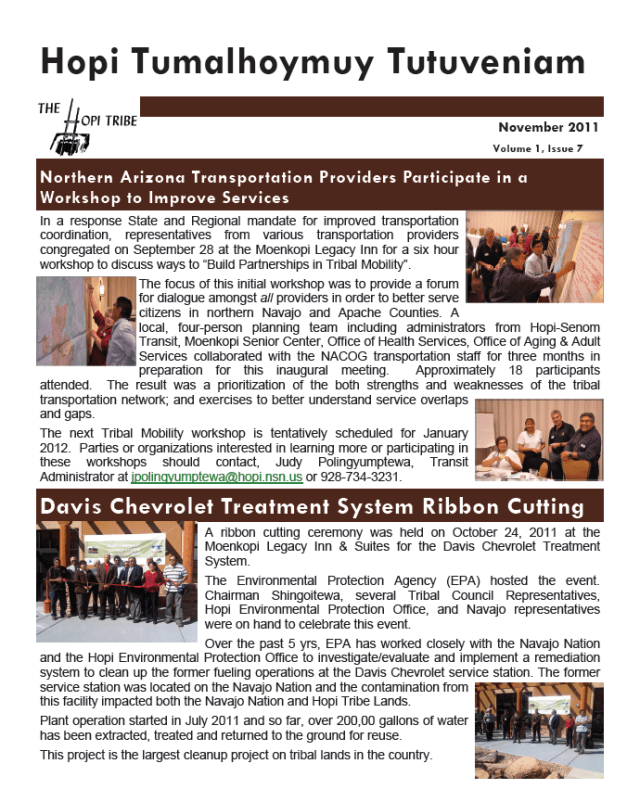
Hopi Tumalhoymuy Tutuveniam – November 2011

Click image to download Newsletter (10 pages)

A presentation on Hopi runners

On Friday November 4 at 12:00 noon at the University of Illinois Native American House, I will give a presentation titled “Hopi Runners and the American Sport Republic, 1908-1912.” The lecture will focus on Hopi runners, Louis Tewanima and Washington Talayamtewa (Talyumptewa), who competed for the Carlisle Indian Industrial School track team between 1908 and 1912. Both runners were from the village of Shungopavi on Second Mesa. The event is free and open to the public. Lunch will be provided. Click here for additional information.

AIS at Illinois to host book reception

Click image to download complete flyer

On Friday October 28 at 4PM, the American Indian Studies Program at the University of Illinois will host a book reception in the Author’s Corner (2nd floor) of the Illini Union Bookstore. I am scheduled to talk about Education beyond the Mesas. My AIS colleagues, Jodi A. Byrd, Vicente M. Diaz, and Robert Dale Parker, will also present on their publications. The gathering is free and open to the public. Light refreshments will be served. For those who live in the Champaign-Urbana area, it would be great to see you at this event!

Hopi Veteran’s Day Events – November 11, 2011

Click to download PDF flyer

Hopi Tumalhoymuy Tutuveniam – October 2011

Click to download the newsletter (12 pages)

Hopi candidate Nikishna Polequaptewa for NIEA board

The following post was originally published on the National Indian Education Association (NIEA) website: http://niea.org/Convention/Board-Elections.aspx. NIEA board member elections will take place at the this year’s NIEA Convention & Tradeshow in Albuquerque, NM, October 26-30.

NIEA members can also vote by absentee ballot. Click here (scroll to the bottom of the page) for more information.

I have known Nikishna Polequaptewa for the past 4 years, and I have written about his accomplishments in a previous post. I have a lot of respect and appreciation for him and the work that he is doing with and for Native people.  NIEA and its members would be very fortunate to have Polequaptewa on the Board of Directors.

Matthew Sakiestewa Gilbert

——————————————–

2011 Board Nominee
Nikishna Polequaptewa
Hopi

“I envision a meaningful shift toward a higher percentage of college educated tribal administrators, dignitaries, business owners, operators, managers, and executives that will have the ability to make informed decisions that will promote Indian self-sufficiency and strengthen tribal sovereignty.”

NIKISHNA POLEQUAPTEWA is a devoted Hopi tribal member and Native education advocate. Through his innovative outreach and retention programs, he has set a standard of excellence for programs involving access, outreach, and retention to higher education for Native students across the country.

Nikishna’s commitment to education and academic achievement was evident long before he attended college. He was a participant in the California Baptist University’s University Bridge Program (1998- 1999), and then in the University of California‘s, Riverside’s High School-University Program the following year (1999- 2000). In 2000, he graduated as class president from Sherman Indian High School and continued his educational pursuits at the University of California, Irvine (UCI). While there, he continued to actively contribute to outreach and retention programs for American Indian students holding roles such as the American Indian Student Association President and Director of American Indian Summer Institute in Computer Science, a UCI American Indian academic resource program. He also reinstated and coordinated the UCI Pow Wow. He graduated with a Bachelor of Arts in Environmental Analysis and Design with a minor in Information and Computer Science in 2005 from the University of California, Irvine.

Nikishna obtained his Master’s Degree from Central Washington University (CWU) with a Master’s of Science in the Resource Management Program in 2007. While at CWU, he served as a research assistant (2005- 2007) and as a Program Manager for the La Jolla Band of Luiseno Indians (2007). That same year, he became founding Director of the American Indian Resource Program at the University of California, Irvine (2007).

Nikishna has earned several honors including: Special Congressional Recognition (through U.S. House of Representative Ken Calvert and U.S. Senator Barbara Boxer), the Presidential Recognition Award (through former President Bill Clinton), the Native American 40 Under 40 Award (2009); and has been successful in securing multiple grants for the American Indian Resource Program and other projects.

Nikishna holds numerous community and leadership positions in organizations such as the UCI Campuswide Climate Council, the American Indian Children’s Council, AISES Chapter (President), the University of California, American Indian Counselors and Recruiters Association (Chair), Nakwatsvewat Institute (Board Chairman), Chancellor’s Advisor Committee (Diversity Chair), and the American Indian Scholarship Fund (Vice Chair). He also holds national memberships in the American Indian Science & Engineering Society (Lifetime Sequoyah Fellow), Society for Advancement for Chicanos and Native Americans in Science, and the National Indian Education Association and holds state memberships in the California Alliance for Minority participation, Inter-tribal Colligate Alliance, the American Indian Chamber of Commerce, and the California Indian Education Association.

Source: http://niea.org/Convention/Board-Elections.aspx

Beyond the Mesas to air tonight on KVCR Channel 24.2 – San Bernardino/Riverside

For those who live in the San Bernardino/Riverside area, Beyond the Mesas will air tonight at 9PM PST on KVCR, Digital Channel 24.2, First Nations Experience, a new Native American channel. See below for additional information.

———————–

Indian Boarding Schools: Keeping the Culture Alive: Beyond the Mesas #101

Wednesday, September 28, 09:00 pm PST on FNX (First Nations Experience) Digital 24.2

Broadcast In: English

Description: Produced with the full participation of The Hopi Cultural Preservation Office, Beyond The Mesas tells the stories of the federal government’s efforts to assimilate and acculturate Hopis, the visit by four Hopi chiefs to Washington, the subsequent Oraibi split, and the forced removal and experiences of Hopi children in off-reservation boarding schools such as the Sherman Institute and the Phoenix and Stewart Indian Schools. Faced with the enforced loss of their language in their children, vastly outnumbered by a technologically advanced military that had the power to annihilate them, enlightened Hopi leadership sought a peaceful middle ground that would preserve the best of Hopi culture and combine it with the best of the white man’s culture. Both federal policies and pressure to resist from within the Hopi community challenged this strategy.

Run Time: 0:26:45
Captions: 608 Captions