Kathy Helms of Gallup Independent on forum to address Navajo-Hopi coal, water issues

This just in from the Gallup Independent

Forum to focus on Navajo-Hopi coal, water issues

By Kathy Helms
Dine Bureau
Gallup Independent

WINDOW ROCK – The people of the Navajo Nation and the Hopi Tribe are at a crossroads, according to former Hopi Tribal Chairman Ben Nuvamsa. The dilemma hinges on whether to continue accepting pennies on the dollar for their resources from outside entities, or take the bull by the horns and create “economic sovereignty” for themselves.

A public forum sponsored by the Inter-Tribal COALition to address tribal water, coal, environmental, cultural and economic issues affecting the tribes will be held at 6 p.m. Sept. 30 on the sixth floor of the Native American Community Building, 4520 N. Central Ave., Phoenix.

Presenters include Daniel Higgins, Ph.D., Sean Gnant of the Brewer Law Firm, Milton Bluehouse Sr., and Nuvamsa. Navajo Nation Council delegates, Hopi Tribal Council members, and interested members of both tribes are asked to attend the forum to learn more about their common issues.

“We believe that we are at the crossroads. Many of these entities are after our water and our coal. We kind of stand, so to speak, at the headwaters of all these resources,” Nuvamsa said.

Coal from the tribes is used to generate electricity so the people in southern Arizona, southern California and Nevada will have electricity in their homes. The massive Central Arizona Project depends on power from Navajo Generating Station so the federal government can deliver surface water to tribes and municipalities in southern Arizona, he said.

“The sad part is that these entities that are using these resources to provide these services to the people and generate profits are not paying us at the fair market value for our water and our coal,” while the tribal councils are prematurely agreeing to settlements without properly informing their people, he said.

“For example, the lease reopener that’s before the Hopi Council – there ought to be increased royalties. Instead of one-time bonuses, there ought to be annual bonuses. There ought to be higher scholarships – $85,000 (for Hopi) is nothing.”

In addition, provisions in the proposed Northeastern Arizona Indian Water Rights Settlement could hold Peabody Energy and others harmless for all past, present and future damages to the water quality. “I think these are the kinds of things that people need to know, that our tribal councils are agreeing to these things,” he said, adding that the companies should be held accountable for damages and the federal government should be held accountable for not enforcing the rules.

“Both nations ought to be able to say, ‘OK, we have this precious resource, we’re going to take all bidders,’ and be able to go out and compete for higher prices, not have it handed to Peabody Coal. We ought to be able to make those decisions ourselves. I call that economic sovereignty,” Nuvamsa said.

During last week’s meeting with U.S. Department of the Interior Deputy Assistant Secretary David Hayes on the proposed water rights settlement – which many have linked to the future survival of NGS and the Central Arizona Project – Shiprock Delegate Russell Begaye said a change of policy may be in order in terms of the use of Navajo resources by outside entities such as Las Vegas, Phoenix, Tucson and Los Angeles.

Begaye said Navajo historically has focused on “outsourcing” its minerals and water resources rather than looking inward to see how they can be used to benefit the Navajo people. He proposed that Navajo look at developing local community-based generating plants which produce up to 10 megawatts of electricity.

“The town of Shiprock where I’m the delegate – about 18,000 folks – we can probably use 2 to 3 megawatts to run the whole community, and the rest we could outsource and sell to outside entities or other communities on our land, using a combination of coal, wind and solar.”

Rather than building mega-plants to power up electricity in other places, if a company said, “’We want to come alongside you and develop those resources to light up your communities on the reservation, to give water to homes on your land, and be able to do it in such a way that these communities can start selling these sources to outside entities,’ then we’re really talking about a trust responsibility that builds the Nation first,” Begaye said.

“I think the focus needs to turn from Phoenix to the Navajo Nation, from Los Angeles to the Navajo Nation. That policy change, if it takes place, will resolve a lot of our issues. We are sitting on gold mines, but those gold mines are being used by outside entities.”

Navajos travel to major cities across the West and “dream about the days when we may have those stores and those manufacturing plants,” Begaye said, all the while knowing it is Navajo resources which made those developments possible. “Why not let’s turn that inward? Let’s change the policy of outsourcing, to using those resources to build a nation.” He asked Interior to help Navajo in that endeavor.

After Interior officials left, the work session turned from water to NGS and despite efforts by Duane Tsinigine and Nelson Begaye to keep the session open to the public, Nabiki’yati’ Committee voted to go into executive session.

Adella Begaye of Wheatfields, a member of Dine Care, said, “This is very sad because there is no accountability, there is no transparency. All these decisions are made without our consent, without our concern. We have been concerned about the water settlement because 36,000 acre feet is not enough for our Nation, and they are now even trying to settle for $400 million – which is nothing.”

She said it was wrong for Navajo and Interior officials to try to push through the settlement by saying there is just a small window of opportunity because Sen. Jon Kyl, R-Ariz., will retire next year and chances for a settlement after that are not likely. “Kyl is for Phoenix to get all the water they can. They’re not for the Navajo Nation.”

Tsinigine left the meeting when it went to executive session. “It’s only fair that all delegates are here to hear these issues, and some of these issues, in general, should be made public. In LeChee, Coppermine and Kaibeto, the majority of the men and women work at Navajo Generating Station and they want to be updated and make sure that the people hear what is at the negotiating table,” he said afterward.

“We’re leaving 75 percent of the Council out of it,” because they were given abrupt notice of the meeting and many had prior commitments, he said. “That’s not fair.”

Marshall Johnson of To Nizhoni Ani, or Beautiful Water Speaks, said the Interior’s visit to discuss their water rights was “like you see on television – a drive-by” that took in the president’s office, Legislative and the Hopi Tribe, but the people, “the original stakeholders,” were left out.

The state of Arizona is the beneficiary of any proposed settlement, he said. During a May hearing in Washington, Shelly and Hopi Tribal Chairman LeRoy Shingoitewa stressed the importance of NGS to the tribes. Johnson, who testified along with Black Mesa Trust Director Vernon Masayesva, opposed extending the lease.

“We told Central Arizona Project it’s about time they get self-sufficient. We’ve been feeding them. They have a $3.5 billion operation in industrial agriculture. We made it available for them. Navajo resources made it possible to push water 3,000 feet elevation uphill. They plant three times a year,” he said. “We have no net benefit from this operation.”

Information:https://beyondthemesas.com/2011/09/21/a-forum-to-address-tribal-water-coal-environment-cultural-and-economic-issues-affecting-hopi-tribe-navajo-nation-phoenix-az-sept 30-2011/

A Forum to Address Tribal Water, Coal, Environment, Cultural and Economic Issues Affecting Hopi Tribe & Navajo Nation – Phoenix, AZ, Sept. 30, 2011

A message from The Inter-Tribal COALition Sponsers…

Hopi and Navajo coal and water are a precious commodity that are the envy of the State of Arizona, Southern California, Nevada, federal government, Peabody Coal Company, Salt River Project, owners of the Navajo Generating Station, cities and towns in the Southwest, and the southern Arizona Indian tribes, among others.  These entities have competing and conflicting interests in our precious natural resources, yet they have not been willing to compensate our tribal nations for mining and pumping of our resources at fair market value. We are at a critical “Cross Roads” and time is ripe for us to exercise our sovereign rights to seek economic and environmental justice, yet our tribal councils have been agreeing to the demands of the federal government, Peabody Coal, Salt River Project, et. al., while compromising any leverage we may have to maximize economic benefits for our people, promote and require environmentally and culturally relevant operations in generating electricity.

Our resources make it possible for the federal government to meet its obligations with tribes in Southern Arizona under their water rights settlements.  Our coal and water make it possible to generate electricity for lift stations along the massive Central Arizona Project water delivery systems so that the tribes and municipalities can receive their surface water needs.  Our coal makes it possible for families in Arizona, Nevada and Southern California to enjoy the conveniences of having electric power in their homes.

Recently both Navajo and Hopi tribes agreed to settle the RICO lawsuits with the federal government, Southern Cal Edison and Peabody Coal (and hold them harmless for past violations) without consulting with tribal members.  A huge proposed water rights settlement agreement is now before the tribes for consideration.  There have been numerous lease violations at Black Mesa by the Peabody Coal Company which have gone unaddressed for years.  Recently, President Obama withdrew EPA’s proposed air emissions standards that would have affected the Navajo Generating Station and other coal powered power plants.  And while the federal government and Peabody Coal Company have been asserting that there are no damages to the N-Aquifer from Peabody’s excessive withdrawals of the N-Aquifer, there is a recent study that challenges these claims.

We invite you to come to this forum to learn about these issues and talk about what we, as tribal members and tribal nations, can do to address these issues.  Knowledge is power.  Learn about these complex issues so that you can hold your council members accountable for making informed decisions on your behalf.  Special invitations go out to Hopi and Navajo tribal members (reservation and off-reservation), and council members/delegates from both tribes.  Spread the word.

The Inter-Tribal COALition Sponsers

Hopi clowning and the life of Michael Kabotie

This semester I am teaching a course on Native religious traditions.  Last week I assigned Emory Sekaquaptewa’s article “One More Smile for a Hopi Clown.”

After reading this article, one of my students sought additional information on Hopi clowning and discovered the above video on Youtube.

She wrote a really interesting post about it on her class blog.

The video is a fascinating look into Hopi clowning and the life of Hopi artist Michael Kabotie. Ed Kabotie, Michael Kabotie’s son, is the one giving the presentation.

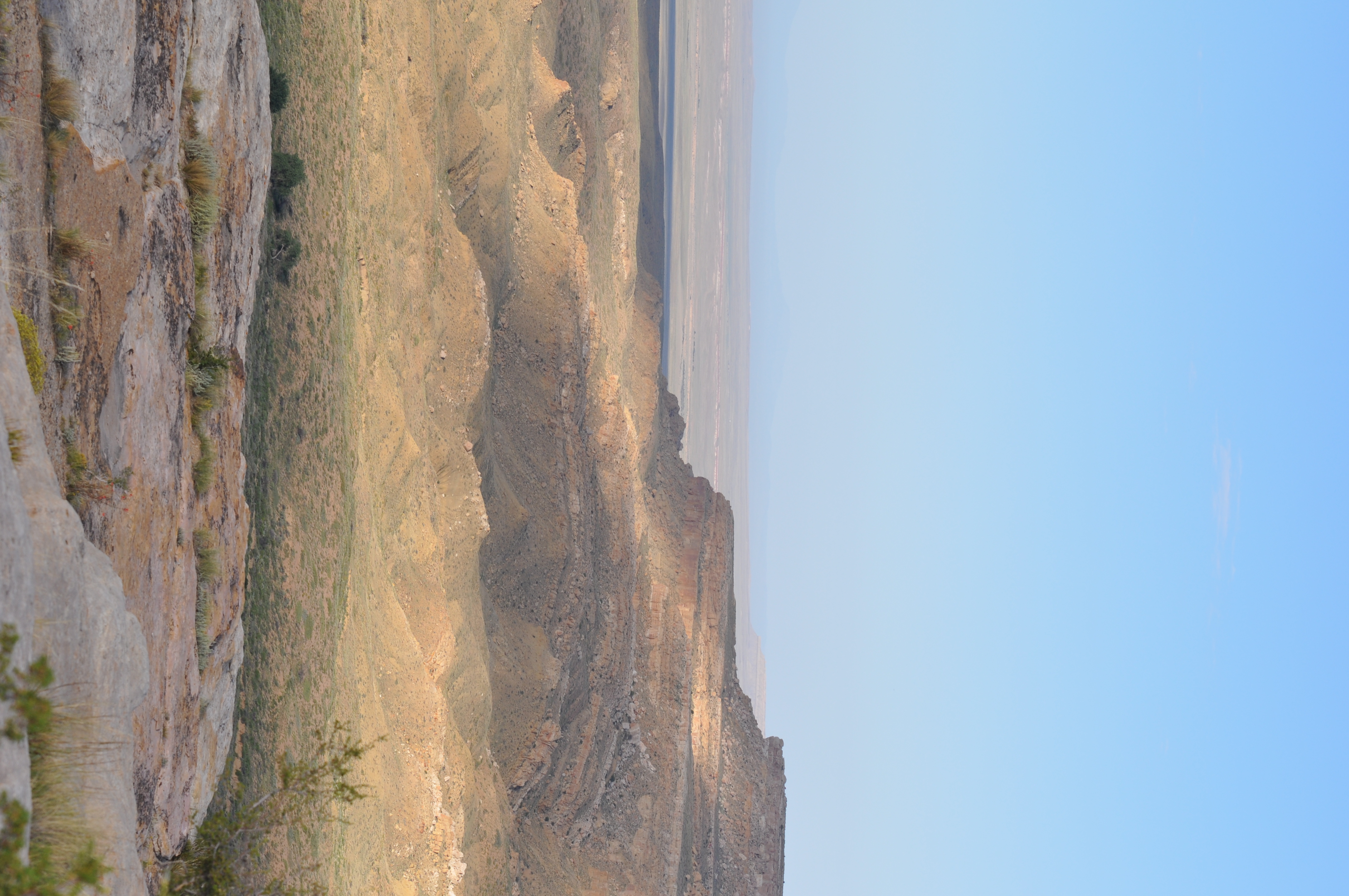
A View from Shungopavi

A View from Shungopavi, Photograph by Matthew Sakiestewa Gilbert

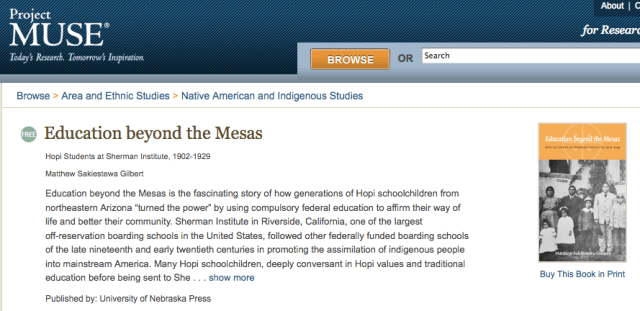
Education beyond the Mesas temporarily available for FREE download

I am pleased to announce that Education beyond the Mesas: Hopi Students at Sherman Institute, 1902-1929 (University of Nebraska Press, 2010) is temporarily available for free download through Project MUSE.

It has always been my desire that people on and off the Hopi Reservation will have access to my research, and the University of Nebraska Press’s decision to allow my book to be featured on Project MUSE, is a major step in that direction.

However, free access to Education beyond the Mesas via Project MUSE will only last until January 2012. See the Project MUSE website for more details.

To download Education beyond the Mesas, please click on the above image or visit the following link: http://beta.muse.jhu.edu/books/9780803234444

Matthew Sakiestewa Gilbert

Trails kept open at the Oraivi Footrace

Oraivi Footrace (2009), Photograph by Matthew Sakiestewa Gilbert

This Saturday August 6, Hopi runner Juwan Nuvayokva and the village of Oraivi will host the annual Oraivi 8K Footrace and 2 Mile Fun Run and Walk.  The 8K race will begin at 6:30AM.  Be sure to arrive early if you intend to run but have not yet registered.  And bring extra cash with you to buy coffee, breakfast burritos, and race t-shirts and mugs. Kwakwha’ to all those who keep our trails open by running in this event!

Hopis and the Navy

Hopis have a long history of serving in the U.S. military. My dad is part of that important history. In the 1970s, he followed in the footsteps of his uncles and joined the Navy.  He was stationed on the aircraft carrier the USS Constellation (CV-64) and traveled way beyond the Hopi mesas to places such as Singapore, Hong Kong, and the Persian Gulf.

After listening to his stories of life aboard the Connie, I also wanted to be in the Navy. As a kid I used to dress up in my dad’s Navy clothes and I even wore his “dog tags” to school! The movie “Top Gun” was a big hit in our home. I also remember hanging out at the Navy recruiter office in Flagstaff, Arizona, just to look at the pamphlets and posters on the walls.

Although my desire to join the Navy ended in high school, I’ve always had great respect for those who have served in the U.S. military.

Today I blog about Hopis in the military as a way to announce a special event about American Indian involvement in the Navy. The gathering will take place on August 7 at the Navy Operational Support Center in Phoenix, Arizona. More information can be found below.

Many thanks to Robert A. Flores, Museum Project Coordinator of the Arizona Capitol Museum, for letting me know about this event.

Matthew Sakiestewa Gilbert

***ANNOUNCEMENT***

Ladies and Gentlemen,

You are cordially invited on Sunday, August 7, 2011, to the Navy Operational Support Center, Phoenix, Arizona. Rear Admiral Sanders United States Navy will speak concerning the important impact of Native Americans currently serving in today’s Navy. The Navy’s impact on the Native American Community and local economy, the Navy’s engagement with American Indian Science and Engineering Society (AISES), as well as the Navy’s commitment, and opportunities in education, leadership, meaningful service, travel, and other areas of significance.

The Admiral would like to address and speak with Native American Elders, Leaders and Native American Youths on Sunday, August 7, at the Naval Facility located on 35th Avenue of the I-10 freeway.

When: Sunday, August 7, 2011

Time: 2:00 p.m. until 4:00 p.m.

Where: Naval Reserve Center 1201 N. 35th Ave. Phoenix, AZ 85009. Located on the Southside of the I-10 freeway, 35th Ave. exit, Exit 141 south, the facility is on the eastside of 35th Ave. To enter the facility, after you take the 35th Ave exit, Exit 141, go south to W Roosevelt Street and turn east toward on W Roosevelt Street towards 34th Ave and turn north on 34th Ave. At the end of 34th Ave, you will see the entrance to the Naval Facility.

To view the facility map, click on the link below or copy and paste it to your browser (It is the facility (1) above/north of Falcon Park on the satellite map),

http://mapq.st/os7epe

The point of contact for this event is Lieutenant Commander (LCDR) Ray Fryberger U.S.N. (602) 353-3001 or you may contact me.

Please RSVP with number of attendees to: 602.926.3827 or rflores@lib.az.us

Please pass this email invitation to others that you feel may be interested in attending.

Respectfully,

Robert

Robert A. Flores

Museum Project Coordinator

Arizona Capitol Museum

Arizona Secretary of State

1700 W. Washington St. Phoenix, AZ 85007

Email: rflores@lib.az.us

(602) 926-3827 (Direct)

(602) 515-6373 (Cell)

Adding color to my blog

Photograph by Matthew Sakiestewa Gilbert

Today my daughters suggested that I add more color to my blog.  According to them, all the black and white photos that I post would be more “pretty” if they were in color.  So in an attempt to add a little color to BEYOND THE MESAS, and to make the overall appearence of my blog more “pretty,” I have posted a (daughter approved) photograph that I took of a hot air balloon that recently flew over our house.  For those who might be interested, I was using a Nikon D60 with a 70-300mm Nikkor lens.

Hopi dancers at 4th of July parade

This slideshow requires JavaScript.

Nuvatukya’ovi Sinom Dance Group at 2009 4th of July Parade, Flagstaff, Arizona. Photographs by Matthew Sakiestewa Gilbert

Opportunity for Hopi and other Native students to learn about Indiana University’s Ph.D. programs

On October 9-12, the Indiana University Graduate Program will host a fall recruitment event titled “Getting You Into IU.” The purpose of the event is to attract minority students who are underrepresented in IU’s Ph.D. programs.

This is a great opportunity for Hopi and other Native students who are thinking about pursuing a Ph.D. in Science, Technology, Engineering, or Mathematics. “Getting You Into IU” is especially geared for students who want to pursue the professoriate or a career in academic research.

Students must be nominated by an adviser, faculty member, or mentor to participate. Those who have been nominated and accepted to attend the event will receive full funding for travel, lodging, and food.

For additional information, click on the above image or visit the following website: http://graduate.indiana.edu/agep/campusvisit.php

Matthew Sakiestewa Gilbert