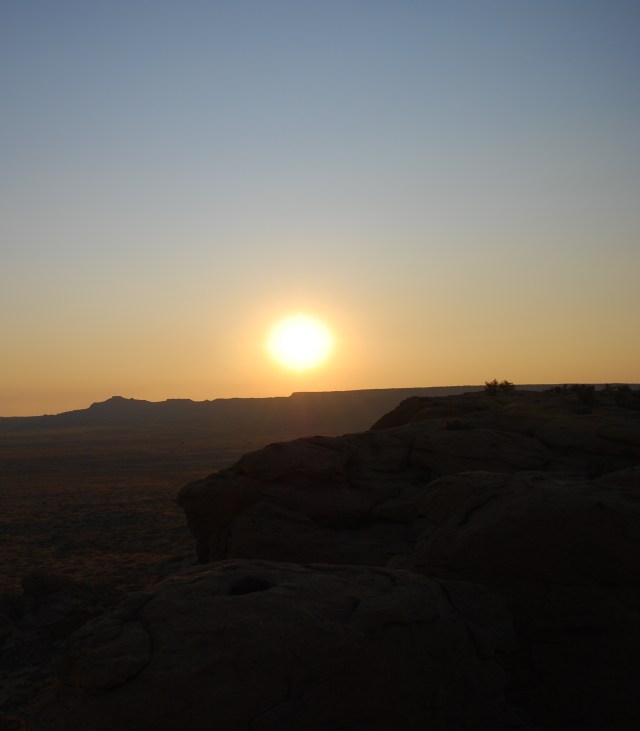
Navajo-Hopi Observer reports that Homolovi Ruins State Park will reopen

Photograph by Matthew Sakiestewa Gilbert

On October 27, 2010, the Navajo-Hopi Observer (NHO) reported that the “Hopi Tribal Council approved a resolution that will keep the Homolovi Ruins Historic Park opened, which will allow safeguard and protection of the cultural and religious site.” State officials closed the Park in February 2010 to help alleviate Arizona’s budget deficit. According to the report in the NHO, the Hopi Tribe has agreed to contribute $175,000 to subsidize the Park’s operating costs.  To learn more about this important development, please visit the following website: http://www.navajohopiobserver.com/main.asp?SectionID=1&SubSectionID=1&ArticleID=12970

Matthew Sakiestewa Gilbert

Education beyond the Mesas: Hopi Students at Sherman Institute, 1902-1929 (University of Nebraska Press)

On Monday of this week the University of Nebraska Press released my book Education beyond the Mesas. My book examines the Hopi experience at Sherman Institute in Riverside, California, from 1902 to 1929. It is a story of resistance, accommodation, and ways Hopi pupils navigated within their village communities, U.S. government policies, and an institution that was designed to destroy their identities as American Indian people. Furthermore, my book is a story of agency, and it demonstrates how Hopi students used their culture to succeed at school, and examines the challenges the pupils faced when they returned to their homes on the reservation.

Thirty one years ago historian David Wallace Adams remarked that a “ study on the federal Indian boarding school system does not exist.” Today the field of Indian boarding schools has grown substantially with contributions from scholars such as Adams, K. Tsianina Lomawaima, Brenda Child, Clyde Ellis, and many others. Recent studies have focused on Indian health, literature, education policies, and the ways Indian pupils “turned the power” at schools originally designed to destroy American Indian cultures. A term used by historians Clifford E. Trafzer, Jean Keller, and Lorene Sisquoc, “turning the power” describes the ability of Native students to turn their educational experiences to their advantage, which often included bringing helpful knowledge and skills back to their indigenous communities.

In my book I examine the ways Hopis “turned the power” at Sherman Institute, and I build upon the work of several scholars including those who have written about the mandatory enrollment of Hopi students at U.S. government schools. While many books on Indian boarding schools examine the experiences of Native students who came from several communities, Education beyond the Mesas is a community specific book that seeks to understand the Hopi experience at Sherman Institute through a Hopi historical and cultural framework.  In the book’s Introduction, I argue that a community specific book on the Hopi places

the history and culture of the Hopi people at the focal point of the narrative. It asks how a student’s culture and tribal history influenced their experience at an Indian school, and builds upon the contributions of other scholars to uncover the complex ways that Hopi history and culture intersected with U.S. government policies. Apart from providing the reader with a historical narrative, this book challenges the notion that a study on the Indian boarding school experience must be understood primarily through a defined framework of Indian education policies. Community-specific books begin with the history and culture of Native people and attempt to determine how students understood their unique experiences at Indian boarding schools as Zunis, Navajos, Apaches, or other Indian people. [Education beyond the Mesas, p. xxix]

I would not have been able to complete this book without the help and support of many individuals. I am especially thankful to my wife, Kylene, and our daughters Hannah, Meaghan and Noelle, and other family members. My colleagues at the University of Illinois, in both the American Indian Studies Program and the Department of History, have provided me with tremendous support since I arrived at Illinois in Fall 2006.

I further extend appreciation to the Hopi Cultural Preservation Office, the Hopi Education Endowment Fund, and the Hopi Tribe Grants and Scholarship Program who so generously made available resources for me to pursue an education beyond the mesas. There are also many Hopi and non-Hopi scholars, students, and community members who have helped and encouraged me along the way, which includes the incredible editorial staff at the University of Nebraska Press. Finally, I wish to acknowledge my grandfather, Victor Sakiestewa, Sr. from Upper Moencopi, who gave me the inspiration and reason to write on his alma mater, “dear ole Sherman.”

Matthew Sakiestewa Gilbert
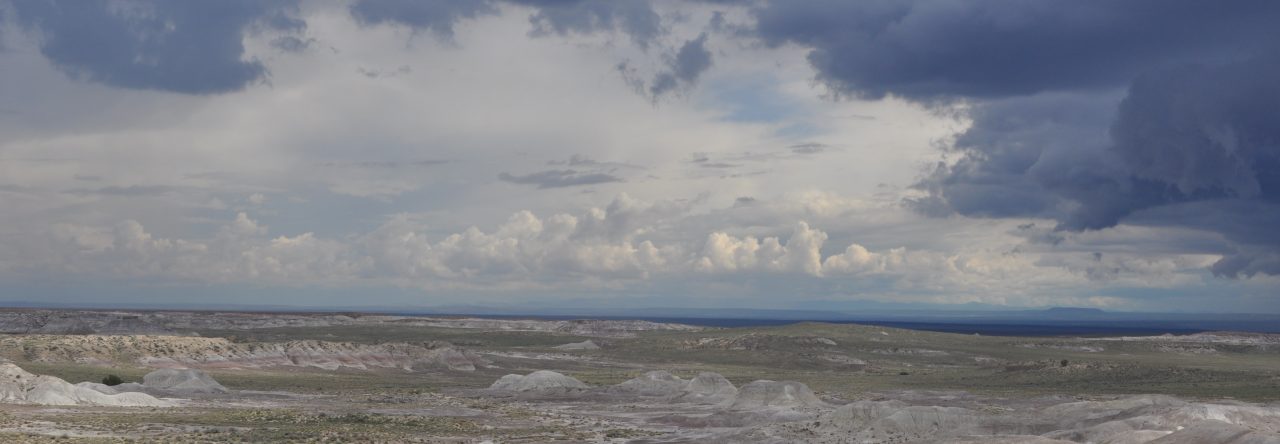
Hopi sunset over Third Mesa

Hopi sunset over Third Mesa, August 7, 2009, Photograph by Matthew Sakiestewa Gilbert

2010 Hopilavayi Forum – Hopilavayit Itam Qasuutokyani

Hopi Summer, 2011 Nominee for OneBookAZ

Several months ago I posted a very positive review of a book by Carolyn O’Bagy Davis titled Hopi Summer: Letters from Ethel to Maud (Rio Nuevo Publishers, 2007). Her book is currently a finalist for the OneBookAZ 2011 award. I have always been supportive of Davis and her work, and Hopi Summer is certainly worthy of this and other awards. If you are a resident of Arizona, and you would like to vote for Hopi Summer, you can do so between September 27 and October 15 at the following website: http://www.onebookaz.org

Matthew Sakiestewa Gilbert

Screening BEYOND THE MESAS at Upper Moencopi

Photograph by Matthew Sakiestewa Gilbert

On Saturday September 18, 2010, I had a special opportunity to screen BEYOND THE MESAS and give a presentation to my family at the village of Upper Moencopi’s Community Center. The screening and presentation were part of the Sakiestewa/Honanie Annual Family Reunion. About 60 people attended the event.

I have screened BEYOND THE MESAS at several universities in the United States, and I have shown it at other locations on the Hopi Reservation, but this was the first time the documentary was screened at Upper Moencopi. The film was well received and it led into a discussion on the benefits and negative consequences of Hopi attendance at off-reservation Indian boarding schools.

After the screening I passed out student case files that I collected at the National Archives in Laguna Niguel, California (now located in Perris, California). The files belong to members of the Sakiestewa and Honanie families who attended Sherman Institute or the Phoenix Indian School from 1906 to the 1940s. Most of the files included school applications, report cards, and handwritten and typed letters.

As a Hopi professor at the University of Illinois I am thankful for the opportunities that I have to bring my research back to the Hopi community. This has always been a driving force behind my work.

Matthew Sakiestewa Gilbert

Scholarship Opportunity: APS Hopi Scholars Program

***HOPI SCHOLARSHIP ANNOUNCEMENT***

Through a partnership with Arizona Public Service (APS), the Hopi Education Endowment Fund (HEEF) and the Hopi Tribe Grants and Scholarship Program (HTGSP) we are pleased to announce a unique scholarship opportunity for Hopi students entitled the APS Hopi Scholars Program. The program will provide eight $3,500 scholarships for 3 seniors, 3 juniors, and 2 sophomores pursuing an AAS, AS, BA or BS at an accredited college or university for the Academic Year (AY) 2010-2011.

In addition to general eligibility requirements, students must submit a Special Scholarship Application and a 1 page essay regarding “Commitment to Community”. The selected students must also perform 40 hours of community service to the Hopi community before the start of the next AY. Applications will be competitive and will be reviewed and awarded by a Selection Committee. If you have any questions please contact the HTGSP at 1-800-762-9630. The deadline is October 1, 2010.

The Application Form can be downloaded HERE

Hopi Education Endowment Fund

PO Box 605

Kykostmovi, Arizona

Phone: (928) 734-2275

Fax: (928) 734-2273

Copyright (c) 2010. Hopi Education Endowment Fund. All rights reserved.

Hopi doctoral candidate to present at Purdue

Hopi filmmaker and photographer at the University of Illinois

Photograph by Matthew Sakiestewa Gilbert

On September 9, 2010,  Victor Masayesva, Jr. from the village of Hotevilla screened a short film and gave a presentation at the University of Illinois at Urbana-Champaign. Masayesva’s visit was part of a university sponsored initiative titled “Sovereignty and Autonomy in the Western Hemisphere: National & Regional Struggles for Power, Identity and Space.” The American Indian Studies Program organized the event.

Masayesva is known throughout the world as an accomplished Hopi photographer and filmmaker. Some of his award winning films include Hopiit, Itam Hakim Hopiit, Ritual Clowns, Imagining Indians, and one of my favorites, Paatuwaqatsi: Water, Land & Life, a film on Hopi running, the sacredness of water, and Hopi relationship with the indigenous people of Mexico.

In addition to directing films, Masayesva has published a book titled Husk of Time: The Photographs of Victor Masayesva with the University of Arizona Press.

To learn more about Masayesva and his work, please visit the following website: http://www.nativenetworks.si.edu/eng/rose/masayesva_v.htm

Matthew Sakiestewa Gilbert

Photographs of the 37th Annual Louis Tewanima Footrace

This slideshow requires JavaScript.

Photographs by Matthew Sakiestewa Gilbert

I arrived at the village of Shungopavi at 5:30 in the morning. A crowd of people gathered at the baseball field. An event volunteer welcomed everyone to the race and gave instructions to the runners.

“The 10K race will begin in 20 minutes” he announced.

A large camera and flash hung around my neck. “Hey, are you with the press?” one man asked. “No, ” I replied, “I am working on a project with the Hopi Cultural Preservation Office on runners. I’m here to photograph the event.”

“The 10K race will begin in 5 minutes” the person behind the megaphone announced.

The runners gathered around the start line. The race had officially begun. Ten seconds later, the runners were gone.

I made my way to the southeast side of the village. The sun had not yet risen over First Mesa. In the valley below, a running trail etched its way through the rocky landscape.

“Any sight of the runners” I asked. “Not yet” a man replied. Everyone waited.

After 25 minutes, the first runner appeared in the distance. It was Hopi runner Juwan Nuvayokva from Oraivi. He ran with ease and strength, showing few signs of fatigue.

On the opposite end of the village 5K runners were climbing their way up the mesa. I arrived to see my father make the final push to the top.

Back at the baseball field the 1 and 2 mile fun runs had started. Children of all ages ran toward the camera.

People clapped and cheered as the youngest runner approached the finish. It was a perfect way to end the race.

Matthew Sakiestewa Gilbert

———————————————

Throughout the week I will be adding more photographs to the slideshow, so be sure to check back.

If you or a family member are pictured in the above slideshow, and you would like a high resolution copy of the photograph, please email me at sakiestewa@gmail.com. I want to also extend a special thanks to Bonnie Talakte, Catherine Talakte, and other event organizers for granting me permission to photograph the 37th Annual Louis Tewanima Footrace on Second Mesa.