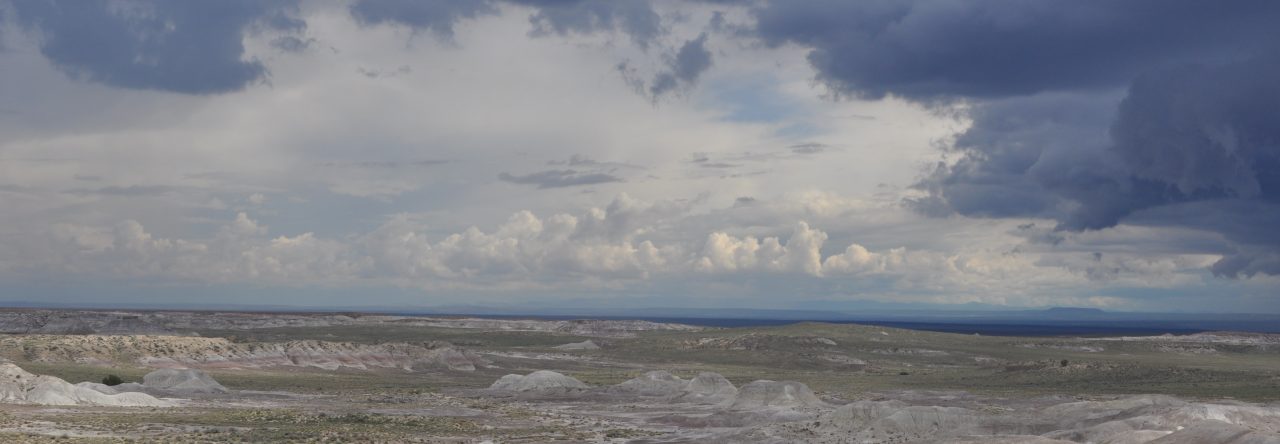
Hopi Footrace on Second Mesa

Louis Tewanima standing with his many trophies and medals. He is wearing his Carlisle track suit. Photo courtesy of the American Indian Athletic Hall of Fame

In less than a week, family members of Hopi runner Louis Tewanima will host the 37th Annual Louis Tewanima Footrace at the village of Shungopavi on Second Mesa. Tewanima is one of the most celebrated runners in Hopi history and he is best known for winning a silver medal at the 1912 Olympic Games in Stockholm, Sweden. As I think about the upcoming footrace, I am reminded of another Hopi footrace on Second Mesa that involved Tewanima.

In a previous post, I wrote about a Hopi runner named Philip Zeyouma who competed for Sherman Institute at the same time Tewanima ran for the Carlisle Indian Industrial School in Pennsylvania. In April 1912, Zeyouma won the Los Angeles Times Modified Marathon of 12 miles, which earned him an opportunity to compete for the U.S. team in Stockholm. On the other side of the country, Tewanima, who by this time had won several running events, was also scheduled to run in the Olympics.

When news that the two Hopi runners would race against each other in Sweden, excitement spread among the students at both schools. Students at Sherman Institute gloried in the thought that one of their Hopi runners would defeat the famous Louis Tewanima, and the pupils at Carlisle had great confidence that Tewanima would outrun the Hopi runner from Sherman. But the showdown between Zeyouma and Tewanima at the Olympic Games in Sweden never took place.

Shortly before Zeyouma was supposed to leave for Sweden, his father expressed disapproval of his son’s participation in the Olympics. Not wanting to disappoint his father, Zeyouma honored his request and went back to the Hopi Reservation for the summer. However, in my article “Hopi Footraces and American Marathons, 1912-1930,” I note that the

rivalry between the two Hopi runners did not cease when Tewanima migrated back to the Hopi mesas as an Olympian. In September 1912, shortly before they returned to their schools, Tewanima and Zeyouma challenged each other to a race on the Hopi Reservation.  On the day of the race, Hopis from the surrounding villages gathered around the starting line and anxiously watched as the two runners made their mark for the twelve-mile course. Zeyouma proudly wore his “Sherman colors,” while Tewanima “appeared in his Carlisle track suit.”

By wearing their running uniforms, the Hopi athletes saw the event as a race between the two schools and identified themselves according to their school affiliation. However, such a display of school loyalty did not go unchallenged by the other Hopi runners in the crowd. Seconds before the race began, some of the older Hopi men remarked that the “boys did not look like [Hopi] runners” at all, and teased Zeyouma and Tewanima for wearing their running outfits. A New York Times reporter noted that when Tewanima heard the men’s insults, Tewanima replied, “If you don’t like our looks get in, and show what you can do.”

The men promptly accepted his challenge and entered the race with no shoes or track suits, and wore “merely discarded” clothes. Six miles into the race, the older men proved too much for the young runners and Zeyouma and Tewanima quit and left the “race to the barefooted runners in the lead.” Coach Joe Shoulder recalled that the winner was about fifty years old, and he looked like he was “dying of consumption” (tuberculosis).

The outcome of the race provides a telling commentary on running in Hopi culture, as well as the relationship between older and younger runners. While the younger runners migrated to off reservation Indian boarding schools, the vast majority of the Hopi people, including older men who were known for the ability to run long distances, remained at home. Consequently, some of the best long-distance runners in U.S. history received little or no attention by those outside of the Hopi community. Although newspaper reporters seemed surprised that men in their fifties had the ability to defeat the younger athletes, the people knew that other Hopis could easily outrun the Hopi Olympian and the track star from Sherman Institute. [“Hopi Footraces and American Marathons, 1912-1930,” American Quarterly, March 2010, vol. 62, no. 1, p. 87, 88]

On Sunday September 5, 2010, runners of various ages will come together to run a footrace on Second Mesa. They will once again make their mark on the start line and run a course similar to the one taken by Tewanima, Zeyouma, and the older runners of the village. In honor of Tewanima, who still inspires thousands of individuals to run, the annual Louis Tewanima Footrace gives testimony to Tewanima’s legacy as an Olympic runner and the continuation of footraces among the people.

Matthew Sakiestewa Gilbert
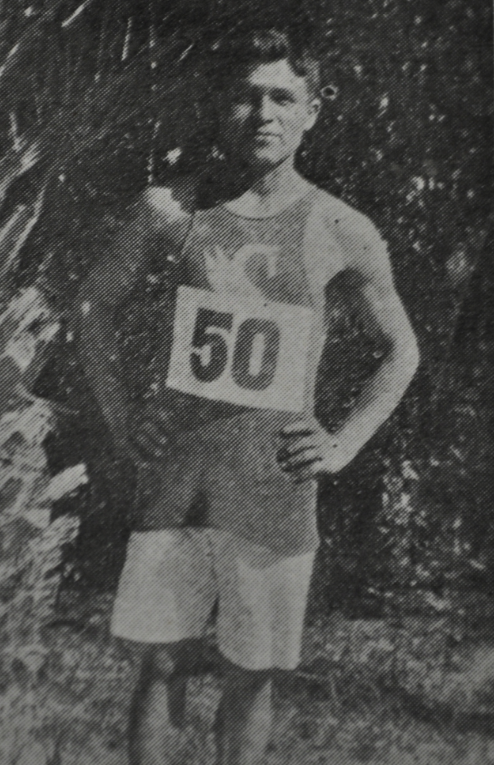
Philip Zeyouma after winning the 1912 Los Angeles Times Modified Marathon. Photo courtesy of the Sherman Indian Museum

Moquis and Kastilam: The Hopi History Project

***ANNOUNCEMENT***

Moquis and Kastilam: The Hopi History Project

Dr. Thomas E. Sheridan and Dr. T.J. Ferguson, both from the University of Arizona, will be presenting information on the Moquis and Kastilam: The Hopi History Project. This project, which has been ongoing for the past seven years, has researched un-transcribed Spanish documents about their presence among the Hopi. Several Hopi interviews will be played as well and there will be time for interaction and viewpoints. This is a collaborative effort between the Hopi Cultural Preservation Office and the University of Arizona, Arizona State Museum. The search for Spanish archival documents have been conducted at the Mexico National Archives, Archives in various Museums in Spain and in Santa Fe, New Mexico. Come hear both scholars as they give an update on the many interesting research findings.

Where: Kykotsmovi Community Building

When: Monday, August 16, 2010

Time: 7:00 p.m. to 9:00 p.m.

For more information contact: (928) 734-3615

Come early to listen to Hopi Oral History interviews on the Hopi-Spanish era conducted by Hopi Cultural Preservation Office Staff. Doors open at 6:00 p.m.

Receive 20% off EDUCATION BEYOND THE MESAS

Receive 20% off each copy of Education beyond the Mesas: Hopi Students at Sherman Institute, 1902-1929, if you order from the University of Nebraska Press. Mention promotion code 6AF10 to obtain the discount. For more information, please click on the following link to download the book’s promotional flyer: Education beyond the Mesas – flyer

Matthew Sakiestewa Gilbert

Photographs of the 2010 Hopi Show

This slideshow requires JavaScript.

Photographs by Matthew Sakiestewa Gilbert

Every year before I attend the annual Hopi Show at the Museum of Northern Arizona in Flagstaff, I intend on taking many photographs of the event. However, once I arrive at the venue, I end up spending most of my time visiting with family, friends and talking to the artists and vendors.

Prior to photographing someone at the Hopi Show, I ask their permission and explain to them how I plan on using their photo. This year I gave people my business card with the BEYOND THE MESAS web address written on the back. I told people that their photo would appear on my blog within the next few weeks.

Many thanks to everyone who agreed to have their picture taken for this post.

Matthew Sakiestewa Gilbert

Hopi radio KUYI 88.1 FM live stream

Photograph by Matthew Sakiestewa Gilbert

Last weekend I attended the 77th Annual Hopi Show at the Museum of Northern Arizona in Flagstaff and spoke with volunteer DJ “Jimbo” (pictured on the left) and Richard Alun Davis (pictured in the center), Station Manager for KUYI 88.1 FM, the official radio station of the Hopi Tribe. They informed me that the radio station is now being transmitted via a live stream on the internet.

In addition to playing a variety of music from rock-n-roll, reggae, country western, and religious selections, KUYI is committed to  broadcasting programs in the Hopi language. Other programs focus on Hopi health, education, farming, and youth.

When I spoke with Davis at the Hopi Show, I asked him if KUYI would be willing to transmit the audio of Beyond the Mesas. He seemed very interested in the idea. Once we finalize the details, I will make an announcement on my blog.

To listen to the live stream of KUYI, please click on the following link: http://www.kuyi.net/listen-online

Matthew Sakiestewa Gilbert

A Hopi runner and his marathon trophy

Photograph by Matthew Sakiestewa Gilbert

Most people who visit the Sherman Indian Museum in Riverside, California, see this first place trophy without knowing who won it. Marathon officials did not engrave the athlete’s name on the trophy, but they did include the date and the event, which was the Vallejo Pre-Olympic National Marathon held in California on December 22, 1929.

At one point in the school’s history, the student’s at Sherman Institute knew who won this award. But as time passed, the trophy, one of the largest in the Museum’s collection, became disassociated from its owner.

The trophy belongs to Hopi runner Harry Chaca from the village of Polacca on First Mesa. He was among the great Hopi runners of the twentieth century. Chaca attended Sherman in the 1920s and early 1930s and he earned several marathon honors while a student at the school.

I wrote about Chaca and his victory of the 1929 Vallejo Pre-Olympic National Marathon in my article “Hopi Footraces and American Marathons, 1912-1930” (American Quarterly, March 2010). I note that prior to this event, Chaca had won other prestigious marathons and his reputation as a great runner spread far beyond the United States.

In Japan, for example, a runner named Yoshikio Sudsuki heard that Chaca was the best runner in America and so he traveled to the U.S. for the sole purpose of competing against the Hopi from Polacca. But at the 1929 Vallejo Pre-Olympic National Marathon, Chaca’s speed and endurance proved too much for the forty-nine year old runner from Tokyo. In my article I write that the

Hopi runner ran at a “killing pace to win” the full marathon in two hours, forty-one minutes, and twenty-five seconds, a “full second better than the performance of Alpien Stenroos” in the 1924 Olympic Games in Paris. One of the fifty thousand spectators of the marathon recalled that Chaca’s “victory” was “all the more noteworthy for his sensational finish. After trailing for twenty-three miles it was at that mark that he applied a final burst of speed that sent him ahead” of Hopi runner Franklin Suhu. In addition to winning the race, Chaca set a new American marathon record, which immediately confirmed his place as the top long-distance runner in the nation. [p. 91]

Shortly after Chaca’s marathon victory, school officials took his trophy and displayed it in a large cabinet located in Sherman’s administration building (now the Sherman Indian Museum). According to school administrators, all individually won trophies belonged to the school.

At times Hopi students attempted to obtain their trophy cups after their terms at Sherman had expired.  During the 1940s, for example, Hopi runner Philip Zeyouma asked the school’s superintendent if he could reclaim his trophies (pictured on the front cover of American Quarterly), but school officials refused to honor his request.

More than eighty years after Chaca won the Vallejo Pre-Olympic National Marathon, his trophy remains at the Sherman Indian Museum. Although government officials consider the award to be property of the Bureau of Indian Affairs, the trophy will always belong to Harry Chaca and his family.

Matthew Sakiestewa Gilbert

Hopi Show at Museum of Northern Arizona

This slideshow requires JavaScript.

Since the 1930s, more than 60 artists have come together each year to sell and demonstrate their art to the public at the annual Hopi Show.  Held on the 4th of July weekend at the Museum of Northern Arizona in Flagstaff, the Hopi Show attracts thousands of visitors from around the world to witness and experience authentic Hopi art, dance, music, and food.

In addition to the artists, several vendors and Hopi organizations such as the Hopi Education Endowment Fund, the Hopi Foundation, and the Black Mesa Trust participate in the event. The show organizers also provide special activities for children, including crafts, ceramics, and an exhibit where kids learn to grind corn and make piki (paper-thin bread) according to the Hopi way.

The above slideshow consists of photographs that I took at the 76th Hopi Show in 2009. This year, the Hopi Show will take place July 3-4. For more information, please click on the following link: http://www.nativeart.net/nativeamericanartshow/indianmarket/hopi-festival-of-arts-and-culture-2010-j0zij5.php

Matthew Sakiestewa Gilbert

Tenure and promotion awarded to Hopi historian

I am pleased to report that Hopi historian Lomayumtewa C. Ishii has been awarded tenure and promotion to Associate Professor of Applied Indigenous Studies & History at Northern Arizona University (NAU).  Ishii received his B.S., M.S., and Ph.D. in history from NAU in 2001.  During his doctoral program, he was also awarded the prestigious Ford Foundation Dissertation Fellowship.

In 2002, Ishii became a postdoctoral fellow of Native Studies at the University of Iowa and a year later he returned to NAU as a Visiting Assistant Professor of Applied Indigenous Studies. He began his tenure track appointment at NAU in 2004.

Ishii has taught courses on various topics, including American Indian history, Native representation, indigenous-centered historiography, and the American Indian post-colonial experience. His scholarship has appeared in several venues, including the Wicazo Sa Review, the Indigenous Nations Studies Journal, and in edited volumes.

For more information, please visit the following website:
http://navajohopiobserver.com/Main.asp?SectionID=1&SubSectionID=1&ArticleID=12475

Matthew Sakiestewa Gilbert

Behind the camera at the Oraivi Footrace

This slideshow requires JavaScript.

Photographs by Matthew Sakiestewa Gilbert

For the past five years, Juwan Nuvayokva, an accomplished Hopi long distance runner, has organized the Oraivi 8K Footrace and 2 Mile Fun Run and Walk on the Hopi Reservation. Both races begin and end in the village of Oraivi on Third Mesa.

Last summer I received permission from Nuvayokva to take pictures of the Oraivi Footrace, which was held on August 9, 2009. When I arrived at the venue, I was informed that the person scheduled to photograph the race was unable to attend, and so the organizers designated me as the “official photographer” for the event.

Some of my pictures are posted on the Oraivi Footrace website, including other photos by George Silas and Lavanya Polacca. The above slideshow includes 41 of the nearly 1,800 photographs that I took of the race.

This year’s Oraivi 8K Footrace and 2 Mile Fun Run and Walk will take place on Sunday August 8, 2010. All individuals are encouraged to participate. There will also be a new race called the 1/2 Mile Kids Dash. For more information, please visit the Oraivi Footrace website at http://oraivifootrace.com/1.html

If you are pictured in the slideshow, and you would like a high-resolution copy of the photograph, feel free to contact me and I will send you the picture via email:   sakiestewa@gmail.com

Matthew Sakiestewa Gilbert

BEYOND THE MESAS film screening at the University of Iowa – April 14, 2010