Legal implications of Hopi Tribal Council vote on SB 2109

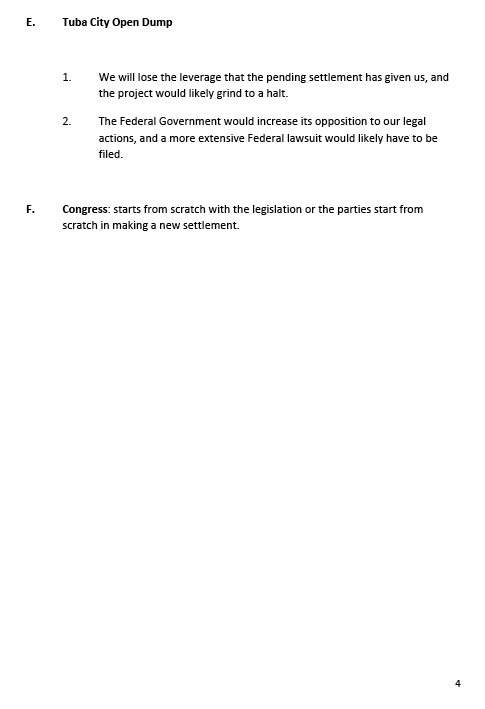
The following Memorandum was written by Hopi Tribe water rights attorneys Richard Monette and Joe Mentor. The Memo was submitted to the Hopi Tribal Council on June 15, 2012, the same day that the Council voted 11-4 to reject SB 2109 by adopting Hopi Tribal Council Resolution No. H-065-2012. The Memo outlines what they consider to be the legal implications for the Hopi Tribe if the Tribe endorses or rejects SB 2109. Click here to download the Memo as a PDF document. Used with permission.

LCR Water Rights Bill Rejected by Hopi – A Report to Hopi People

A message from Benjamin H. Nuvamsa…                            Sunday June 17, 2012

LCR Water Rights Bill Rejected by Hopi – A Report to Hopi People

Attached is a report to members of the Hopi Tribe and to the Hopi Tribal Council on the council meeting held last Friday, June 15, 2012, regarding our Action Item No. H-065-2012.  Our Action Item is to reject the Little Colorado River Water Rights Agreement, S.2109.  Please pass this information on to other tribal members.  Thanks to everyone, we defeated this dangerous bill introduced by Senators Jon Kyl and John McCain regarding our water rights to the Little Colorado River.

Despite this victory, this matter is not over.  Shingoitewa and Mase are still intent on continuing negotiations on this bill, despite what the action item, and now Resolution, No. H-065-2012, mandates.  In fact, Shingoitewa, Mase and Hopi attorneys are talking to and negotiating with Navajo’s attorneys.  Resolution No. H-065-2012 prohibits Shingoitewa, the Water & Energy Team and the Tribal Council from further negotiations on S.2109.  You should know that George Mase has an Action Item, No. H-053-2012, before the tribal council that “endorses” Senate Bill 2109.  But the council’s vote on June 15, 2012, killed Kyl’s and McCain’s bill and deems George Mase’s action item a moot issue; so it should not be addressed by the tribal council.  We are monitoring this matter and will advise you when the council may act on Mase’s action item so you can attend the council meeting.

——————————————

Below is the report that Nuvamsa refers to in his message. You can also download the report as a PDF document by clicking here

June 16, 2012

To: Honorable Members of the Hopi Tribe

Honorable Members of the Hopi Tribal Council

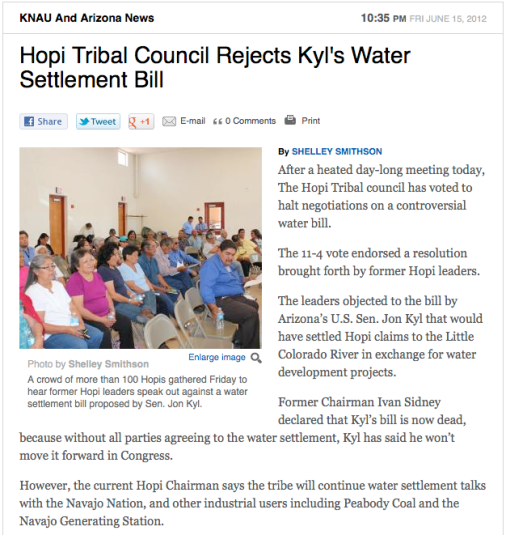
June 15, 2012, was an historic day in the history of our tribe. Hopi village representatives, traditional leaders and tribal members gathered at the Hotevilla Elderly Center and overwhelmingly rejected Senator Jon Kyl’s and Senator John McCain’s Senate Bill 2109, the Navajo-Hopi Little Colorado River Water Rights Settlement Act of 2012. At the end of the long day, the Hopi Tribal Council voted 11 to 4 to pass Action Item H-065-2012 that was endorsed by three former Hopi tribal chairmen and four former Hopi tribal vice chairmen, and sponsored by Vice Chairman Honanie, to reject Senate Bill 2109.

Our Action Item, No. H-065-2012, does several things: (1) it rejects Senate Bill 2109; (2) it prohibits any further negotiations of Senate Bill 2109 by the tribal chairman, Water & Energy Team and the tribal council; (3) it requires the tribal chairman to report the Hopi Tribal Council’s rejection of Senate Bill 2109 to Senator Jon Kyl, to the Congress, Senate Committee on Indian Affairs, and to the Department of Interior; (4) it requires that, if another water rights agreement comes before the tribe, that it will only be decided on by members of the Hopi Tribe through a voter referendum (not the tribal council) after a full and open consultation with and through participation of the villages and tribal members. The council vote also effectively killed the Agreement-in-Principle because without Senate Bill 2109, there is no Agreement-in-Principle.

Not one village, not one tribal member, and not one traditional leader supported Senate Bill 2109. Villages and traditional leaders provided written testimonies, in the form of letters, proclamations and resolutions, all opposing the Kyl/McCain bill. But despite the resounding opposition by the Hopi and Tewa people, there were four votes in opposition to Action Item H-065-2012, most notably by all three representatives from Sipaulovi.

The day did not start without controversy. First, tribal chairman Shingoitewa and Sipaulovi representative George Mase tried to surprise those in attendance by bringing George Mase’s Action Item, No. H-053-2012, to the council floor. But thanks to an objection raised by Kykotsmovi Village Representative Nada Talayumptewa and others, the matter was stopped. Action Item H-053-2012 proposes to endorse Senate Bill 2109.

Next, our request to hold the council meeting in larger facilities was not honored by Shingoitewa, but thanks to former vice chairman Qötsaquahu’s persistence, we forced a vote. After a unanimous vote, we moved the meeting to Hotevilla. Once we convened at Hotevilla, there was yet another attempt by Shingoitewa to exclude the news media. The news media was previously excluded by Shingoitewa in the morning session in council chambers. And again, at the insistence of Qötsaquahu, a vote was taken and the majority vote allowed the news media to stay. But Shingoitewa demanded there will be no recording of the proceedings.

At the outset of the meeting, we insisted that Shingoitewa and the council not control our presentations by limiting what we say and by limiting how long we take to make our presentations. But throughout the entire day, Shingoitewa consistently tried to limit and control our presentations. Because of his constant interruptions and time remaining in the day, many people who traveled from far away and took the time to speak, were not able to address the council. For this, I apologize to these people.

After the presentations, Vice Chairman Honanie made the motion, seconded by Rebecca Masayesva, to approve Action Item H-065-2012. It passed by a vote of 11 to 4. But after the meeting, Hopi chairman Shingoitewa was quoted as saying to the news media, “The tribe will continue water settlement talks with the Navajo Nation, and other industrial users including Peabody Coal and the Navajo Generating Station.” But passage of Action Item H-065-2012 is very specific in prohibiting Shingoitewa, the Water & Energy Team, and the Hopi Tribal Council from any further negotiations of Senate Bill 2109. This statement by Shingoitewa demonstrates his deliberate intention to disregard the voice of the people and would violate the new tribal law passed this day by the Hopi Tribal Council. If he does not abide by the mandate of the villages, traditional leaders and tribal members, and the tribal council, then it would constitute a direct violation of the tribal constitution.

Passage of our action item would now deem George Mase’s Action Item, H-053-2012, a moot issue. But Shingoitewa and Mase are intent on bringing this action item before the tribal council later this month. We encourage you to impose on your council representatives to require George Mase to withdraw his action item. We also encourage everyone to show up at the council chambers when this action item will be discussed and object to the council to act on this action item. Remember this right belongs to the villages, not the tribal council.

In closing, I want to express my deepest, heartfelt appreciation to everyone who participated in this very important issue. This includes all village governments and village leaders who took a stand by issuing proclamations, resolutions, letters; all traditional leaders who issued proclamations, the veterans, allottees, tribal members, and many more. In particular, I want to thank former tribal chairmen and vice chairmen who took personal responsibility to sign the action item and made very compelling arguments to the tribal council. We appreciate the Village of Hotevilla for offering their facility for the meeting. And finally, special appreciation goes to members of the tribal council who voted to support our action item. Your participation and stance against the dangerous Kyl/McCain bill will go down in the annals of our history.

Kwak’wha; Pai’lolmani, 

Benjamin H. Nuvamsa

Shungopavi Village, Bear Clan 

Former Hopi Tribal Chairman 
Hopi Tribal Council votes down SB 2109

Here’s the latest from Shelley Smithson at KNAU. Although this is a big win for those of us who are against the legislation, it’s not over yet. Expect a revised version of SB 2109 to surface in the near future. Kyl and his supporters will not give up that easily.

KNAU NPR runs story on Hopi and SB 2109

Click image to read and listen to full story

Three Hopi villages now formally reject SB 2109

Rosanda Suetopka Thayer of the Navajo-Hopi Observer (NHO) recently reported that in addition to the leadership at Hotevilla, village leaders at Bacavi and now Shungopavi have officially notified Chairman LeRoy Shingoitewa and the Hopi Tribal Council of their disapproval of SB 2109. Momentum against SB 2109 is building back home, and I anticipate similar actions by other villages in the near future. See Thayer’s articles in the NHO:

Shungopavi religious leaders oppose Hopi Tribe’s claim to waive Hopi water rights (June 13, 2012)

Village of Bacavi formally rejects Senate Bill 2109 (June 12, 2012)

Village of Hotevilla formally rejects SB 2109 (May 29, 2012)

Hopi Tumalhoymuy Tutuveniam – June 2012

Click image to download (12 pages)

NO RUNNING ALLOWED

I recently returned from attending the Native American & Indigenous Studies Association conference at Mohegan Sun and Resort. Mohegan Sun is a tribally owned and operated hotel and casino in Uncasville, CT.

The day after I arrived at the hotel I stopped by the Concierge and asked about running paths in the area. The woman behind the desk told me that people were not permitted to run on the roads near the hotel.

She said that if security saw me running outside, they would drive after me, put me in the car, and take me back.

It sounded like fun. But I quickly came to the conclusion that hotel security had better things to do than chase after running Hopis.

Still, I  wonder how long it would have taken the hotel police to catch up with me? Probably not very long.

Officials at Mohegan Sun are not against running. They put the “NO RUNNING” rule in place to protect their guests. According to the Concierge, several runners have been hit by cars, and many of these incidents have been “hit and runs.”

Nevertheless, I found it ironic that I was staying at a hotel on an Indian reservation and not allowed to run outside. But again, they had good reasons for their running policy.

After my conversation with the Concierge, I made my way to the hotel rec room and reluctantly got on a treadmill.

I don’t like running on treadmills.

I wanted to be outside dodging cars and attempting to outrun the police. Instead I was stuck on a machine, watching court t.v., and feeling very little sense of accomplishment.

Village of Hotevilla formally rejects SB 2109 – Story by Rosanda Suetopka Thayer

The following story by Rosanda Suetopka Thayer will be published soon in various newspapers. News of Hotevilla’s formal rejection of SB 2109 is very significant and I hope that other villages will make similar statements in the near future. The official Hotevilla Proclamation and Resolution on SB 2109 is included at the end of this post. PLEASE DISTRIBUTE WIDELY.

————————————————————————–

Village of Hotevilla formally rejects SB 2109

Historical, unprecedented move by ” Hopi traditional” village a first in dissaproving LCR settlement

Story by Rosanda Suetopka Thayer

Exercising its aboriginal sovereignty rights, the “traditional” village of Hotevilla, 3rd Mesa has formally rejected the Hopi tribal approval of SB 2109, making it the first of 12 villages located on the Hopi reservation to formally notify the Hopi Tribal Council of its dissaproval of any further action or legislative movement on its village behalf.

In a formal village meeting held on May 21, 2012, at a regular meeting of the village community, Hotevilla adopted a Proclamation and Resolution directing and mandating that the Hopi Tribal Council reject Senate Bill 2109 – Navajo -Hopi Little Colorado River Rights Settlement Act of 2012 and that “failure” to honor the village directive “shall constitute gross neglect of duty as defined in the Hopi constitution and By-Laws, Article V, section 2.

This Hotevilla proclamation is consistent with the Hopi Appellate Courts Final Decision in the Village of Bacavi’s Certified Question filed in 2010 that traditional Hopi villages retain all aspects of “their inherent aboriginal sovereignty” and that those powers are “outside the scope of authority of the Hopi Tribal Council.

The discussion and approval of this village proclamation was a result of two separate village public meetings held at Hotevilla to educate its village membership on the water issue.

Public meetings were held on March 26th and April 13th, 2012.

The second public meeting on April 13th, the Hopi Tribes’ Water and Energy Team Chair-George Mase, along with Hopi Chairman Leroy Shingoitewa, made their arguments to the village in favor of the settlement agreement and “agreement in principle.”   This meeting was requested by Hotevilla village with the added special condition that no outside tribal attorneys be present and that the Hopi Chairman and his Water and Energy Team present their materials in the Hopi language solely on their own.

This proclamation asserts that the village of Hotevilla has the “inherent sovereign power” to maintain and exercise its rights and powers over all matters and resources belonging to the village and asserts that these rights and powers have “never been delegated to the Hopi Tribal Council.”

The Hopi Constitution and By-Laws does in fact, specifically “admonish” that the Hopi Tribal Council “shall not sell or lease tribal properties which includes water rights.”

Despite protests from Hopi Energy and Water Team Chairman-George Mase at the public meeting who said that “we cannot walk away from this agreement”, the Hotevilla Village Board of Directors, on behalf of its traditional village membership wholly reject SB2109 and “any form of agreement intended to waive, or extinguish our rights to our sacred waters” and directs the Hopi Council to reject the bill.

The formal 3-page village proclamation by Hotevilla is titled, “HV-102-2012” and was signed off on May 21st.

Click to download the Hotevilla Proclamation and Resolution on SB 2109 (4 pages).

Smithsonian to host exhibit on Native Olympic athletes

This Friday May 25, the Smithsonian will open an exhibit titled “Best in the World: Native Athletes in the Olympics.” The exhibit will feature Jim Thorpe, Duke Kahanamoku, Andrew Sockalexis, Billy Mills, and Hopi runner Louis Tewanima of Shungopavi on Second Mesa.

The Smithsonian has a nice write-up about the event on its website:

On the 100th anniversary of the Olympic Games in which athletes Jim Thorpe (Sac and Fox), Duke Kahanamoku (Native Hawaiian), Andrew Sockalexis (Penobscot) and Lewis Tewanima (Hopi) represented the United States in Stockholm, the Smithsonian’s National Museum of the American Indian presents “Best in the World: Native Athletes in the Olympics.” The exhibition opens Friday, May 25.

In 1912, Thorpe swept both the pentathlon and decathlon at the Olympic Games, becoming the first and only Olympian to accomplish such a feat and earning the accolades of King Gustav V of Sweden, who proclaimed Thorpe to be “the greatest athlete in the world.” Thorpe was joined that year by fellow Native teammates Kahanamoku, who won the 100-meter freestyle; Sockalexis, who placed fourth in the marathon; and Tewanima, who won the silver medal and set an American record for the 10,000 meters that stood for more than 50 years until Billy Mills (Oglala Lakota) won the gold medal in Tokyo in 1964.

Louis Tewanima competed in the 1908 (London) and 1912 (Stockholm) Olympic Games. For those who might be interested, I have written an article on Tewanima titled “Marathoner Louis Tewanima and the Continuity of Hopi Running, 1908-1912,” which will appear soon in the Western Historical Quarterly.

Lilian Hill presentation on Hopi Tutskwa Permaculture

This is a 30 minute presentation by Lilian Hill of Kykotsmovi on the great work that she and others are doing in the Hopi Tutskwa Permaculture program. She talks about Hopi farming, orchard keeping, ecological building, sustainability, and many other topics. Also, be sure to check out her article about the program in the Green Fire Times. Here’s additional information on Hopi Tutskwa Permaculture from the Kleiwerks International website:

Hopi Tutskwa Permaculture is a community group based in Kykotsmovi Village within the Hopi Nation in Arizona. Tutskwa means “the life ways and knowledge of the land,” an important part of mission of Hopi Tutskwa Permaculture: to create opportunities for community members to participate in the continuation of Hopi culture.