“Marathoner Louis Tewanima and the Continuity of Hopi Running, 1908-1912” (Western Historical Quarterly, Autumn 2012)

Click to download article (23 pages)

In the summer of 2010, I started writing an article titled “Marathoner Louis Tewanima and the Continuity of Hopi Running, 1908-1912.” The article was recently published in the Western Historical Quarterly (Autumn 2012, Vol. 43.3, pp. 324-346), which is the official journal of the Western History Association.

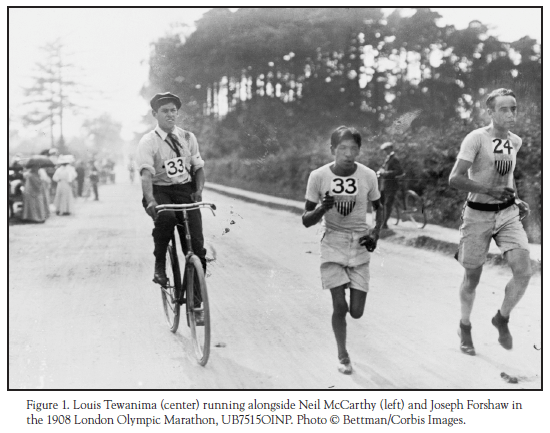
Louis Tewanima was from the village of Shungopavi on the Hopi Reservation in northeastern Arizona. In January 1907, he and ten other Hopis traveled to Pennsylvania to attend the Carlisle Indian Industrial School. While at Carlisle, Tewanima received fame and notoriety by winning several running events, which gave him opportunities to compete in the 1908 (London) and 1912 Olympic Games in Stockholm, Sweden. At the Stockholm Olympics, he won the silver medal in the 10,000 meter race.

Over the years, a number of people, especially non-Hopi individuals, have written about Louis Tewanima. The majority of the scholarly literature on Tewanima is found in Peter Nabokov’s Indian Running or larger narratives on Natives and sports, most notably Joseph B. Oxendine’s American Indian Sport Heritage and John Bloom’s To Show What an Indian Can Do.

Although popular audiences often read Tewanima’s story in newspaper articles, magazines, and books, these publications tend to focus on his participation in the 1912 Olympic Games in Stockholm, and many of them perpetuate a romantic portrayal of Tewanima by retelling accounts of him running after rabbits as a young man and running to Winslow, Arizona, “just to see the trains [go by].”

Contrary to one contemporary writer who noted that Tewanima was “almost totally forgotten,” scholars have remained intrigued by his accomplishments, although they are often overshadowed by accounts of his Carlisle teammate, Sac and Fox athlete Jim Thorpe. While references to Tewanima grace the pages of many articles and books, further studies are needed, particularly ones that interpret his accomplishments within the contexts of Hopi and American sport culture.

In my article I argue that Tewanima’s story represents his ability to redefine Hopi running in the twentieth century and shows how he maneuvered within American and European perceptions of Natives and sports. His participation in running events also tells of a time when white Americans situated indigenous people on the fringes of U.S. society but embraced them when they brought honors to the country by representing the nation in athletic competitions at home and abroad.

Furthermore, Tewanima’s involvement in marathons and Olympic races demonstrates the ways Americans used his success to advance the ideals of U.S. nationalism as he simultaneously continued the long tradition of running among his people.

A number of individuals helped me along the way as I conducted research and revised the article for publication, especially my colleagues in the American Indian Studies Program, and the Department of History at the University of Illinois. I am also thankful for the assistance of various Hopi individuals, including Tewanima’s relatives, the remarkable editorial staff of the Western Historical Quarterly, the Journal’s three anonymous reviewers, and officials with the Hopi Cultural Preservation Office for their support of my work.

If you would like to download a copy of my essay, please visit the following link: http://beyondthemesas.com/wp-content/uploads/2012/09/marathoner-louis-tewanima-and-the-continuity-of-hopi-running-1908-1912-whq-autumn-2012.pdf
Upcoming talk at the Louis Tewanima Footrace Pre-Race Dinner

On Sunday September 2, the Louis Tewanima Footrace Committee will host the annual Footrace at the village of Shungopavi on Second Mesa. This year is a particularly special one as the Committee is organizing the event to commemorate the 100 year anniversary of Louis Tewanima’s silver medal performance in the 10,000 meter Olympic race in Stockholm, Sweden.

In addition to running in the 10K, I have been asked by race officials to speak on Tewanima at the pre-race dinner the night before on September 1. I am scheduled to speak at 7:00PM (MST) at the Shungopavi Community Center. The pre-race dinner is free and open to the public. For more information on the Footrace, and to obtain registration materials, please visit the following website: http://tewanimafootrace.org/

THE ARIZONA REPUBLIC: “Hopi Tribe unfairly blamed in water-settlement collapse” by LeRoy N. Shingoitewa

The following letter is an opinion piece that Hopi Tribe Chairman LeRoy Shingoitewa published in The Arizona Republic on August 27, 2012. http://www.azcentral.com/arizonarepublic/opinions/articles/20120823hopi-tribe-water-settlement-collapse.html

Hopi Tribe unfairly blamed in water-settlement collapse

by LeRoy N. Shingoitewa

I was disappointed to see the Hopi Tribe’s position on the Little Colorado River water settlement so badly mischaracterized in a Viewpoints column written by U.S. Sens. Jon Kyl and John McCain (“An endless water fight,” Aug. 12).

The settlement would resolve the rights of many parties to water in the Little Colorado’s basin and was reached after 13 years of negotiations between the Hopi Tribe, the Navajo Nation, and numerous federal and state parties.

I am acutely aware of the need for water for our people. More than 40 percent of the homes on the Hopi Reservation have no running water or indoor plumbing. Many Hopi villages receive water with more than four times the allowable levels of arsenic. Water for another village is threatened by uranium pollution. We participated in the settlement negotiations to resolve these problems. There are no Hopi Tribal Council representatives who prefer litigation over settlement.

Despite our support for the settlement, the Hopi Tribal Council also voted to oppose certain provisions in Kyl’s implementing legislation that are extraneous to the water-rights settlement. Specifically, the Council objected to provisions requiring the Navajo Nation to provide water for the Navajo Generating Station or to renew coal-mining leases. Hopi negotiators did not participate in “crafting” these sections.

While these issues are very important, they are not related to ensuring an adequate, sustainable supply of water for our people. Combining these two issues was both unwise and unnecessary.

We informed Kyl of our objections when he joined these two issues. We also communicated the reasons for our position on the proposed legislation. Prior to his column, we submitted suggestions to make the legislation consistent with the settlement agreement. We asked him to remove provisions from the legislation that have nothing to do with the water settlement and to clarify ambiguities in the legislation to comport with assurances we received during the negotiating process. Unfortunately, we have yet to receive a response.

Kyl and McCain unfairly blame the tribes for rejecting the settlement, even though on July 5 the Hopi Tribal Council voted to approve the settlement. All the parties to the settlement negotiations are responsible for the outcome, not just the Hopi Tribe. The state and private parties, who spent millions of dollars on legal fees for the negotiations, will have to answer to their ratepayers and customers for what is now a failed settlement.

Unfortunately, it appears Kyl and McCain have given up hope of enacting legislation to implement the settlement. We are disappointed.

I suspect many of the private parties in northeastern Arizona — who negotiated long and hard for the certainty they desire — are equally disappointed that their interests were overwhelmed by the generating station. After all, none of the power produced by the generating station is consumed in our region. It all subsidizes the pumping of Central Arizona Project water to Phoenix and Tucson.

With all due respect to Kyl, if he had not insisted on including the generating-station issue, the water settlement would be final and on its way to enactment.

I thank Arizona’s senators for their efforts to promote the settlement. In recognition of his impending retirement, I’d also like to thank Kyl for his service to the people of Arizona and wish him well in future endeavors.

The Hopi Tribe stands ready to work with his successor and Arizona’s congressional delegation to solve our water concerns, as well as those of our neighbors. The generating station should be dealt with separately, however, in recognition of the fact that it is a separate issue.

LeRoy N. Shingoitewa is chairman of the Hopi Tribe.

Hopi Tumalhoymuy Tutuveniam – August 2012

Click image to download (6 pages)

Indian Country Today: The Summer Games Are the Native Games

On July 31, Indian Country Today published a nice write-up on past Native athletes and the Olympic Games. Scroll down on the article to read about Hopi runner Louis Tewanima.

Image
Click image for full story

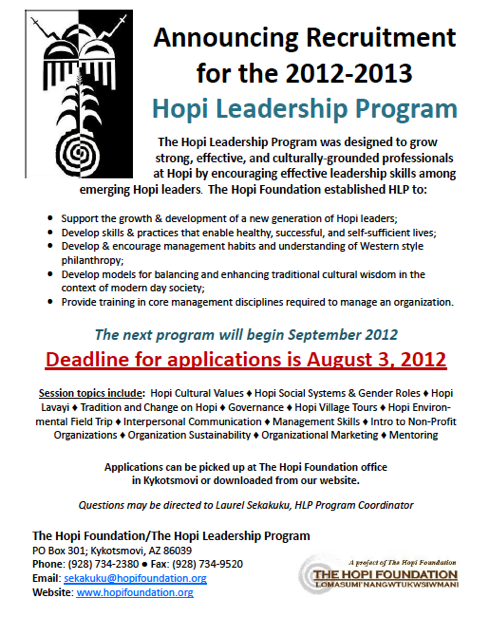
Applications sought for 2012-2013 Hopi Leadership Program

Please click here for the 2012-2013 Hopi Leadership Program application form (12 pages).

Criticism over distribution of Hopi Tribe LCR Settlement Agreement “Fact Sheet”

UPDATE July 15, 2012: On Saturday I noted that the following responses from Benjamin H. Nuvamsa and Rosanda Suetopka Thayer focused on Micah Loma’omvaya’s (Hopi Chief of Staff) role in distributing last week’s Hopi Tribe LCR Settlement Agreement “Fact Sheet“. I now realize that their comments refer to a Press Release that the Hopi Tribe issued on July 12 surrounding Rosanda Suetopka Thayer’s efforts to remove Chairman Leroy Shingoitewa from office. Click here for a copy of the Press Release. I apologize for the confusion.
—————————————————
Benjamin H. Nuvamsa, July 13, 2012
There seems to be certain amount of credence placed recently by the local news media on comments, quotes, etc. from staff (political appointees) other than directly from the Hopi tribal chairman Leroy Shingoitewa, particularly concerning the current water rights debate.  Be advised that we do not place any credence or credibility on comments made by Shingoitewa’s staff, like comments by Micah Lomaomvaya.  Micah is not tribal chairman, vice chairman; and therefore has no authority to speak on behalf of the Hopi Tribe.  He has no authority to be issuing press releases, or making comments on any matter in the papers.  Those authorities are vested in the tribal chairman.  Those authorities and protocols are similar to the Office of the President of the United States.  We do not see any press releases, nor comments coming out of Vice Chairman Honanie’s office, because he understands and respects the proper delegations of authority.  He understands the protocols and when it is an appropriate time to issue statements on behalf of his office, or on behalf of the tribe.  Thank you.
———————————————–
Rosanda Suetopka Thayer, July 13, 2012
“Its truly unfortunate and completely unprofessional that Micah Loma’omvaya, chief of staff for Mr. Shingoitewa, without formal Hopi Council authorization to release such a ill-informed press statement regarding the Hopi and Tewa grassroots movement to remove Shingoitewa for serious neglect of duty.
Only the Hopi Tribal Council through formal action or the Hopi chairman with council authorization can speak on behalf of the tribe, not a politically appointed staff member like Loma’omvaya.
For me personally, Loma’omvaya’s release shows the level of paranoia, intimidation and lack of signature accountability, that Shingoitewa has created and fosters at the Hopi Tribe against anyone who opposes him, including all members of the media, tribal or non-tribal.
This has been evidenced by Shingoitewa’s refusal to allow reporters into local publicly posted Hopi council meetings over his past two years in office including the Hopi Tribes’ own newspaper, the Hopi Tutuveni, which is the only local and free news medium available to Hopi community members for public information.
No community member, enrolled or un-enrolled is safe from Shingoitewa and his supporters, especially after such a heated public battle where clearly the Hopi and Tewa people did not support Shingoitewa’s LCR settlement proposal and in which Shingoitewa continues to try and re-visit an already dead tribal water issue.
The “Shingoitewa Removal” public meeting slated for Saturday, July 14th at the First Mesa Consolidated villages community will still move forward with the full open support of Hopis and Tewas who want Shingoitewa removed from office for serious neglect of duty.”

The Hopi Tribe Fact Sheet and FAQ on Navajo-Hopi Little Colorado River Water Rights Settlement Agreement

Thanks to Micah Loma’omvaya, Chief of Staff for the Hopi Tribe, for sending me the following documents to post on BEYOND THE MESAS. Click images to download.

The Hopi Tribe Fact Sheet on LCR Settlement Agreement, July 10, 2012- Click image to download (2 pages)
Hopi Tribe LCR Settlement Agreement FAQ, May 1, 2012 – Click image to download (9 pages)

Hopi professor will bike for Hopi Cancer Assistance Fund

Angela Gonzales (Hopi), Associate Professor of Development Sociology and American Indian Studies at Cornell University, has started a new blog to chronicle her goal of raising $10,000 for the Hopi Cancer Assistance Fund (HCAF).

To promote interest in her quest, Angela will bike 1,539 miles from Bellingham, WA, to Ventura, CA, beginning September 25, 2012.

Learn more about Angela’s motivation to raise support for the HCAF by visiting her blog, Angela Bikes 4 Hopi. Also, please consider giving financially to this worthy cause.

Thanks for spreading the word!

PRESS RELEASE: Hopi Tribe Endorses Historic Little Colorado Water Rights Settlement

While the following press release notes that the “Hopi Tribe” endorses the Little Colorado Water Rights Settlement, opinions and policies passed down from the Hopi Tribe do not reflect the opinion of all Hopi people or villages. Many Hopis are against SB 2109 and the Little Colorado Water Rights Settlement that Hopi Chairman LeRoy Shingoitewa proposes here. Keep an eye on this space, as Hopi responses are sure to follow.

————————–

FOR IMMEDIATE RELEASE Contact:
The Hopi Tribe, Office of the Chairman
Chief of Staff
Phone: (928) 734- 3106
Fax: (928) 734-6665

Hopi Tribe Endorses Historic Little Colorado Water Rights Settlement

Kykotsmovi, Ariz. (June 21, 2012) – The Hopi Tribal Council voted today to endorse a  proposed water right settlement for the Tribe’s Little Colorado River water right claims.  The  proposed settlement would end decades-long water rights adjudication and is the first step in  ensuring a dependable supply of clean water for the Tribe.  “I am greatly pleased by the  Council’s decision,” stated Hopi Tribal Chairman LeRoy Shingoitewa.  “For the first time since
our reservation was established we will be able to guarantee clean, reliable water supplies for our people.”

Council Representative George Mase, Chairman of the Tribal Council’s Water and  Energy Team, agreed with Chairman Shingoitewa’s assessment:  “After talking to the Hopi  people and hearing their concerns, it is clear that the people want a clean and reliable water  supply.  Our team negotiated for years to reach a settlement, and I am pleased that the Council  decided to endorse the settlement.”

The Hopi Tribe has claimed reserved water rights from four sources:  on-reservation surface water and groundwater, surface water from the Little Colorado River, and surface  water from the mainstem Colorado River. The proposed settlement would confirm the Hopi  Tribe’s rights to on-reservation surface water and groundwater, reserve a quantity of water from the mainstem Colorado River for a future settlement the Hopi Tribe’s mainstem water  rights claims, provide for the development of essential on-reservation water delivery infrastructure, and establish a framework for the sustainable management of the N-Aquifer  which is currently threatened by unmanaged pumping.  In return, the Tribe would waive its  claims to the Little Colorado River and its damages claims for injuries to water rights or water quality that occur before the settlement goes into effect.

“The Little Colorado River is by far the least reliable of our four potential water sources,” explained Councilman Mase.  “This is a fair tradeoff.”

Chairman Shingoitewa agreed with Councilman Mase’s assessment.  “We are confident the benefits for the Hopi Tribe outweigh the risks of continued litigation,” explained Chairman Shingoitewa. “The settlement proposal provides a path to ensure a lasting supply of clean water for both tribes. Hopefully the Navajo Nation will endorse the settlement as well.”

In order to become effective, Congress also must ratify the settlement and appropriate funds for the development of projects specified in the settlement.  The Hopi Tribal Council voiced its concerns about the proposed federal legislation, which was introduced before the agreement was reached.  The Council has previously instructed Chairman Shingoitewa and Water and Energy Team’s Chairman Mase to co-sign a letter to Senators Kyl and McCain asking for changes in their proposed legislation.  Specifically, the Tribal Council will be asking Senators Kyl and McCain to remove provisions related to the Navajo Generating Station and other items contained in the federal legislation.

“These provisions have nothing to do with our settlement,” explained Chairman  Shingoitwea.  “Therefore, we are asking Senators Kyl and McCain to remove them from the settlement legislation.”

The Hopi Tribe also will seek support for solutions to address water contamination at Moenkopi, First Mesa, and Keams Canyon.  “These are important outstanding issues,” said Councilman Mase.  “We aren’t waiting for the proposed Hopi Groundwater Project to get them resolved.”

Finally, if the proposed settlement is enacted, the Hopi Tribe will pursue its claims to mainstem Colorado River water to ensure a permanent homeland for the Tribe.  “Our claims to water from the mainstem Colorado River are not affected by this settlement,” explained Councilman Mase.  “We will pursue these once the Little Colorado River settlement is ratified by Congress.”

For more information about the settlement, visit the Hopi Tribe’s website at http://www.hopi-nsn.gov/, or call the Office of Chairman, at (928) 734-3106.
# # #