Important issues facing the Hopi Tribe

The following post was written and provided by Benjamin H. Nuvamsa….

There are several very important issues currently facing our tribe, but no one from the tribal administration is sharing them with our villages, traditional leaders, and tribal members.  These issues have potentially long lasting and devastating impacts on our tribe.  There are other issues that the current tribal administration is doing, or has done, but tribal members have no knowledge of them.  If you are interested and want to hear about these issues, come to the Hopi Cultural Center on Thursday at 5:00 p.m. for an evening of discussion and dialogue.  We are at a very critical juncture in the history of our tribe that I believe everybody should know what direction the current tribal administration is taking our tribe.  Some of the issues we will discuss include.

1.       Revised Senate Bill 2109 (and House Resolution 4067) “Navajo and Hopi Little Colorado River Water Rights Settlement Act of 2012”.  Despite the overwhelming rejection of this bill by our villages, leaders and tribal members, Leroy Shingoitewa & certain members of the Water & Energy Team are continuing to negotiate this legislation and the Settlement Agreement.  In fact, they are in Washington, DC this week in meetings with Department of Interior Secretary Ken Salazar and Navajo Nation officials.  We recently received a copy of proposed changes to S.2109 that Shingoitewa and his attorneys have been secretly negotiating without our knowledge and approval.  Secretary Salazar and some tribal officials have indicated they want to push this legislation for passage during the lame duck Congress (before the end of this year).  We, past elected tribal leaders, have written to the tribal council to direct Shingoitewa to cease the negotiations and comply with Resolution H-072-2012.  And I sent a letter to Secretary Salazar (with copies to Senator Akaka, Senator Kyl, Senator McCain, Assistant Secretary-Indian Affairs Washburn) that Shingoitewa and the tribal council do not have authority to negotiate and give away our water rights.

2.       Hopi LCR Water Rights Claim in the Apache County Superior Court.  There was a hearing recently in Phoenix on Hopi’s water rights claim to the Little Colorado River.  If Shingoitewa and his team continue with their negotiations of S.2109, any agreements on S.2109 by Shingoitewa may compromise the claim our tribe filed several years ago in the Apache County Superior Court (Little Colorado River Water Rights Adjudication).  What will be the impacts on our aboriginal rights, Spanish law rights, and Federal reserved rights; and what will we lose, if S.2109 is passed into law?

3.       Mishongnovi Case (Tribal Court No. 2011-CV-0023; Appellate Court No. 2012-AP-0002).  Recently the Hopi Appellate Court sent out invitations to villages and others to file Amicus Briefs in a case that may impact the traditional leadership and governance in our villages.  It is vitally important that village leaders are made aware of this issue and that they consider filing their respective Amicus Briefs on behalf of their villages.  You remember the Hopi Appellate Court issued its ruling on the Bacavi Certified Question  in February 2010.  This was an important and historic ruling for our Hopi and Tewa villages.  The Mishongnovi case could have even more significant impacts on our traditional villages.  It is really important that all villages, traditional leaders and others file their briefs to the appellate court before the deadline expires.

4.       RICO Lawsuit Settlement.  In June 1999 the Hopi tribe joined in the Navajo Nation’s lawsuit against Peabody Energy, Southern Cal Edison and Salt River Project for price fixing scheme against the tribes on coal royalties, and breach of coal leases under a law called Racketeering Influenced & Corrupt Organizations (RICO) Act.   Navajo Nation demanded a 20% royalty for its coal but ended up only with a 12.5% rate.  Under RICO, Navajo could potentially claim treble damages (three times) of up to $1.8 billion.  But in August 2011, the Navajo Nation agreed to a settlement for much less than its claim ($600.0 million claim originally filed).  Shingoitewa and Lyttle agreed to a settlement without the knowledge and approval of the Hopi tribal council and the Hopi people.  Questions remain as to: What happened to the settlement funds? What did Hopi give up by accepting the money? What were Robert Lyttle’s fees? Did Shingoitewa agree to certain waivers and release of claims against the Defendants (e.g. release of claims for over-pumping of the N-aquifer)?  The Shingoitewa administration have, so far, refused to answer these and other questions raised by Council Representative Becky Masayesva.

5.       Robert Lyttle.  The tribal council recently voted, by a secret ballot, to hire Robert Lyttle as In-House Counsel to the Hopi Tribal Council.  In doing so, they purposely overlooked a highly qualified Hopi tribal member who, along with others, applied for the job opening.  Robert Lyttle did not apply for the job but was selected by Shingoitewa’s supporters on tribal council in a secret ballot vote.  Back in May 2010, Robert Lyttle entered into a contract with Shingoitewa at a time when he was not admitted to the Arizona State Bar; and at a time when there was no “Law Firm of Robert Lyttle” (in fact, there is no Robert Lyttle Law Firm), and despite the requirement for a “law firm” in the contract he signed, and the Council Resolution the tribal council passed.  Since then, millions of the tribe’s money have gone to Robert Lyttle and his purported “law firm”.  The other attorneys who purportedly are partners or members of his “law firm” are members of other law firms.  How much money has been paid to Robert Lyttle?  What work did they perform?  Are there legal contracts between the Hopi Tribe (approved by tribal council) and all of Lyttle’s attorney friends who purportedly work in his “law firm”?  What funds were used to pay Lyttle?  We all have a right to have these, and other questions, answered by the Shingoitewa (and the Treasurer).

6.       Tribal Fiscal Year 2009 Audit.  The tribal council recently approved a Fiscal Year 2009 audit performed by Walker & Armstrong.   The audit firm has worked for the tribe for a long time and may have violated several auditing standards (rules).  They may have violated conflicts of interest rules by acting both as auditors and consultants.  In the audit report, the firm evaluated tribal investments, investment risks, investment quality, past and future investment performance.  This goes well beyond and outside the scope of the audit.  So the question is, did Walker & Armstrong violate Generally Accepted Accounting Principles, Generally Accepted Auditing Standards, and Financial Industry Regulatory Authority (FINRA)?  Walker & Armstrong was deeply involved in the former Treasurer Russell Mockta matter and tribal investments; and may have certain vested interests to continue working for (auditing) the tribe.

7.       Miscellaneous. There are several other issues, such as the APS Right-of-Way, Law & Order Code, Snow Bowl, Grand Canyon Escalade Project, Shingoitewa’s new effort to revise the Hopi Constitution, etc., that will be briefly addressed.

These are only a few issues that face our tribe.  We just want to share them with you for your information since this administration is not keeping us informed.   What you (we) do about them is entirely up to tribal members.  Thank you.

Chancellor’s Postdoctoral Fellowships in American Indian Studies, University of Illinois at Urbana-Champaign, 2013-2014

American Indian Studies at the University of Illinois Urbana-Champaign seeks two Postdoctoral Fellows for the 2013-2014 academic year. This fellowship program provides a stipend, a close working association with AIS faculty, and assistance in furthering the fellow’s development as a productive scholar. Applicants should have an ongoing research project that promises to make a notable contribution to American Indian and Indigenous Studies. While fellows will concentrate on their research, they may choose to teach one course in American Indian Studies. Furthermore, fellows are expected to participate in the intellectual community of the American Indian Studies Program. One of the positions may be renewable for a second year.

Stipend and Benefits: The Fellowship stipend for the 2013-2014 academic year is $42,000, including health benefits. An additional $5,000 will be provided for the fellow’s research, travel, and related expenses.

Minimum Qualifications: Ph.D. or equivalent terminal degree is required. Candidates must have completed all degree requirements by August 15, 2013. Preference will be given to those applicants who have finished their degrees in the past five years. The one-year fellowship appointment period is from August 16, 2013, to August 15, 2014.

To Apply: Create your candidate profile through the University of Illinois application login page at https://my.atlas.illinois.edu/submit/go.asp?id=538 and upload your application materials:

Candidates should submit a letter of application providing a thorough description of the research project to be undertaken during the fellowship year, a curriculum vitae, two samples of their scholarly writing, and two letters of recommendation.

Applications received by January 18, 2013 will receive full consideration. The review process will continue until the fellowships are filled. For further information, contact Matthew Sakiestewa Gilbert, Chair, Chancellor’s Postdoctoral Fellowship Committee, American Indian Studies: Phone: (217) 265-9870, Email: tewa@illinois.edu, or visit the Program’s website at http://www.ais.illinois.edu.

The University of Illinois at Urbana-Champaign is an Equal Opportunity Employer (www.inclusiveillinois.illinois.edu).

“Hopi Running” – University of Illinois, Springfield, Nov. 5, 2012, 7PM

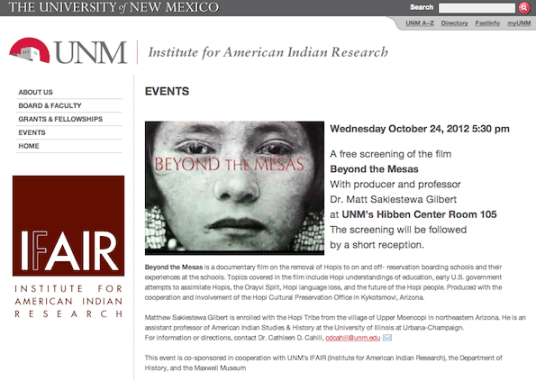
Beyond the Mesas to screen at UNM – October 24, 5:30PM

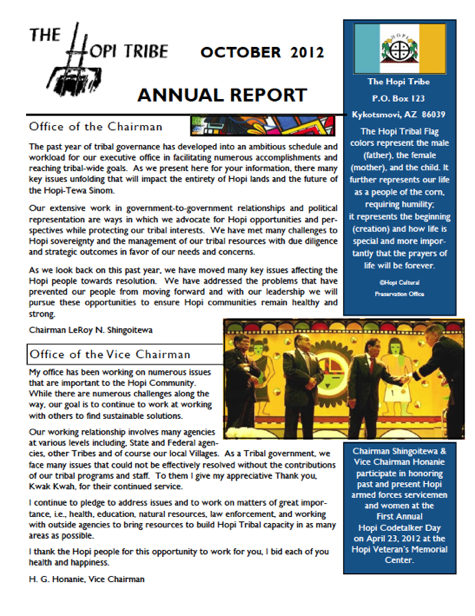
The Hopi Tribe Annual Report, October 2012

Click to download (4 pages)

NEWS RELEASE: Hopi Leaders Strongly Oppose Development of the Grand Canyon Escalade

FOR IMMEDIATE RELEASE

October 5, 2012

HOPI LEADERS STRONGLY OPPOSE DEVELOPMENT OF

THE GRAND CANYON ESCALADE

Kykotsmovi, Ariz. – At a recent Tribal Council meeting, Hopi leaders unanimously agreed to approve Resolution H-113-2012, in which they formally state their position to strongly oppose the development of a commercial initiative at the Grand Canyon called the “Grand Canyon Escalade”.

The Hopi people continue to have connections to their ancestral past, including the landscapes, ruins, ceremonial trails, shrines, springs and rivers. The Hopi and many other southwestern Tribes, as well as members of the Navajo Tribe, hold the Grand Canyon (Öngtupqa) and its cultural contributories, a sacred place of reverence and respect. Hopi religious leaders and the Hopi people in general, also strongly oppose this development

“The Canyon is still regularly visited by Hopis to deposit prayer offerings in the area of the confluence, so this development will adversely affect the sacredness of this special place”, said Leigh Kuwanwisiwma Director of the Hopi Tribe’s Cultural Preservation Office. “Because of the significance of Öngtupqa, it is extremely important for the Hopi people to preserve and protect this area from harm and wrongful exploitation.”

Hopi Vice Chairman Herman G. Honanie said “the proposed development located at the confluence is unacceptable to Hopi religious leaders, practitioners and the Hopi people as it will significantly and forever adversely impact Hopi sacred places to which Hopis have aboriginal title and use”.

“This development will forever compromise the tranquility and sacredness of all the surrounding area. The Hopi people and the Hopi Tribal Council strongly oppose the development of the Grand Canyon Escalade and will continue to advocate for protection of Öngtupqa and all its elements” said Hopi Chairman LeRoy N. Shingoitewa. “The Hopi Tribal Council calls upon the Pueblo of Zuni, Navajo People, and other tribes to which the Grand Canyon is sacred, the National Congress of American Indians, Inter-tribal Council of Arizona, All Indian Pueblo Council and the National Park Service to join in opposing this development and collectively support legislation to protect the Grand Canyon and other Native American sites”. 

Confluence Partners LLC, represented by Albert Hale and supported by Navajo President Ben Shelly, proposed the development of the Grand Canyon Escalade to include a river walk and restaurant at the bottom of the Grand Canyon confluence, where the Colorado and Little Colorado Rivers meet. A main feature of the proposed development is to build a luxury resort/spa at at the northeast rim along with a tram which would take tourists down to the river and stop at the restaurant. A river walk will give a view of the confluence.
# # #

See also “Hopi Tribe Formally Opposes Little Colorado Resort and Tramway Project” (KNAU): http://knau.org/post/hopi-tribe-formally-opposes-little-colorado-resort-and-tramway-project

PLEASE DONATE NOW to Hopi professor’s bike ride to raise money for Hopi Cancer Assistance Fund

I’m writing to follow-up on my earlier post about Dr. Angela Gonzales’s bike ride to raise money for the Hopi Cancer Assistance Fund. Angela is both a tribal member and a Professor at Cornell University working with the Hopi Tribe to develop educational interventions to increase cervical cancer screening among Hopi women.

After months of planning, it’s almost time for her to begin her 1,539 mile bike ride down the Pacific Coast. I’m writing to ask you to consider making a donation in support of her effort to raise $10,000 for the Fund.

Angela has been working in partnership with The Hopi Foundation and the Hopi Cancer Assistance Fund and has raised over $5,000. With your assistance I am certain she can reach her goal of $10,000.  You can donate online with a credit or debit card at http://www.razoo.com/story/Hcaf.  If you prefer to donate by check or money order, you can find instructions on how to do so on her blog, Angela Bikes 4 Hopi.

All donations are tax-deductible and 100% of the proceeds raised will directly benefit Hopi cancer patients and their families.

Throughout the ride Angela will post periodic updates and photos to her blog.  I encourage you to bookmark the page so you can check in on her progress.  She made a couple of recent posts to the blog, including an interactive Google map that shows the route she will be riding and the places she will staying.

Thank you for considering a donation in support of Angela’s effort to raise money for the Hopi Cancer Assistance Fund.  I know that the best advertising is by word of mouth, and so in addition to your own donation I would like to ask you to pass this message on to at least three of your closest family members, friends, or work colleagues who might be interested in contributing.

Please also consider sharing this post on your Facebook page, Twitter feed, blog, and other social networks.

Working in the spirit of nami’nangwa and sumi’nangwa, we can help Angela meet (and hopefully exceed) her $10,000 fundraising goal for this great cause.

JOB ANNOUNCEMENT: Assistant or Associate Professor of American Indian and Indigenous Studies at the University of Illinois at Urbana-Champaign

Please see the following job announcement for an Assistant or Associate Professor of American Indian and Indigenous Studies at the University of Illinois at Urbana-Champaign.

https://jobs.illinois.edu/academic-job-board/job-details?jobID=24751&job=college-of-liberal-arts-and-sciences-assistant-associate-professor-american-indian-studies-f1200131

Job Details
Category: Faculty and Other Academic
Description:

Assistant or Associate Professor of American Indian and Indigenous Studies  

The American Indian Studies Program at the University of Illinois, Urbana-Champaign (http://www.ais.illinois.edu) invites applications for a tenure-track assistant professor or tenure-eligible associate professor with a target start date of August 16, 2013.  Salary is competitive and commensurate with experience.
American Indian Studies is searching for a scholar in interdisciplinary American Indian or Indigenous Studies. While fields and regions of coverage are open, evidence of innovative transnational, comparative, creative, or interdisciplinary approaches to American Indian or Indigenous studies is preferred. The successful candidate will have a record of research excellence and publication in American Indian or Indigenous studies (tenured) or demonstrate potential to develop such a record (tenure-track). Along with research and publication, the position requires significant contributions to undergraduate teaching, graduate mentoring, and program, university, and other forms of professional service. Current program faculty conduct research in comparative Indigenous studies, media studies, expressive culture, intellectual history, literary history, educational history, sports, social and political theory, language revitalization, policy, governance, health, militarization, and performance, and the search committee will be interested in candidates who can complement those areas. A joint appointment or teaching arrangement with another academic unit on campus is likely.
Minimum qualifications include the PhD or equivalent by the start of appointment, clear knowledge and experience in American Indian and Indigenous studies, scholarly achievement and promise, and evidence of teaching excellence. Experience working with American Indian or other Indigenous communities is a plus.
To ensure full consideration, create your candidate profile through https://jobs.illinois.edu and upload your letter of application detailing current research plans, curriculum vitae, and contact information for three references by October 26, 2012.  For inquiries regarding the position, contact search committee co-chairs, Jodi Byrd (jabyrd@illinois.edu) and Vicente Diaz (vmdiaz@illinois.edu).
Illinois is an Affirmative Action /Equal Opportunity Employer and welcomes individuals with diverse backgrounds, experiences, and ideas who embrace and value diversity and inclusivity. (www.inclusiveillinois.illinois.edu).
College Name or Administrative Unit: College of Liberal Arts and Sciences
Title: College of Liberal Arts and Sciences- Assistant/Associate Professor-American Indian Studies (F1200131)

“Tracking Tewanima” by Cindy Yurth of the Navajo Times

On September 1st I traveled back home to deliver a talk on Louis Tewanima at the Louis Tewanima Footrace Pre-Race Dinner. A reporter for the Navajo Times named Cindy Yurth was present in the audience, and recently published a story about the gathering. A special thanks to Yurth for granting me permission to republish her article on my blog.

————————————–

Tracking Tewanima

Centennial footrace draws record crowd to mesas

By CIndy Yurth

Tséyi’ Bureau

SHUNGOPOVI, Ariz. — Louis Tewanima may be the most celebrated Hopi runner, but he himself would have admitted he was not the fastest, a Hopi historian told the crowd gathered Saturday night for a celebration of the centennial of Tewanima’s bringing home an Olympic silver medal to this tiny but spectacular hamlet on top of Second Mesa.

The fastest Hopi ever was probably some unheralded farmer who never had a chance to go to school — or was forced to, as Tewanima was.

Still, Tewanima was the one who brought home the medal, and this past weekend Hopis along with well-wishers from around the world celebrated the centennial of that feat with footraces of varying lengths along some of the very trails Tewanima himself once graced.

“It was great to follow in his footsteps,” said the second-place finisher in the commemorative 10K race, 16-year-old Kyle Sumatzkuku of Moencopi and Mishongnovi. “I look up to him, even though he was even smaller than me.”

Sumatzkuku is not a large person by any means, but he’s probably correct in assuming Tewanima was smaller. Tewanima was 5-foot-4 1/2 and 115 pounds, according to Illinois University Professor Matthew Sakiestewa Gilbert, who gave the historical address Saturday night. In the press of his day, he was referred to as “the little Hopi redskin.”

This past weekend, though, he was everywhere. Perhaps literally.

“We believe they (the spirits of the departed) come to us in the clouds,” said race announcer Bruce Talawyma. “So he’s all around us today.”

Somewhere else, in fact, the race might have been cancelled when a torrential downpour washed out part of the trail Saturday. But Hopis, those ultimate dry farmers, know better than to scoff at moisture, even when it comes at such an inopportune time.

“That’s what we’re running for, right?” asked Sam Taylor, Tewanima’s great-nephew and one of the organizers of the race, at the pre-race carb-loading party that featured both the traditional spaghetti and a Korean noodle dish, courtesy of a Second-Mesa war bride and her churchmates. That’s a whole ‘nother story.

Running for rain was certainly the rule  in Tewanima’s time. As a member of the Sand Clan, Gilbert explained, Tewanima and his kinsmen were charged with running to far away places and back to “bring back the rain.”

That could be part of why Tewanima offered to run for Carlisle Indian School even though he was dragged to the school after protesting Natives being forced to study at Western institutions — and how he ultimately ended up in the Olympics.

As for the history of the Louis Tewanima race itself, it was mostly started because the organizers — the Hopi Athletic Association — saw the need for a competitive footrace on Hopi to give Hopi runners a goal. Naming it after Tewanima was almost an afterthought, said Leigh Kuwanwisiwma, who helped organize the first Tewanima Footrace in 1972.

“I’m not really sure how Louis Tewanima was brought into it,” Kuwanwisiwma confessed.

One sure thing is that the race succeeded in bringing attention to Tewanima’s feat, which may have been nearly forgotten otherwise.

“Everybody knew Louis Tewanima, just like we know everyone in the village,” explained race volunteer Kathy Swimmer of Shungopovi. “When I was growing up, him and his wife used to sit on their front porch in the morning and watch the kids load into the school bus. We just thought they were a nice old couple. I had no idea he was an Olympian until I joined the high school booster club and started helping with the race.”

After winning the silver medal, Tewanima returned to Shungopovi and never ran again except for religious reasons and pleasure.

As Gilbert mentioned in his talk, Tewanima himself knew he was not the fastest Hopi and never had been.

In the course of his research for a book on Hopi running he plans to publish soon, Gilbert uncovered a tale that he thinks sheds some light on the Tewanima era.

Apparently, Tewanima and fellow Hopi track star Philip Zeyouma, who attended Sherman Institute, were both home for a break and people encouraged them to race each other to prove once and for all which man was the best runner.

As both men appeared on the starting line in their school-issue tracksuits, the older men of the village started teasing them.

“You don’t look much like Hopi runners,” taunted one man.

“If you think you can do better, then come and show us!” challenged Tewanima.

Two 50-year-old men stepped forward.

“According to the New York Times report, they had essentially no clothes on, no shoes on, and looked like they were dying of consumption,” Gilbert said.

However, “By the time they reached the six-mile mark, those older men were so far ahead that Louis Tewanima and Philip Zeyouma dropped out of the race.”

The two 50-year-olds crossed the finish line “and just kept going,” Gilbert said.

So neither Tewanima nor Zeyouma was the fastest Hopi. And yet, Gilbert argued, they deserve to be honored, particularly Tewanima.

“This new generation of Hopi runners represented a transition in Hopi running,” the historian said.

“Whereas before people ran for transportation, and for religious reasons,” Gilbert said, “Tewanima ran as an ambassador of his people. He used running to create a privileged condition for himself at the Indian school. He used running to broaden his experience of the world.”

And as for the Louis Tewanima Footrace, “it gives testimony to the importance of running in Hopi society,” Gilbert said. “It celebrates the continuity of Hopi running.”

A record crowd of 361 runners would seem to agree.

————————————–

First Peoples blog features Q&A on BEYOND THE MESAS

Yesterday  Natasha Varner of First Peoples: New Directions in Indigenous Studies published a Q&A with me on their blog about BEYOND THE MESAS. In this post I discuss a number of topics, including my reasons for starting a blog and advice for new bloggers. I’m honored by this opportunity, and very grateful to First Peoples for their willingness to feature BEYOND THE MESAS on their website. Here’s the link to the post: http://www.firstpeoplesnewdirections.org/blog/?p=5754