Native Historians and the Future of American Indian History

Below is a talk I gave at the Organization of American Historians conference (San Francisco, CA) on April 12, 2013. My talk was part of a panel discussion organized by Creek historian Donald Fixico on Native historians and the field of Native American history. At the time, I was an assistant professor of American Indian studies and history at the University of Illinois at Urbana-Champaign. It was an honor for me, especially so early in my career, to be invited to deliver a paper for this panel by such an esteemed Native historian.

********************************************

Native Historians and the Future of American Indian History

by Matthew Sakiestewa Gilbert

It’s an honor to be here today. 

I want to thank my fellow panelists, Rose Stremlau and Paul Rosier, our Chair Sherry Smith, and a special thanks to Don Fixico, who invited us to participate in this morning’s panel.

As many of you would agree, it’s an exciting time to work on American Indian history.

I think back to much of the 20th century when Native history was predominantly written by white, male scholars.

Some here might say that not much has changed.

Perhaps this is true, and it likely is, but there are shifts in our field that encourage me as an indigenous person, and that are worth discussing in today’s forum.

This morning, I want to focus my comments, albeit very brief comments, on the work and role of Native historians.

I’m encouraged by the number of Native historians who recently completed their Ph. D.s, secured faculty appointments, and are actively publishing their work. I’m thinking here of Oneida historian Doug Kiel, Cherokee and Choctaw historian Kent Blansett, and Apache and Dakota historian Kiara Vigil.

These, and many other Native historians, are on my “radar.” And they should be on all of our “radars” as we think about the future of American Indian history.

Some of these historians, such as Doug Kiel, have chosen to write about their own people, and some have attempted to explain their people’s histories by using indigenous frameworks and Native ways of understanding.

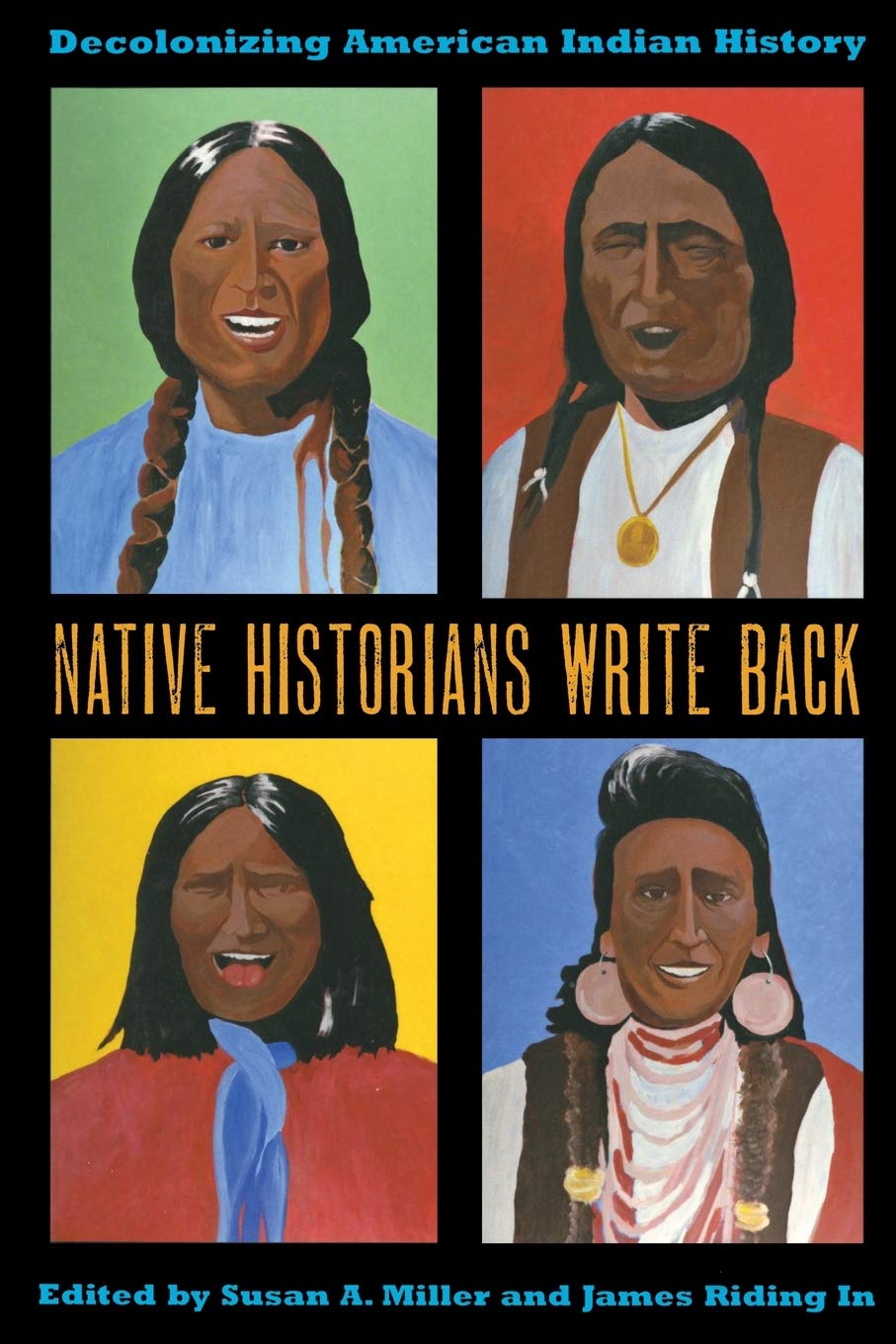
This, of course, reminds me of Seminole historian Susan Miller, who in her edited book Native Historians Write Back, keenly observed that Indigenous thinkers often prefer to “work within” their “own people’s specific worldview.”
Native historians understand this. We get it, but our use of indigenous frameworks (or epistemologies) in our work do not always clearly or convincingly translate with non-Native historians.

I experienced this most recently when I submitted an essay on Hopi runner Louis Tewanima to the Western Historical Quarterly. 

I was surprised that one of the reviewers had noted that my essay lacked a theoretical frame or argument. 

In my essay, I argued (in part) that when Tewanima competed and excelled in American and Olympic marathons, he followed in the tradition of ancient Hopi clan runners who once ran far beyond Hopi ancestral lands to bring blessings to the Hopi people. 

I situated Hopi culture at the center of the narrative, and I used a Hopi frame to explain his participation and success in national and international running events.

I did not want to write just another article on running – or even Native running. Nor did I want to provide readers with another romantic portrayal of Tewanima. 

Either my reviewer did not see the Hopi frame that I was employing, or he or she refused to accept it.

As Native historians, we need to continue asserting and introducing indigenous frameworks of understanding in so-called mainstream academic history journals. 

We know that this approach to Native history will be welcomed in American Indian Studies journals, but we have a broader (history) audience to reach with our work.

And this audience needs to be reminded that there are ways of thinking of Native history that go beyond the theories and models so commonly used and accepted by Western historians. 

Finally, some of us need to do a better job consulting the scholarship of Native historians and other thinkers when we research and publish on their indigenous communities. 

When we write about the Choctaw or Kiowa, we ought to honor their people by citing and listening to their scholars and other writers. Of course, I’m thinking here of Choctaw historian Jacki Thompson Rand, Choctaw writer LeAnne Howe, and Kiowa historian Jenny Tone-Pah-Hote.

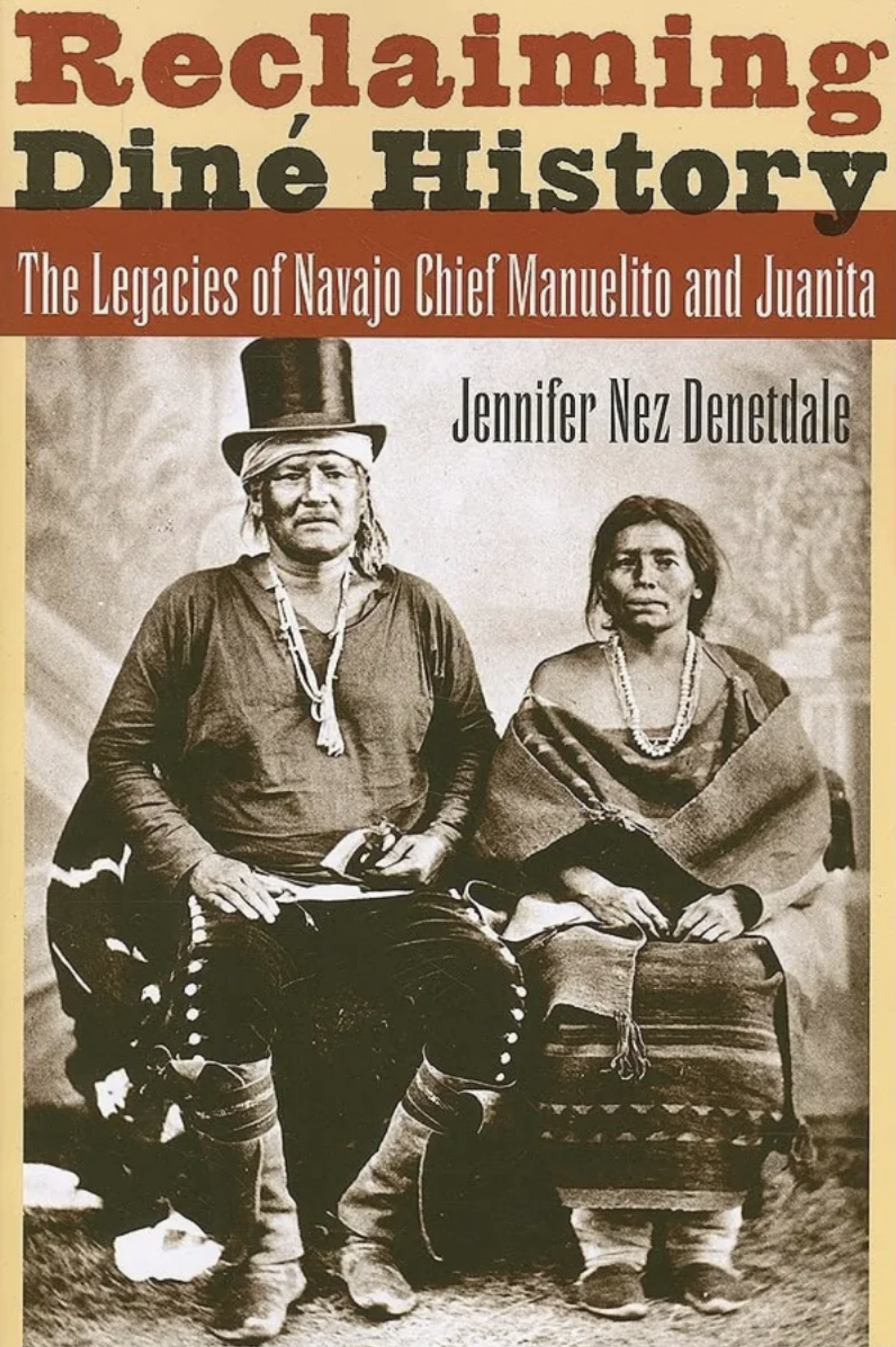
And when we write about the Dine’, we ought to ask ourselves how the work of Dine’ historians Jennifer Nez Denetdale, Lloyd Lee, and many others might enlighten our understanding of their people.
Some here might say that I am simply stating the obvious.

I wish this were the case, but having peer-reviewed numerous essays for journals and other academic publications in my relatively short academic year, I know that this remains a problem in our field.

Indigenous communities did not send us to academic institutions to receive Ph. D.s in history to simply increase the number of Native faculty at universities and colleges.

They did not send us to academic institutions to simply add a bit of color to a once predominantly white narrative.

We have a message to tell about our history and cultures. And we have a responsibility to tell these histories in ways that are meaningful and useful to our people.

When we write about our people, our voices matter. They have always mattered. 

I know that I spent my time talking about Native historians, but there are also young non-Native scholars such as Kate Williams and Kevin Whalen who are making noteworthy contributions. We should be appreciative when our Non-Native colleagues do it right and honor Indian people with their work.

In conclusion, I want to emphasize again that this is an exciting time to research and write on the history of American Indian people. We have a bright future ahead of us, and I look forward to seeing how the field will evolve and improve as Indian people take greater ownership of their past and write histories that originate from their communities and perspectives.

Kwa-kwa
A short piece on Hopi running for Highlights magazine

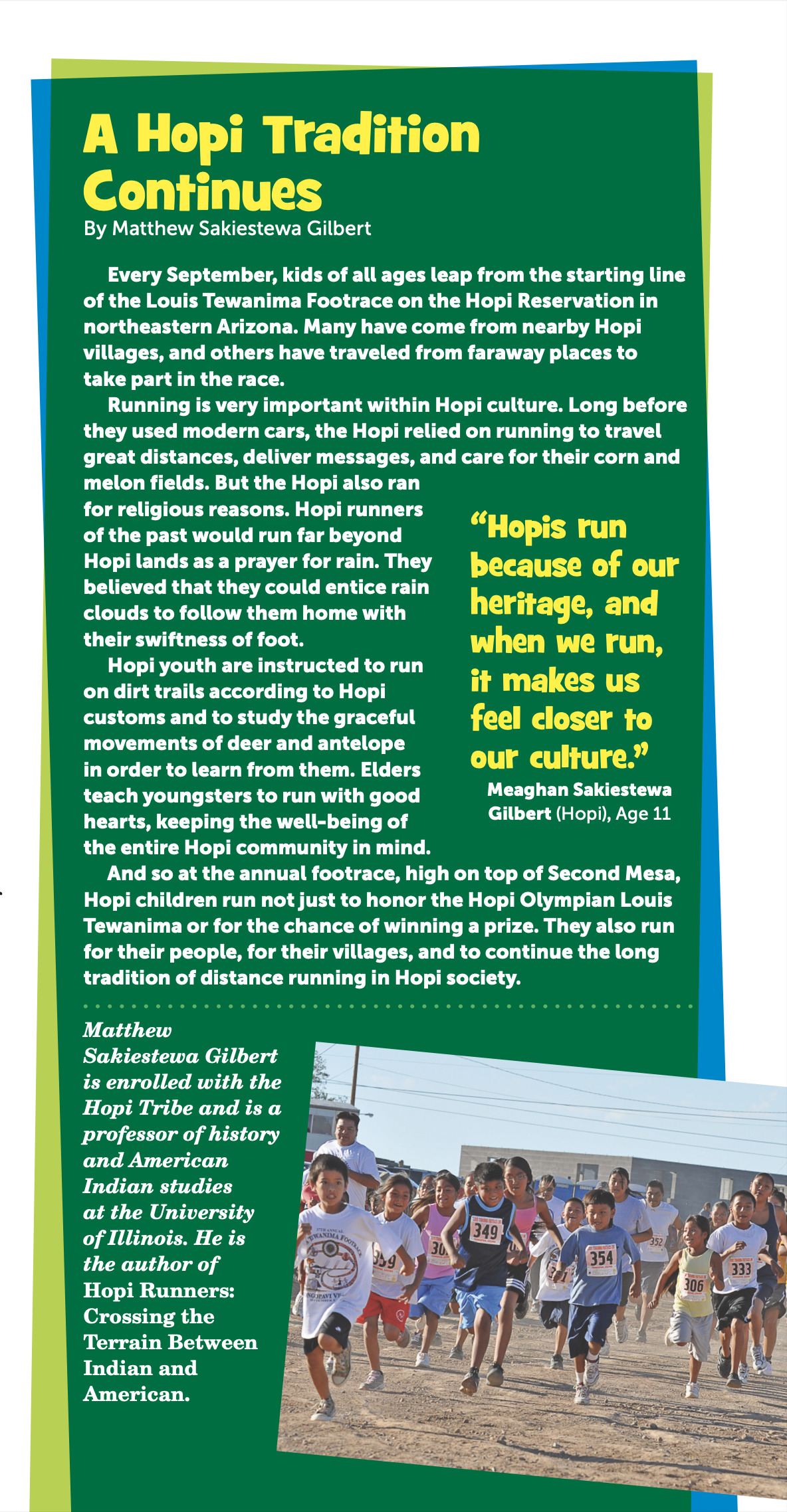
Seven years ago, editors from Highlights, a magazine for children, asked if I would be willing to write a short piece on Hopi running. I was thrilled to do so. The piece, titled “A Hopi Tradition Continues,” was part of a larger story on Hopi runner Louis Tewanima called “Miles from Home” by Kim Valice.

When I was young, my parents (and school) subscribed to Highlights, and I, along with my siblings, spent hours reading its stories, fascinated by the many colorful drawings and other images gracing its pages. Taking place before children could “surf” the internet, we waited for the arrival of each new edition with great anticipation. The magazine became our gateway to the world.

As I reflect on my childhood, this contribution will always remain special to me. It is not a “heavy-hitting” scholarly piece, published in one of the academy’s esteemed journals. It is not something that would significantly enhance a faculty’s tenure and promotion case. However, it is more meaningful than that. It was written for children, most of whom had never heard about the Hopi people, where we come from, or our long tradition of distance running.

Hopi Runners Presentation, Hosted by Amerind Museum

On Saturday September 12, I gave a presentation on my book Hopi Runners: Crossing the Terrain between Indian and American (University Press of Kansas). The event was hosted by Amerind Museum in Dragoon, Arizona. I have the privilege of serving on Amerind’s Board of Directors. It is a terrific organization that does a lot of good work with and for Native communities in the Southwest. Below is the video of my talk, with 660 people in attendance!

*Interested in purchasing Hopi Runners? Right now, until October 31, 2020, the University Press of Kansas is running a special if you purchase through their website. Use Promotion Code HOPI30 to receive 30% Off plus FREE Shipping!

Beyond the Mesas – A Conversation with Michael Adams (Hopi/Tewa)

Earlier this month I had an opportunity to interview counselor, jeweler, and author Michael Adams (Hopi/Tewa) from the village of Tewa on the Hopi reservation in northeastern Arizona. The interview covers a range of topics, including the role of family in one’s education and career paths, the process of overcoming challenges, schooling beyond the Hopi mesas, and the importance of positive thinking. The interview was conducted on June 10, 2020 via Zoom. To learn more about Michael Adams and his counseling resources and art, please visit:

www.nextwavewarrior.com (Next Wave Warrior)

www.gourdjewels.com (GourdJewels)

Youtube: (Michael Adams)

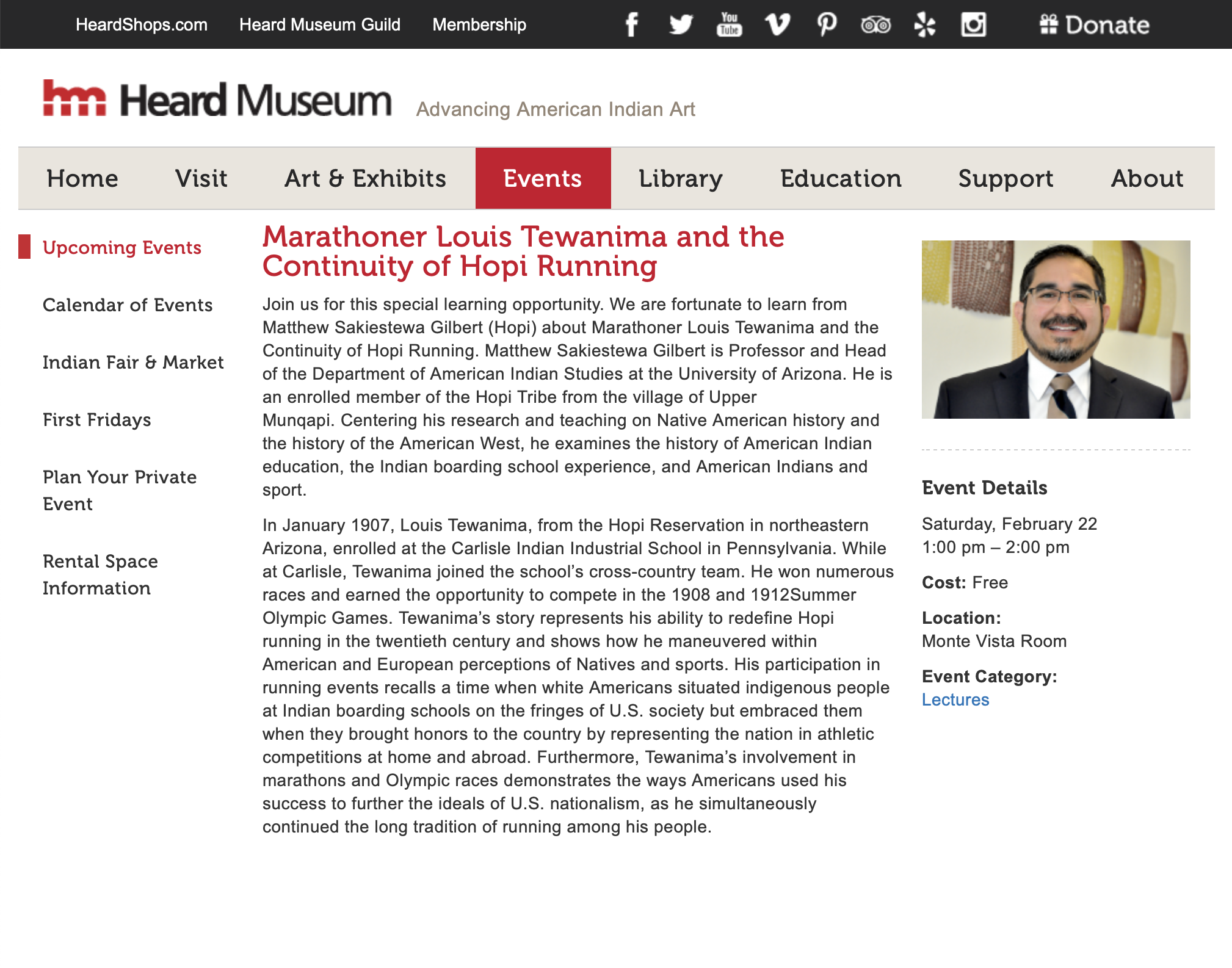
Upcoming talk on Hopi runner Louis Tewanima at the Heard Museum

Hopi Runner talk announcement
For more information, visit: https://heard.org/event/marathoner-louis-tewanima-and-the-continuity-of-hopi-running/

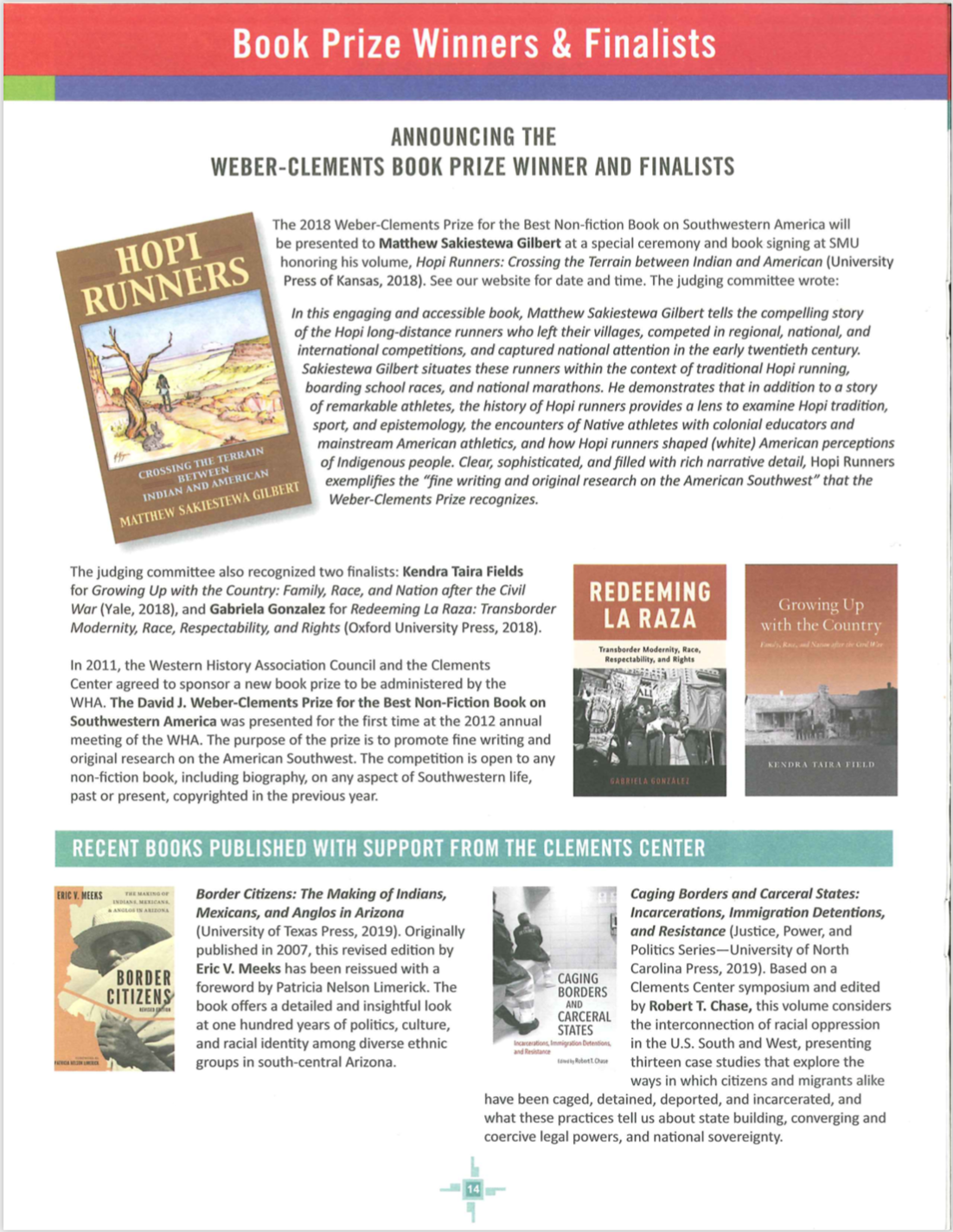
Hopi Runners wins 2019 David J. Weber-Clements Prize

I am pleased to announce that my book on Hopi long distance runners has won the 2019 David J. Weber-Clements Center Prize for “best non-fiction book on Southwestern America.”

The award is presented annually by the William P. Clements Center for Southwest Studies and the Western History Association. I received the award last week at the Western History Association conference, which was held at the Westgate Resort and Casino in Las Vegas.

This would not have been possible without the support of many people over the years who encouraged me as I wrote and completed the book. To them, I extend a heartfelt Kwakwha!

Screen Shot 2019-10-26 at 12.04.54 PM


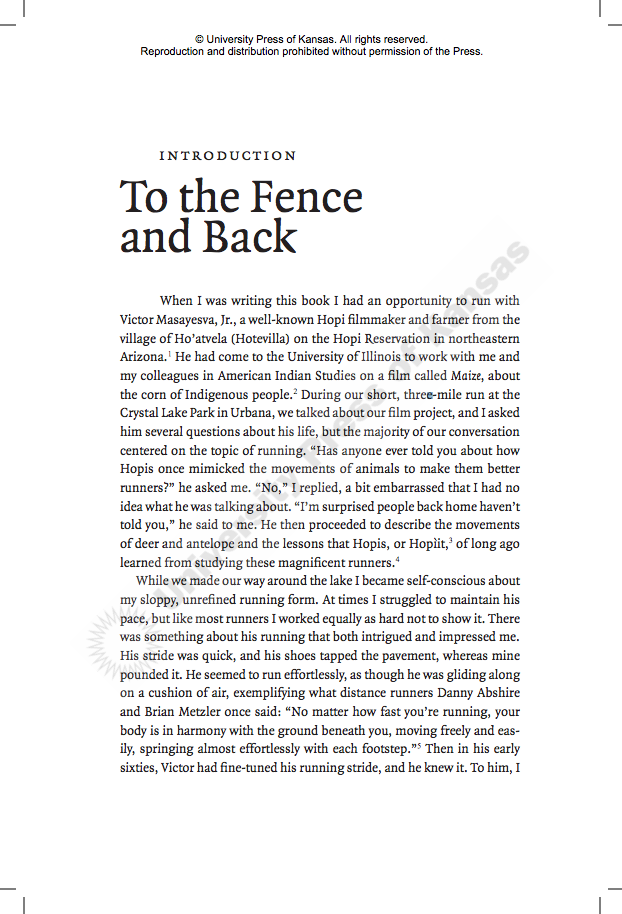
Hopi Runners – Preface, Acknowledgments, and Introduction

I am pleased to pass along the Preface, Acknowledgments, and Introduction to my book Hopi Runners: Crossing the Terrain between Indian and American, compliments of the University Press of Kansas. Click image to download.

Also, for those who might be interested, the University Press of Kansas is currently having a 30% off sale (and free shipping) on all books, including Hopi Runners. The sale will last from now until December 15, 2018. Use promotion code HOLI30 when you make your order. The discount and free shipping brings the cost down to about $20 for the book.

Screenshot 2018-11-22 10.27.18

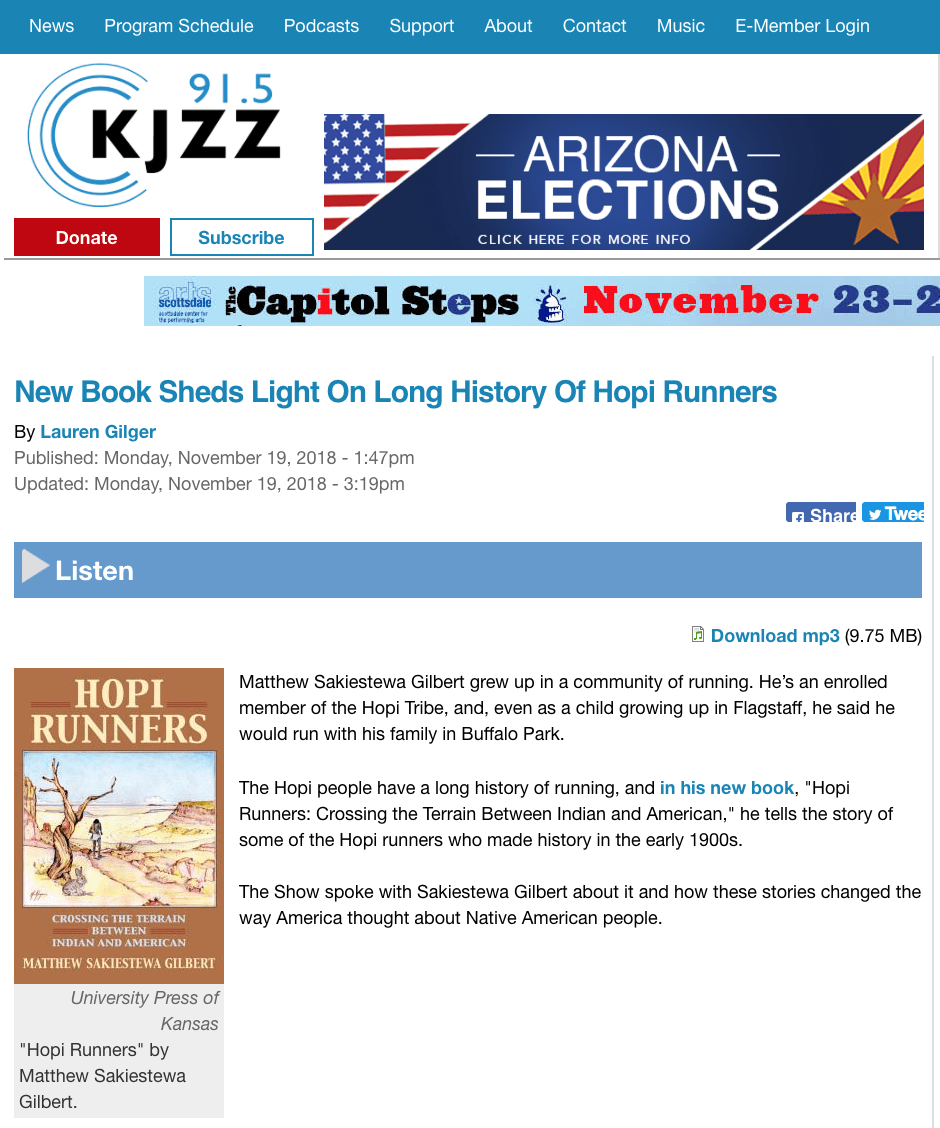
New Book Sheds Light On Long History of Hopi Runners (91.5 KJZZ / PHX)

Hopi Runners - KJZZ

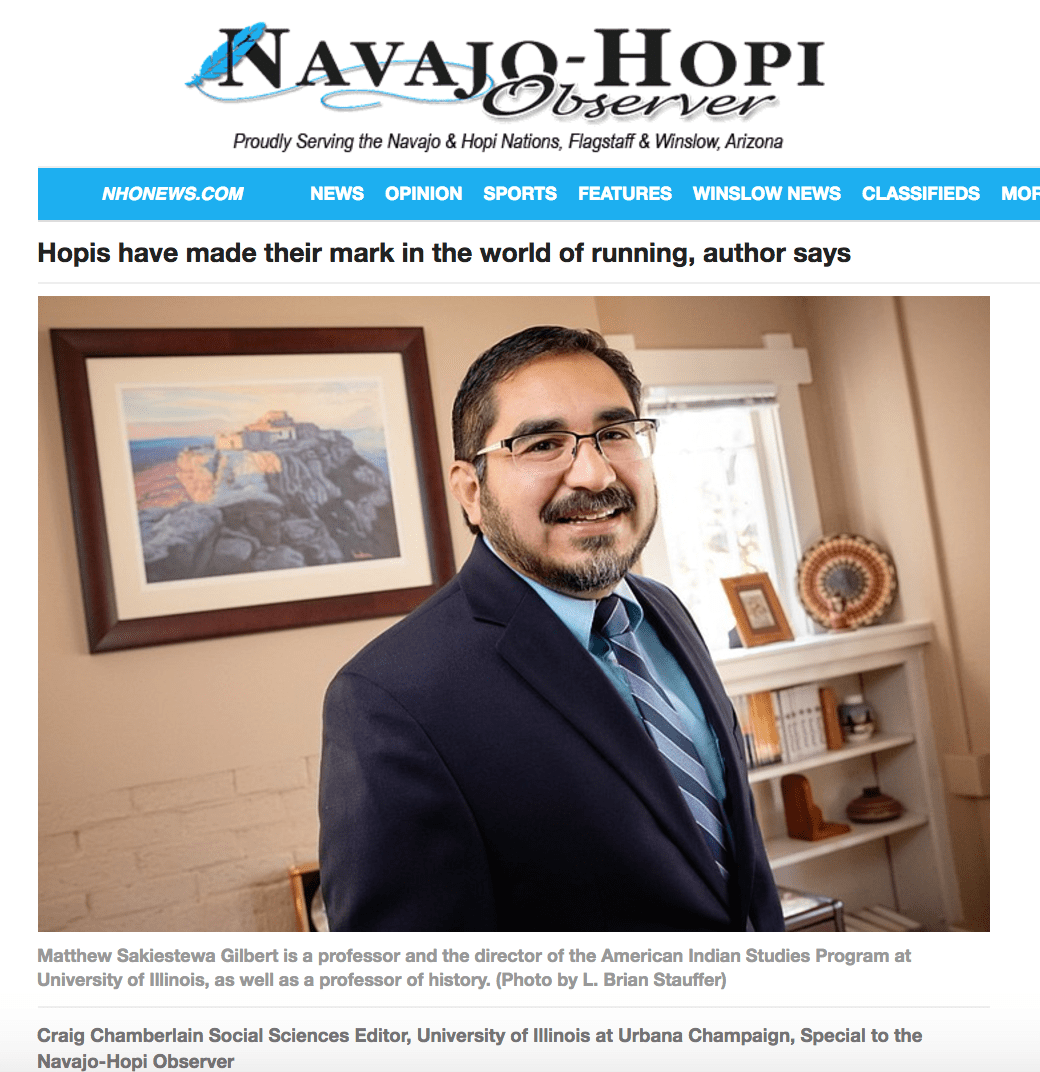
Hopis have made their mark in the world of running, author says

Screenshot 2018-11-04 13.59.18

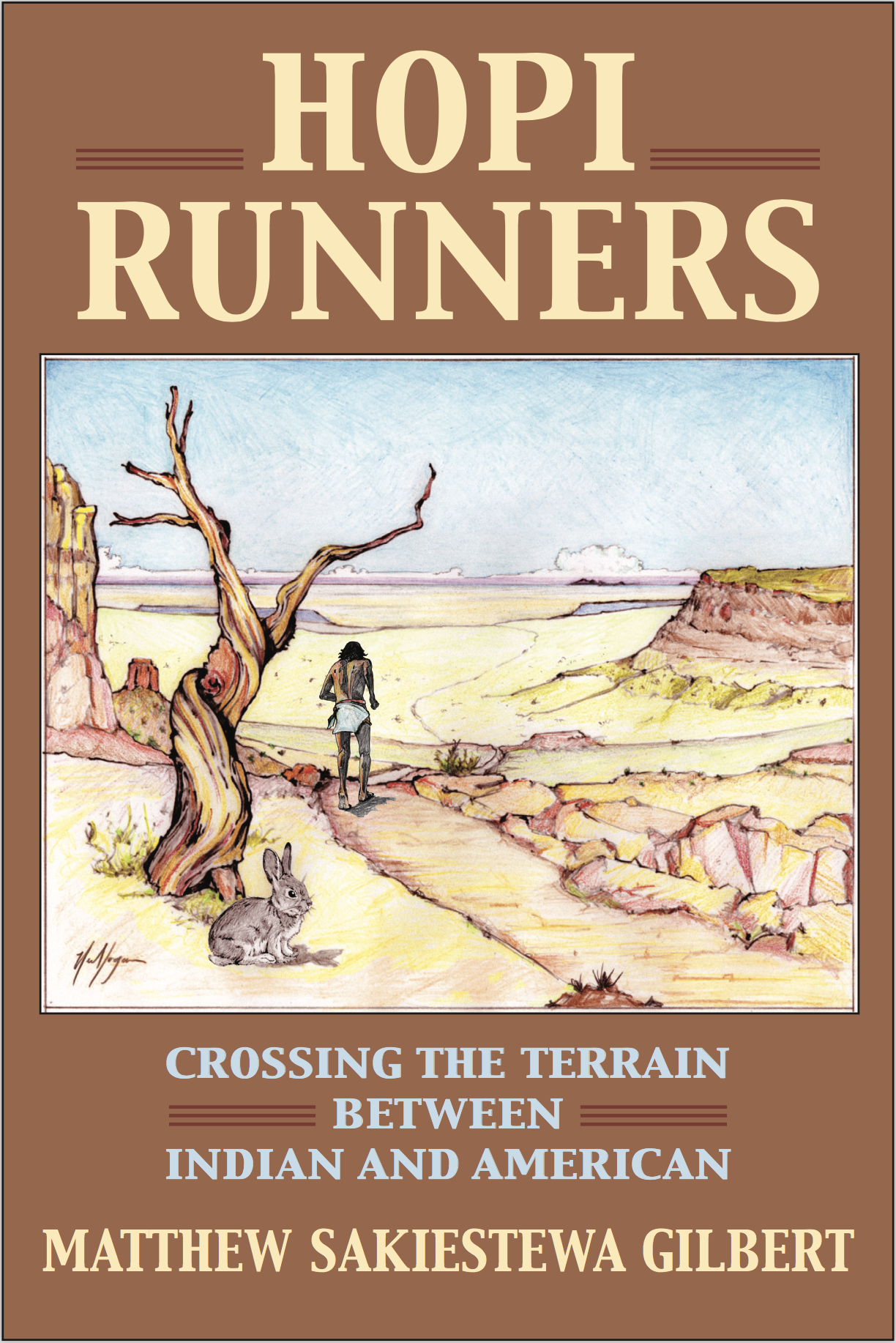
Hopi Runners: Crossing the Terrain between Indian and American

Screen Shot 2018-04-30 at 12.02.29 PM

Today the University Press of Kansas officially launched my book Hopi Runners: Crossing the Terrain between Indian and American (CultureAmerica series).  

I am grateful for the support of so many people over the years who have encouraged me as I completed this project. I thank my family and friends, past and current students, colleagues at the University of Illinois, and numerous scholars here in the United States and abroad. I also thank the wonderful staff at the press, and of course, readers of this blog!

Last week, Craig Chamberlin of the University of Illinois News Bureau published a story about the book. You can access the story here. If you are interested in purchasing a copy of Hopi Runners, you can do so through Amazon or the publisher’s website.

Below is an excerpt from the book’s Introduction titled “To the Fence and Back.” The excerpt comes from a section of the Introduction where I describe Hopi runners who competed at federal off-reservation Indian boarding schools:

While Hopis participated in several sports, including basketball, football, and even boxing, their greatest success came as members of track and cross-country teams. Sports at off-reservation schools provided Native athletes opportunities that did not exist  for them on their reservations. When Hopis joined cross-country teams at Sherman Institute, or the Indian school at Carlisle, they experienced for the first time different regions of the country, life in modern cities, and a new way of running footraces. And Hopis used these opportunities to learn and interact with people from other parts of the United States and the world. While competing in marathons, Hopis ran with runners from Ireland, Germany, Sweden, and Japan, and although from vastly different cultures, they spoke a common – and perhaps universal – language of competitive running.

Having come from a society that valued long-distance running for ceremonial and practical purposes, Hopi youth transferred this cultural mindset with with them when they entered these faraway schools. Hopi runners who competed at Indian schools had come from a tribe of racers. While none of these athletes needed to be taught the essence of long-distance running, coaches nevertheless trained them in modern running techniques and rules to compete effectively in American track and cross-country events. The dirt trails on the reservation did not resemble the paved roads or clay tracks used in many American running competitions. And so, in their first year on a school’s cross-country team, Hopis learned about running in different locations, climates, and elevations. And they had to develop mental and physical strategies for running in cities, on mountain roads, or in front of thousands of cheering spectators in a stadium.

When Hopis ran on trails back home, they did so in a relatively quiet and peaceful environment, far from the sounds of locomotives arriving and departing towns such as Winslow. Running on or near the mesas, Hopis became attuned with their bodies and surroundings, becoming one with their environment. They listened to their own breathing, the sound of their feet tapping the trail as they danced on Mother Earth. They felt the rhythmic pounding of their heart telling them to adjust or steady their pace. And they listened to birds singing and the sound of the wind cutting through the canyons. And often they ran alone, experiencing physical ailments that all distance runners endure. “He was alone and running on,” Kiowa poet N. Scott Momaday writes of a Jemez Pueblo runner named Abel. “All of his being was concentrated in the sheer motion of running on, and he was past caring about pain.” In the high desert of Arizona, Hopi runners also beheld beautiful landscapes , greeted majestic sunrises and sunsets, and had unobstructed views for miles in all directions. Running with no distractions from the outside world, Hopis ran with “good hearts,” prayed silently for the well-being of their people, and sang songs to the katsina spirits to entice the rain clouds to follow them home to their villages.

However, the tranquil environment that encompassed the trails back home did not reflect the fast pace and at times chaotic life in large modern American cities…

Matthew Sakiestewa Gilbert, Hopi Runners: Crossing the Terrain between Indian and American (University Press of Kansas, 2018), 8, 9, 10.