Hopi Runners: Crossing the Terrain between Indian and American

Screen Shot 2018-04-30 at 12.02.29 PM

Today the University Press of Kansas officially launched my book Hopi Runners: Crossing the Terrain between Indian and American (CultureAmerica series).  

I am grateful for the support of so many people over the years who have encouraged me as I completed this project. I thank my family and friends, past and current students, colleagues at the University of Illinois, and numerous scholars here in the United States and abroad. I also thank the wonderful staff at the press, and of course, readers of this blog!

Last week, Craig Chamberlin of the University of Illinois News Bureau published a story about the book. You can access the story here. If you are interested in purchasing a copy of Hopi Runners, you can do so through Amazon or the publisher’s website.

Below is an excerpt from the book’s Introduction titled “To the Fence and Back.” The excerpt comes from a section of the Introduction where I describe Hopi runners who competed at federal off-reservation Indian boarding schools:

While Hopis participated in several sports, including basketball, football, and even boxing, their greatest success came as members of track and cross-country teams. Sports at off-reservation schools provided Native athletes opportunities that did not exist  for them on their reservations. When Hopis joined cross-country teams at Sherman Institute, or the Indian school at Carlisle, they experienced for the first time different regions of the country, life in modern cities, and a new way of running footraces. And Hopis used these opportunities to learn and interact with people from other parts of the United States and the world. While competing in marathons, Hopis ran with runners from Ireland, Germany, Sweden, and Japan, and although from vastly different cultures, they spoke a common – and perhaps universal – language of competitive running.

Having come from a society that valued long-distance running for ceremonial and practical purposes, Hopi youth transferred this cultural mindset with with them when they entered these faraway schools. Hopi runners who competed at Indian schools had come from a tribe of racers. While none of these athletes needed to be taught the essence of long-distance running, coaches nevertheless trained them in modern running techniques and rules to compete effectively in American track and cross-country events. The dirt trails on the reservation did not resemble the paved roads or clay tracks used in many American running competitions. And so, in their first year on a school’s cross-country team, Hopis learned about running in different locations, climates, and elevations. And they had to develop mental and physical strategies for running in cities, on mountain roads, or in front of thousands of cheering spectators in a stadium.

When Hopis ran on trails back home, they did so in a relatively quiet and peaceful environment, far from the sounds of locomotives arriving and departing towns such as Winslow. Running on or near the mesas, Hopis became attuned with their bodies and surroundings, becoming one with their environment. They listened to their own breathing, the sound of their feet tapping the trail as they danced on Mother Earth. They felt the rhythmic pounding of their heart telling them to adjust or steady their pace. And they listened to birds singing and the sound of the wind cutting through the canyons. And often they ran alone, experiencing physical ailments that all distance runners endure. “He was alone and running on,” Kiowa poet N. Scott Momaday writes of a Jemez Pueblo runner named Abel. “All of his being was concentrated in the sheer motion of running on, and he was past caring about pain.” In the high desert of Arizona, Hopi runners also beheld beautiful landscapes , greeted majestic sunrises and sunsets, and had unobstructed views for miles in all directions. Running with no distractions from the outside world, Hopis ran with “good hearts,” prayed silently for the well-being of their people, and sang songs to the katsina spirits to entice the rain clouds to follow them home to their villages.

However, the tranquil environment that encompassed the trails back home did not reflect the fast pace and at times chaotic life in large modern American cities…

Matthew Sakiestewa Gilbert, Hopi Runners: Crossing the Terrain between Indian and American (University Press of Kansas, 2018), 8, 9, 10.


Lunar Run, Munqapi, Ariz., January 7, 2017

15740735_1328665020531111_2477837249784153793_n

We Run Strong Runners Forum, January, 7, 2017

WRSFORUM17 copy.jpg

Watch 15 min version of Run Hopi as seen on ESPN

Screenshot 2016-07-25 17.25.57

Click above or on the below link to see the 15 minute version of Run Hopi as aired on ESPN! 30 min version to air on Friday July 29. http://espn.go.com/video/clip?id=17131436


Run Hopi to air today on ESPN SportsCenter, 10AM and 11PM Eastern Time

ESPN to air film on Hopi cross country team

WP_20160527_11_06_19_Pro

In May of this year, I was interviewed by ESPN producer Scott Harves for a film on Hopi running and the Hopi cross country team. The interview took place in the Department of History library at the University of Illinois at Urbana-Champaign.

During the two-hour interview, Harves asked me to talk about Hopi culture and society, but most of his questions centered on the long history of Hopis and distance running.

Having won 26 consecutive state titles, the Hopi High cross country team has received considerable attention from media outlets, including a recent story by John Branch in the New York Times.

A 15 minute version of the film, Run Hopi, is scheduled to air on ESPN this Sunday July 24 at 10:00AM and 11:00PM (eastern time) on the SportsCenter (http://espn.go.com/video/sportscenter). It will likely be aired several more times throughout the summer.

A longer 30 minute version of the film will be aired on July 29 at 8:30PM (eastern time) on ESPN2.

To learn more about Run Hopi, and to watch a trailer of the film, see Andy Hall’s article on the ESPN FrontRow website entitled “Sunday’s SC Featured tells of Hopi reservation cross-country dynasty.”

Two Hopis to compete in the Boston Marathon

Pre-race photo of Caroline Sekaquaptewa and Steven Ovah, 2014 Boston Marathon
Pre-race photo of Caroline Sekaquaptewa and Steven Ovah, 2014 Boston Marathon – Photo courtesy of Caroline Sekaquaptewa

This morning Hopi runners Caroline Sekaquaptewa and Steven Ovah will compete in the Boston Marathon! The Elite Women’s Division will begin at 9:32AM (ET), and the Elite Men’s Division will start at 10:00AM (ET). You can follow the marathon live at http://universalsports.com/. This is a big deal for Hopi. It’s not every year that runners from back home have an opportunity to represent our people in this event!

Wings of America 15th Annual American Indian Running Coaches’ Clinic

Screen Shot 2013-07-07 at 2.52.46 PM
Plate by Jemez Pueblo potter Bernice T. Gachupin

In June I had a great opportunity to speak at the Wings of America organization’s annual American Indian Running Coaches’ Clinic in Albuquerque, New Mexico.

Wings of America exists to “enhance the quality of life for American Indian youth” by promoting running and pride in one’s “cultural identity.”

I spoke to a group of nearly 50 Native high school runners, and a number of coaches, including Hopi coach Rick Baker. I don’t often get a chance to speak to such a well-informed audience!

However, the highlight for me was listening to Hopi runner Wendi Lewis from Kykotsmovi, who gave a wonderful talk on running through the “trials and tribulations of life.”

Other presenters included Navajo scholar Lloyd Lee, Anthropologist Peter Nabakov, who once published a remarkable book entitled Indian Running, Jemez Pueblo runner Steve Gachupin, and many others.

Although I was not able to listen to Steve Gachupin’s talk, I have great respect for him as a runner.

Known for winning six consecutive Pikes Peak Marathons in the late 1960s and early 1970s, he is a strong advocate for running among Native youth.

I first learned about Gachupin and his running accomplishments from an excellent article by historian Brian S. Collier  entitled “’To Bring Honor to My Village’: Steve Gachupin and the Community of Jemez Running and the Pikes Peak Marathon” (Journal of the West, Fall 2007).

If you are at all interested in running, be sure to read this article (it’s an article that I often cite in my work).

I should also note that the beautiful plate above was given to everyone who presented at the Clinic. It was made by Jemez Pueblo potter Bernice Gachupin, Steve Gachupin’s wife.

Finally, I want to give a special thanks to Wings of America Program Director Dustin Quinn Martin and other organizers for their hard work in making this terrific event possible.

Kwakwha’!

Running on a track

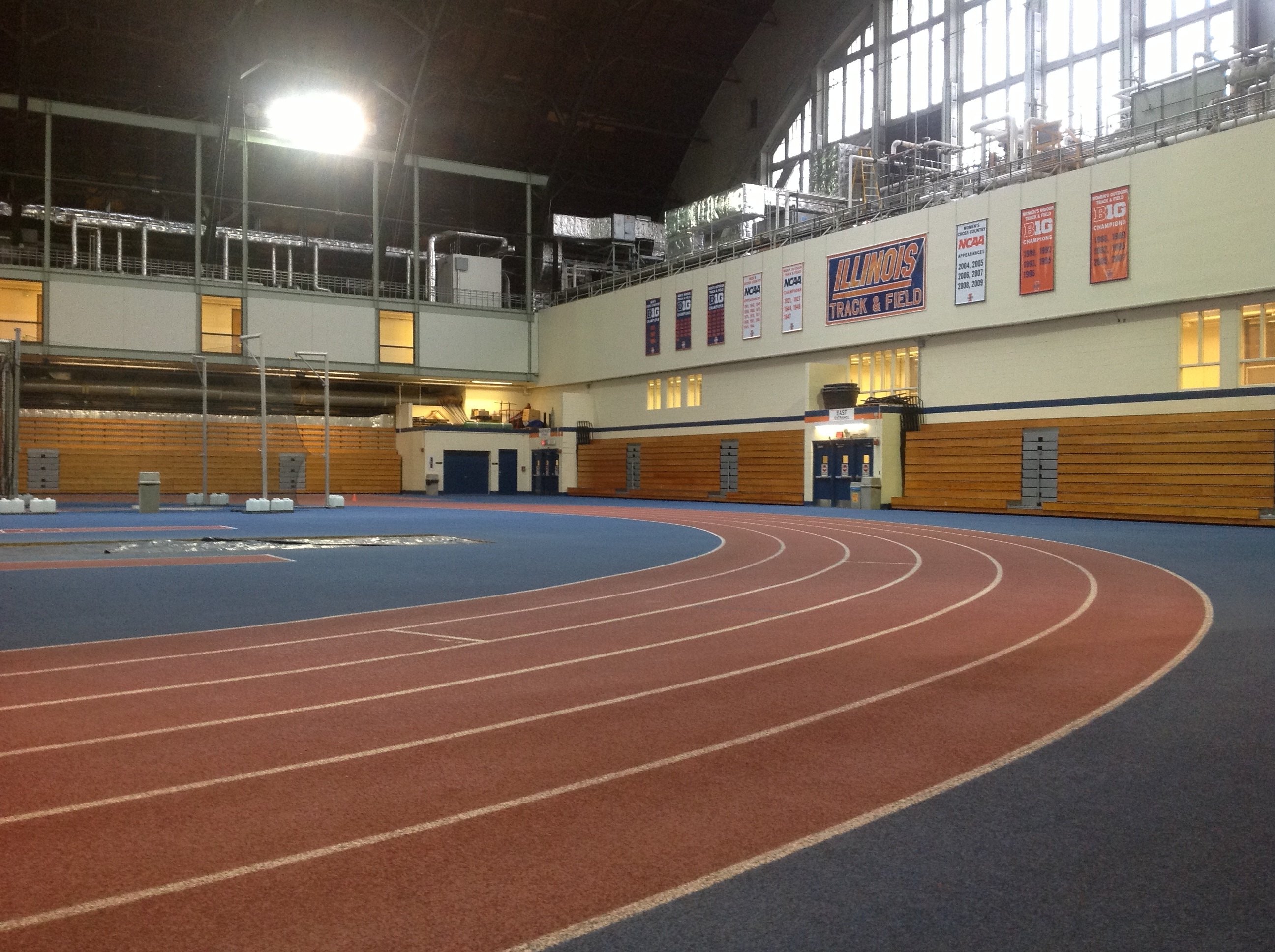
Armory track
Armory track & field – University of Illinois at Urbana-Champaign

This winter I’ve been running on the Armory track at the University of Illinois.

The last time I used a track was in high school.  Back then I was quite a bit faster.

Now days I plug along at a 10 minute per mile pace.

I am obviously not out to impress anyone, especially members of the UofI’s men’s or women’s track team who run circles around me during their practice.

But it’s a pace that I’m able to maintain, at least for a while.

There are benefits to running on a track, and there are a lot of things about running on the streets of Champaign that I don’t miss: Traffic, car exhaust, stop lights, curbs, potholes, imbalanced dogs, angry geese, angry people, extreme temperatures, and those darn concrete slabs!

When the weather warms up, I will once again take my place among Champaign’s outdoor runners.

But I doubt this will last for long.

As soon as the temperatures reach into the 90s, and we start experiencing high humidity, it’s back to the track for me!

UPCOMING TALK: “Hopi Runner Harry Chaca and the 1929 Vallejo Pre-Olympic National Marathon”, UC Riverside, February 7

I am scheduled to give a talk entitled “Hopi Runner Harry Chaca and the 1929 Vallejo Pre-Olympic National Marathon” this Thursday February 7 at 1:30PM.

My presentation is part of the two-day symposium, “Sherman Institute: The American Indian Boarding School Experience”, which will be held at UC Riverside’s Costo Library.

For more information about the gathering, please visit UC Riverside, Sherman Indian High School Host Symposium

Below is the schedule for the event:

Sherman Institute: The American Indian Boarding School Experience

February 7, 2013: Costo Library (4th Floor Rivera Library)

9 AM: Wlecome by Clifford E. Trafzer and Lorene Sisquoc, Moderators

Invocation by Henry Vasquez

9:30-10: David Adams (Cleveland St. University), “What We Don’t Know about the
History of Indian Boarding Schools”

10-10:30: Robert McCoy (Washington St. University), “Building to Assimilate:
Mission Architecture of Sherman Institute”

10:30-11: Diana Bahr (UCLA), “Robert Kennedy and Sherman Institute, A Promise
Fulfilled.”

11-11:30: Leleua Loupe (CSU Fullerton), “A Network of Control: Exploiting
Indigenous Labor in the West”

11:30-12: Kevin Whalen (UCR), “Indian School and Company Town: Sherman
Student-Laborers at Fontana Farms Company, 1907-1930″

Lunch Break

1:30-2: Matthew Sakiestewa Gilbert (University of Illinois), “Hopi Runner Harry
Chaca and the 1929 Vallejo Pre-Olympic National Marathon”

2-2:30: William O. Medina (Riverside Community College), “Patriotic Indians at
Sherman Institute”

2:30-3: Jason Davis (CSU San Bernardino), “Paradigm Shift: Assimilation to
Preservation at Sherman Indian School”

3-3:30: Kathleen Bartosh (UCLA), “Domesticity and Defense: The Female Experience
at the Sherman Institute, 1930-1960.”

3:30-4: Jean Keller (Palomar College), “Before Sherman Institute: The Perris Indian
School.”

Rupert Costo Chair, California Center for Native Nations, Native American Student
Programs, Native American Educational Program of UC Riverside and the Sherman
Indian Museum offer this Symposium as Sponsors.

—————————————————————————————————

Sherman Institute: The American Indian Boarding School Experience

February 8, 2013, Sherman Indian High School Auditorium

9-10:  Panel 1,  Former Students, Staff, and Faculty

10-11:  Panel 2,  Current Students, Staff, and Faculty

11-12:  Panel 3,  Sherman Scholars and Historians

12-1:  Lunch Break

1-4:  Sherman School Museum is Open

2-3:  Visit to Sherman School Cemetery

Symposium is sponsored by the Sherman School Museum and Costo Chair, California Center for Native Nations, Native American Educational Program,

and Native American Student Programs of UC Riverside.