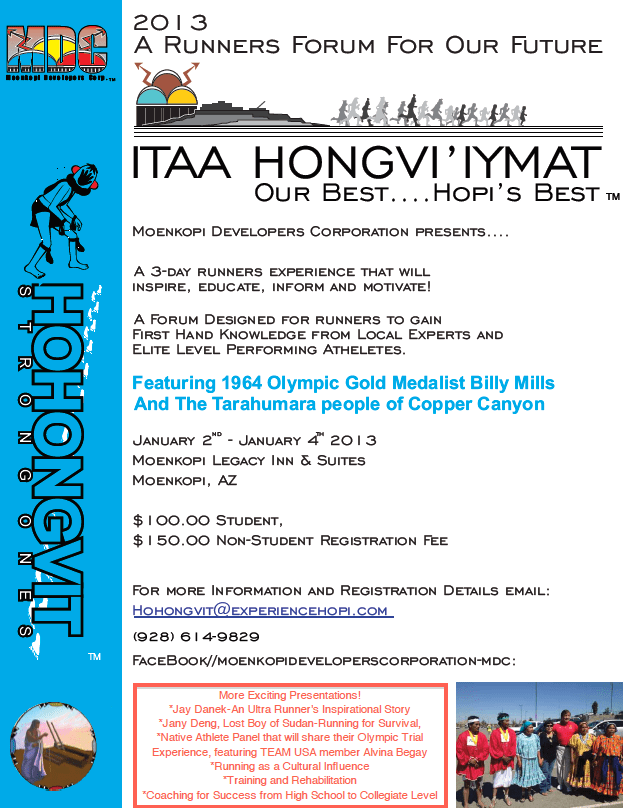
Oglala Lakota Olympian Billy Mills will be the keynote speaker, alongside Tarahumarah runners from Copper Canyon in Mexico. Navajo runner Alvina Begay will also present.
I was asked to present at the forum, but I’m unable to make the trip back home during the first week in January.
Please help spread the word about this gathering of Hopi and other indigenous runners!
In the summer of 2010, I started writing an article titled “Marathoner Louis Tewanima and the Continuity of Hopi Running, 1908-1912.” The article was recently published in the Western Historical Quarterly (Autumn 2012, Vol. 43.3, pp. 324-346), which is the official journal of the Western History Association.
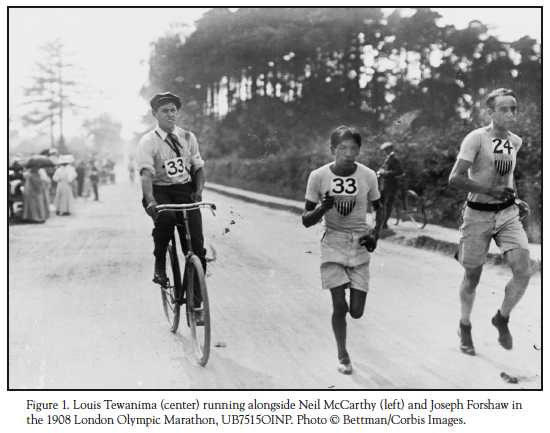
Louis Tewanima was from the village of Shungopavi on the Hopi Reservation in northeastern Arizona. In January 1907, he and ten other Hopis traveled to Pennsylvania to attend the Carlisle Indian Industrial School. While at Carlisle, Tewanima received fame and notoriety by winning several running events, which gave him opportunities to compete in the 1908 (London) and 1912 Olympic Games in Stockholm, Sweden. At the Stockholm Olympics, he won the silver medal in the 10,000 meter race.
Over the years, a number of people, especially non-Hopi individuals, have written about Louis Tewanima. The majority of the scholarly literature on Tewanima is found in Peter Nabokov’s Indian Running or larger narratives on Natives and sports, most notably Joseph B. Oxendine’s American Indian Sport Heritage and John Bloom’s To Show What an Indian Can Do.
Although popular audiences often read Tewanima’s story in newspaper articles, magazines, and books, these publications tend to focus on his participation in the 1912 Olympic Games in Stockholm, and many of them perpetuate a romantic portrayal of Tewanima by retelling accounts of him running after rabbits as a young man and running to Winslow, Arizona, “just to see the trains [go by].”
Contrary to one contemporary writer who noted that Tewanima was “almost totally forgotten,” scholars have remained intrigued by his accomplishments, although they are often overshadowed by accounts of his Carlisle teammate, Sac and Fox athlete Jim Thorpe. While references to Tewanima grace the pages of many articles and books, further studies are needed, particularly ones that interpret his accomplishments within the contexts of Hopi and American sport culture.
In my article I argue that Tewanima’s story represents his ability to redefine Hopi running in the twentieth century and shows how he maneuvered within American and European perceptions of Natives and sports. His participation in running events also tells of a time when white Americans situated indigenous people on the fringes of U.S. society but embraced them when they brought honors to the country by representing the nation in athletic competitions at home and abroad.
Furthermore, Tewanima’s involvement in marathons and Olympic races demonstrates the ways Americans used his success to advance the ideals of U.S. nationalism as he simultaneously continued the long tradition of running among his people.
A number of individuals helped me along the way as I conducted research and revised the article for publication, especially my colleagues in the American Indian Studies Program, and the Department of History at the University of Illinois. I am also thankful for the assistance of various Hopi individuals, including Tewanima’s relatives, the remarkable editorial staff of the Western Historical Quarterly, the Journal’s three anonymous reviewers, and officials with the Hopi Cultural Preservation Office for their support of my work.
This Friday May 25, the Smithsonian will open an exhibit titled “Best in the World: Native Athletes in the Olympics.” The exhibit will feature Jim Thorpe, Duke Kahanamoku, Andrew Sockalexis, Billy Mills, and Hopi runner Louis Tewanima of Shungopavi on Second Mesa.
The Smithsonian has a nice write-up about the event on its website:
On the 100th anniversary of the Olympic Games in which athletes Jim Thorpe (Sac and Fox), Duke Kahanamoku (Native Hawaiian), Andrew Sockalexis (Penobscot) and Lewis Tewanima (Hopi) represented the United States in Stockholm, the Smithsonian’s National Museum of the American Indian presents “Best in the World: Native Athletes in the Olympics.” The exhibition opens Friday, May 25.
In 1912, Thorpe swept both the pentathlon and decathlon at the Olympic Games, becoming the first and only Olympian to accomplish such a feat and earning the accolades of King Gustav V of Sweden, who proclaimed Thorpe to be “the greatest athlete in the world.” Thorpe was joined that year by fellow Native teammates Kahanamoku, who won the 100-meter freestyle; Sockalexis, who placed fourth in the marathon; and Tewanima, who won the silver medal and set an American record for the 10,000 meters that stood for more than 50 years until Billy Mills (Oglala Lakota) won the gold medal in Tokyo in 1964.
Louis Tewanima competed in the 1908 (London) and 1912 (Stockholm) Olympic Games. For those who might be interested, I have written an article on Tewanima titled “Marathoner Louis Tewanima and the Continuity of Hopi Running, 1908-1912,” which will appear soon in the Western Historical Quarterly.
At the end of January, I wrote a post about recent articles on Native runners. In this post, I mentioned that as the 2012 Olympic Games in London approaches, we should expect to see an increase in the number of articles being published on Native athletes, especially long distance runners.
I also wrote an article on Tewanima titled “Marathoner Louis Tewanima and the Continuity of Hopi Running, 1908-1912.” The essay is scheduled to appear in the August 2012 edition of the Western Historical Quarterly – the official journal of the Western History Association.
I’ve noticed an increase in the number of articles being published on indigenous runners. Many, including a nice write-up in Indian Country Today, center on Navajo runner Alvina Begay and her attempt to qualify for the 2012 Olympic Games in London.
Although she did not make the U.S. team, she is a remarkable runner. Keep your eyes on Begay and Navajo runner Craig Curley, who also tried out for the Olympics, as we look to the future of indigenous running.
And take a few minutes to view this clip:
In the March 2012 edition of Runner’s World, Kenny Moore wrote a lengthy and insightful article on Oglala Lakota runner Billy Mills. Mills ran cross-country for Haskell Institute (now Haskell Indian Nations University) and the University of Kansas. But he is best known for winning a gold medal in the 10,000 meter race at the 1964 Olympic Games in Tokyo.
Check out the following video:
At the Olympics, Mills also broke Hopi Olympic runner Louis Tewanima’s long standing U.S. record in the same event. Records are meant to be broken (you have to break one to make one). And who better to break Tewanima’s record than another indigenous runner?
Also, Indian Country Today recently ran a short story about a documentary film titled Racing the Rez. The film is about Hopi and Navajo cross-country runners who competed for Tuba City High School in Tuba City, Arizona. It is scheduled to be released this Fall.
Although I don’t know much about the film or its producer (Brian Truglio), it looks very promising.
Here is the trailer:
As the 2012 Olympic Games in London approaches, expect to see more articles on Native athletes, especially long distance runners.
When I started beyondthemesas.com in November 2009, I told myself that I would blog for six months. After that, I would reevaluate whether I wanted to continue.
More than two years later, the blog has received 31,612 “hits” and 180 comments. While some bloggers receive this many hits in one week (or one day), I am grateful to know that a handful of people find beyondthemesas.com useful and perhaps even interesting.
At the very least, the blog provides an alternative to the many bizarre websites out there on the Hopi.
The most popular posts continue to be on Hopi runners and photography. This year, the posts on the Hopi and Navajo water rights issue received a lot of attention.
Many thanks to people back home and those beyond the mesas who dropped by this past year to read my blog. I look forward to another productive year of blogging in 2012.
Over the past few weeks I have been lecturing in my courses on Hopi long distance runners. At some point in the semester, I threw out the idea to my students that if they ran the Rattlesnake Master 10K (Urbana, IL) with me on November 6, I would give them 10 points of “extra credit.”
At most, I thought 1 or 2 students would agree to this proposal. Boy was I surprised when 18 students showed up on the day of the race!
Kudos to my students for waking up early on a Sunday morning, spending their money on race entry fees, and bracing the wind and cold. They made their professor proud.
Some ran the 10K race, while others opted for the 5K event. We had a great time, and today I made good on my promise and gave them each 10 well-deserved points of extra credit.
On Friday November 4 at 12:00 noon at the University of Illinois Native American House, I will give a presentation titled “Hopi Runners and the American Sport Republic, 1908-1912.” The lecture will focus on Hopi runners, Louis Tewanima and Washington Talayamtewa (Talyumptewa), who competed for the Carlisle Indian Industrial School track team between 1908 and 1912. Both runners were from the village of Shungopavi on Second Mesa. The event is free and open to the public. Lunch will be provided. Click here for additional information.





 BEYOND THE MESAS, LLC