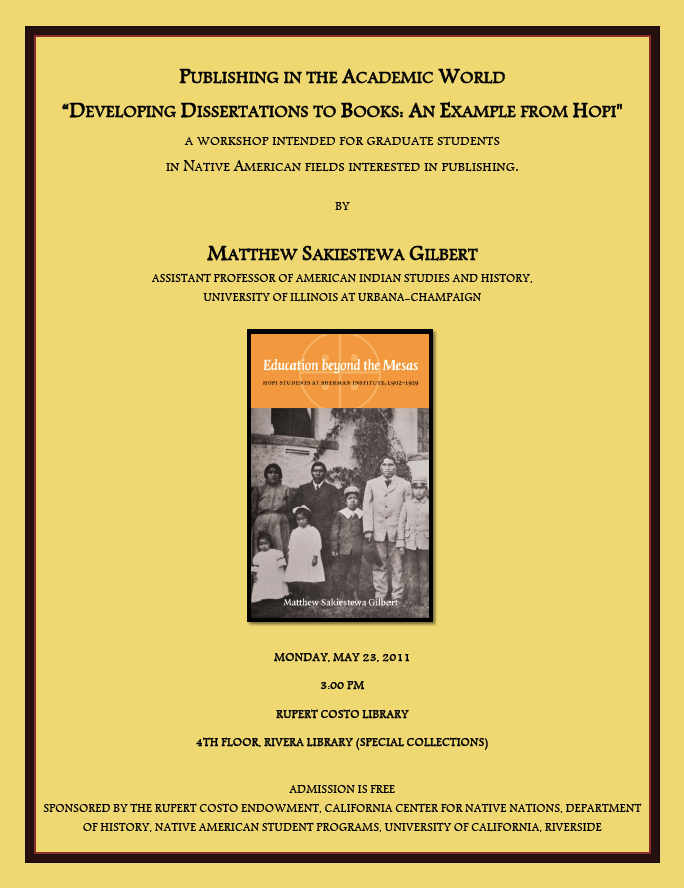
 I recently returned from a trip to California where I presented a paper titled “Hopi Marathon Runner Louis Tewanima and the Olympic Games, 1908-1912” at the Native American and Indigenous Studies Association conference in Sacramento. I also heard a great presentation by Hopi educator and scholar Darold H. Joseph from Moencopi titled “Re-Centering Indigeneity: Culturally Responsive Schooling Practices for American Indian and Alaskan Native Youth.” Darold is a Ph.D. candidate in Special Education at the University of Arizona. After the conference ended on May, 22, I traveled to the University of California, Riverside, to give two talks, one of which was titled “Publishing in the Academic World: Developing Dissertations to Books, An Example from Hopi.” Both events were sponsored by the California Center for Native Nations. I spent my remaining time in Riverside conducting research at the Sherman Indian Museum.
Tag: Hopi scholarship
Hopi scholars publish articles
I am pleased to report that Hopi scholars Sheilah E. Nicholas of the University of Arizona and Lomayumtewa C. Ishii of Northern Arizona University recently published the following articles:
Nicholas, Sheilah E., “Language, Epistemology, and Cultural Identity: ‘Hopiqatsit Aw Unanguakiwyungwa‘ (‘They Have Their Heart in the Hopi Way of Life’)”, American Indian Culture and Research Journal, 2010, Vol. 34, No. 2, pp. 125-144.
This article provides an in-depth “on the ground” look at the Hopi language shift—“becoming accustomed to speaking English”—through the lenses of the study participants who represent the youth, parent, and grandparent generations. The article also gives attention to Hopi oral tradition and the Hopi identity-formation process in order to articulate the link among language, epistemology, and identity, spotlighting what of the traditions, practices, and religion remain salient and why they remain salient. [p. 127]
Ishii, Lomayumtewa C., “Western Science Comes to the Hopis: Critically Deconstructing the Origins of an Imperialist Canon,” Wicazo Sa Review, Fall 2010, Vol. 24, No. 2, pp. 65-88.
The number of western texts written about Hopi culture is enormous. The work of Jesse Walter Fewkes, beginning in the 1890s, marks a key starting point in the articulation of a western perspective of Hopi culture, initiating a canon rooted in nineteenth-century anthropological thought. Fewkes’s work also illustrates how the establishment of a “cultural archive” was pragmatically related to his research, which included excavations of Hopi sites (notably the village of Awatovi), as well as through his personal commentary. This article examines nineteenth-century anthropological theory, Fewkes’s employment of that theoretical orientation, and how his work established the foundation of a “cultural archive” that constitutes a canon in the study of Hopi culture. But more importantly, by critically reading these texts a decolonization process reveals a western imperialistic mind at work. [p. 65]
Hopi runners article available for download
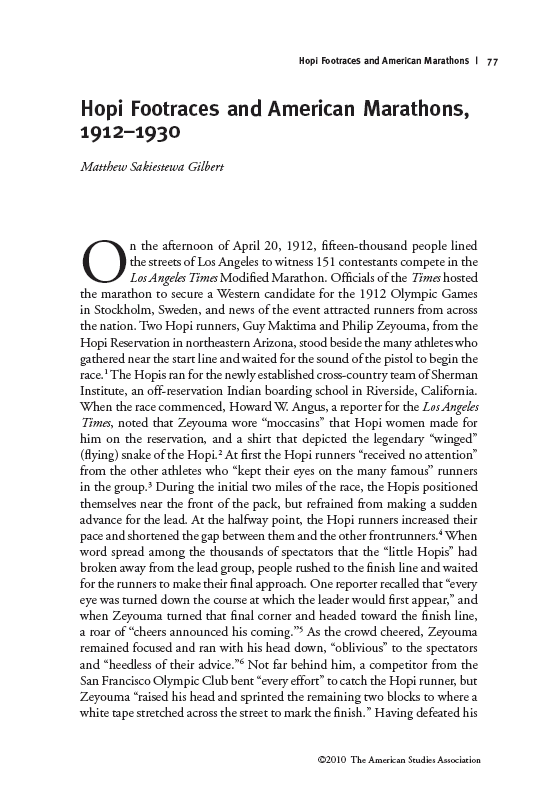
Over the past year, several people have stumbled across my blog looking for information on Hopi runners. For those who might be interested, I have made my article “Hopi Footraces and American Marathons, 1912-1930” (American Quarterly, March Issue 2010, Vol. 62, No. 1, pp. 77-101) available for download. Simply click on the above image to download the article as a PDF document.
Matthew Sakiestewa Gilbert
Education beyond the Mesas: Hopi Students at Sherman Institute, 1902-1929 (University of Nebraska Press)

On Monday of this week the University of Nebraska Press released my book Education beyond the Mesas. My book examines the Hopi experience at Sherman Institute in Riverside, California, from 1902 to 1929. It is a story of resistance, accommodation, and ways Hopi pupils navigated within their village communities, U.S. government policies, and an institution that was designed to destroy their identities as American Indian people. Furthermore, my book is a story of agency, and it demonstrates how Hopi students used their culture to succeed at school, and examines the challenges the pupils faced when they returned to their homes on the reservation.
Thirty one years ago historian David Wallace Adams remarked that a “ study on the federal Indian boarding school system does not exist.” Today the field of Indian boarding schools has grown substantially with contributions from scholars such as Adams, K. Tsianina Lomawaima, Brenda Child, Clyde Ellis, and many others. Recent studies have focused on Indian health, literature, education policies, and the ways Indian pupils “turned the power” at schools originally designed to destroy American Indian cultures. A term used by historians Clifford E. Trafzer, Jean Keller, and Lorene Sisquoc, “turning the power” describes the ability of Native students to turn their educational experiences to their advantage, which often included bringing helpful knowledge and skills back to their indigenous communities.
In my book I examine the ways Hopis “turned the power” at Sherman Institute, and I build upon the work of several scholars including those who have written about the mandatory enrollment of Hopi students at U.S. government schools. While many books on Indian boarding schools examine the experiences of Native students who came from several communities, Education beyond the Mesas is a community specific book that seeks to understand the Hopi experience at Sherman Institute through a Hopi historical and cultural framework. In the book’s Introduction, I argue that a community specific book on the Hopi places
the history and culture of the Hopi people at the focal point of the narrative. It asks how a student’s culture and tribal history influenced their experience at an Indian school, and builds upon the contributions of other scholars to uncover the complex ways that Hopi history and culture intersected with U.S. government policies. Apart from providing the reader with a historical narrative, this book challenges the notion that a study on the Indian boarding school experience must be understood primarily through a defined framework of Indian education policies. Community-specific books begin with the history and culture of Native people and attempt to determine how students understood their unique experiences at Indian boarding schools as Zunis, Navajos, Apaches, or other Indian people. [Education beyond the Mesas, p. xxix]
I would not have been able to complete this book without the help and support of many individuals. I am especially thankful to my wife, Kylene, and our daughters Hannah, Meaghan and Noelle, and other family members. My colleagues at the University of Illinois, in both the American Indian Studies Program and the Department of History, have provided me with tremendous support since I arrived at Illinois in Fall 2006.
I further extend appreciation to the Hopi Cultural Preservation Office, the Hopi Education Endowment Fund, and the Hopi Tribe Grants and Scholarship Program who so generously made available resources for me to pursue an education beyond the mesas. There are also many Hopi and non-Hopi scholars, students, and community members who have helped and encouraged me along the way, which includes the incredible editorial staff at the University of Nebraska Press. Finally, I wish to acknowledge my grandfather, Victor Sakiestewa, Sr. from Upper Moencopi, who gave me the inspiration and reason to write on his alma mater, “dear ole Sherman.”
Matthew Sakiestewa Gilbert
Receive 20% off EDUCATION BEYOND THE MESAS
Receive 20% off each copy of Education beyond the Mesas: Hopi Students at Sherman Institute, 1902-1929, if you order from the University of Nebraska Press. Mention promotion code 6AF10 to obtain the discount. For more information, please click on the following link to download the book’s promotional flyer: Education beyond the Mesas – flyer
Matthew Sakiestewa Gilbert
A Hopi runner and his marathon trophy

Most people who visit the Sherman Indian Museum in Riverside, California, see this first place trophy without knowing who won it. Marathon officials did not engrave the athlete’s name on the trophy, but they did include the date and the event, which was the Vallejo Pre-Olympic National Marathon held in California on December 22, 1929.
At one point in the school’s history, the student’s at Sherman Institute knew who won this award. But as time passed, the trophy, one of the largest in the Museum’s collection, became disassociated from its owner.
The trophy belongs to Hopi runner Harry Chaca from the village of Polacca on First Mesa. He was among the great Hopi runners of the twentieth century. Chaca attended Sherman in the 1920s and early 1930s and he earned several marathon honors while a student at the school.
I wrote about Chaca and his victory of the 1929 Vallejo Pre-Olympic National Marathon in my article “Hopi Footraces and American Marathons, 1912-1930” (American Quarterly, March 2010). I note that prior to this event, Chaca had won other prestigious marathons and his reputation as a great runner spread far beyond the United States.
In Japan, for example, a runner named Yoshikio Sudsuki heard that Chaca was the best runner in America and so he traveled to the U.S. for the sole purpose of competing against the Hopi from Polacca. But at the 1929 Vallejo Pre-Olympic National Marathon, Chaca’s speed and endurance proved too much for the forty-nine year old runner from Tokyo. In my article I write that the
Hopi runner ran at a “killing pace to win” the full marathon in two hours, forty-one minutes, and twenty-five seconds, a “full second better than the performance of Alpien Stenroos” in the 1924 Olympic Games in Paris. One of the fifty thousand spectators of the marathon recalled that Chaca’s “victory” was “all the more noteworthy for his sensational finish. After trailing for twenty-three miles it was at that mark that he applied a final burst of speed that sent him ahead” of Hopi runner Franklin Suhu. In addition to winning the race, Chaca set a new American marathon record, which immediately confirmed his place as the top long-distance runner in the nation. [p. 91]
Shortly after Chaca’s marathon victory, school officials took his trophy and displayed it in a large cabinet located in Sherman’s administration building (now the Sherman Indian Museum). According to school administrators, all individually won trophies belonged to the school.
At times Hopi students attempted to obtain their trophy cups after their terms at Sherman had expired. During the 1940s, for example, Hopi runner Philip Zeyouma asked the school’s superintendent if he could reclaim his trophies (pictured on the front cover of American Quarterly), but school officials refused to honor his request.
More than eighty years after Chaca won the Vallejo Pre-Olympic National Marathon, his trophy remains at the Sherman Indian Museum. Although government officials consider the award to be property of the Bureau of Indian Affairs, the trophy will always belong to Harry Chaca and his family.
Matthew Sakiestewa Gilbert
Tenure and promotion awarded to Hopi historian
I am pleased to report that Hopi historian Lomayumtewa C. Ishii has been awarded tenure and promotion to Associate Professor of Applied Indigenous Studies & History at Northern Arizona University (NAU). Ishii received his B.S., M.S., and Ph.D. in history from NAU in 2001. During his doctoral program, he was also awarded the prestigious Ford Foundation Dissertation Fellowship.
In 2002, Ishii became a postdoctoral fellow of Native Studies at the University of Iowa and a year later he returned to NAU as a Visiting Assistant Professor of Applied Indigenous Studies. He began his tenure track appointment at NAU in 2004.
Ishii has taught courses on various topics, including American Indian history, Native representation, indigenous-centered historiography, and the American Indian post-colonial experience. His scholarship has appeared in several venues, including the Wicazo Sa Review, the Indigenous Nations Studies Journal, and in edited volumes.
For more information, please visit the following website:
http://navajohopiobserver.com/Main.asp?SectionID=1&SubSectionID=1&ArticleID=12475
Matthew Sakiestewa Gilbert
 BEYOND THE MESAS, LLC
