Hopi Runner Completes Boston Marathon

My foreword to Kevin Whalen’s Native Students at Work: American Indian Labor and Sherman Institute’s Outing Program, 1900-1945

Screenshot 2016-05-10 12.56.26

Foreword

Matthew Sakiestewa Gilbert

University of Illinois at Urbana-Champaign

Six years ago, I received an email from my former graduate advisor Clifford Trafzer about a student named Kevin Whalen, who was conducting research on Sherman Institute, an off-reservation Indian boarding school in Riverside, California. Although Cliff had written to me about his students in the past, his enthusiasm for this student, coupled with my interest in Sherman, caused me to take special notice of Kevin and his work. At the time of Cliff’s email, he and I were putting together an edited collection on Sherman with Oregon State University Press, and he wanted me to consider including Kevin’s essay in our book, a chapter he had written entitled “Labored Learning.”

In the academy it is common for established scholars to “guard turf” and to be critical of others who do work in their area of research. All junior faculty experience this to some degree, and even I allowed this mentality to influence my initial thoughts about Kevin. Who was this “star,” as Cliff described him, and what more could he possibly add to what I had already done? While these were my original reactions to Cliff’s description of Kevin, my opinion of him quickly changed once I began reading his essay. It took only a few pages into his chapter for me to realize that his work was too good, and his writing too polished, for me to deny that there was something unique and special about him and his project.

In the chapter that Kevin wrote for our collection, he explained that beginning in the early 1900s, officials at Sherman sent Native students off-campus to work as domestic servants, ranch hands, and many other occupations. He noted how school superintendents and local farmers and ranchers used the agricultural industry of Southern California to further deeply held U.S. government assimilation goals and to fill the region’s labor needs. And he explored the reasons why Indian students agreed (and often requested) to work “beyond” the “school walls” at places such as the Fontana Ranch, and at the many citrus orchards in the greater Riverside area. Although I had written about Hopi students who participated in the school’s Outing Program in my book Education beyond the Mesas, Kevin took the conversation of Indian labor at Sherman to a different level. Even at this point, I could see that he was establishing himself as an authority on Sherman and Indian labor at off-reservation Indian boarding schools.

While Kevin and I share an interest in Sherman Institute and Indian boarding school histories in general, there are other areas in our career trajectories that we have in common. We both graduated from the same PhD program, and we were mentored and taught by the same faculty, including Cliff and Ojibwe historian Rebecca “Monte” Kugel. As graduate students at the University of California, Riverside, we learned the importance of working with Native communities, and not just writing about them. Our professors taught us the value of contributing something useful to Indian tribes, and they urged us to consider how our research could benefit Native communities.

In many ways, the education that we received in Native history at UC Riverside was a combination of the theoretical and the practical. Familiarity with archives and the process of honing skills needed to analyze documents was only part of our training. Cliff and Monte also encouraged us to leave the comforts of campus and interact with and work alongside Native people. Kevin certainly experienced this. As a graduate student, he regularly accompanied Cliff to community gatherings on and off Indian reservations in Southern California, including the Colorado River Indian Tribes. And he interviewed numerous individuals for his book, including the director of the Sherman Indian Museum, Lorene Sisquoc, and former Sherman student Galen Townsend, to name a few.

After Kevin completed his PhD from UC Riverside, he became my colleague at the University of Illinois at Urbana-Champaign and continued working on his book as a Chancellor’s Postdoctoral Fellow of American Indian Studies. At the time, the American Indian Studies Program was at the center of a major national and international controversy surrounding the university’s dehiring of the program’s new faculty member Steven Salaita. Although he had just arrived on campus, Kevin stood by my colleagues and me as we protested the university’s decision and demonstrated our commitment to shared governance and academic freedom. Nobody expected Kevin to join the fight, but he eagerly engaged in the protests, and soon it became clear to all that our struggle had also become his struggle.

While Kevin found himself in the middle of a highly politicized situation, and one that required huge amounts of time and energy from the program, he did not allow it to distract him from his major research project. In fact, nearly every time I walked into his office, he was revising some aspect of his book. Whether he was agonizing over external reader reports or adding new material to chapters, Kevin was always working. He gained valuable insights from faculty, including our director, Robert Warrior, and twice participated in writer workshops where colleagues and graduate students critiqued his work and offered suggestions on ways to improve it. During his yearlong fellowship at Illinois, Kevin and I also spent hours together—usually over a meal, coffee, or a craft beer—talking about his book. We had long conversations about the field of American Indian studies, the growing literature on Indian boarding school studies, and the important contributions that he was making with his scholarship.

The following book, then, has emerged from numerous spaces, and each of these spaces has influenced Native Students at Work in unique ways. They have all done their part to transform what started as a chapter of an edited collection into the present volume. Kevin will no doubt write other books. He may even one day write a second book on Sherman or some other aspect of Indian boarding schools. But for me, this book will always remain special. Not many scholars get an opportunity to help shepherd a project along from its infancy to publication. I did just that, and I remain grateful to Kevin for allowing me to accompany him on this journey.

Spending time with my dad on Second Mesa

2015-09-05 19.40.00 copy

Last month I spent time with my dad, Willard Sakiestewa Gilbert, on Second Mesa. As some readers know, I often write and speak about his influence on my life and career. [See my post “Job Shadowing my Father, and my Path to Tenure”]

He, along with my mom and other members of my family, accompanied me to the Village of Shungopavi where I gave a talk on Hopi runners at the Louis Tewanima Footrace Pre-Race Dinner.

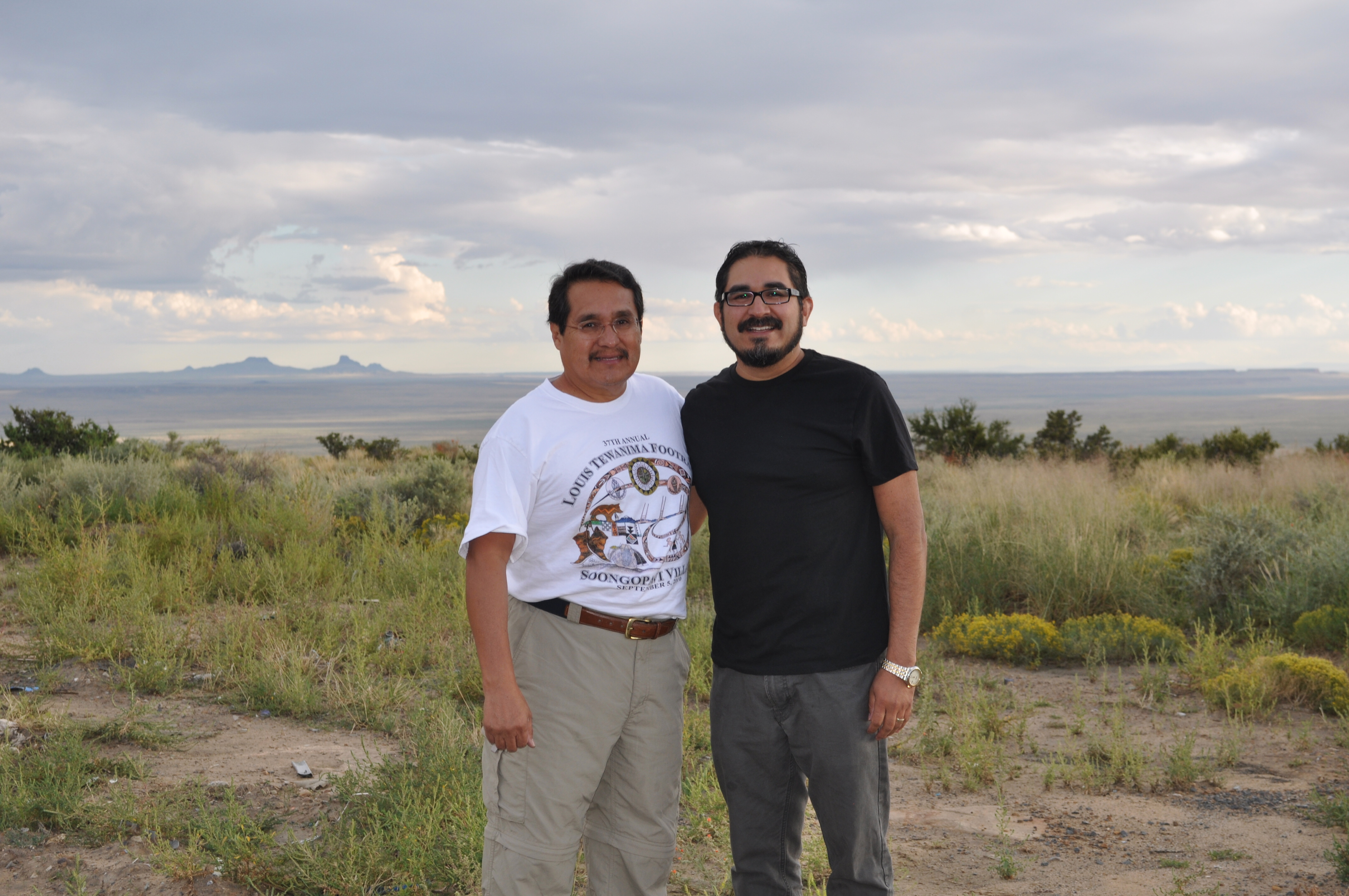
The photograph above is of me standing with my dad – right before I went inside the Shungopavi Community Center to present (below).

A special thanks to Sam Taylor and the Louis Tewanima Association for the opportunity to participate in their event.

2015-09-05 20.16.44 copy

Paatuwaqatsi Run featured in Indian Country Today

“This is Screenshot 2015-09-02 08.53.36 copynot a race…It’s a remembrance run to keep the ancient trails alive.” – Bucky Preston, Village of Walpi

“It’s a monument to community, heritage, and preservation.” – Kim Secakuku

There’s a nice write-up about the Paatuwaqatsi – Water Is Life – 30 mile Hopi run in yesterday’s Indian Country Today. The article highlights Hopi understandings of running, and reminds Hopi and non-Hopi people of the “spiritual and cultural” purpose of running in Hopi culture. The event, which includes the 10 mile loop, will take place on September 12 at the Village of Polacca. For more information about the run, click here. Also, click on the following link to read the entire article by Lee Allen entitled “Hopi Run for Life Celebrates the Sanctity of Water.”

Upcoming talk on Hopi runners at Tewanima pre-race dinner

For those who might be interested….

I will be speaking on Hopi runners and U.S. marathons at this year’s Louis Tewanima Footrace Pre-race “carb” dinner. The event will take place at the Shungopavi Community Center – Village of Shungopavi, Hopi REz – Saturday Sept. 5 @5PM MST.

I first presented at the Pre-race dinner in September 2012. Cindy Yurth of the Navajo Times did a nice write-up about the 2012 presentation and race in her article “Tracking Tewanima.” I blogged about it here.

I look forward to seeing some of you at the event!

Beyond the Mesas exceeds 100,000 clicks!

This week Beyond the Mesas exceeded 100,000 clicks since it was launched in November 2009. To mark this milestone, I thought I would publish a Q&A that I participated in for the First Peoples New Directions website in 2012. The Q&A covers a variety of topics related to blogging and my reasons for blogging as a Hopi person. The original post can be accessed here.

————————————–

Beyond the Mesas: A Q&A with Blogger Matthew Sakiestewa Gilbert

September 17th, 2012 – Posted by Natasha Varner

Hopi scholar and University of Illinois at Urbana-Champaign professor, Matthew Sakiestewa Gilbert has been maintaining his blog, Beyond the Mesas, for nearly three years. In his posts, he integrates his research on education and running with issues of Hopi politics, sovereignty, and self-determination. Last August, we included his blog in our roundup of Indigenous blogs to follow because of his admirable efforts to make scholarly research accessible to a broader public that included his home community. Today, Dr. Sakiestewa Gilbert discusses how he got into blogging, his objectives in keeping the blog going, and some suggestions for others thinking of starting their own blogs.

What motivated you to start the blog?

I wanted a place to share my research with people on and off the Hopi Reservation. Throughout graduate school, and my first three years at the University of Illinois, I made my research available to people back home by publishing articles in the Hopi Tutuveni, the official newspaper of the Hopi Tribe. However, when the Hopi Tribe announced that the Tutuveni would close in December 2009, I had to come up with an alternative way to bring my work back to Hopi. I also wanted to create a space where the public could access reliable information on the Hopi people. There are a lot of bizarre websites on the Hopi, most of which focus on Hopi prophesies and spirituality. But these websites do little (if anything at all) to inform people about Hopi issues today.

Has your blogging purpose or engagement with your readership changed over time? If so, how?

Over the years I’ve tried to focus my blog posts on topics pertaining to Hopi sovereignty, self-determination, running, education, and photography. While I originally started blogging to share my research with the public, I also use it as a platform to showcase the work and accomplishments of other Hopi scholars. This part of my blog is really important to me. For example, when Hopi scholars Angela Gonzales (Cornell University) and Lomayumtewa C. Ishii (Northern Arizona University) received tenure and promotion at their respective institutions, I announced it on my blog. I also do this when Hopis publish articles or chapters in books. However, I don’t just highlight the work of Hopi scholars. A quick glance at my blog will reveal posts on Hopi artists, educators, preservationists, and various community leaders. The day my blog becomes all about me is the day I shut it down.

You don’t shy away from engaging in Hopi politics on your blog; could you talk a bit about why you chose to get involved in political issues and what that entails for you?

My posts on Hopi politics receive the most attention from readers. Depending on the post, I can receive up to 200 hits or more per day, especially if the post is about Hopi or Navajo water rights. Earlier this year, federal officials, and some members of the Hopi Tribal Council, attempted to pass the Navajo-Hopi Little Colorado River Water Rights Settlement Act. Of course, this was/is an extremely important topic for our people, and I didn’t hesitate to use my blog to share information about the Legislation with Hopis and the public. I also received a lot of help with my efforts. Hopi grassroots organizers such as Benjamin Nuvamsa provided me with information for my blog, and even officials with the Hopi Tribe sent me materials to share with my readers. Although I made it clear on my website that I opposed the proposed legislation, I was happy to make my blog available to both groups. I was also glad to provide people with materials to help them make a more informed decision about the Act.

Why do you think it’s important for scholars to keep blogs that are accessible and useful to the general public and, specifically, to Indigenous communities?

We have a responsibility to our Native communities. We have an obligation to bring our research to our people in meaningful and useful ways. However, many back home will never have access to our publications. To make our research more accessible to Native communities or the general public, we need to look beyond scholarly journal articles and books to find other ways to disseminate this information. We need to consider using social networks such as Facebook, Twitter, and blogs. At this point in my life, I’m not able to make frequent trips back to the Hopi Reservation. But I’ve been able to stay connected to home through my blog. People back home know what I’m up to. They are able to see how I’ve used my education – an education that the Hopi Tribe generously funded through the Hopi Tribe Grants and Scholarships Program and the Hopi Education Endowment Fund. Also, in comparison to other Native bloggers, I came to the world of blogging late. Several Native scholars had already made their research available to readers on their websites, including Debbie Reese, Julia Good Fox, and Deborah Miranda. This is in addition to more recent blogs by Hopi scholars Angela Gonzales and Trevor Reed.

Do you have any advice for other scholars thinking about starting blogs?

Find a mentor, especially early on, to help you navigate the world of blogging. I was fortunate to have Debbie Reese there to help if I had questions about blog content or the more technical aspects of blogging. Also, don’t give up on your new blog prematurely. When I started blogging, I told myself that regardless of how many views my blog received per day, I would commit to blogging for six months. Once six months passed, I reevaluated my desire to blog, and the usefulness of my website. It’s very easy to get discouraged as a new blogger. You wonder if all the time and effort you put into blogging is worth it, especially when the activity on your blog is down. But you have to keep the big picture in mind. You have to give your blog time to grow. And you have to give your readers time to value your blog and its content.

And some logistical questions: About how many hours do you spend maintaining the blog each week? What platform do you use? Did you have any formal training or did you just start blogging?

I usually spend four to five hours a week maintaining my blog. Sometimes I spend 10 hours or more, especially if I’m working on a post that requires a lot of thought. Other time is spent responding to comments or emails, updating web links, and searching the Internet for blog related information. I also pay close attention to my blog stats, which provide information on the terms people use to find my blog, the general geographical location of my readers, and the number of hits I receive on any given post. This helps me to gauge what people are interested in, and it gives me ideas about future articles for my blog. The blogging platform that I use is WordPress.com, which is a powerful and yet easily accessible host. While blogging with WordPress is free, I pay annual fees for my website domain name, and the ability to customize the website’s Cascading Style Sheets (CSS), which allows me to manipulate the website in various ways. I had no formal training before I started my blog. I watched several WordPress tutorials on-line, and took advantage of other videos on YouTube.

Has the blog opened any doors for you or shaped your research or teaching in any unexpected ways?

Since launching my blog in 2009, I started assigning blog assignments in a few of my classes. In lieu of a research paper, I give my students an opportunity to maintain a blog on issues pertaining to the course. I require my students to post twenty times throughout the semester. Blog posts must be well-written, interesting, thought provoking, and no less than 250 words in length. By using my blog as an example, I have my students focus their posts on topics that pertain to Native sovereignty, representation, decolonization, and Indian self-determination. The blog assignment encourages an atmosphere of learning, teaching, and mutual respect among my students.  It also gives my students an opportunity to publish responsibly, to avoid commonly held Native stereotypes in their own writing, and to engage the public intellectually.

What’s the most surprising or meaningful feedback you’ve ever gotten about your blog – either as a comment on the site or delivered to you in person?

I always appreciate it when people let me know that they find my blog interesting or useful. Sometimes I get emails from young students (6th grade, middle school, high school), who stumble across my blog as they search for information on the Hopi for their school projects. They occasionally send me short questionnaires to fill out on Hopi history and culture, which I’m happy to do. Hopi people also regularly submit comments on my blog. One of the comments took place after I published a post on Hopi runner Harry Chacca (Chaca, Chauca) from the village of Polacca on First Mesa. Chacca won numerous events while competing for the cross-country team of Sherman Institute in Southern California. When his granddaughter, Cheryl Chaca, read my post, she commented about how pleased she was to learn about her grandfather’s running accomplishments and wished “he could have read” the post himself. However, the most meaningful comment came from my oldest daughter, Hannah, who at the time was seven years old. One morning, I heard the words “If so, please consider…” coming from our living room. I looked around the corner, and to my surprise, I saw my daughter sitting with my iPad on her lap. My blog was open on the screen. When I asked what she was doing, she simply replied, “I’m learning about Hopi.”

Matthew Sakiestewa Gilbert is an enrolled member of the Hopi Tribe from the village of Upper Moencopi in northeastern Arizona. He is an [associate] professor of American Indian Studies & History at the University of Illinois at Urbana-Champaign and a co-editor of the forthcoming Oregon State University Press/First Peoples volume,  The Indian School on Magnolia Avenue: Voices and Images from Sherman Institute (December 2012). Sakiestewa Gilbert is also the author of Education beyond the Mesas: Hopi Students at Sherman Institute, 1902-1929 (University of Nebraska Press, 2010). He is currently completing a book entitled Hopi Runners: Crossing the Terrain between Indian and American, 1908-1932, which is under contract with the University Press of Kansas (CultureAmerica Series).
“A Second Wave of Hopi Migration” (History of Education Quarterly, August 2014)

A short response essay I wrote entitled “A Second Wave of Hopi Migration” was recently published in the History of Education Quarterly (Volume 54, No. 3, August 2014), the flagship journal of the History of Education Society.

The article is part of a special edition on Indian education histories that was edited by Adrea Lawrence,  Donald R. Warren, and KuuNUx TeeRit Kroupa. In addition to the editors, various scholars contributed to this collection, including K. Tsianina Lomawaima, David Wallace Adams, Milton Gaither, Yesenia Lucia Cervera, and Bryan McKinley Jones Brayboy (click here for the Table of Contents).

In my essay I note that historians have primarily interpreted the American Indian boarding school experience through a frame of Indian education policies and discussions of assimilation and acculturation. But I argue that there is perhaps a more nuanced way of understanding the education history of Indigenous people.

By using my grandfather Lloyd (Quache) Gilbert as an example, who attended the Phoenix Indian School in the 1940s and early 1950s, I instead highlight the value and importance of utilizing Native ways of understanding to interpret Hopi and other American Indian education histories.

I also discuss and critique the U.S. government’s name changing policy, and explain how school officials required my grandfather (and his siblings) to change his surname from “Quache” (“friend” in the Hopi language) to the English surname “Gilbert.”

The complete essay can be downloaded by clicking the image below.

Screen shot 2014-08-01 at 10.54.52 AM

Those aren’t weeds, they’re dandelions!

Screen shot 2014-05-17 at 9.41.39 PM
My “serious weed problem”.

The other day my doorbell rang.

When I answered the door, I saw a gentleman standing on my porch. He seemed eager to greet me.

“Hello, sir, I am a representative from TruGreen lawn care services.”

“Ok,” I replied, gesturing for him to begin his well-rehearsed sales pitch on the latest fertilizers and lawn chemicals.

“I see that you have a serious weed problem in your lawn”, he remarked.

“Oh, those aren’t weeds, they’re dandelions, and I think they’re beautiful,” I told him. “Just look at how yellow and pretty they are.”

“Are you serious?” he asked me.

“Yeah, I’m serious. And if I could plant more in my yard I would.”

Not knowing what to make of my comments, the salesman, who had initially approached me with much confidence in his arsenal of anti-weed products, now seemed perplexed.

And just as quickly as he appeared on my porch, he wished me a good day, turned around, and walked away.

Two Hopis to compete in the Boston Marathon

Pre-race photo of Caroline Sekaquaptewa and Steven Ovah, 2014 Boston Marathon
Pre-race photo of Caroline Sekaquaptewa and Steven Ovah, 2014 Boston Marathon – Photo courtesy of Caroline Sekaquaptewa

This morning Hopi runners Caroline Sekaquaptewa and Steven Ovah will compete in the Boston Marathon! The Elite Women’s Division will begin at 9:32AM (ET), and the Elite Men’s Division will start at 10:00AM (ET). You can follow the marathon live at http://universalsports.com/. This is a big deal for Hopi. It’s not every year that runners from back home have an opportunity to represent our people in this event!

Past Hopi chairman responds to allegations

Screen shot 2014-04-02 at 3.17.59 PM
Bronze bust of Louis Tewanima at the 2010 Louis Tewanima Memorial Footrace. Photograph by Matthew Sakiestewa Gilbert

Last week Felicia Fonseca of the Associated Press alerted me to a story that she was writing about a criminal complaint made by Anna Mae Silas, Gibson Namoki (BIA Police Officer), and the Hopi Museum. The complaint alleged that past Hopi chairman Benjamin H. Nuvamsa of Shungopavi had stolen a bronze bust of famed Hopi runner Louis Tewanima.

Although I don’t know all the details in this case, I find it hard to believe that Nuvamsa would steal the bronze bust of his grandfather. In fact, the whole case seems a bit bizarre, and it leaves me with a lot of unanswered questions: What could Nuvamsa possibly gain from stealing this bust? Why did an individual – who appeared to be a Museum staff – help the former Hopi chairman load the bust in Nuvamsa’s vehicle, and then, six months later, assist  Silas, Namoki, and the Hopi Museum in filing a complaint against him in Hopi tribal court?

For those who have frequented Beyond the Mesas over the years, you know that I have a lot of respect for Nuvamsa. You also know that I greatly appreciate his activist work back home. Of course, it’s my hope that this will all be cleared up soon so that we can get back to focusing on Tewanima’s running legacy, and the inspiration his life and accomplishments have been for so many Hopi and non-Hopi people.

To learn more about the allegations against Nuvamsa, read Fonseca’s newspaper article “Ex-Hopi chairman charged with Olympian bust theft”. See also Nuvamsa’s response to the allegations below.

—————————–

March 31, 2014

How Can It Be Theft?

This is my response to the baseless “Theft” charge filed against me by Anna Mae Silas, Gibson Namoki (Bureau of Indian Affairs Police Officer), and the Hopi Museum on the alleged “theft” of a bronze bust of our famous Olympian, Louis Tewanima.

Section 3.8.4 of the Hopi Law and order Code defines “THEFT” as: “A person who knowingly takes or controls the property or services of another person without consent of the owner or other proper legal authority, is guilty of an offense”.

An essential element of the crime that has to be proven by the Tribal Prosecutor, beyond a reasonable doubt, is that the Tewanina bust was taken “without the consent of the owner or other proper legal authority.”

Here are the facts I intend to present in my defense. Louis Tewanima, from Shungopavi Village, was a great Hopi runner. He was an Olympian. He and the famous Jim Thorpe represented the United States of America at the 1912 Olympics in Stockholm where Tewanima won the Silver Medal in the 10,000 meters, setting a U.S. record for 10,000 meters. He also ran the marathon in the London Olympics in 1908. Louis Tewanima was inducted into the United States Olympic Hall of Fame; and to the Arizona Sports Hall of Fame. Tewanima is our grandfather. I grew up with him in the same house at Shungopavi.

Every Labor Day, since 1974, we celebrate the accomplishments of my grandfather, Louis Tewanima, at the Annual Tewanima Footraces. See http://www.tewanimafootrace.org/ for more information about the annual Tewanima Footrace. Each year our families, and race organizers, would bring his trophies and pictures to the races to honor his accomplishments and for public display. A bronze bust of Louis Tewanima has been displayed at the annual races in recent years. Shortly before the 2013 races, I visited the Taylor family of Shungopavi (members of the Association and relatives of Tewanima) and inquired how I could help with the race. They talked about displaying the bust at the 2013 annual footrace. We agreed that I could help the race organizers by going to the Hopi Museum and obtaining the bust to be displayed during the 2013 footrace. I asked where the bust is kept and was told that it was at the Hopi Museum, at the Hopi Cultural Center.

On August 29, 2013, during museum regular business hours, I went to the Hopi Museum to obtain the Tewanima bust on behalf of the race organizers. Anna Mae Silas was not there. However, her brother, Matthew Silas, Jr., was there tending to the museum’s business. Because he appeared to be “tending the store” and appeared to me as a museum employee, I told him the purpose of my visit. He said “Ok, it’s back here” and walked me over to where the bust was displayed. He said “It’s real heavy … let me carry it for you”. But I said, “I think I can lift it”.

I picked it up and Mathew Silas opened the museum door and helped me load it into my personal vehicle. Mathew Silas never tried to stop me from taking the bust. He never told me I had no right to take it or that I was doing anything improper or illegal. To the contrary, Mathew’s actions, by showing me the location of the bust and helping me load it into my vehicle, indicated to me that I was doing nothing wrong, illegal or criminal and that the Hopi Museum, as it had in the past, was allowing the bust to be in the temporary possession of the Tewanina race organizers for display at the upcoming race. I then went to the Taylor residence and dropped the bust off at their house so that it could be displayed at the race. That was the last time I saw the bust.

I had no criminal intention of stealing the bust or taking it without the museum’s consent. Had Mathew Silas told me not to take it, or that he would call the police, I would have left the museum without borrowing it. All appearances that day lead me to believe that Mathew Silas was an employee of the Hopi Museum and he allowed me to take the bust. When I explained to Mr. Silas the reason why I wanted to borrow the bust, he understood and showed me where the bust was displayed. In fact, he helped me load the bust in my vehicle. If I intended to steal the bust, why would I steal it in broad daylight, during museum hours while the museum was open, and in front of, and with the help of Mathew Silas, a museum employee, then drop it off at the Tayler residence for them to use during the race?

If this was truly a case of theft, why did it take the Hopi Museum, Anna Mae Silas, Mathew Silas, Jr., and BIA Police Officer Gibson Namoki six (6) months to file the criminal charge against me? According to the criminal complaint, the alleged theft occurred on August 29, 2013, yet, the Criminal Complaint was not filed until February 24, 2014 – six months later. Did it actually take the BIA Police, Hopi Museum, Anna Mae Silas and Mathew Silas six (6) months to investigate and decide that I had stolen the bust? Or, are there other ulterior motives and reasons for filing this baseless charge against me, and publicizing it to disgrace me in public?

If I am to be charged with theft of the bust, then shouldn’t Mathew Silas, Jr. also be charged as a co-conspirator because he showed me the location of the bust, opened the museum entrance door as I carried it out and helped me put it in my car?

The story about the arrest warrant that was issued against me is even more confusing. After the complaint was filed on February 24, 2014, the court claimed it mailed me a Notice to Appear (Summons) in Hopi Court for arraignment on March 10, 2014. The Court mailed the summons to a Mesa, Arizona address that I have not used in over eight years. In other words, an old address. My present mailing address is in Pinetop, Arizona. Naturally, since the summons was mailed to an eight-year old address in Mesa, I did not receive the notice. I, therefore, was unaware that I was to appear in Hopi Court on March 10th. When I did not appear in court on March 10th, Hopi Chief Judge Jess Lorona issued a warrant for my arrest. I had no knowledge of theft complaint, the summons to appear in court on March 10th, or the arrest warrant. I did not

receive word about these matters until I was contacted by news reporter from Flagstaff, and was asked to respond to the theft complaint and arrest warrant. I immediately contacted a lawyer and we arranged to quash and set aside the arrest warrant and the court would send me new summons where I am to appear in Hopi court on April 8, 2014. I will appear at every court hearing to fight this ridiculous theft charge.

I only hope that the Tribal Prosecutor, BIA Police, Hopi Museum and Anna Mae Silas will come to their senses and find the courage and wisdom to drop and dismiss this ludicrous theft charge and save everyone (Prosecutor, Police, Court and me and my family) time, money, embarrassment and other tribal resources in pursuing a matter that has no supporting evidence or merit.

Publicizing this baseless theft charge in the local, regional and national papers was only a futile attempt to disgrace me, but it now raises a lot of serious questions that must be answered.

In closing, there are many good Hopi people that have stepped forward and offered to testify on my behalf, including witnesses who saw Mathew Silas, Jr. helping me load the bust into my vehicle; and members of the Louis Tewanima Association.

Benjamin H. Nuvamsa

Village of Shungopavi – Bear Clan

Former Hopi Tribal Chairman