Hopi XC team wins 23rd consecutive state championship (12 News)

Picture 10

Here’s a story that 12 News in Arizona ran earlier this month on the Hopi High School boys cross country team. They recently won their 23rd consecutive State championship, and the Hopi High girls cross country team won their sixth State title.

In the early 1900s, newspaper reporters and their illustrators often gave bizarre reasons why Hopis did so well in running events.

Some said that Hopis excelled in running because they had once been chased by Spanish vaqueros (cowboys), and rather than fighting the Spaniards, the Hopis chose to run away.

Hopis had supposedly done this so many times that they became great runners.

Well, needless to say, I was quite pleased to see that the reporter for 12 News focused her reporting on Hopi culture, and the long tradition of running among our people.

Nuvamsa requests Secretary of the Interior to withdraw SB 2109 and HR 4067 from Congressional legislative process

November 8, 2012

The Honorable Ken Salazar

Secretary – Department of the Interior

1849 C Street, NW

Washington, DC 20240

Dear Secretary Salazar:

Mr. Secretary, I write this letter to you on behalf of our Hopi and Tewa Senom (People), our traditional leaders and our village governments concerning Senate Bill 2109, “Navajo and Hopi Little Colorado River Water Rights Settlement Act of 2012”. As you know, Arizona Senator Jon Kyl introduced S.2109 to the United States Senate on February 12, 2012. Arizona Senator John McCain co-sponsored this bill. And on February16, 2012, Arizona Congressman Ben Quayle introduced a companion bill, House Resolution No. 4067.

At a historic Hopi Tribal Council meeting on June 15, 2012, held at the Hotevilla Youth/Elderly Center on our reservation, the Hopi Tribal Council enacted Resolution H-072-2012 that formally rejected S.2109 by the Hopi Tribe. A copy of Resolution H-072-2012 is enclosed for your information.

The Hopi Tribal Council enacted this Resolution after our Hopi and Tewa villages, our traditional leaders, our village governments, and tribal members overwhelmingly objected to and rejected S.2109. Several of our past elected Hopi tribal leaders also objected to S.2109 and supported the enactment of Resolution H-072-2012. Enclosed are copies of proclamations and resolutions adopted by our villages and traditional leaders. Also enclosed is a copy of Action Item H-065-2012 endorsed by the past Hopi elected leaders which resulted in the passage of Resolution H-072-2012.

But, we understand Hopi Chairman LeRoy Shingoitewa and certain members of the Hopi Tribal Council will be attending a meeting at the Department of Interior, sponsored by your office, to discuss the proposed changes to S.2109. The Hopi and Tewa Senom vehemently object to this meeting and any attempt to revise S.2109 without prior consultation with us and without our concurrence.

Be advised that Chairman Shingoitewa, the Hopi Tribal Council and the Hopi Water & Energy Team do not have the authority to negotiate S.2109 and any amendments thereto. Resolution H-072-2012 specifically prohibits Chairman Shingoitewa and the Hopi Water & Energy Team from further negotiations of S.2109. This Resolution has never been amended or rescinded, so it is in full force and effect. Consequently, Chairman Shingoitewa does not have the authority to sign the Water Settlement Agreement on behalf of the Hopi Tribe.

The Constitution and By-Laws of the Hopi Tribe, adopted in 1936, is not like other typical Indian Reorganization Act (IRA) constitutions of other tribal nations. The Hopi Constitution acknowledges the traditional and inherent powers of our villages. Our traditional villages are autonomous villages that still maintain their “Inherent Aboriginal Sovereignty” and powers of self-government. Please refer to the enclosed copy of the Hopi Tribal Appellate Court’s Final Answer to Bacavi Village’s Certified Question of Law that addresses the traditional, inherent powers of our villages.

Our villages are the rightful owners of water rights. The authority to negotiate water rights is authority reserved to our villages; and is authority not delegated to the Hopi Tribal Council in the Hopi Constitution. The Hopi Constitution was a “boiler plate” constitution authored by and provided by the United States. As such, the United States already understands that any negotiation and agreement regarding our water rights can only be agreed to with full concurrence and approval of our villages.

Water right is a property right. It is a sacred right of our villages. Any action by Chairman Shingoitewa, the Hopi Tribal Council and other parties may be unconstitutional and may constitute a wrongful taking of property without just compensation under Federal and Hopi tribal law. The Indian Civil Rights Act of 1968 prohibits any Indian tribe from taking private property for public use without just compensation. Thus, our villages would have legitimate claims for compensation for the unlawful taking of their water rights if the Hopi Tribe and other parties proceed with negotiating and pursuing the passage of S.2109.

Mr. Secretary, water is sacred and is central to our Hopi way of life. As Hopi Senom, we have a sacred covenant with our caretaker, Maasau, to protect our traditions, ceremonies and our natural resources. Important matters such as land, water and other natural resources are properly addressed by our traditional leaders and villages. Therefore, we respectfully request that you facilitate the formal withdrawal of S.2109 and H.R. 4067 from the Congressional legislative process.

With Respect,

Benjamin H. Nuvamsa

Village of Shungopavi (Hönwugnwa – Bear Clan)

Former Hopi Tribal Chairman

Enclosures

cc: Honorable Senator Jon Kyl, United States Senate

Honorable Senator John McCain, United States Senate

Honorable Daniel Akaka, Chairman, Senate Committee on Indian Affairs

Honorable Ben Quayle, Representative, House of Representatives

Honorable Kevin Washburn, Assistant Secretary – Indian Affairs

Hopi Traditional Leaders

Hopi Villages

Hopi Tutuveni

“Hopi Running” – University of Illinois, Springfield, Nov. 5, 2012, 7PM

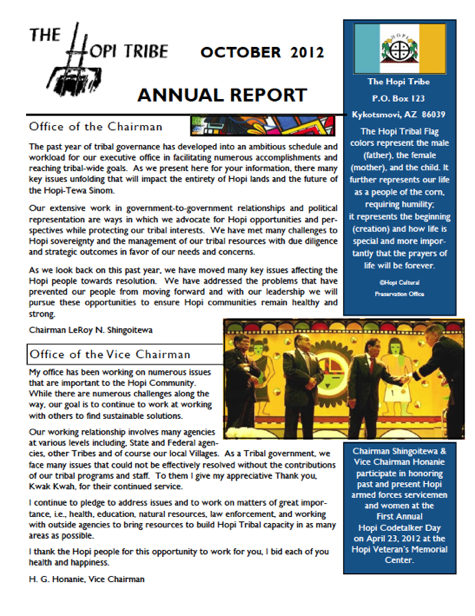
The Hopi Tribe Annual Report, October 2012

Click to download (4 pages)

NEWS RELEASE: Hopi Leaders Strongly Oppose Development of the Grand Canyon Escalade

FOR IMMEDIATE RELEASE

October 5, 2012

HOPI LEADERS STRONGLY OPPOSE DEVELOPMENT OF

THE GRAND CANYON ESCALADE

Kykotsmovi, Ariz. – At a recent Tribal Council meeting, Hopi leaders unanimously agreed to approve Resolution H-113-2012, in which they formally state their position to strongly oppose the development of a commercial initiative at the Grand Canyon called the “Grand Canyon Escalade”.

The Hopi people continue to have connections to their ancestral past, including the landscapes, ruins, ceremonial trails, shrines, springs and rivers. The Hopi and many other southwestern Tribes, as well as members of the Navajo Tribe, hold the Grand Canyon (Öngtupqa) and its cultural contributories, a sacred place of reverence and respect. Hopi religious leaders and the Hopi people in general, also strongly oppose this development

“The Canyon is still regularly visited by Hopis to deposit prayer offerings in the area of the confluence, so this development will adversely affect the sacredness of this special place”, said Leigh Kuwanwisiwma Director of the Hopi Tribe’s Cultural Preservation Office. “Because of the significance of Öngtupqa, it is extremely important for the Hopi people to preserve and protect this area from harm and wrongful exploitation.”

Hopi Vice Chairman Herman G. Honanie said “the proposed development located at the confluence is unacceptable to Hopi religious leaders, practitioners and the Hopi people as it will significantly and forever adversely impact Hopi sacred places to which Hopis have aboriginal title and use”.

“This development will forever compromise the tranquility and sacredness of all the surrounding area. The Hopi people and the Hopi Tribal Council strongly oppose the development of the Grand Canyon Escalade and will continue to advocate for protection of Öngtupqa and all its elements” said Hopi Chairman LeRoy N. Shingoitewa. “The Hopi Tribal Council calls upon the Pueblo of Zuni, Navajo People, and other tribes to which the Grand Canyon is sacred, the National Congress of American Indians, Inter-tribal Council of Arizona, All Indian Pueblo Council and the National Park Service to join in opposing this development and collectively support legislation to protect the Grand Canyon and other Native American sites”. 

Confluence Partners LLC, represented by Albert Hale and supported by Navajo President Ben Shelly, proposed the development of the Grand Canyon Escalade to include a river walk and restaurant at the bottom of the Grand Canyon confluence, where the Colorado and Little Colorado Rivers meet. A main feature of the proposed development is to build a luxury resort/spa at at the northeast rim along with a tram which would take tourists down to the river and stop at the restaurant. A river walk will give a view of the confluence.
# # #

See also “Hopi Tribe Formally Opposes Little Colorado Resort and Tramway Project” (KNAU): http://knau.org/post/hopi-tribe-formally-opposes-little-colorado-resort-and-tramway-project

PLEASE DONATE NOW to Hopi professor’s bike ride to raise money for Hopi Cancer Assistance Fund

I’m writing to follow-up on my earlier post about Dr. Angela Gonzales’s bike ride to raise money for the Hopi Cancer Assistance Fund. Angela is both a tribal member and a Professor at Cornell University working with the Hopi Tribe to develop educational interventions to increase cervical cancer screening among Hopi women.

After months of planning, it’s almost time for her to begin her 1,539 mile bike ride down the Pacific Coast. I’m writing to ask you to consider making a donation in support of her effort to raise $10,000 for the Fund.

Angela has been working in partnership with The Hopi Foundation and the Hopi Cancer Assistance Fund and has raised over $5,000. With your assistance I am certain she can reach her goal of $10,000.  You can donate online with a credit or debit card at http://www.razoo.com/story/Hcaf.  If you prefer to donate by check or money order, you can find instructions on how to do so on her blog, Angela Bikes 4 Hopi.

All donations are tax-deductible and 100% of the proceeds raised will directly benefit Hopi cancer patients and their families.

Throughout the ride Angela will post periodic updates and photos to her blog.  I encourage you to bookmark the page so you can check in on her progress.  She made a couple of recent posts to the blog, including an interactive Google map that shows the route she will be riding and the places she will staying.

Thank you for considering a donation in support of Angela’s effort to raise money for the Hopi Cancer Assistance Fund.  I know that the best advertising is by word of mouth, and so in addition to your own donation I would like to ask you to pass this message on to at least three of your closest family members, friends, or work colleagues who might be interested in contributing.

Please also consider sharing this post on your Facebook page, Twitter feed, blog, and other social networks.

Working in the spirit of nami’nangwa and sumi’nangwa, we can help Angela meet (and hopefully exceed) her $10,000 fundraising goal for this great cause.

“Tracking Tewanima” by Cindy Yurth of the Navajo Times

On September 1st I traveled back home to deliver a talk on Louis Tewanima at the Louis Tewanima Footrace Pre-Race Dinner. A reporter for the Navajo Times named Cindy Yurth was present in the audience, and recently published a story about the gathering. A special thanks to Yurth for granting me permission to republish her article on my blog.

————————————–

Tracking Tewanima

Centennial footrace draws record crowd to mesas

By CIndy Yurth

Tséyi’ Bureau

SHUNGOPOVI, Ariz. — Louis Tewanima may be the most celebrated Hopi runner, but he himself would have admitted he was not the fastest, a Hopi historian told the crowd gathered Saturday night for a celebration of the centennial of Tewanima’s bringing home an Olympic silver medal to this tiny but spectacular hamlet on top of Second Mesa.

The fastest Hopi ever was probably some unheralded farmer who never had a chance to go to school — or was forced to, as Tewanima was.

Still, Tewanima was the one who brought home the medal, and this past weekend Hopis along with well-wishers from around the world celebrated the centennial of that feat with footraces of varying lengths along some of the very trails Tewanima himself once graced.

“It was great to follow in his footsteps,” said the second-place finisher in the commemorative 10K race, 16-year-old Kyle Sumatzkuku of Moencopi and Mishongnovi. “I look up to him, even though he was even smaller than me.”

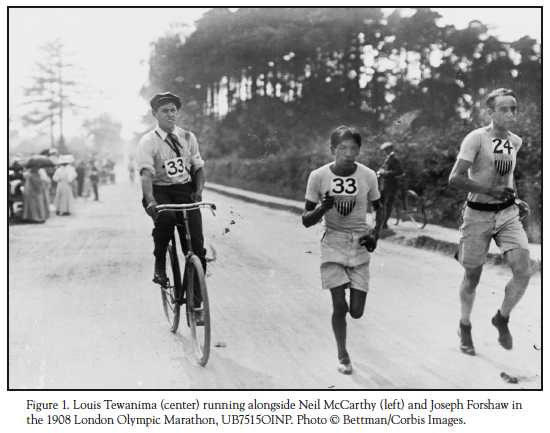
Sumatzkuku is not a large person by any means, but he’s probably correct in assuming Tewanima was smaller. Tewanima was 5-foot-4 1/2 and 115 pounds, according to Illinois University Professor Matthew Sakiestewa Gilbert, who gave the historical address Saturday night. In the press of his day, he was referred to as “the little Hopi redskin.”

This past weekend, though, he was everywhere. Perhaps literally.

“We believe they (the spirits of the departed) come to us in the clouds,” said race announcer Bruce Talawyma. “So he’s all around us today.”

Somewhere else, in fact, the race might have been cancelled when a torrential downpour washed out part of the trail Saturday. But Hopis, those ultimate dry farmers, know better than to scoff at moisture, even when it comes at such an inopportune time.

“That’s what we’re running for, right?” asked Sam Taylor, Tewanima’s great-nephew and one of the organizers of the race, at the pre-race carb-loading party that featured both the traditional spaghetti and a Korean noodle dish, courtesy of a Second-Mesa war bride and her churchmates. That’s a whole ‘nother story.

Running for rain was certainly the rule  in Tewanima’s time. As a member of the Sand Clan, Gilbert explained, Tewanima and his kinsmen were charged with running to far away places and back to “bring back the rain.”

That could be part of why Tewanima offered to run for Carlisle Indian School even though he was dragged to the school after protesting Natives being forced to study at Western institutions — and how he ultimately ended up in the Olympics.

As for the history of the Louis Tewanima race itself, it was mostly started because the organizers — the Hopi Athletic Association — saw the need for a competitive footrace on Hopi to give Hopi runners a goal. Naming it after Tewanima was almost an afterthought, said Leigh Kuwanwisiwma, who helped organize the first Tewanima Footrace in 1972.

“I’m not really sure how Louis Tewanima was brought into it,” Kuwanwisiwma confessed.

One sure thing is that the race succeeded in bringing attention to Tewanima’s feat, which may have been nearly forgotten otherwise.

“Everybody knew Louis Tewanima, just like we know everyone in the village,” explained race volunteer Kathy Swimmer of Shungopovi. “When I was growing up, him and his wife used to sit on their front porch in the morning and watch the kids load into the school bus. We just thought they were a nice old couple. I had no idea he was an Olympian until I joined the high school booster club and started helping with the race.”

After winning the silver medal, Tewanima returned to Shungopovi and never ran again except for religious reasons and pleasure.

As Gilbert mentioned in his talk, Tewanima himself knew he was not the fastest Hopi and never had been.

In the course of his research for a book on Hopi running he plans to publish soon, Gilbert uncovered a tale that he thinks sheds some light on the Tewanima era.

Apparently, Tewanima and fellow Hopi track star Philip Zeyouma, who attended Sherman Institute, were both home for a break and people encouraged them to race each other to prove once and for all which man was the best runner.

As both men appeared on the starting line in their school-issue tracksuits, the older men of the village started teasing them.

“You don’t look much like Hopi runners,” taunted one man.

“If you think you can do better, then come and show us!” challenged Tewanima.

Two 50-year-old men stepped forward.

“According to the New York Times report, they had essentially no clothes on, no shoes on, and looked like they were dying of consumption,” Gilbert said.

However, “By the time they reached the six-mile mark, those older men were so far ahead that Louis Tewanima and Philip Zeyouma dropped out of the race.”

The two 50-year-olds crossed the finish line “and just kept going,” Gilbert said.

So neither Tewanima nor Zeyouma was the fastest Hopi. And yet, Gilbert argued, they deserve to be honored, particularly Tewanima.

“This new generation of Hopi runners represented a transition in Hopi running,” the historian said.

“Whereas before people ran for transportation, and for religious reasons,” Gilbert said, “Tewanima ran as an ambassador of his people. He used running to create a privileged condition for himself at the Indian school. He used running to broaden his experience of the world.”

And as for the Louis Tewanima Footrace, “it gives testimony to the importance of running in Hopi society,” Gilbert said. “It celebrates the continuity of Hopi running.”

A record crowd of 361 runners would seem to agree.

————————————–
First Peoples blog features Q&A on BEYOND THE MESAS

Yesterday  Natasha Varner of First Peoples: New Directions in Indigenous Studies published a Q&A with me on their blog about BEYOND THE MESAS. In this post I discuss a number of topics, including my reasons for starting a blog and advice for new bloggers. I’m honored by this opportunity, and very grateful to First Peoples for their willingness to feature BEYOND THE MESAS on their website. Here’s the link to the post: http://www.firstpeoplesnewdirections.org/blog/?p=5754

“Marathoner Louis Tewanima and the Continuity of Hopi Running, 1908-1912” (Western Historical Quarterly, Autumn 2012)

Click to download article (23 pages)

In the summer of 2010, I started writing an article titled “Marathoner Louis Tewanima and the Continuity of Hopi Running, 1908-1912.” The article was recently published in the Western Historical Quarterly (Autumn 2012, Vol. 43.3, pp. 324-346), which is the official journal of the Western History Association.

Louis Tewanima was from the village of Shungopavi on the Hopi Reservation in northeastern Arizona. In January 1907, he and ten other Hopis traveled to Pennsylvania to attend the Carlisle Indian Industrial School. While at Carlisle, Tewanima received fame and notoriety by winning several running events, which gave him opportunities to compete in the 1908 (London) and 1912 Olympic Games in Stockholm, Sweden. At the Stockholm Olympics, he won the silver medal in the 10,000 meter race.

Over the years, a number of people, especially non-Hopi individuals, have written about Louis Tewanima. The majority of the scholarly literature on Tewanima is found in Peter Nabokov’s Indian Running or larger narratives on Natives and sports, most notably Joseph B. Oxendine’s American Indian Sport Heritage and John Bloom’s To Show What an Indian Can Do.

Although popular audiences often read Tewanima’s story in newspaper articles, magazines, and books, these publications tend to focus on his participation in the 1912 Olympic Games in Stockholm, and many of them perpetuate a romantic portrayal of Tewanima by retelling accounts of him running after rabbits as a young man and running to Winslow, Arizona, “just to see the trains [go by].”

Contrary to one contemporary writer who noted that Tewanima was “almost totally forgotten,” scholars have remained intrigued by his accomplishments, although they are often overshadowed by accounts of his Carlisle teammate, Sac and Fox athlete Jim Thorpe. While references to Tewanima grace the pages of many articles and books, further studies are needed, particularly ones that interpret his accomplishments within the contexts of Hopi and American sport culture.

In my article I argue that Tewanima’s story represents his ability to redefine Hopi running in the twentieth century and shows how he maneuvered within American and European perceptions of Natives and sports. His participation in running events also tells of a time when white Americans situated indigenous people on the fringes of U.S. society but embraced them when they brought honors to the country by representing the nation in athletic competitions at home and abroad.

Furthermore, Tewanima’s involvement in marathons and Olympic races demonstrates the ways Americans used his success to advance the ideals of U.S. nationalism as he simultaneously continued the long tradition of running among his people.

A number of individuals helped me along the way as I conducted research and revised the article for publication, especially my colleagues in the American Indian Studies Program, and the Department of History at the University of Illinois. I am also thankful for the assistance of various Hopi individuals, including Tewanima’s relatives, the remarkable editorial staff of the Western Historical Quarterly, the Journal’s three anonymous reviewers, and officials with the Hopi Cultural Preservation Office for their support of my work.

If you would like to download a copy of my essay, please visit the following link: https://beyondthemesas.com/wp-content/uploads/2012/09/marathoner-louis-tewanima-and-the-continuity-of-hopi-running-1908-1912-whq-autumn-2012.pdf

Upcoming talk at the Louis Tewanima Footrace Pre-Race Dinner

On Sunday September 2, the Louis Tewanima Footrace Committee will host the annual Footrace at the village of Shungopavi on Second Mesa. This year is a particularly special one as the Committee is organizing the event to commemorate the 100 year anniversary of Louis Tewanima’s silver medal performance in the 10,000 meter Olympic race in Stockholm, Sweden.

In addition to running in the 10K, I have been asked by race officials to speak on Tewanima at the pre-race dinner the night before on September 1. I am scheduled to speak at 7:00PM (MST) at the Shungopavi Community Center. The pre-race dinner is free and open to the public. For more information on the Footrace, and to obtain registration materials, please visit the following website: http://tewanimafootrace.org/