The Hopi Education Endowment Fund (HEEF) is still accepting nominations for members to the Board through this Thursday, June 30, 2011. With a capacity of up to 30 members, the HEEF is seeking to fill 14 seats. Once elected, Members serve three-year terms and are provided opportunities to actively engage with the HEEF in a variety of capacities that include committee work, volunteerism, networking and support of special events.
Sahmie Wytewa, HEEF’s Nomination Committee Chairperson stated, “I see the Hopi Education Endowment Fund constantly developing and diversifying its membership to meet the needs of our community. 20 years from now, I expect that we are going to be looked at and called upon as a valid and sustainable model for financing education infinitely. If you can imagine being a part of that vision, we want you on Our team!”
Any Hopi tribal member or current HEEF Member may nominate a person for election to the HEEF Board. Nominations are accepted until 5:00 p.m. (MST) June 30, 2011. To submit a nomination, fill out the attached Nomination Form or for more information contact Sam Tenakhongva at samt@hopieducationfund.org or call 928-734-2275. The HEEF is a non-profit entity of the Hopi Tribe, for more information on the HEEF visit our website at www.hopieducationfund.org
To read more on the 2011 Member Nomination and Recruitment Process click here
Hopi Education Endowment Fund
PO Box 605
Kykotsmovi, AZ 86039Phone: (928) 734-2275
Fax: (928) 734-2273Copyright (C) 2011 Hopi Education Endowment Fund All rights reserved.
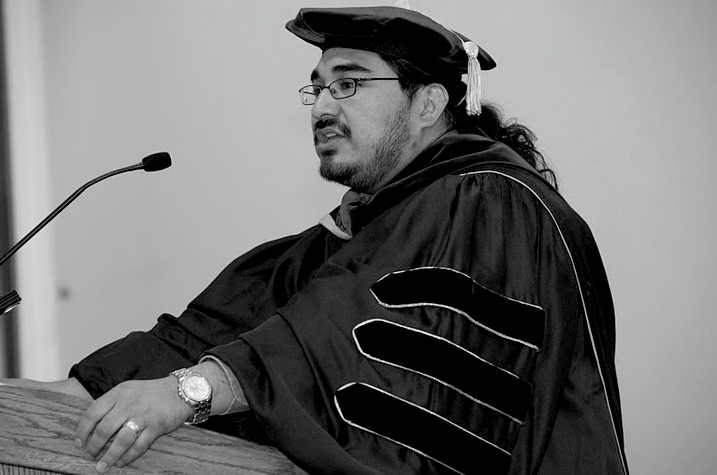
Matthew Sakiestewa Gilbert at 2009 Native American House Congratulatory Ceremony. Photo courtesy of Muskogee Creek writer and photographer Durango Mendoza.
In the Spring of 2009, our Native students at the University of Illinois asked me to say the closing remarks for the Native American House Congratulatory Ceremony. The event took place on May 16, 2009. Since we are appoaching the end of the academic year, I thought that it would be fitting if I posted these remarks on my blog.
————————————
Returning to the Cottonwood Trees of Our Communities
Matthew Sakiestewa Gilbert
I have the privilege and honor of saying a few closing remarks to end our time together.
We are fortunate at the University of Illinois to have students who have not forgotten that the greatest “scholars” and teachers come from their own communities. These men and women have not published books for Oxford or Harvard University Press. They have not published articles in the esteemed journals of the academy. But they are known by people in their communities as the gatekeepers and protectors of intellectual property, and teachers of knowledge.
Among my people in northeastern Arizona, parents, grandparents, uncles, aunties, and other community members often told their children stories about the owl, the squirrel, and giant beasts that threatened to destroy the Hopi way of life. Hopi elders shared these stories with their children to teach them life lessons. Lessons that would help them to succeed in life, contribute to their communities, and to be passed on to their children and grandchildren.
At an early age, Hopi children were taught to value hard work, and to shun laziness. “Get up before Taawa, itana (the sun, our father) greets our village,” Hopi parents often told their children, “Taawa, itana has many things to accomplish throughout the day, and he need not waste his time and energy on getting you out of bed.”
The stories and teachings that have emerged in Hopi and other indigenous cultures have great meaning for people of the past, present, and future. They ground Native people in their communities, they connect us to our places of origin, and they forever remind us of who we are as Choctaw, Ho-Chunk, Kiowa, and other indigenous people.
I am reminded of a story that originates from my village of Moencopi that Hopi educator Dr. Noreen (Kewanwytewa) Sakiestewa once retold about a young girl who was lazy, and did absolutely nothing. She did not help her parents take care of her siblings, she refused to grind corn, and she had no desire to learn Hopi stories and songs. Seeing her laziness and apathy, people in the village called her kyena, which is Hopi slang for “ignorant one.”
Sakiestewa recounts that one day, as the girl wandered about near the wash by her village, she sat under a large cottonwood tree. The wise old cottonwood tree realized that her people, and even the animals, had become angry with her, and so he asked the young girl: “Why are you not a part of your people?” The girl did not respond, and so the wise old cottonwood tree told her to gather yucca plants and to bring them to him.
When she returned, the wise old cottonwood tree taught her how to weave a plaque with a coil design. But the girl became restless, and she wanted to learn other design patterns to incorporate in her plaques. So the wise old cottonwood tree told her to observe the things of nature. “Look at the sky, the mountains, and the animals, and they will show you new patterns for your plaques.”
After several days or traveling and searching, the young girl from Moencopi came across a rattlesnake who asked her why she had wandered so far from her village. “I am on a journey to find new designs,” she told him. And so the wise old snake said to her, “Look at the design on my back. I give you permission to use my design in your plaques.”
Soon the young girl came across other designs, and months later, she returned to her people with beautiful plaques and immediately started teaching her sisters, and other girls in the village how to make baskets. All that she had learned amazed the people at Moencopi. And from that day forward, they no longer called her kyena.
In her retelling of this story, Sakiestewa asks the question:
“At what point did the girl come out of not being kyena? Overwhelmingly, the response was when she learned to make baskets. The Hopi response to when she stopped being kyena was when she returned and taught the skill of basket making thereby completing her circle.” [Norene E. Kewanwytewa, “Being Hopi: A Collaborative Inquiry Into Culturally Responsive Education,” Ed.D. Dissertation, Northern Arizona University, 2002, pp. 2-4].
Today, as we gather together to honor our students, I close by urging our Native graduates to return to the cottonwood trees of their communities. Complete the circle, and take what you have learned at the University of Illinois and contribute something useful to your people. And never forget that long ago, our people held to and practiced indigenous ways of understanding that provided meaning, and continue to provide meaning, for every aspect of life.
Join us as we host the “HEEF Art Sale – Supporting Hopi Students”, featuring outstanding pieces of native art including pottery, jewelry, sculptures, paintings, katsina dolls, prints, textiles and baskets.
In conjunction with the sale, the HEEF is conducting a raffle with numerous items available including a “3 Corn Maidens” Pendleton blanket, jewelry, prints, resort packages and more. Tickets are available for $2 per ticket of 3 tickets for $5. To purchase contact the HEEF Office at (928) 734-2275.
The HEEF is still accepting all forms of artwork and more information on the sale can be found by visiting www.hopieducationfund.org or by contacting the HEEF at 928-734-2275. All proceeds from the event benefit deserving Hopi college students across the U.S. in addition to funding other educational programs for the Hopi people.
I am pleased to report that Hopi scholars Sheilah E. Nicholas of the University of Arizona and Lomayumtewa C. Ishii of Northern Arizona University recently published the following articles:
Nicholas, Sheilah E., “Language, Epistemology, and Cultural Identity: ‘Hopiqatsit Aw Unanguakiwyungwa‘ (‘They Have Their Heart in the Hopi Way of Life’)”, American Indian Culture and Research Journal, 2010, Vol. 34, No. 2, pp. 125-144.
This article provides an in-depth “on the ground” look at the Hopi language shift—“becoming accustomed to speaking English”—through the lenses of the study participants who represent the youth, parent, and grandparent generations. The article also gives attention to Hopi oral tradition and the Hopi identity-formation process in order to articulate the link among language, epistemology, and identity, spotlighting what of the traditions, practices, and religion remain salient and why they remain salient. [p. 127]
Ishii, Lomayumtewa C., “Western Science Comes to the Hopis: Critically Deconstructing the Origins of an Imperialist Canon,” Wicazo Sa Review, Fall 2010, Vol. 24, No. 2, pp. 65-88.
The number of western texts written about Hopi culture is enormous. The work of Jesse Walter Fewkes, beginning in the 1890s, marks a key starting point in the articulation of a western perspective of Hopi culture, initiating a canon rooted in nineteenth-century anthropological thought. Fewkes’s work also illustrates how the establishment of a “cultural archive” was pragmatically related to his research, which included excavations of Hopi sites (notably the village of Awatovi), as well as through his personal commentary. This article examines nineteenth-century anthropological theory, Fewkes’s employment of that theoretical orientation, and how his work established the foundation of a “cultural archive” that constitutes a canon in the study of Hopi culture. But more importantly, by critically reading these texts a decolonization process reveals a western imperialistic mind at work. [p. 65]
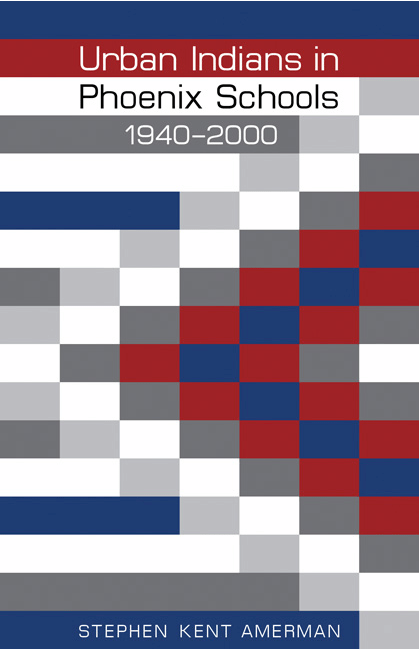
Stephen Kent Amerman, an associate professor of history at Southern Connecticut State University, has published a book entitledUrban Indians in Phoenix Schools, 1940-2000. His book is part of the Indigenous Education Series with the University of Nebraska Press. Various studies have been written on the educational experiences of American Indian people. However, much of this literature has tended to focus on the Indian boarding school experience during the so-called assimilation period. Recent studies, such as Taos/Dine scholar Glenabah Martinez’s monograph, Native Pride: The Politics of Curriculum and Instruction in an Urban Public Schooland Amerman’s book, fill a major gap in the literature on the experiences of Native students who attended public high schools. Amerman also writes about Hopis who went to Phoenix urban schools, which is a topic not often examined by scholars of Hopi and Indian education history. Below is a brief synopsis of the book from the University of Nebraska Press website.
Matthew Sakiestewa Gilbert
In the latter half of the twentieth century, tens of thousands of Native American families moved to cities across the United States, some via the government relocation program and some on their own. In the cities, they encountered new forms of work, entertainment, housing, and education. In this study, Stephen Kent Amerman focuses on the educational experiences of Native students in urban schools in Phoenix, Arizona, a city with one of the largest urban Indian communities in the nation. The educational experiences of Native students in Phoenix varied over time and even in different parts of the city, but interactions with other ethnic groups and the experience of being a minority for the first time presented distinctive challenges and opportunities for Native students.
Using oral histories as well as written records, Amerman examines how Phoenix schools tried to educate and assimilate Native students alongside Hispanic, Asian, black, and white students and how Native children, their parents, and the Indian community at large responded to this new urban education and the question of their cultural identity. Reconciling these pressures was a struggle, but many found resourceful responses, charting paths that enabled them to acquire an urban education while still remaining Indian.
Stephen Kent Amerman is an associate professor of history at Southern Connecticut State University. His articles have appeared in American Indian Culture and Research Journal, American Indian Quarterly, and Journal of Arizona History.
On Monday of this week the University of Nebraska Press released my book Education beyond the Mesas. My book examines the Hopi experience at Sherman Institute in Riverside, California, from 1902 to 1929. It is a story of resistance, accommodation, and ways Hopi pupils navigated within their village communities, U.S. government policies, and an institution that was designed to destroy their identities as American Indian people. Furthermore, my book is a story of agency, and it demonstrates how Hopi students used their culture to succeed at school, and examines the challenges the pupils faced when they returned to their homes on the reservation.
Thirty one years ago historian David Wallace Adams remarked that a “ study on the federal Indian boarding school system does not exist.” Today the field of Indian boarding schools has grown substantially with contributions from scholars such as Adams, K. Tsianina Lomawaima, Brenda Child, Clyde Ellis, and many others. Recent studies have focused on Indian health, literature, education policies, and the ways Indian pupils “turned the power” at schools originally designed to destroy American Indian cultures. A term used by historians Clifford E. Trafzer, Jean Keller, and Lorene Sisquoc, “turning the power” describes the ability of Native students to turn their educational experiences to their advantage, which often included bringing helpful knowledge and skills back to their indigenous communities.
In my book I examine the ways Hopis “turned the power” at Sherman Institute, and I build upon the work of several scholars including those who have written about the mandatory enrollment of Hopi students at U.S. government schools. While many books on Indian boarding schools examine the experiences of Native students who came from several communities, Education beyond the Mesas is a community specific book that seeks to understand the Hopi experience at Sherman Institute through a Hopi historical and cultural framework. In the book’s Introduction, I argue that a community specific book on the Hopi places
the history and culture of the Hopi people at the focal point of the narrative. It asks how a student’s culture and tribal history influenced their experience at an Indian school, and builds upon the contributions of other scholars to uncover the complex ways that Hopi history and culture intersected with U.S. government policies. Apart from providing the reader with a historical narrative, this book challenges the notion that a study on the Indian boarding school experience must be understood primarily through a defined framework of Indian education policies. Community-specific books begin with the history and culture of Native people and attempt to determine how students understood their unique experiences at Indian boarding schools as Zunis, Navajos, Apaches, or other Indian people. [Education beyond the Mesas, p. xxix]
I would not have been able to complete this book without the help and support of many individuals. I am especially thankful to my wife, Kylene, and our daughters Hannah, Meaghan and Noelle, and other family members. My colleagues at the University of Illinois, in both the American Indian Studies Program and the Department of History, have provided me with tremendous support since I arrived at Illinois in Fall 2006.
I further extend appreciation to the Hopi Cultural Preservation Office, the Hopi Education Endowment Fund, and the Hopi Tribe Grants and Scholarship Program who so generously made available resources for me to pursue an education beyond the mesas. There are also many Hopi and non-Hopi scholars, students, and community members who have helped and encouraged me along the way, which includes the incredible editorial staff at the University of Nebraska Press. Finally, I wish to acknowledge my grandfather, Victor Sakiestewa, Sr. from Upper Moencopi, who gave me the inspiration and reason to write on his alma mater, “dear ole Sherman.”